




Why you can smell theirs and not yours: olfactory receptors adapt to a constant. Within about a fortnight your own home becomes undetectable to you while remaining perfectly detectable to everybody else. You are not adapted to your parents' house, so you receive it in full.
Why a childhood home hits so hard: smell reaches memory and emotion by a short route, and the smells of a childhood house were learned before you had words for them — so they return as feeling rather than as description.
If you want your own signature: it is built the same way. Consistency, not intensity. One scent at a low level for a year does more than a strong one changed every month.
2. Then the building itself, which contributes more than people credit. Lime plaster and cement behave differently. Teak, rosewood, plywood and particle board smell nothing like one another. A stone or red-oxide floor, a vitrified tile and an old wooden one hold and release moisture differently, and an older building has had decades for all of it to settle into a single character.
3. Then the air outside and the water in it. A coastal flat, a dry Deccan one and a north Indian winter carry entirely different outdoor air indoors, and humidity governs how strongly everything in the house releases what it holds.
4. Then the things that repeat: incense, agarbatti or a diya lit daily; plants; a dog; a puja cupboard; whether the windows are open all day or shut against dust. Repetition is the whole mechanism. A thing done once leaves nothing. A thing done every morning for thirty years becomes the house.
5. And you cannot smell your own because you are adapted to it. Receptors report change and discard constants, so within roughly two weeks your home becomes undetectable to you and remains perfectly detectable to everybody else. Their house is not your constant, which is exactly why it arrives so completely.
6. If you want a signature of your own, build it the same way: consistently rather than strongly. One scent at a low level for a year does more than a strong one changed every month, and that is the only thing this page is going to recommend you buy.
A portion of every order supports girl-child education through Nanhi Kali.

What a house smell is actually made of
It helps to stop thinking of it as a smell and start thinking of it as a deposit. Every day, a house receives a small quantity of a great many volatile materials and holds most of them — in the plaster, in the wood, in the upholstery, in the curtains, in the grout, in the paper on the shelves — and releases them again slowly and continuously for weeks or months afterwards. One evening's cooking makes no difference to any of that. Four thousand evenings of the same cooking, in the same kitchen, with the same masala box and the same oil, does something no fragrance house could reproduce on purpose: it produces a composition with hundreds of components, all in the proportions that particular household happens to live in. That is what you are meeting in the first four seconds inside your parents' front door, and it is why the experience feels so specific and so unlike anything you can name.
The ingredients, and which of them you get to choose
What goes into a house's signature, where each part comes from, roughly how long it persists once it is there, and — the honest column — how much of it you actually control. Most of the list is not a choice at all, which is precisely why the parts you do choose are worth being deliberate about.
| Contributor | Where it comes from | How long it lingers | Yours to choose? |
|---|---|---|---|
| Cooking, and which masalas ★ | Hot oil aerosolises and travels; whatever goes into it goes onto every soft surface in range | Weeks in fabric, indefinitely if repeated daily | Barely. It is what your household eats, and the largest single contributor there is |
| Soap, detergent, floor cleaner | Bathrooms, the wash, and the morning mop — renewed every day without fail | Days on skin and fabric, permanently while the habit continues | Yes, and it is the change people notice fastest when a household switches brand |
| Hair oil | Coconut, amla or sesame, onto pillowcases, headrests, sofa backs and towels | Weeks in textiles; one of the most persistent of all | Yes, and it is the most underestimated item on this list |
| Building materials and their age | Lime plaster or cement, the floor, the joinery, the paint, the age of all of it | Decades. An old building smells more coherent because it has reached equilibrium | No. This is the house rather than the household |
| Furniture and its wood | Teak, rosewood, mango, plywood, particle board and the adhesives in engineered board | Years for solid wood; new engineered furniture off-gasses hard for weeks and then settles | Partly, and mostly at the moment of buying |
| Local air and the city's humidity | Coastal salt and damp, Deccan dust, north Indian winter smoke, and whatever is under the window | Continuous. Humidity also governs how strongly everything else releases | No, though how much you ventilate decides how much arrives |
| Plants, pets, incense, the puja cupboard | Daily, small, and enormously characteristic — agarbatti, dhoop, a dog, damp soil | Incense marks fabric and plaster for days; a pet is continuous | Yes, and these are what most people actually recognise as somebody's house |
| How much the windows are opened | Not a smell at all — the removal rate, which decides how much of the rest stays | Governs everything above it | Yes, and it is free |
| A chosen background scent | One reed, or one bottle in one machine, run at the same low level for a year | Months from a reed; hours from a diffuser, but the deposit accumulates | Entirely. It is the only line on this list you write on purpose |
Reed · months at one levelfrom ₹749Shop →  One scent · 15ml₹299Shop →
  Sukoon · same hour daily₹1,899Shop →
Why you cannot smell your own, and why theirs stays with you
Start with the thing most people do next, which is try to buy it. You cannot purchase your parents' house and you should not spend money trying, because what makes it what it is has no fragrance equivalent and never will. A large part of it is the food, which means the answer would have to be the cooking rather than a bottle. Another large part is the building — a plaster, a floor, a door and a set of cupboards from a period nobody builds in any more. Another is a great many years of a specific soap, a specific detergent and a specific hair oil, applied by specific people. Even the parts that sound purchasable are not really: the sandalwood in a house with a puja cupboard is a burning material behaving as a burning material, not a diffuser note; the coffee in a house where somebody grinds it every morning is a kitchen, not a scent. Trying to recreate it usually produces the opposite of the intended effect, because a bought approximation of a remembered smell reads as an approximation, and the gap between the two is more noticeable than the resemblance. What I have seen work, when somebody genuinely wants a thread of continuity from one house to another, is much smaller and much more literal: keep using the soap your mother uses, or the same brand of floor cleaner, or the same hair oil, or light the same incense at the same hour. Those are exact rather than approximate, they cost nothing extra, and they carry more than any product sold as a memory would.
Then the useful half, which is that a signature can be built deliberately and the method is not the one people assume. It is consistency rather than intensity, and it is the single most important sentence on this page: one scent run at a low level for a year does far more for how a home smells than a strong one changed every month. The reason is the same accumulation this page has been describing. A background scent run daily deposits a little into the plaster, the curtains, the upholstery and the cupboards each time, and after a few months the room is holding a low continuous version of it independently of whether anything is switched on — which is exactly how your parents' house works, and exactly what a strong scent changed monthly never achieves, because each new one arrives on top of the last and none of them is ever there long enough to settle. The second reason is that you will go nose-blind to whatever you choose within about a fortnight, which is not a problem to be solved but the goal itself: the point at which you stop noticing your background scent is the point at which it has become the smell of your house rather than a product you are running. The failure mode is well documented and worth naming, because it is what a monthly change is usually a symptom of: you stop perceiving it, conclude it has weakened, and either raise the dose or switch to something louder, while every visitor is still receiving the level you originally set and is now receiving considerably more than that. Set it low, leave it, and ask one honest guest twice a year rather than adjusting it yourself.
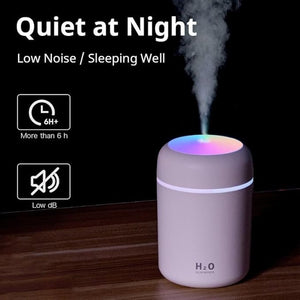
So the commercial part of this page is short, and I would rather it were. Two formats build a signature and one of them barely counts as a purchase. A reed diffuser from ₹749 is the closest thing there is to how a house actually acquires a smell: no electricity, no timer, nothing to remember, a level that establishes over 24 to 72 hours and then holds for months, with 130ml from ₹1,249, duos from ₹1,498 and 300ml refills at ₹2,399. Because it never stops, it deposits continuously, which is the mechanism this whole page is about. A Sukoon at ₹1,899 does the same job on a schedule — 500ml, 270–320 sq ft, 16–18 hours per fill on low at 30–50 ml/h, steady, 2H and 4H timers, a remote, auto shut-off and three 15ml Hotel Collection scents of your choice included — and the instruction that matters for a signature is three drops rather than five, at the same hour every day, for a year. The dose is per tank rather than per litre, so a Boond at ₹899 takes the same three drops. Buy one 15ml bottle at ₹299 and stay with it; the ₹1,799 300ml 300ml refill at about ₹6 a millilitre is for the scent that has already stopped being a product, and you will know which one that is by about the tenth month. The honest constraints, as always: SOSA makes no room or linen spray for the home; a reed is not a same-day product; a cool-mist ultrasonic adds 30 to 50 millilitres of water an hour and is wrong for a damp room; the water-based Hotel Collection runs in the Sukoon, Boond and Megh only and never in a reed or the waterless Vaayu; and candles, from the Bookshop candle at ₹379 upwards, are events rather than signatures and must be attended and put out. And a house with no fragrance in it at all still has a signature. It is made of your cooking, your soap and your open windows, and there is nothing second-rate about that.
The SOSA edit
This is the shortest edit in the cluster and deliberately so. The first two rows are the honest answer for most people who arrive at this page, and only the third and fourth involve spending anything. The last row is the mistake I would most like readers to avoid.
| Step | What it is | When it is the answer | Cost |
|---|---|---|---|
| 1. Buy nothing, and keep something instead ★ | The same soap, the same floor cleaner, the same hair oil, the same incense at the same hour | If what you want is continuity with the house you grew up in. Exact beats approximate, and it costs nothing extra | ₹0 |
| 2. Open the windows on a schedule | The removal rate, which decides how much of everything else stays and how coherent the result is | Always. A house that never exchanges air has an accumulation rather than a signature, and the two smell different | ₹0 |
| 3. One reed diffuser, left alone | Unplugged, no routine, 24–72 hours to establish and then months at one level, depositing continuously | The closest format to how a house naturally acquires a smell. Morning Freshness ₹749, Garden Bloom and Evening Calm ₹799, Fresh Brew and Mountain Breeze ₹849 | from ₹749 |
| 4. One 15ml scent in a Sukoon or Boond | Three drops per tank, same hour daily, for a year. Timers so it stops rather than runs all day | If you want a scent tied to an hour rather than to the whole day. Three drops, not five, and the same one every time | ₹299 + ₹1,899 / ₹899 |
| 5. The 300ml refill, eventually | About ₹6 per millilitre against roughly ₹20 at 15ml — months of daily running rather than weeks | Only for the scent that has already become the smell of the house. You will know which by about the tenth month | ₹1,799 |
| The mistake: changing the scent every month | Nothing gets long enough to settle into the fabric, so nothing ever becomes the house | Printed rather than implied. A signature is made of repetition, and rotation is the opposite of repetition | — |
Versailles
My mother's house has a smell I could identify blindfolded from the landing and could not describe to you if you paid me, and I have spent a career learning to describe smells. That is not a failure of vocabulary. It is what happens to something you learned before you had any vocabulary at all — it goes in as the world rather than as a description, and it comes back the same way. I know roughly what is in it: her cooking, a particular soap she has used for thirty years, coconut oil, an old teak cupboard, lime plaster, the dust of a specific city and a window that is open more than mine ever is. Knowing the components has never once made the arrival less complete.
So I am not going to tell you that you can buy it, and I would think less of this brand if it did. What I will tell you is that your own home is doing the same thing right now, to your children or your guests or whoever walks through the door, and that you are the only person who cannot hear it. If you want to put a deliberate line into that composition, put one in and then leave it alone. One scent, low, every day, for a year. It will become invisible to you, and that is the point at which it has stopped being something you bought and started being the smell of your house. Almost everything else sold in this category is sold on the opposite principle, and I think the opposite principle is wrong.
Everything is made and supported from Pune, and a part of every order funds girl-child education through Nanhi Kali. You get a home that smells like somewhere you chose; a girl gets a classroom. That equation has always felt right to me.
Frequently asked questions
- Nose-blindness at home: why you cannot smell your own house — the adaptation, in full.
- How to find out what your house actually smells like to other people — the practical version.
- Should I change my home fragrance regularly? — the case against rotation, argued properly.
- Why does my house smell like this? The complete diagnostic guide — every symptom, mapped.
- Brand: the SOSA founder story.
Facts verified August 2026: Diagnostic facts used in this guide: a closed room accumulates what it cannot exchange, so cross-ventilation needs two openings rather than one; a drain's U-bend water seal evaporates in roughly two to four weeks of disuse and then admits sewer gas, which is corrected by pouring water down the drain; microbial growth in fabric and on surfaces accelerates above about 60% relative humidity, and Indian monsoon indoor humidity commonly runs 80–95%, which is the one situation where ventilating on a wet day can import moisture rather than remove it; an air-conditioner's cold, wet evaporator coil and filter grow biofilm that is blown into the room on start-up; textiles adsorb cooking aerosol and body oils and re-release them for weeks; and olfactory adaptation makes a constant household smell undetectable to its residents within about a fortnight while visitors still perceive it. Timings: a scented candle scents a normal room in roughly 15–20 minutes, a Sukoon ultrasonic diffuser reaches a steady level in about 20 minutes from cold, and a reed diffuser needs roughly 24–72 hours. SOSA products and prices: Sukoon 500ml ₹1,899 (270–320 sq ft, 16–18h on low, 9–12h high, 30–50 ml/h, 2.4MHz cool mist, remote, steady/2H/4H timers, BPA-free, auto shut-off, includes three 15ml Hotel Collection scents of your choice); Boond 300ml ₹899; Megh 6-litre ₹3,499; waterless Vaayu ₹11,999 (up to 1000m³); Aangan ₹25,999. Hotel Collection water-based fragrance 15ml ₹299, 100ml ₹999, 300ml ₹1,799, Pack of 7 at 15ml ₹1,799; dose 3–6 drops per tank. Reed diffusers (separate alcohol-free line): Morning Freshness from ₹749, Garden Bloom and Evening Calm from ₹799, Fresh Brew and Mountain Breeze from ₹849; 130ml from ₹1,249; duos from ₹1,498; 300ml refills ₹2,399. Scented candles: Bookshop 80g ₹379, Amber Rose 130g ₹599 and 220g ₹799, Smoked Oudh 130g ₹449, ceramic jar candles ₹949, Pure Calm wax melt set ₹854. Free shipping above ₹499. SOSA does not make a room or linen spray for the home. The Hotel Collection scents are SOSA's own interpretations; SOSA is not affiliated with or endorsed by any hotel brand. Prices subject to change — see the live product pages.