



Why several diffusers give you several hot spots: concentrations add. Put a second bottle across the room and each point in the room receives the sum of two curves. Near either bottle the sum is dominated by the near one, so you get a second peak. At the midpoint you are the farthest you can be from both at once, so you are adding two of the smallest numbers available. Two sources make two hills with a valley between, not a plateau.
What genuinely flattens a room, free: six reeds rather than three, halve the bottle-to-person distance, nose height on a surface, out of the draught but not in a dead corner, close the door, and above all the ceiling fan on low — a fan supplies the transport a reed structurally lacks. It shortens the bottle; that is the trade.
What flattens it properly: an active diffuser, which disperses the oil inside the device and pushes it out as a moving stream. Sukoon ₹1,899, 270–320 sq ft, is very often the correct bedroom answer. Vaayu ₹11,999 is rated to 1000 m³, roughly 2,000–3,000 sq ft, and is wrong for one room.
The gap, stated: between Safar ₹3,999 — named and sold as a car and travel diffuser — and Vaayu, SOSA has no mid-sized waterless bedroom nebuliser.
2. Because a diffuser has no way to transport what it emits. There are only two things that can move vapour across a room. Molecular diffusion, which is genuine but far too slow to cross several metres of a bedroom in any time that matters to you. And whatever air the room happens to be moving — convection off a warm wall, a fan, an AC, a draught under a door. The second does almost all the work, and it is not under the bottle’s control at all. Your hot spot is really a statement about how still your room is.
3. Because adding sources adds peaks, and the sums do not fill the middle. This is the part that costs people money. A second bottle across the room does not average out with the first. Each point in the room receives the sum of both curves, and sums are dominated by whichever term is largest — which is always the nearer bottle. So you buy a second peak and the low point between them barely moves, because the midpoint is by definition the farthest place from both sources at once.
4. Because your nose exaggerates the boundary. The physical gradient is perfectly smooth. Perception is not: it compresses a wide range of concentrations into a narrow band of impressions, so a slope reads as an edge you can walk across. This is also why walking past a diffuser registers so strongly and sitting near it registers so little — the nose reports change far better than steady state, and receptors adapt to a constant stimulus within minutes.
5. Because consistency is a property of moved air, and it has to come from somewhere. Either the room supplies it — a ceiling fan on low, in a closed room, is the free version and it works — or the device supplies it, which is what an active diffuser does by breaking the oil into an airborne mist inside itself and pushing it out as a moving stream. There is no third route, and in particular there is no bottle you can buy that contains it.
Alcohol-free, phthalate-free, composed in Pune. A portion of every order supports girl-child education through Nanhi Kali.
What a hot spot actually is, in three parts
The phrase makes it sound like an anomaly — a spot, as though the rest of the room were the normal condition and this bit had gone wrong. It is the other way round. The peak is the normal condition of a point source and the rest of the room is what is left over. Three things stack to produce the experience you are describing, and they are worth separating because only one of them can be bought away.
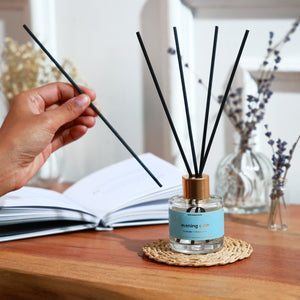
 Garden Bloom₹799Everything a reed diffuser does happens within a few centimetres of itself. Oil wicks up the fibre, spreads across the surface, and evaporates at whatever rate temperature, humidity and passing air allow. What leaves is a vapour with no direction and no momentum. So the concentration map of your room has one maximum, and it is sitting on the shelf where you put the bottle. This is why more emission does not help. Reed count, bottle size and a deeper composition all raise the height of that maximum; none of them changes where it is or how quickly it falls away. Six reeds gives you a taller peak on exactly the same footprint, and a shorter bottle life to pay for it.
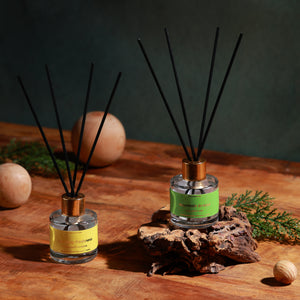
 A second bottle₹1,548Here is the idea people are quietly relying on when they buy a second diffuser: two sources will meet somewhere in the middle and fill the room between them. What actually happens is that every point in the room receives whatever arrives from bottle A plus whatever arrives from bottle B. Near A, the contribution from A is large and from B is tiny, so the total is essentially A. Near B, the reverse. And in the middle, both contributions are at their smallest, because the middle is the one place that is far from everything. You do not get a plateau. You get two hills and a shallower valley. The valley does lift a little, which is why the fix feels almost successful and never quite is.
 Evening Calm₹799Nobody describes a gradient. People describe a corner, a bubble, a zone with a boundary — and they are being accurate about their experience and inaccurate about the physics. Olfaction compresses an enormous range of concentrations into a small range of impressions, which means large changes near the bottom of the range register as almost nothing and the transition reads as a step. On top of that, receptors adapt to a constant stimulus within minutes, so the moment you sit down inside the peak your own reading of it starts to fall. The practical consequence: you are the worst available instrument for judging your own room. Leave for fifteen minutes and walk back in, and ask a visitor.
The arithmetic of adding sources, without any arithmetic
Imagine walking the long diagonal of your bedroom with one diffuser on a chest of drawers. The reading in your nose climbs as you approach, peaks alongside the bottle, and falls away again. One hill. Now put a second, identical bottle in the opposite corner and walk the same line. You climb the first hill, come down the far side — and then, before you reach the bottom, you start climbing the second. The floor of the room has risen slightly, and there are now two summits instead of one. What has not appeared anywhere is a flat stretch.
The reason is that the midpoint is a geometrically unlucky place. It is the farthest point in the room from source A and, at the same time, the farthest from source B. Both bottles are contributing their weakest output there, and adding two weak contributions gives you a moderately weak one. Meanwhile each source has doubled the strength of the corner it is standing in, because the near source overwhelms the far one entirely. So the ratio between the best and worst place in the room barely improves, and you have spent another ₹749 to ₹849 to discover it. Emission was never the missing quantity.
Now change one thing and nothing else: switch the ceiling fan on to its lowest setting with the door shut. The bottles are the same, the reeds are the same, the oil is the same. But the air is now circulating, and circulation carries what the reeds release away from the reeds and mixes it through the volume. The peaks come down, the valley comes up, and the room reads as a single fragranced space rather than as a route between two lamps. Nothing was added to the fragrance. What was added was transport, and transport is the quantity every hot spot is short of. The one cost is bottle life: air moving over a wetted surface evaporates it faster, so a 50ml will not see out its usual 6–8 weeks.
One bottle, two bottles, four bottles, and moved air
The same room, five configurations, and what the concentration map looks like in each. The fourth row is the one people arrive at after three purchases, and the fifth is the one that costs nothing.
| Configuration | Shape of the room | Where the weakest point is | Best-to-worst ratio | Cost |
|---|---|---|---|---|
| One reed diffuser | A single peak falling away in every direction | The far corner | Large — and this is normal, not faulty | ₹749–₹849 |
| One reed diffuser, six reeds instead of three | The same peak, taller | Still the far corner | Unchanged — you scaled the curve, you did not reshape it | ₹0, and roughly half the bottle life |
| Two reed diffusers, opposite corners | Two hills with a valley between them | The midpoint — the farthest place from both at once | Slightly better, and it still reads as two zones | Another ₹749–₹849 |
| Four small diffusers around the room | Four peaks and several shallow valleys | Wherever you happen to be standing between them | Better again, at four times the running cost and four bottles to maintain | Roughly ₹3,000 and repeating |
| One reed diffuser plus a ceiling fan on low, door shut ★ | One gentle rise on an otherwise flat field | Much less clearly defined — mixing has blurred it | Substantially improved, within minutes | ₹0, and a shorter bottle |
| One active diffuser — Sukoon ₹1,899 ★ | Broadly even across 270–320 sq ft, with a local feature at the outlet | No meaningful weak point inside the rated area | Small — this is what evenness looks like | ₹1,899, plus power, filling and added humidity |
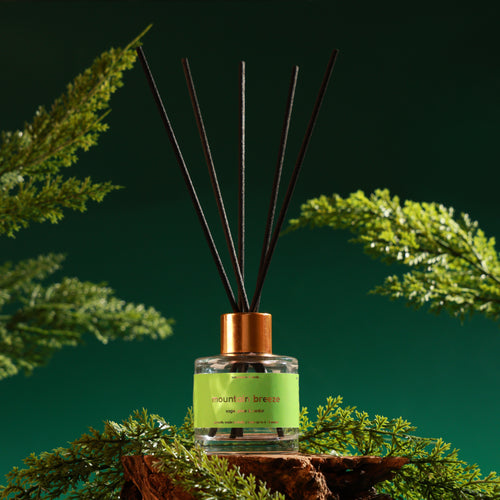
Point source · Mountain Breeze 9.4₹849Shop → 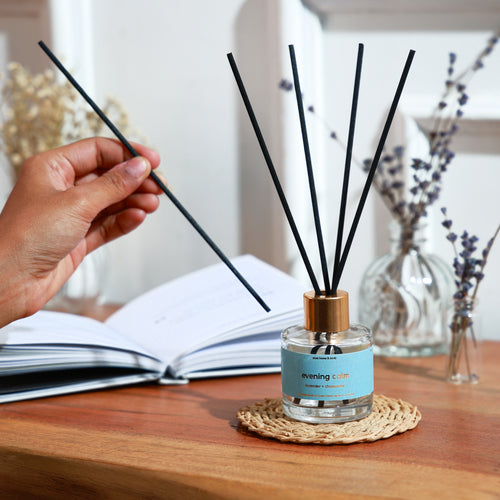 Bedside zone · Evening Calm 8.9₹799Shop →
  A field · Sukoon 270–320 sq ft₹1,899Shop →
Flattening the peaks for nothing, before flattening them for money
Here is the free list in full, and I would work it for a week before spending anything, because a good share of the people reading this are finished by the end of it. Reed count. Six fibre reeds is full projection; three is a soft bedside level that roughly doubles the life of the bottle. This will not reshape the room, but it will tell you quickly whether you are simply under-dosed. Distance. Halve the gap between the bottle and where you actually sit or sleep — with a point source, distance dominates everything, so this is the single most effective change for you even though it changes nothing about the room. Height. At or slightly below nose height, on a surface, not the floor and not the top of a wardrobe.
Draught. Not on a windowsill, not in a running AC’s blast, not beside an open balcony door — and equally not tucked into a dead corner behind a curtain, which is a common overcorrection. You want the bottle standing in the room’s circulation and out of its exhaust. The door. Closed for the hours that matter; an open window or balcony door does not weaken the bottle, it flushes the room, and air that leaves takes the fragrance with it. And the fan. Low setting, closed room, not directly under the blades at full speed. It is the best free advice in this whole subject because it is the only free source of transport available to you, and transport is the missing quantity in every hot spot. It will shorten the bottle. I would rather tell you that plainly than let you find out in week five and blame the oil.
One further free change that is not about the room at all: change how you are measuring. Sitting inside the peak is the worst way to assess a room, because a constant stimulus is exactly what receptors adapt to. Step out for fifteen minutes, walk back in, and ask somebody who does not live in the house. I have talked more than one person out of replacing a diffuser that their guests could smell from the front door.
If you want a field rather than peaks — the ladder, and the gap in our own range
In the order I would actually spend, assuming the free week has been worked through properly. The last row is the thing I cannot sell you, and it matters more to a reader with one bedroom than any of the rows above it.
| Step | What it is | When it is the right answer | Price |
|---|---|---|---|
| 1. The free list, ending with the fan ★ | Reed count, distance, height, draught, door, ceiling fan on low in a closed room | Always first. The fan is the only free source of transport there is | ₹0 |
| 2. One reed, sized and sited properly | 50ml for up to about 150 sq ft, 6–8 weeks; 130ml above that, 14–18 weeks. Six fibre reeds either way | When you want a deliberate zone — a bedside, a desk, a reading chair — rather than a whole volume | ₹749–₹1,349 |
| 3. A second reed diffuser, but only for the right room | Two point sources, two peaks, a shallower valley between | A long or L-shaped room used at both ends, two rooms that are one volume, or different scents per zone. Not for evenness in one open space | ₹1,498–₹1,598 as a duo |
| 4. Sukoon ₹1,899 ★ | Ultrasonic, 500ml, 270–320 sq ft, 16–18h on low, three 15ml Hotel Collection scents included | When the requirement is genuinely a consistent room. Very often the correct bedroom answer | ₹1,899 |
| 5. Safar ₹3,999, with the disclosure | Waterless cold diffusion of undiluted oil, 20ml, cordless, three speeds, 1 / 2 / 3-hour auto-off. Named and sold as a car and travel diffuser | The waterless mechanism at personal scale, if you can live with recharging it. Not set-and-forget | ₹3,999 |
| The honest gap | Between Safar and Vaayu ₹11,999 (1000 m³, roughly 2,000–3,000 sq ft) there is no mid-sized waterless bedroom nebuliser in this range. Megh ₹3,499 is not the answer either — six litres, about 100 hours, only about 215 sq ft | Said plainly. Nothing here is “a Vaayu for one room” | — |
Versailles
“Hot spot” is a phrase I have come to like, because whoever coined it was paying close attention. It describes the experience precisely. What it gets wrong is only the implication — that a spot is an aberration and the rest of the room is the intended state. With a passive diffuser it is the other way round: the spot is the product working, and the rest of the room is simply out of range. A reader who has one hot spot has a functioning bottle of oil and a still room.
What I try to head off is the second purchase. It is an entirely rational move — anyone told a diffuser scents a room would reasonably conclude that two diffusers scent it twice as well — and it is the one that costs money and teaches nothing, because the geometry defeats it. The middle of the room stays the middle of the room. I would far rather someone spent nothing, put the fan on low for a week, and then decided whether they still had a problem.
And if the answer is yes, the honest ladder starts at Sukoon at ₹1,899, not at anything dearer, and I would say before you paid that reed oil does not pour into it. Meanwhile the bottle keeps its job. Mine sits on a bedside table making no noise, needing no socket, working through a power cut, costing me around ₹13 to ₹15 a day, and it will never break. That is a good object. It is simply not a room system. Everything is composed in Pune, and a part of every order funds a girl’s classroom through Nanhi Kali.
Frequently asked questions
- Even distribution across a bedroom — the head question, and the free method in order.
- The same strength at bed, desk and door — three sampling points on one gradient.
- One strong corner and three weak ones — the practical fixes, and the honest ceiling.
- Several passive or one active? — scored honestly, including the rows passive wins.
- Can active diffusion be more consistent? — the mechanism, explained rather than asserted.
- Fragrance in the air, not around the bottle — the vocabulary you need to search well.
- Distribution versus strength — the shape of the curve, not its height.
- Choosing by distribution, not bottle size — volume is duration, not coverage.
- Should I look beyond reed diffusers? — the family pillar, free fixes first.
- Brand: the SOSA founder story.
SOSA facts verified August 2026: Reed diffusers are supplied in 50ml and 130ml only — 50ml suits rooms up to about 150 sq ft and lasts 6–8 weeks, 130ml suits rooms above 150 sq ft and lasts 14–18 weeks, at roughly ₹13–₹15 a day. Six reeds is full projection; three is a soft bedside level and roughly doubles the life; two or three reeds in a 50 sq ft bathroom can make a 50ml last nearly three months; flip the reeds every 3–5 days. Morning Freshness ₹749 / ₹1,249 · Evening Calm ₹799 / ₹1,299 · Garden Bloom ₹799 / ₹1,299 · Mountain Breeze ₹849 / ₹1,349 · Fresh Brew ₹849 / ₹1,349. Duos: Day & Night ₹1,498, Fresh & Grounded ₹1,548, Warmth & Bloom ₹1,598 (50ml × 2); 130ml duos ₹2,498 / ₹2,548 / ₹2,598. Strength scale, perceived intensity rather than quality: Evening Calm 8.9 softest, Garden Bloom 8.9, Morning Freshness 9.0, Mountain Breeze 9.4, Fresh Brew 9.5 deepest. Six fibre reeds rather than rattan, heat-stable CCT carrier rather than DPG, alcohol-free, phthalate-free, paraben-free, IFRA-compliant, 0 ppm formaldehyde, refillable glass bottle, tested at 45°C and 85% RH, composed in Pune. Refills 300ml ₹2,399 and 500ml ₹3,499, oil only and never a first purchase. Machines: Boond ₹899 (300ml, up to about 150 sq ft, ~6h, USB, night light) · Sukoon ₹1,899 (500ml, 270–320 sq ft, 16–18h on low, three 15ml Hotel Collection scents included) · Megh ₹3,499 (6L, ~100h runtime but only ~215 sq ft, never a coverage upgrade) · Safar ₹3,999, a waterless cold-diffusion device named and sold as a car and travel perfume diffuser, with a 20ml bottle, a 2000 mAh battery, up to 10 hours continuous or about 30 hours intermittent per charge, three speeds and a 1 / 2 / 3-hour auto-off timer · Vaayu ₹11,999, a waterless cold-air nebuliser rated to 1000 m³, roughly 2,000–3,000 sq ft, with a 400ml tank, app and onboard control and under 38 dB operation, and the wrong purchase for one bedroom. Aangan ₹25,999 and Meenar ₹38,500 are commercial machines and are not home recommendations. No coverage figure is published for Safar and none is quoted here. Between Safar and Vaayu, SOSA has no mid-sized waterless bedroom nebuliser. Reed oil, the water-based Hotel Collection and pure fragrance oil are not interchangeable across these mechanisms. No health, air-quality, allergy, sleep or mood claims are made anywhere on this page, and fragrance is not presented as a way to remove a smell. Free shipping above ₹499, and a portion of every order supports girl-child education through Nanhi Kali. SOSA is an independent Indian fragrance house; the Hotel Collection is SOSA's own interpretation inspired by the world's finest hotels and SOSA is not affiliated with or endorsed by any hotel brand. Prices subject to change — see the live product pages.