


Why Does My Bathroom Smell Fine in the Morning and Bad at Night?

Why Does My Bathroom Smell Fine in the Morning and Bad at Night?

★ The bathroom you clean every day that still smells · and the drain nobody thinks to checkCandle ₹379 · reed ₹749 · Boond ₹899 · Sukoon ₹1,899 · free shipping above ₹499A portion funds girl-child education
★ SOSA · find the cause, then scent the room
A U-bend holds a water seal against sewer gas. It evaporates in a few unused weeks, and then the room vents. A mug of water fixes it
★ ★ ★ ★ ★
★★★★★
"A mug of water down the floor drain. That was it. I had been cleaning a bathroom that was not dirty for six months."
Sunita G. Free fix · drain trap
The whole answer
★★★★★
"Came back from three weeks away to a sewage smell and assumed something had died. Dry traps in two bathrooms. Sorted in five minutes."
Dinesh A. After holiday
Free fix · five minutes
★★★★★
"Asked which reed to buy for the bathroom. Was told to check three things first and come back. Two of them fixed it and I bought the reed anyway."
Preethi V. Diagnosed first
Bought second
★★★★★
"Kitchen sink, not the bathroom. The smell had been travelling and I had been treating the wrong room entirely."
Yash C. Kitchen trap
Found the source
★★★★★
"Towels. Never dry properly in monsoon, and a damp towel in a small bathroom is a smell generator. Now they go out on the balcony."
Anita M. Towels, Mumbai
Free fix · dry them
★★★★★
"Once the drain was fixed, a small reed by the basin was all it needed. Nothing to plug in, nothing to remember."
Farhan K. Reed · bathroom
from ₹749
★★★★★
"A mug of water down the floor drain. That was it. I had been cleaning a bathroom that was not dirty for six months."
Sunita G. Free fix · drain trap
The whole answer
★★★★★
"Came back from three weeks away to a sewage smell and assumed something had died. Dry traps in two bathrooms. Sorted in five minutes."
Dinesh A. After holiday
Free fix · five minutes
★★★★★
"Asked which reed to buy for the bathroom. Was told to check three things first and come back. Two of them fixed it and I bought the reed anyway."
Preethi V. Diagnosed first
Bought second
★★★★★
"Kitchen sink, not the bathroom. The smell had been travelling and I had been treating the wrong room entirely."
Yash C. Kitchen trap
Found the source
★★★★★
"Towels. Never dry properly in monsoon, and a damp towel in a small bathroom is a smell generator. Now they go out on the balcony."
Anita M. Towels, Mumbai
Free fix · dry them
★★★★★
"Once the drain was fixed, a small reed by the basin was all it needed. Nothing to plug in, nothing to remember."
Farhan K. Reed · bathroom
from ₹749
Reed diffusers: no electricity, no routine, one level for months · from ₹749 A reed needs 24–72 hours to establish — the right buy for a habit, the wrong one for tonight Air the room first · scent layers on clean air, it never replaces it


Founder Diaries · Home Fragrance · Bathrooms, Drains & Plumbing Smells
By Sonal Sahani · ISIPCA Versailles 11 min read Updated August 2026
This is a better question than it looks, because the pattern is the evidence. A smell that arrives at the same time every day and is gone by the next morning is not random and it is not the building: it is something that changes across a day, and there are only so many things in a bathroom that do. Five of them, in fact, and they are all identifiable by an evening of paying attention. This page lists them, gives you a substitution test that isolates yours, and then deals with the readers whose pattern runs in the opposite direction, because that is a different fault with a different answer.
Quick answers — read this first
The logic: a daily cycle has a daily cause. Something that is different at ten at night from how it was at seven in the morning is doing this.

The five candidates: the room has been used five or six times rather than once; the towels have been wet since the morning shower; humidity has stacked up with each use and never fully cleared; the room is warmer, which raises the volatility of everything in it; and a floor drain wetted in the morning may be drying out by night.

If yours is worse in the morning instead: that is overnight accumulation behind a closed door with the extractor off — a different fault, and the fix is airflow rather than objects.

The test: change one variable for one day and see whether the evening moves.
The short answer
Short answer: because five things are different at night. The room has been used several times instead of once, the towels have been wet since morning, humidity has accumulated with each shower, the room is warmer, and a drain wetted at seven may be drying by ten. The towels are the single most likely of the five.
If the pattern is reversed and yours is worse in the morning, the cause is different: eight hours of a closed door with the extractor off and nobody in the room, so everything released simply accumulates. That is an airflow problem rather than an object problem, and it is fixed by leaving the door ajar overnight and running the fan on at night.
Shop, after the cycle is broken: a reed diffuser from the alcohol-free line — Morning Freshness ₹749, Garden Bloom and Evening Calm ₹799, Fresh Brew and Mountain Breeze ₹849 — because it holds one level through the eleven hours nobody is in the room. A Boond at ₹899 belongs in the corridor outside, not in the bathroom. Free shipping above ₹499.
Straight answer
Why is my bathroom fine in the morning and bad by the evening?
1. Because the pattern is the diagnosis, and it narrows things enormously. A smell that follows the clock has a cause that follows the clock. That rules out the building, the drains being permanently wrong, and most of what people worry about, and leaves you with a short list of things that are genuinely different at ten at night.

2. The towels have been wet for fourteen hours. They were used at seven, hung over a rail in the most humid room in the house, and have been evaporating into a small enclosed volume ever since. By evening they have had an entire working day to develop, and they are the largest wet object in the room.

3. The room has been used five or six times rather than once. Every use adds water, warmth and organic material, and the room clears less than it gains if the fan is only run during showers.

4. It is warmer at night than it was at dawn. Volatility rises with temperature, so the identical sources release more of themselves into the air of a warm evening room than they did into the same room at its coolest hour. Nothing has to have changed for the smell to change.

5. And a floor drain wetted in the morning may be drying out by night. In a hot dry month an unused trap loses its seal over a day, which is why some bathrooms develop a sharp edge in the evening that a mug of water removes in seconds.

6. If yours is the other way round, that is a different fault. Worse in the morning means overnight accumulation with the door shut and the fan off — a ventilation problem rather than an object one. Both patterns are covered below.

A portion of every order supports girl-child education through Nanhi Kali.

TL;DR: a daily cycle has a daily cause. By evening the room has been used several times, the towels have been wet since seven, humidity has stacked up, the room is warmer so everything present is more volatile, and a morning-wetted floor drain may be drying. If yours is worse in the morning instead, that is overnight accumulation behind a closed door, which is a different fix.
SOSA alcohol-free reed diffusers
For a room nobody is in when it needs to be working
SOSA alcohol-free reed diffusers from ₹749
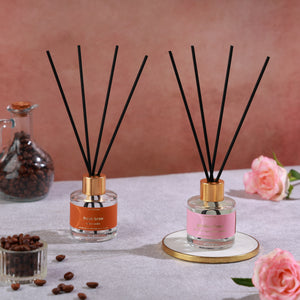
Every timed or switched product assumes somebody is there to time or switch it. In a bathroom nobody is, which is exactly why a daily cycle develops in the first place. A reed has no on and no off. It holds one modest level through the eleven hours between the morning shower and the evening one, which is the stretch this page is really about, and it is doing that at three in the afternoon when the room is empty and quietly getting worse. Five scents from ₹749, 130ml from ₹1,249, 300ml refills ₹2,399, alcohol-free, and 24 to 72 hours to establish. It is a background rather than a correction, and it goes in after the cycle has been broken.

A daily cycle has a daily cause

Most people arrive at this question slightly frustrated, because a smell that comes and goes feels harder to pin down than one that is simply there. It is the opposite. A constant smell could be almost anything in the room; a smell on a twelve-hour rhythm has to be caused by something that is itself on a twelve-hour rhythm, and that is a very short list. So the method here is subtraction. Write down what is genuinely different about that bathroom at ten at night compared with seven in the morning, and then work out which of those differences could produce a smell. There are five serious candidates and I have never needed a sixth.

1
THE FIRST THREE
Use count, wet towels, and humidity that never fully clears
Take them in order of how much they contribute. The first difference is simply that the room has been used. At seven in the morning it is coming off six or seven unused hours; by ten at night it has absorbed a full day of a household — showers, basin use, the WC, hands, hair, a shave, whatever else — and each of those leaves water, warmth and a small amount of organic material behind. None of it is individually significant and the accumulation is, because the room gains faster than it clears if the extractor only runs while somebody is in there. The second, and in my experience the largest single contributor, is the towels. A bath towel used at seven in the morning is a large piece of wet cotton hanging in the most humid room in the house, and it does not dry in an hour — in monsoon it may not dry at all before it is used again. By evening it has had fourteen hours of being warm and damp, which is considerably more than enough, and it is quietly releasing that into a small enclosed volume the whole time. This is such a common answer that the towels have a page of their own. The third is humidity, which is cumulative in a way people underestimate. Every shower pushes the room's relative humidity to saturation. If the room only partly clears before the next one, each use starts from a higher baseline than the last, and by evening the room has been sitting above the level at which things grow — roughly sixty per cent — for most of the day. That is not a smell in itself. It is the condition under which every other source in the room performs better, which is why the same towel in a January bathroom behaves so differently from the same towel in July.
2
THE SECOND TWO
A warmer room, and a floor drain quietly drying out
Then two that almost nobody thinks of, and one of them is elegant. The fourth difference is temperature, and it matters more than its size suggests. Smell requires a molecule to leave a surface and reach your nose, and how readily that happens rises with temperature — noticeably, not marginally. A bathroom at ten at night, in a flat that has been warming all day, in a room that has had several hot showers in it, is several degrees warmer than the same room at its coolest hour before dawn. So the identical sources, unchanged in every other respect, are simply releasing more of themselves. This is why a reader can go looking for something that has changed and find nothing: nothing has changed except the thermometer, and that was enough. It is also why the smell often seems to arrive suddenly in the second week of March. The fifth is the floor drain, and it is the one worth checking first because it costs nothing. A trap holds its seal by having water in it, that water evaporates continuously, and in a hot dry month a shallow floor gully can lose enough over the course of a single day to start letting gas past by evening. A morning shower tops it up; twelve hours of a warm room draws it back down. The result is a bathroom with a faint sharp edge at night and none at breakfast, on a perfect daily cycle, and every one of those readers assumes it must be something complicated. Pour a mug of water down every floor drain in the evening for three days. If the night-time smell disappears, that was it, and you have solved a six-month problem for nothing. The mechanism is set out in full here. The tell is the character: drain is sharp, penetrating and low in the room; the towel and humidity group is heavier, greyer and strongest near the rail.
The order I would check the five in, on a weeknight: the towels, then the floor drain, then the fan's run-time. Those three account for the overwhelming majority of evening bathrooms, and none of them costs anything to test.
3
THE REVERSED PATTERN
If yours is worse in the morning, it is a different fault entirely
Now the counter-case, because a good number of readers arrive at a page like this having already decided which pattern they have and having got it the wrong way round. If your bathroom is at its worst when you walk in first thing and improves through the day, none of the five above is your answer. That is overnight accumulation, and it is a ventilation fault rather than an object fault. The mechanism is different in kind: for eight or nine hours the door has been shut, the extractor has been off, nobody has opened a window, and there has been no air exchange at all. A closed room does not stop producing smell; it stops removing it. Everything in there that off-gasses slowly — the drain, the last of the day's damp, the bin, the mat — has been accumulating into a sealed volume with nowhere to go, and you open the door onto the concentrate. The fix is correspondingly different. Leave the bathroom door ajar overnight rather than shut, which alone changes most of these rooms. Run the extractor for twenty minutes at bedtime rather than only after the morning shower. Open the window before you sleep if the bathroom has one and the weather allows. And do the object work anyway, because the overnight concentrate is made of whatever is in the room, so drying the towels properly helps both patterns. There is one more thing worth knowing, and it applies to both patterns: you are not a constant instrument. You arrive at that door in the morning after eight hours away from the room with a completely unadapted nose, which is the most sensitive it will be all day. At ten at night you have been in and out of the flat for hours. Some of what people describe as a morning smell is a morning nose, and the honest way to settle it is to have somebody else walk in at both hours and tell you what they get.

The five things that change across a day

Each row is something that is genuinely different about your bathroom at ten at night compared with seven in the morning. The third column is how to test it in one day without spending anything, and the fourth is the fix. All five tests are free and four of the five fixes are too. Start at the top: the first two rows are the answer for most households.

The daily cycle
What is different about the room at night, and how to prove which one is yours
What changes Why it produces a smell The one-day test The fix
1. The towels have been wet since morning ★ The largest wet object in the smallest humid room, hung folded so the two faces never dry. Fourteen hours of it by evening Dry them somewhere else for one day and change nothing else. If the evening improves, that was it Spread wide not folded, a second rail, dried outside, washed weekly and hotter
2. The room has been used five or six times Water, warmth and organic material added at every use, in a room that gains faster than it clears Run the fan for twenty minutes after every use for a day rather than during Run-on time after every shower, and the door ajar so the fan has air to pull
3. Humidity has stacked up all day Each shower starts from a higher baseline than the last, and above about 60% everything present performs better Compare a weekday with a day nobody showered at home Squeegee the glass and tiles, hang the mat, extractor on after rather than during
4. The room is warmer at night Volatility rises with temperature, so the same sources release more without anything having changed Compare the same room on a cool night and a warm one, with everything else identical Nothing directly — but it explains why the other four suddenly matter in March
5. A floor drain wetted at 7am is drying by 10pm The trap seal evaporates through a warm day and starts letting gas past by evening. Sharp rather than heavy, and low in the room A mug of water down every floor drain in the evening for three days A mug of water, and a spoon of cooking oil on top of a rarely used gully to slow evaporation
Shop this guide
For the eleven hours nobody is in the room
The SOSA principle
A constant smell could be almost anything in the room. A smell on a twelve-hour rhythm has to be caused by something that is itself on a twelve-hour rhythm.
Which is why the pattern you were about to apologise for is the most useful piece of evidence you have. Five candidates, five free tests, and one evening to work through them.

Isolating yours, and breaking the cycle

The method is substitution, and it is worth doing properly because guessing wrong here costs you a fortnight. Change exactly one variable for exactly one day and leave everything else alone, then check the room at the hour it is normally worst. Day one: take the towels out of the bathroom entirely — dry them on a balcony, in the bedroom, anywhere else — and change nothing else at all. If the evening is noticeably better, you have your answer and it is the commonest one. Day two, if day one did nothing: pour a mug of water down every floor drain at about six in the evening. Day three: run the extractor for twenty minutes after every single use rather than during. Day four: squeegee the glass and wall tiles after every shower and hang the bath mat over the rail rather than leaving it on the floor. Four days, four variables, nothing spent, and at the end of it you will know which of the five you have rather than treating all of them forever. Keep a note on your phone if the household is busy, because the failure mode here is changing three things at once and learning nothing. And do the honest-guest version at the end: ask somebody who does not live there to walk into the bathroom at ten at night and tell you plainly what they get, because after a day in your own flat you are the least reliable instrument in it.

Then the fixes themselves, which are mostly matters of arrangement rather than of purchase. Towels spread across the full width of a rail rather than folded in half over it, which halves the drying time by doubling the exposed surface, and a second rail or a hook on the back of the door if there is not enough hanging space for the household. The bath mat off the floor and over something after use, because a wet mat lying on cold stone has no air beneath it and simply stays wet. A shower curtain shaken out to hang open rather than left bunched, since the folds of a bunched curtain are permanently damp. The extractor run for fifteen to twenty minutes after each use with the door ajar so it has make-up air, which the exhaust fan page covers in detail. A mug of water down every floor drain, and if you have a gully that is genuinely never used, a spoonful of cooking oil on top of the water slows evaporation for weeks. The bin emptied daily rather than when it looks full. Every item on that list is free, and between them they break the cycle in the large majority of bathrooms. What they have in common is that they all reduce the amount of standing water in the room, because the daily cycle is a water cycle before it is anything else.

Then fragrance, and here the shape of this particular problem points to a particular format. The hours you need help with are the eleven when nobody is in the room. That rules out anything you have to switch on, because the person who would switch it on has left the flat. A candle needs attending and putting out and is therefore wrong for a room you walk out of. A timed machine assumes somebody set the timer, and in a bathroom nobody ever does past the first week. A reed diffuser has no on and no off: it holds one modest level continuously through the whole cycle, including at three in the afternoon when the room is empty and quietly getting worse, which is precisely the shape of this requirement. Morning Freshness at ₹749 — Malabar lemon, peppermint and eucalyptus — is the one for this room, with Mountain Breeze at ₹849 as the dry woody alternative; 130ml from ₹1,249, duos from ₹1,498, 300ml refills ₹2,399, and 24 to 72 hours before it is established, so do not judge it on the first evening. A steadiness is worth more here than a peak, and that is not a compromise — it is the correct specification for a room with no operator in it. What does not belong in this room is a cool-mist ultrasonic: the Sukoon at ₹1,899 and the Boond at ₹899 add 30 to 50 millilitres of water an hour, and this page has just spent two sections explaining that the daily cycle is made of water. Put one in the corridor or bedroom outside at three drops of the water-based Hotel Collection per tank, which is where you are standing when you notice the problem anyway. And fragrance goes last, after the cycle is broken — scent over an evening bathroom that is still wet gives you both, in order.

The pattern you were about to apologise for is the best evidence in the room. Something that happens on a schedule has a cause that keeps one.
— Sonal Sahani, SOSA

The SOSA edit

Four days of free testing, then the arrangement fixes, then a format chosen for the specific fact that nobody is in this room when it needs help. The prices do not start until row five, and if the cycle breaks at row one you should stop there.

The SOSA edit
An evening bathroom, in the order to work through it
Do this What it is Why it comes here in the order Cost
1. Take the towels out for one day ★ Dry them anywhere else, change nothing else, and check the room at the hour it is normally worst The single most likely cause, and the cleanest one-variable test available ₹0
2. A mug of water down every floor drain at six The trap seal topped up in the evening rather than the morning, for three days running A seal that survives the morning can be gone by night in a hot month. Sharp rather than heavy is the tell ₹0
3. Fan run-on after every use, door ajar Fifteen to twenty minutes after each use rather than during, with make-up air The room gains faster than it clears if the fan only runs while somebody is in it ₹0
4. Squeegee, mat hung, curtain shaken out Water removed as liquid and wet objects given air on both sides The daily cycle is a water cycle. Everything here reduces the standing water the day is built on ₹0
5. Morning Freshness Malabar lemon, peppermint and eucalyptus, alcohol-free, no on and no off Only once the cycle is broken. It works through the eleven hours nobody is there to operate anything ₹749
Not for this room: a cool-mist diffuser The Boond at ₹899 and Sukoon at ₹1,899 add 30–50 ml of water an hour Good machines, wrong room. Put one in the corridor outside at three drops per tank ₹899 outside
Honest notes for buyers: fragrance is the last step, never the first. It layers on air that is already clean and moving, and it will not remove a source — not damp, not a dry drain trap, not a loaded sofa, not a filter that needs washing. Deal with the cause, change the air, then scent the room. On timing: a candle puts scent into a room in fifteen to twenty minutes and a Sukoon reaches a steady level in about twenty, while a reed diffuser needs a day to three days before it is doing its job — the wrong buy for a deadline and the right buy for a room you want to hold one level for months. SOSA does not make a room or linen spray for the home; the sprays in the range are car perfumes. A cool-mist ultrasonic adds 30–50 ml of water an hour to the air, so it is the wrong machine for a room you are trying to dry out. The Hotel Collection is water-based and runs in the Sukoon, Boond and Megh only — not in reeds and not in the waterless Vaayu. Reed diffusers are a separate alcohol-free line with their own scents. Candles must be attended and put out. The Hotel Collection scents are SOSA's own interpretations inspired by the world's finest hotels; SOSA is an independent Indian fragrance house, not affiliated with or endorsed by any hotel brand. A portion of every order supports girl-child education through Nanhi Kali.
SOSA Boond
For the corridor the bathroom door opens onto, not for the bathroom
SOSA Boond ₹899
A 300ml ultrasonic diffuser running the water-based Hotel Collection at three to six drops per tank — the dose is per tank rather than per litre, since you are scenting the mist and not the water. It does not belong in the bathroom, which is wet enough already and where a cool mist at 30 to 50 millilitres an hour is working against you. It belongs in the passage or the bedroom outside it, because in most flats what people describe as an evening bathroom smell is actually noticed from the doorway rather than from inside. Three drops on the 2H timer from about seven handles the room you are standing in when you notice the problem.
SS
ISIPCA
Versailles
A note from Sonal

What I like about this question is that the reader has already done the hard part without realising it. They noticed a pattern. Most people describing a household smell to me describe a mood — it is worse lately, it comes and goes — and a pattern with a clock attached to it is worth ten of those. It means we can stop looking at the room as a whole and start looking only at the things in it that behave differently at different hours, which in a bathroom is a list of five. I have never had to go past the towels and the floor drain in somebody else's flat.

The other half of my answer is about what to buy afterwards, and it is a slightly unfashionable one. A bathroom on a daily cycle is a room that needs help during the hours you are not in it, which means the correct product is the one with the least impressive peak and the steadiest middle. A candle is wonderful and you have to be there. A machine on a timer is excellent and somebody has to have set it. A reed does nothing dramatic at any moment and is doing exactly the same thing at half past three in the afternoon as it was at nine in the morning, which in this particular room is the whole specification. Lemon, mint and eucalyptus at ₹749, after the towels have somewhere better to dry.

Everything is made and supported from Pune, and a part of every order funds girl-child education through Nanhi Kali. You get a home that smells like somewhere you chose; a girl gets a classroom. That equation has always felt right to me.

Frequently asked questions

Why does my bathroom smell worse at night than in the morning?
Because five things are different by then: the room has been used several times rather than once, the towels have been wet since the morning shower, humidity has accumulated with each use, the room is warmer so everything present is more volatile, and a floor drain wetted at seven may be drying out by ten.
What if my bathroom is worse in the morning instead?
That is a different fault. Eight or nine hours behind a closed door with the extractor off and no air exchange means everything released simply accumulates, and you open the door onto the concentrate. Leave the door ajar overnight and run the fan for twenty minutes at bedtime.
How do I work out which cause is mine?
Change one variable for one day and leave everything else alone. Day one, dry the towels somewhere else. Day two, a mug of water down every floor drain at six. Day three, run the extractor after every use. Day four, squeegee the glass. Four days, nothing spent, and a definite answer.
Can a drain trap really dry out in a single day?
A shallow floor gully in a hot dry month can lose enough of its seal across a warm day to start letting gas past by evening, especially if it is only wetted by the morning shower. It is sharp and low in the room rather than heavy, and a mug of water in the evening for three days settles the question.
What kind of fragrance suits a bathroom with a daily cycle?
One with no on and no off, because the hours that need help are the ones when nobody is in the room. An alcohol-free reed diffuser from ₹749 holds a steady level through the whole day, including the afternoon when the room is empty. Allow 24 to 72 hours before judging it, and fix the cycle first.
A cycle with a cause
Break the pattern firstthen hold one level through the hours nobody is there
The alcohol-free reed line is ₹749 for Morning Freshness, ₹799 for Garden Bloom and Evening Calm and ₹849 for Fresh Brew and Mountain Breeze, with 130ml from ₹1,249, duos from ₹1,498 and 300ml refills at ₹2,399. Reeds need 24 to 72 hours to establish, add no water to the air and need no socket in a wet room. The Boond is ₹899 for the corridor outside. Free shipping above ₹499, and a portion of every order supports girl-child education through Nanhi Kali.
See the reed diffusers → Morning Freshness · ₹749
Continue the read
More from SOSA
Editorial standards & sources
About this guide: Written by Sonal Sahani, ISIPCA Versailles-trained founder and perfumer at SOSA Home & Body, on why a bathroom smell that follows a daily cycle must have a daily cause — the five things that are genuinely different between a morning and an evening bathroom, why a towel wet since seven is the commonest of them, how temperature alone changes what a room releases, why a floor drain wetted at breakfast can be venting by ten, the substitution test that isolates which cause is yours, and what the reversed morning-worse pattern means instead.

Facts verified August 2026: Diagnostic facts used in this guide: a closed room accumulates what it cannot exchange, so cross-ventilation needs two openings rather than one; a drain's U-bend water seal evaporates in roughly two to four weeks of disuse and then admits sewer gas, which is corrected by pouring water down the drain; microbial growth in fabric and on surfaces accelerates above about 60% relative humidity, and Indian monsoon indoor humidity commonly runs 80–95%, which is the one situation where ventilating on a wet day can import moisture rather than remove it; an air-conditioner's cold, wet evaporator coil and filter grow biofilm that is blown into the room on start-up; textiles adsorb cooking aerosol and body oils and re-release them for weeks; and olfactory adaptation makes a constant household smell undetectable to its residents within about a fortnight while visitors still perceive it. Timings: a scented candle scents a normal room in roughly 15–20 minutes, a Sukoon ultrasonic diffuser reaches a steady level in about 20 minutes from cold, and a reed diffuser needs roughly 24–72 hours. SOSA products and prices: Sukoon 500ml ₹1,899 (270–320 sq ft, 16–18h on low, 9–12h high, 30–50 ml/h, 2.4MHz cool mist, remote, steady/2H/4H timers, BPA-free, auto shut-off, includes three 15ml Hotel Collection scents of your choice); Boond 300ml ₹899; Megh 6-litre ₹3,499; waterless Vaayu ₹11,999 (up to 1000m³); Aangan ₹25,999. Hotel Collection water-based fragrance 15ml ₹299, 100ml ₹999, 300ml ₹1,799, Pack of 7 at 15ml ₹1,799; dose 3–6 drops per tank. Reed diffusers (separate alcohol-free line): Morning Freshness from ₹749, Garden Bloom and Evening Calm from ₹799, Fresh Brew and Mountain Breeze from ₹849; 130ml from ₹1,249; duos from ₹1,498; 300ml refills ₹2,399. Scented candles: Bookshop 80g ₹379, Amber Rose 130g ₹599 and 220g ₹799, Smoked Oudh 130g ₹449, ceramic jar candles ₹949, Pure Calm wax melt set ₹854. Free shipping above ₹499. SOSA does not make a room or linen spray for the home. The Hotel Collection scents are SOSA's own interpretations; SOSA is not affiliated with or endorsed by any hotel brand. Prices subject to change — see the live product pages.
ブログに戻る