

Cause two — olfactory adaptation: you stop noticing a constant unchanging smell within minutes. Real, and it happens with the window shut too.
The test that separates them: leave the room for fifteen minutes and walk back in. If it is there on your return but gone after two minutes, you are adapting. If it is absent even on your return, the air is leaving.
The thing not worth buying: a bigger bottle. A 130ml at ₹1,249 holds more oil and lasts longer — it does not release faster, and it fixes neither cause.
2. And because you would stop noticing it anyway. Olfactory receptors adapt to a constant unchanging stimulus within minutes. The signal keeps arriving; your brain stops reporting it because nothing about it has changed. This is why you can smell that a friend's flat has a smell and cannot smell your own. It is a genuine second cause and it survives every fix you apply to the first.
3. Diagnose before you buy. Leave the bedroom for fifteen minutes with the door shut behind you and walk back in. Present on entry, gone by minute three: adaptation. Absent even on entry: the air. If you have both, you have both, and most people with an open bedroom window do.
4. Move the bottle before you change the bottle. A diffuser sitting on a sill or on the direct line between the window and the door is in the fastest-moving air in the room, which is the one place it cannot work. The far side of the room from the opening, at or slightly below nose height, out of direct sun, is the placement that gives the room a chance.
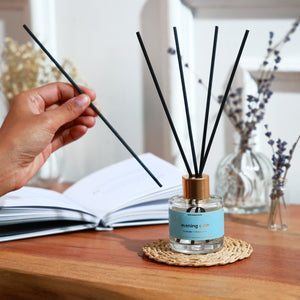
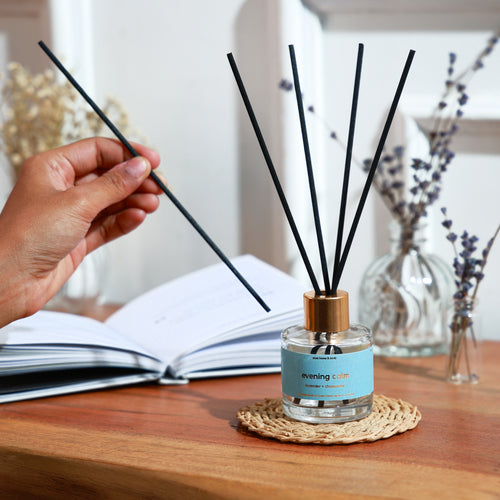
5. Then use the hours you have. A bedroom is one of the best fragrance environments in an Indian flat, but only from the point the window shuts. Three reeds rather than six is usually correct for a closed bedroom — the room holds what you give it, so restraint reads better and the bottle lasts roughly twice as long. Evening Calm at ₹799 is the softest thing we make and the natural fit.
Alcohol-free, phthalate-free, made in Pune. A portion of every order supports girl-child education through Nanhi Kali.
The two causes, separated — because the fixes are not the same
Almost every message we get about a diffuser that has "stopped working" contains both of these tangled together, and the reader has usually concluded that the bottle is weak. It very rarely is. What has happened is that a room with a high air exchange rate and a nose that adapts within minutes are producing the same symptom from two unrelated directions. Fix the wrong one and nothing changes, which is how people end up buying a second bottle to solve a problem the first bottle never had.
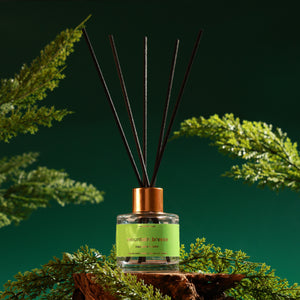
 Mountain Breeze₹849Whatever the diffuser has put into the room over the last hour goes out of the window along with the air holding it. The room resets towards outside air, and it does so faster the larger the opening, the greater the pressure difference across the flat, and the more of the rest of the home is also open. I am not going to give you an air-change figure, because in a real bedroom it depends on all of those and any number I published would be invented. The behaviour, though, is completely predictable: with the window open you will smell the diffuser near the bottle and almost nowhere else in the room. That is not a projection failure. It is a room that will not hold a concentration.
 Evening Calm₹799Your olfactory system is built to detect change rather than to keep announcing the same information. Presented with an unchanging stimulus, it reduces its response within minutes — the molecules are still arriving, you are simply no longer being told. This is the reason you cannot smell your own house and every visitor can, and it is why sniffing harder is exactly the wrong test: the harder you concentrate on a smell you are adapted to, the more certain you become that it is not there. Nothing about the bottle has changed. If people who do not live with you comment on the bedroom and you cannot detect a thing, the diffuser is working for everybody but you.
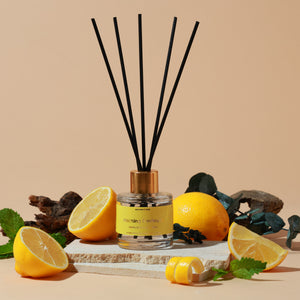
 Morning Freshness₹749There is a third pattern worth naming so you do not misfile it as either of the above. A new bottle runs hot for the first few days while the reeds saturate and the lightest, most volatile materials leave first. By week three you are smelling the heart and base, which is the composition as it was designed to sit in a room. It is not fading; it is settling. Flipping the reeds every three to five days restores projection without opening a new bottle, and it is the single most effective free adjustment available to you. If the reader with the open window does one thing this week, flip the reeds and then test by walking in from outside.
The fifteen-minute test, and what to do with each result
This costs nothing and settles the question. Shut the bedroom door, leave the flat or go and sit in another room for fifteen minutes, then walk back in without pausing at the doorway to think about it. What you register in the first three or four seconds is the honest reading, because it is the only moment your nose is un-adapted. Anything you conclude after two minutes inside is a report from a system that has already turned the signal down.
If the fragrance is clearly there on entry, you have an adaptation situation and the product is doing precisely what a home fragrance is supposed to do. A diffuser you can smell continuously in your own bedroom is, in fact, set too strong for the room — home fragrance is designed to be noticed on arrival and at transitions, not to sit at the front of your attention all evening. In that case the correct response is to change nothing at all, or to reduce the reed count if it is more than you want on arrival.
If it is absent even on entry, you have an air exchange situation, and the honest position is that no bottle solves it while the window is open. What you can do is change where the bottle stands and which hours you are counting on. Move it off the direct line between the window and the door, to the far side of the room, out of any draught and away from direct sun — a reed diffuser has no fan and relies on the room's own gentle air movement, so it wants to be in the room's circulation and out of its through-draught. Then treat the hours after the window shuts as the ones the purchase is for. Those are usually the hours you care about most in a bedroom anyway.
| What you notice | Cause | What helps | What does not |
|---|---|---|---|
| Nothing at all, even walking in from outside | Air exchange — the window | Placement off the draught line; count the closed hours instead | A larger bottle, a stronger scent, more reeds |
| Clear on entry, gone within minutes | Adaptation — your receptors | Nothing. This is correct behaviour | Sniffing harder; buying a second bottle |
| Guests comment on it and you cannot detect it | Adaptation, plus person-to-person sensitivity differences | Trust the visitor; they are the better instrument | Increasing the dose to convince yourself |
| Strong for a week, quieter by week three | The volatile top materials leaving first — settling, not fading | Flip the reeds every 3–5 days | Replacing the bottle early |
| Only detectable within a foot of the bottle | Air exchange, usually with the bottle sitting in the draught | Move it to the far side of the room from the opening | Putting it nearer the window so it "spreads" |
| Fine in the bathroom, absent in the bedroom | Room volume and how much each room is shut | Accept the difference; the small shut room will always win | Assuming the bedroom bottle is defective |
Softest · Evening Calm₹799Shop → 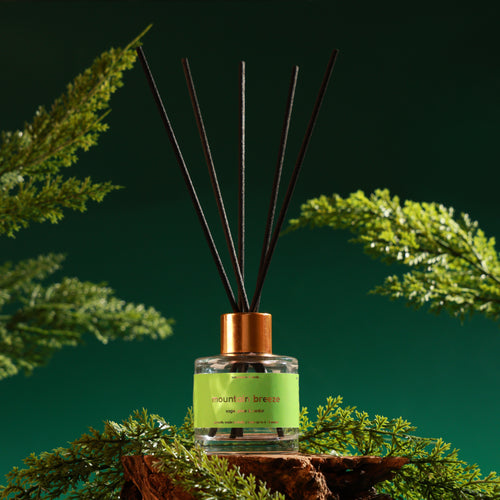 Green · Mountain Breeze₹849Shop →
 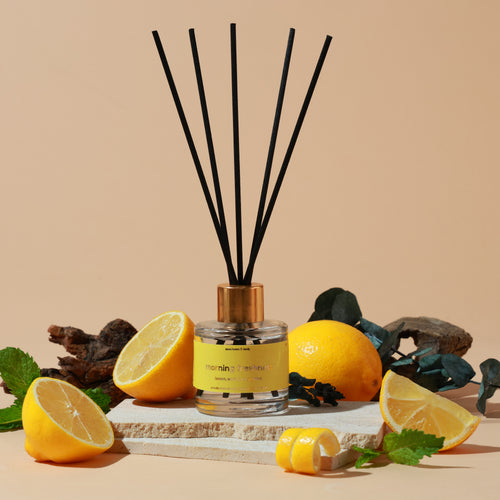 Bright · Morning Freshness₹749Shop →
What to change, in the order that costs least
Placement first, because it is free and it is wrong more often than anything else. A bottle on the windowsill is in the fastest air in the room; a bottle on the direct line between the window and the door is in the second fastest. Move it to the far side of the room from the opening, on a stable surface at or slightly below nose height, out of direct sun and away from any flame. Fragrance oil is flammable, so if there is a diya or an agarbatti anywhere in the room, the diffuser goes well clear of it.
Reed count second, because it is also free. Six reeds is full projection and three is a soft bedside level that roughly doubles the life of the bottle. The instinct in a room that seems weak is to add reeds, and in a high-airflow room that mostly gets you a faster-emptying bottle rather than a stronger-smelling room — the reeds set how quickly the oil leaves, not how well the room retains it. In a bedroom that is shut for the night, three is very often the correct answer, and people who describe a scent as cloying are usually describing an over-dose rather than the composition.
Only then think about the scent itself. If the room reads as flat rather than absent, the register may be wrong for it: Evening Calm at 8.9 is deliberately quiet, Mountain Breeze at 9.4 is dry, green and considerably more present, and Morning Freshness at 9.0 is bright and reads as clean. The scale measures perceived intensity in a room, not quality and not concentration, and it exists so that somebody buying for a small sealed bedroom can deliberately choose down it rather than assuming stronger is better.
What to buy for a bedroom with an open window — and what to skip
Assuming the window is open by day and shut at night, which is the commonest version of this. The purchase is small on purpose. Note the last row: on this page the honest gap is not a missing scent, it is the fact that the most obvious upgrade fixes neither cause.
| Buy | What it is | When it is the right answer | Price |
|---|---|---|---|
| 1. Evening Calm 50ml ★ | Kashmir lavender, chamomile, soft musk drydown — 8.9, the softest | Three reeds, far side of the room, for the hours after the window shuts | ₹799 |
| 2. Mountain Breeze 50ml | Himalayan pine, sage, Indian cedar — 9.4, dry and green | If lavender reads as too soft, or florals are not welcome in the room | ₹849 |
| 3. Morning Freshness 50ml | Malabar lemon, peppermint, eucalyptus globulus — 9.0, bright | For the attached bathroom, where two or three reeds go a very long way | ₹749 |
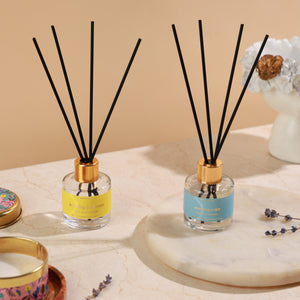
| 4. Day & Night duo | Two 50ml bottles rather than a set or a box | If you are doing the bedroom and the bathroom together | ₹1,498 |
| The honest gap: the upgrade that fixes neither cause | A 130ml at ₹1,249–₹1,349 holds more oil and runs 14–18 weeks; it does not release faster, so it does nothing for an open window and nothing for adaptation. A 300ml refill at ₹2,399 is oil alone and is not a first purchase. Neither is the answer to this question | Named plainly, because both are bought for this reason and neither works | ₹1,249+ / ₹2,399 |
Versailles
The question in the title is one of the two or three most common we receive, and the reason it is worth a whole page is that the person asking it is usually holding two problems and thinks they have one. An open window and an adapted nose produce the same complaint from opposite ends of the chain — one is about the room, one is about the reader — and the only way through is to separate them before anyone spends money.
I would also gently push back on the assumption underneath the question. Wanting to smell your own diffuser continuously is a reasonable thing to want and an unreasonable thing to expect. Perfumery for a room is written for arrival and for transitions: the moment you walk in, the moment you come out of the shower, the moment you sit down. A fragrance you are aware of all evening in your own bedroom is nearly always over-dosed for the space, and the fix for that is fewer reeds rather than a different bottle.
So: flip your reeds, move the bottle off the window line, and judge it in the four seconds after you walk in. If your household says the room smells lovely and you cannot detect it, believe them. Everything is composed in Pune, and a part of every order funds a girl's classroom through Nanhi Kali.
Frequently asked questions
- Is it a waste of money at all? — the honest answer, given first.
- Fresh air without closing anything — fragrance the rooms that are already shut.
- Cross-ventilated 2BHK — and exactly where to stand the bottle.
- Balcony doors and living rooms — a far larger opening than a window.
- Sukoon in a ventilated flat — control, not immunity.
- Without wasting oil — and whether more reeds help.
- A high floor with constant breeze — the complete system.
- Brand: the SOSA founder story.
SOSA reed diffusers — facts verified August 2026: Five scents, all alcohol-free, on a heat-stable CCT (caprylic/capric triglyceride) base rather than DPG, phthalate-free, paraben-free, IFRA-compliant, 0 ppm formaldehyde, six fibre reeds in a refillable glass bottle, composed and made in Pune, India. Morning Freshness 50ml ₹749 · 130ml ₹1,249 · 9.0. Evening Calm 50ml ₹799 · 130ml ₹1,299 · 8.9, the softest in the range. Garden Bloom 50ml ₹799 · 130ml ₹1,299 · 8.9. Mountain Breeze 50ml ₹849 · 130ml ₹1,349 · 9.4. Fresh Brew 50ml ₹849 · 130ml ₹1,349 · 9.5. Longevity 6–8 weeks on 50ml and 14–18 weeks on 130ml; 50ml suits rooms up to about 150 sq ft and 130ml above that. Six reeds is full projection, three is a soft level and roughly doubles the life; flip cadence every 3–5 days for Morning Freshness and 5–7 for Garden Bloom. Duos: Day & Night ₹1,498, Fresh & Grounded ₹1,548, Warmth & Bloom ₹1,598. Refills 300ml ₹2,399 · 500ml ₹3,499, oil only and not a first purchase. Machines: Boond ₹899, Sukoon ₹1,899 (500ml, 270–320 sq ft, 16–18 hours on low), Megh ₹3,499 (six-litre tank, around 100 hours, but only about 215 sq ft — a runtime machine, never a coverage upgrade). Climate-tested through 45°C heat and 85% relative humidity. The reed line contains no oud, sandalwood, vetiver or amber; Smoked Oudh and Sandalwood exist as ₹449 jar candles. SOSA sells no room spray, air purifier, dehumidifier, plug-in or timer, and every SOSA spray is a car perfume. Reed oil and the water-based Hotel Collection are separate systems and are not interchangeable in either direction. Free shipping above ₹499. SOSA is an independent Indian fragrance house and is not affiliated with or endorsed by any hotel brand. Prices subject to change — see the live product pages.