




Why the lobby escapes it: you are there for four minutes, not four hours. You arrive un-adapted, from outside, and you leave before adaptation completes.
The test that settles it: leave for fifteen minutes and walk back in. Or ask somebody arriving from outside. A visitor is a better instrument than you are.
What is genuinely different about the lobby: waterless cold-air nebulising — pressurised air shattering undiluted oil into a dry mist, pushed into a building’s moving air on a schedule, in the same scent for years. That is a diffusion-technology outcome, not a fragrance-oil outcome.
The mistake this page exists to prevent: chasing your own adaptation with more oil. You will adapt to the higher level too, within minutes, while everybody who walks in finds the room overwhelming. A diffuser you can smell continuously in your own home is set too strong for the room, and the fix is fewer reeds rather than a different scent.
The honest gap: no amount of money buys you out of adaptation, and between Safar ₹3,999 and the ₹11,999 Vaayu — 1000 m³, roughly 2,000–3,000 sq ft — SOSA has no mid-sized waterless bedroom nebuliser.
2. Because you are never in a lobby long enough for it to happen. You cross the threshold, take four or five breaths of air at a concentration your nose has not been sitting in, and then you leave. The arrival is the whole exposure. Ask somebody who works a full shift at that desk whether they can smell it, and you will get the same answer you would give about your own hallway. The lobby is not immune to adaptation; you are simply a tourist in it.
3. Because the lobby is also genuinely engineered, and it would be dishonest to pretend otherwise. Luxury hotels use waterless cold-air nebulising — pressurised air shattering undiluted oil into a dry micro-mist that travels with the building’s moving air, often introduced into the HVAC, running on a schedule at a consistent intensity, in one scent held for years. Your reed diffuser is passive capillary diffusion, which moves no air at all and produces a fragrant zone rather than a fragranced room. Both facts are real. The perception half explains why you cannot smell your home; the mechanism half explains why your guests get a smaller impression than a lobby gives them.
4. So stop taking your own reading, because it is the least reliable measurement in the house. Leave the flat for fifteen minutes and walk back in with the door shut behind you. Or ask somebody arriving from outside where they first notice anything and how strong it is. A visitor is a better instrument than you are, and they cost nothing. If guests remark on it and you cannot detect it, your diffuser is working correctly for everybody except you — which is the ordinary condition of owning one, not a fault.
5. And do not chase your own adaptation with dose, because that is the expensive dead end. Adding reeds, buying a larger bottle or moving to a machine raises the concentration, you adapt to the new level within minutes, and you are exactly where you started — except that everyone walking in now finds the room heavy. A diffuser you can smell continuously in your own home is set too strong for the room. Six fibre reeds is full projection, three is a soft bedside level and roughly doubles the life. In a small sealed room, the correct move is usually downwards.
Alcohol-free, phthalate-free, paraben-free, IFRA-compliant, 0 ppm formaldehyde. Free shipping above ₹499, and a portion of every order supports girl-child education through Nanhi Kali.

What adaptation actually is, and why it is an efficiency rather than a fault
A nervous system is not built to tell you what is there. It is built to tell you what has changed. Every sense you have works this way to some degree — you stop feeling your watch, you stop hearing the fan, you stop seeing the frame of your spectacles — and smell is among the fastest and most complete at it. Sustained exposure to a constant odour reduces the perceived intensity of that odour, within minutes, and does so without any change in the physical concentration of the air you are breathing. The receptors keep binding, the signal keeps travelling, and the part of the system that decides what is worth your attention concludes, correctly, that a smell which has been identical for twenty minutes is not news.
This has a consequence people find genuinely startling when they first hear it: the strength of the fragrance in your home is not something you are in a position to judge. You have the worst possible vantage point — permanently inside the stimulus. Everybody else in the world has a better one, because they arrive from somewhere else. It is also why the first week of a new diffuser feels dramatic and the third feels quiet: partly that is a real change, since the lightest, most volatile materials leave first and the composition settles into its heart and base, and partly it is you, adapting. Both are happening, and they are easy to confuse. The reed-flipping cadence of every three to five days exists to address the first half: flipping re-wets the dry upper length of the reeds and restores projection without opening a new bottle.
There is a second, kinder consequence worth stating. If somebody who has just walked in tells you the house smells lovely and you cannot detect a thing, you have not been sold a weak product and you are not imagining the compliment. Sensitivity to individual materials varies enormously between people even before adaptation is taken into account, and you are carrying the additional handicap of living there. The diffuser is doing its job for every person in the building except its owner. That is the design working, not failing.
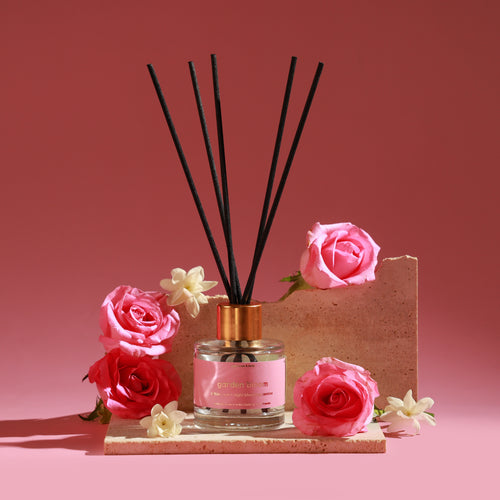
 Garden Bloom₹799This is the largest single component and it is the one nobody counts, because it does not feel like a variable — it feels like the truth about the two rooms. You meet the lobby for four minutes with a nose that has been outdoors, and you meet your hallway for fourteen hours with a nose that has been in it. Those are not comparable measurements of two fragrances; they are two different experiments. The staff at that lobby desk have the same relationship with the hotel’s signature that you have with your own hall, and if you ask them they will confirm it. Nothing you buy changes this. What changes is what you build for — arrivals, thresholds and the hours you are away.
 Hotel Collection₹999 / 100mlThe second reason is real engineering and I will not minimise it to make the perception argument tidier. A lobby runs waterless cold-air nebulising: pressurised air shatters undiluted fragrance oil into a dry micro- or nano-mist that travels with the building’s own airflow, frequently introduced through the HVAC rather than released from an object on a table. No water, no dilution, no heat, no added humidity, no white dust. Compare that with passive capillary diffusion, where oil climbs six fibre reeds and evaporates into whatever air happens to pass, with no energy input and no air moved. The hotel smell is a diffusion-technology outcome, not a fragrance-oil outcome — and the same oil in the two systems produces two different rooms.
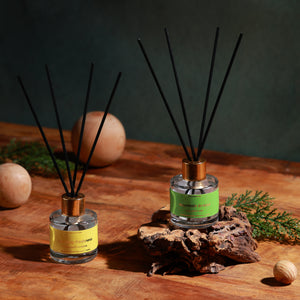
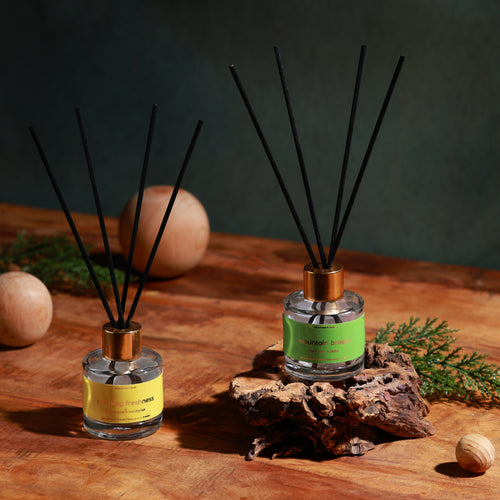
 Mountain Breeze₹849Have you ever tried to find the diffuser in a hotel? Most people cannot, and there is a reason: there often is not one in the room to find. When scent is introduced into a building’s moving air rather than emitted from an object, there is no gradient to walk up and no source to locate — the fragrance is simply a property of the space. That absence of a findable source is a large part of why it reads as designed rather than added, and it is the thing a bottle on a console table can never quite reproduce, because a bottle is visibly the reason. The third component is plain novelty: you have no memory of that scent as ordinary, and your own home’s fragrance has been filed under “home” since the second week.
The test, and what to do with the result
Everything above becomes actionable through one free experiment, and I would run it before spending anything at all. Shut the room you want to judge, go out for fifteen minutes, and walk back in. Do not sniff around the bottle; stand at the threshold and take the reading you would take in somebody else’s house. If the room reads as clearly fragranced, your setup is working and your problem was never the product — it was that you live there. If it reads as faint from the doorway but obvious at arm’s length from the bottle, you have a transport problem: the oil is fine, the concentration simply falls away with distance, which is exactly what passive capillary diffusion does and why a reed gives a fragrant zone rather than a fragranced room. If it reads as faint even close to the bottle, you have a dose problem and the answer is more reeds or a larger bottle, both of which are cheap.
The better version of the test is somebody else. A visitor is a better instrument than you are, and the useful question to ask them is not “can you smell it?” — which invites politeness — but “where did you first notice anything, and was it too much?”. That gives you two numbers: the distance at which the fragrance becomes perceptible, and whether you have overshot. Overshoot is far more common than people expect in small, well-sealed, air-conditioned bedrooms, and it is invisible from inside because the owner has adapted to it. It is also the single most likely reason a room a guest finds heavy feels like nothing to the person who bought the bottle.
There is one more thing worth knowing, because it is the only lever that acts on adaptation itself rather than on the room. Sensitivity recovers during a gap. That is why the effect you are chasing lands on arrivals from outside, and it is the argument for intermittency in a machine rather than continuous running: Safar has three speeds and a 1, 2 or 3-hour auto-off; Vaayu has app scheduling with 1h, 4h, 8h and 24h windows. It is also the argument for zoning a home with two or three different registers instead of one everywhere: a home that smells identical in every room stops registering as a smell at all within a week, because there is never a change to report. Variety across doorways is free and it does more for perception than any increase in dose.
| What is happening | Why | Can money fix it? | What to do instead |
|---|---|---|---|
| You cannot smell your own home ★ | Olfactory adaptation — receptors stop reporting a constant, unchanging stimulus within minutes | No. You will adapt to any higher level too, within minutes | Leave for fifteen minutes and walk back in. Ask a guest. Build for arrivals |
| The lobby hits you at the door | You arrive un-adapted, from outside, and leave before adaptation completes | No — and it is not a fault to fix | Design the threshold: shut doors, keep the approach in a different register |
| Guests notice less at your home than in a lobby | Mechanism. Passive capillary moves no air; a lobby nebulises undiluted oil into moving air on a schedule | Yes. This is the half worth buying | Sukoon ₹1,899, 270–320 sq ft, 16–18 hours on low — with water; or Safar ₹3,999 undiluted, personal scale |
| Faint at the door, strong at the bottle | Distance decay. A reed’s concentration is highest at the source and falls away — a fragrant zone, by design | Partly — more reeds raises the peak but does not extend reach | Move the bottle to where you actually sit, then consider moved air |
| Faint even at the bottle | Under-dosed for the room. A 50ml is specified for up to ~150 sq ft, a 130ml above it | Yes, and cheaply — six reeds rather than three, or the larger bottle | Check this before anything else. It is the one genuinely free fix |
| The honest gap: no product at any price makes you able to smell your own home continuously — and if one appeared to, it would be over-dosed for everybody else. Separately, between Safar at personal scale and Vaayu ₹11,999 at 1000 m³ — roughly 2,000–3,000 sq ft, and the wrong purchase for one bedroom — SOSA has no mid-sized waterless bedroom nebuliser. | |||
 Passive · Garden Bloom₹799Shop → Active · Sukoon₹1,899Shop →
  Ultrasonic-only · Hotel Collection₹999 / 100mlShop →
Being fair to the reed, and to the person who bought one
It would be easy to read all of this as an argument against passive diffusion and it is not one. A reed diffuser is the only thing on this page that is silent, needs no power, needs no water, needs no charging, has no schedule to remember and cannot be left running by accident — because it is always running. It costs roughly ₹13 to ₹15 a day. It survives a power cut. It has no tank to run dry unnoticed, no plate to descale and no app to open. And it looks like a glass object on a table rather than a small appliance, which is the honest reason a great many people would not put a machine in a bedroom or a hallway at any price. Nothing in this cluster changes that, and it is why the reed remains the product we sell most of.
What a reed cannot do is transport. Oil climbs six fibre reeds by capillary action and evaporates at whatever rate the room’s temperature, humidity and airflow allow; no air is moved, so the concentration is highest at the bottle and falls away with distance. That is a fragrant zone rather than a fragranced room, and it is the design rather than a defect. If your fifteen-minute test says the room is fine at the bottle and quiet at the door, you have hit that ceiling and no stronger oil will change it, because the limit is on transport rather than on emission. And a reed cannot be scheduled, which matters for adaptation specifically: it has no off period during which your sensitivity recovers.
The last thing I would say to the person who bought one and now feels foolish is that buying a fragrance to solve a diffusion problem is the most natural mistake in this whole category, and nearly everybody makes it once. The marketing vocabulary encourages it — everything is described as strong, long-lasting or intense, and almost nothing is described in terms of mechanism. You were not careless. You were shopping in the only vocabulary available. The useful thing you can take away is the correct one: the words for what a lobby does are waterless cold-air nebulising, and once you can search for that, your next search works.
What to change, in order — and the rung that does not exist
The first three rows are free, and on this page they are not throat-clearing: for most readers who arrive here, the answer is genuinely in them. The last row is the gap in our own range, said plainly, alongside the harder truth that half of what you are asking for cannot be bought at all.
| Do this | What it is | When it is the right answer | Price |
|---|---|---|---|
| 1. Take the measurement properly ★ | Shut the room, leave for fifteen minutes, walk back in and read it from the threshold. Better still, ask an arriving guest where they first noticed anything and whether it was too much | First, always. Your own continuous reading of your own home is the least reliable measurement available to you | ₹0 |
| 2. Adjust the dose — often downwards | Six fibre reeds for full projection, three for a soft bedside level and roughly double the life. Flip every 3–5 days to restore projection without opening a new bottle | If a guest says it is a lot, you have overshot and cannot tell. If it is faint even at the bottle, you are under-dosed and this is the cheap fix | ₹0 |
| 3. Zone the home rather than flooding it | Two or three different registers in different rooms rather than one everywhere — a duo is two 50ml bottles, not a boxed set | A home that smells identical everywhere stops registering within a week. Change at a doorway is what a nose reports | ₹1,498–₹1,598 |
| 4. Sukoon — buy transport, not strength | Ultrasonic water mist. 500ml, 270–320 sq ft, 16–18 hours on low, three 15ml Hotel Collection scents included | When the threshold reading is genuinely faint and you want real coverage. Accept dilution, refilling, added humidity and possible white dust in hard water | ₹1,899 |
| 5. Safar — the hotel mechanism, personal scale | Waterless cold-air nebulising of undiluted oil. 20ml, 2000 mAh Type-C, up to 10 hours continuous or ~30 intermittent, 3 speeds, 1/2/3-hour auto-off, 6.9 cm. Named and sold as a car and travel diffuser, with bedside and hotel room among its stated uses | When you want undiluted oil and no added water, and when an off period matters. No published room-coverage figure; it needs recharging | ₹3,999 |
| Never a coverage upgrade: Megh | 6L tank, around 100 hours of runtime, about 215 sq ft — less than the ₹1,899 Sukoon | A runtime and humidity machine, and the easiest product in our own range to misread as the bigger one | ₹3,499 |
| The honest gap, twice over | Nothing on sale anywhere makes you able to smell your own home continuously — and a setup that appeared to would be over-dosed for every guest. Separately, no mid-sized waterless bedroom nebuliser exists at SOSA between Safar and Vaayu ₹11,999, which is rated to 1000 m³ and is the wrong purchase for one bedroom | Both said plainly, because the first one is the reason most people on this page should spend nothing at all | — |
Versailles
Of everything I have written for this series, this is the page I would most like people to read before they buy anything at all — including from us. The single commonest message we receive is some version of “it has stopped working”, and the single commonest correct answer is “you have stopped noticing”. Those two feel identical from inside a nose, and the difference between them is the difference between a purchase and a fifteen-minute walk.
I understand why the escalation happens. You cannot smell it, so you add reeds. You still cannot smell it, so you buy a bigger bottle. Then a machine. Each step raises the concentration, and each step is followed within minutes by your receptors doing exactly what they did before. Meanwhile the people coming through your door are experiencing a room you have no way of assessing. I have been in homes where the owner apologised for the fragrance being too faint while I was quietly wondering how they slept in it. That is not carelessness on their part. It is the ordinary consequence of being the only person who cannot take the measurement.
The other half of the answer is ours to be honest about. A lobby is not just a nose trick — it is a machine nebulising undiluted oil into moving air on a schedule, in one scent held constant for years, across a building designed for it. If what you want is more presence for the people who visit you, that is a real thing to buy, and what you are buying is transport rather than a better smell. Know that our small waterless device is named and sold as a car diffuser and has no published room coverage, that the ultrasonic route puts water into the air, and that the machine above them is built for a whole floor rather than a bedroom. There is no middle rung in our range and I would rather say so. Everything is composed in Pune, and part of every order funds a girl’s classroom through Nanhi Kali.
Frequently asked questions
- How hotels do it in seconds — threshold concentration and a scent held constant for years.
- The “wow, your home smells amazing” effect — one scent, one room, ventilate before.
- Guests noticing before they sit down — placement inside the entrance, out of the draught.
- An arrival moment at the bedroom door — why a closed door is the cheapest tool you own.
- Nice once you sit inside, but no immediate impact — the concentration gradient explained.
- Reed, spray or active diffusion — three shapes over time, honestly compared.
- A signature scent at your own bedroom door — and the honest limit on getting it yourself.
- Arrival effect vs continuous background — two setups in tension, and how to choose.
- Stronger fragrance or better diffusion? — the pillar, and the one free exception.
- Brand: the SOSA founder story.
Facts verified August 2026: Three diffusion mechanisms are described — passive capillary (reed diffusers), ultrasonic water mist (Boond ₹899, 300ml, up to ~150 sq ft, ~6 hours, USB, night light; Sukoon ₹1,899, 500ml, 270–320 sq ft, 16–18 hours on low, three 15ml Hotel Collection scents included; Megh ₹3,499, 6L tank, ~100 hours runtime, ~215 sq ft, which is less coverage than Sukoon and never a coverage upgrade) and waterless cold-air nebulising (Safar ₹3,999, 20ml bottle, 2000 mAh Type-C battery, up to 10 hours continuous or around 30 hours intermittent, 3 speeds, 1/2/3-hour auto-off timer, 6.9 cm, named and sold as a car and travel diffuser with car, handbag, desk, bedside and hotel room among its stated uses, no published room-coverage figure; Vaayu ₹11,999, coverage up to 1000 m³ or roughly 2,000–3,000 sq ft, 400ml refillable tank lasting up to about 90+ days, Bluetooth app and onboard buttons, 1h/4h/8h/24h run windows, adjustable intensity, key-lock, under 38 dB, freestanding or wall/HVAC mount, 5W, CE, RoHS, SGS). SOSA reed diffusers: five scents, 50ml ₹749–₹849 lasting 6–8 weeks and suiting rooms up to ~150 sq ft, 130ml ₹1,249–₹1,349 lasting 14–18 weeks and suiting above 150 sq ft, six fibre reeds included and flipped every 3–5 days, six reeds for full projection and three for a soft bedside level, about ₹13–₹15 a day, heat-stable CCT carrier rather than DPG, alcohol-free, phthalate-free, paraben-free, IFRA-compliant, 0 ppm formaldehyde, refillable glass bottle, climate-tested at 45°C and 85% RH, composed in Pune. SOSA strength scale: Evening Calm 8.9 (softest), Garden Bloom 8.9, Morning Freshness 9.0, Mountain Breeze 9.4, Fresh Brew 9.5 (deepest). Duos are two 50ml bottles at ₹1,498–₹1,598; 130ml duos ₹2,498–₹2,598; refills 300ml ₹2,399 and 500ml ₹3,499, oil only and never a first purchase. Hotel Collection fragrance oils are water-based and ultrasonic-only at 15ml ₹299 (a refill), 100ml ₹999, 300ml ₹1,799 and a pack of seven at ₹1,799; they cannot be used in reed diffusers and reed oil cannot be used in ultrasonic machines, so no hotel-inspired reed diffuser exists. Free shipping above ₹499. A portion of every order supports girl-child education through Nanhi Kali. SOSA is an independent Indian fragrance house; the Hotel Collection scents referenced here are SOSA’s own interpretations inspired by the world’s finest hotels, and SOSA is not affiliated with, endorsed by or a supplier to any hotel brand. Prices subject to change — see the live product pages.