


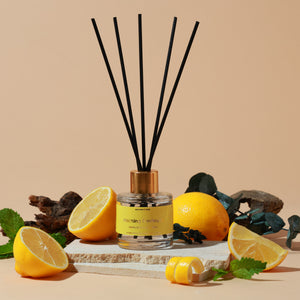
The mechanism that actually decides it: soft furnishings act as a slow reservoir — carpet, curtains and upholstery take fragrance up and release it back over hours, which smooths the profile and forgives an imperfect setting. Hard rooms do none of that. The concentration in a minimal lounge tracks the machine almost directly, so the setting has to be right rather than approximately right.
The practical consequence: lower intensity, more continuous delivery, and placement in the airflow path rather than beside the seating. A hard room will not average out a mistake for you.
The honest gap: no decay rate, falloff curve or throw figure is published for any SOSA machine, and none can honestly be given for a specific room — it depends on volume, air change, surface area and how often the doors open. Anybody quoting you a number for how long a scent “lingers” on hard surfaces is guessing.
- The straight answer, in five parts
- What soft mass was doing, and what happens without it
- The register a mineral room asks for
- Every direction proposed for a minimal lounge, judged
- Delivery, placement and the acoustics of a hard room
- The minimal-lounge edit — and the honest gaps
- A note from Sonal
- FAQs
2. Understand that the room has no reservoir. An upholstered lounge stores fragrance in its textiles and gives it back slowly, which smooths every peak and covers every error. A minimal room does not. Concentration follows the machine, and the room empties as fast as the air changes. Set the level correctly rather than approximately, because nothing in the room will correct it for you.
3. Deliver it continuously and low, not in strong intervals. Without soft mass to average the peaks, an interval of high output is perceived as an interval of high output. The same quantity of oil spread evenly across the day is perceived as a room with a character. This is the single most common reason a beautifully designed minimal lounge gets complaints.
4. Reason in volume, and be honest about the ceiling. Minimal design likes double height, mezzanines and open stairs, and a square-foot figure conceals all three. Vaayu is rated to 1000 m³ ≈ 2,000–3,000 sq ft at ordinary ceiling heights; a galleried lounge of the same footprint is a larger problem, and a closed door is a boundary while an open plan is one volume.
5. Choose waterless, not ultrasonic, and treat it as a finishes decision. An ultrasonic mists oil diluted in water: it adds humidity and can leave a fine white mineral film, which on black granite, matte joinery, brushed steel and full-height glazing is extremely visible. A waterless cold-air nebuliser shatters undiluted oil into a dry nano-mist with no water and no residue. Everything SOSA makes is alcohol-free, phthalate-free, paraben-free, IFRA-compliant and 0 ppm formaldehyde, composed in Pune, and a portion of every order supports girl-child education through Nanhi Kali.

What the soft furnishings were doing, and what happens when you take them away
Everything a club believes about how fragrance behaves indoors was learned in rooms full of textile. Carpet with underlay, lined curtains, wing chairs, cushions, a runner on a staircase — that is an enormous amount of fibre surface, and fibre surface interacts with airborne molecules. Some proportion of what a machine releases lands on that mass, is held there, and comes off again over the following hours. The room is therefore not a simple container. It is a container with a sponge in it, and the sponge does three useful things and one harmful one, all of which a minimal lounge removes at a stroke.
 Vaayu₹11,999In a carpeted lounge, an over-enthusiastic setting is partly absorbed and re-released, which flattens the peak into something broader and lower. The room is forgiving, and a good deal of ordinary club practice depends on that forgiveness without anybody realising it. Take the textiles out and the buffer goes with them. What the machine emits is what the room holds, and a setting one notch too high is experienced as a setting one notch too high, at the seating, immediately. This is why minimal lounges generate a characteristic complaint pattern: a burst of objections in the first fortnight after commissioning, then, once the club has responded by turning everything down, a second wave of staff insisting it has stopped working. Both are the same phenomenon. A room with no reservoir has a narrower correct band than the room your GM learned on.
Aangan₹25,999The harmful thing soft mass does is hold everything else too. A heavily furnished club room accumulates decades of cooking carry-over, damp, body odour and smoke in its textiles and gives all of it back on a humid evening, which is the entire reason so much of this cluster is about moisture rather than about perfume. A minimal lounge has almost none of that inheritance. Glass and stone do not hold last Tuesday. Provided the ventilation is competent and the drain traps are serviced, a hard room genuinely starts each morning close to neutral — and a neutral starting point needs a smaller signal to register as fragranced, not a larger one. The commonest specification error in minimal interiors is reading the absence of accumulated smell as an absence of performance, and responding with more output. What you are actually smelling is the room doing its job.
Vaayu₹11,999In a carpeted lounge, an over-enthusiastic setting is partly absorbed and re-released, which flattens the peak into something broader and lower. The room is forgiving, and a good deal of ordinary club practice depends on that forgiveness without anybody realising it. Take the textiles out and the buffer goes with them. What the machine emits is what the room holds, and a setting one notch too high is experienced as a setting one notch too high, at the seating, immediately. This is why minimal lounges generate a characteristic complaint pattern: a burst of objections in the first fortnight after commissioning, then, once the club has responded by turning everything down, a second wave of staff insisting it has stopped working. Both are the same phenomenon. A room with no reservoir has a narrower correct band than the room your GM learned on.
Aangan₹25,999The harmful thing soft mass does is hold everything else too. A heavily furnished club room accumulates decades of cooking carry-over, damp, body odour and smoke in its textiles and gives all of it back on a humid evening, which is the entire reason so much of this cluster is about moisture rather than about perfume. A minimal lounge has almost none of that inheritance. Glass and stone do not hold last Tuesday. Provided the ventilation is competent and the drain traps are serviced, a hard room genuinely starts each morning close to neutral — and a neutral starting point needs a smaller signal to register as fragranced, not a larger one. The commonest specification error in minimal interiors is reading the absence of accumulated smell as an absence of performance, and responding with more output. What you are actually smelling is the room doing its job.
 Mountain Breeze₹849Minimal interiors tend to come with the things that move air: big glazed elevations, high-level supply, exposed services, double height, an open stair to a mezzanine, and frequently a terrace door that spends the evening open. Air that leaves takes the fragrance with it, and a room whose doors stand open is not a fragrance environment during those hours — it becomes one the moment they close. That is not a defect to be overcome with output; it is a condition to be scheduled around. It also means the fragrance goes precisely where the air goes, so a machine placed for the convenience of a power socket rather than for the supply path will scent a corner of the room and a stairwell nobody uses. Recirculating air conditioning in a closed hard room distributes very evenly indeed, which is the best case; a room on full fresh air with the doors open is the worst.
The register a mineral room asks for, material by material
Now the composition, which is the easy half. A minimal lounge is a cool visual environment, and the fragrance should agree with it. Members do not consciously compare what they see with what they smell, but the comparison happens anyway: put a warm, sweet, ambered fragrance into a room of pale stone and steel and the effect is of two different briefs colliding. It usually gets described as the room smelling like a hotel, which in a business club is not a compliment. The four useful materials are tea, bergamot, cedar and something green or saline, and each is doing a specific job.
White tea is the spine of a mineral register. It is transparent, faintly astringent and almost weightless, and its great advantage in a hard room is that it has very little accumulation behaviour — it does not build into anything heavier as the hours pass. Bergamot supplies daylight. It is the material that makes a cool room read as fresh rather than as cold, which matters enormously in a lounge with north glazing and grey stone. It is also the lightest thing in the composition and will always be the first to leave, so it belongs as an accent rather than as the structure. Cedar is the only wood I would put in a minimal room, because it is dry rather than creamy, and because it is close to linear over hours — at four in the afternoon it still smells like cedar rather than like what cedar became. A green or faintly saline edge is the optional fourth element, and it is what stops the whole thing reading as an office-building air freshener: something vegetal, slightly bitter, a little mineral.
What to strike out is equally definite. No vanilla, tonka, caramel, praline or anything else that reads as edible — a business lounge with a coffee counter has enough real food smell in it already, and a gourmand fragrance in a working room makes people think about eating rather than about working. No powdery florals, which age a modern room by twenty years in one breath. No heavy amber or resin, which in a room with hard reflective surfaces has nowhere to settle and simply hangs. And no aquatic or ozonic accord, which is the direction people most often ask me for when they say minimal — SOSA publishes no marine or ozonic fragrance in any format, and the nearest honest answer is a tea-and-bergamot register with a green edge, which I would rather describe accurately than sell you as something it is not.
Every direction proposed for a minimal lounge, judged
What architects and house committees suggest for a glass-and-stone business lounge, and how each behaves in a room with no absorbent mass over a working afternoon. The last two rows are the ones to strike out, and the final row names a direction SOSA does not publish at all.
| Direction | What it does in a mineral room | Over a working afternoon | Verdict |
|---|---|---|---|
| White tea ★ | Transparent and faintly astringent; agrees with stone and glass | Does not build; still light at five o’clock | The spine of the composition |
| Bergamot | Daylight in a cool room; stops grey reading as cold | Lightest material present; leaves first | Specify as an accent, never as the base |
| Dry cedar | The only wood that does not turn creamy or sweet | Near-linear; unchanged over four hours | Specify. It gives the room a floor |
| Green or saline edge | Vegetal and slightly bitter; removes the office-lobby quality | Stable, and keeps the composition from reading generic | Optional, and usually worth it |
| Gourmand — vanilla, caramel, coffee | Reads as food in a room where people are working | Accumulates and turns cloying with no textile to absorb it | No. Nothing edible in a business lounge |
| Amber, resin, heavy sandalwood | Warmth against a cool material palette; the briefs collide | Hangs, because there is nothing to take it up | No. It is the wrong argument for this room |
| Aquatic, marine or ozonic | What most people mean when they say “minimal and clean” | Cannot be assessed — it does not exist here | SOSA publishes no marine or ozonic fragrance in any format. Tea, bergamot and a green edge are the nearest honest direction |
The lounge · Vaayu₹11,999See it → A whole floor · Aangan₹25,999See it → 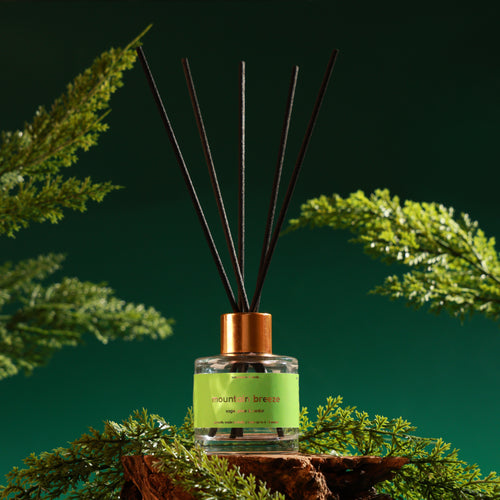 Dry cedar, to try · reeds₹849See it →
Delivery, placement, and the one specification a hard room makes non-negotiable
Three practical matters follow from the absence of soft mass, and the third is the one most often missed at drawing stage. The first is delivery shape. Because the room has no reservoir, the profile the machine produces is close to the profile the member experiences, so a low continuous delivery is preferable to intervals of strong output. The same quantity of oil, spread differently across a day, produces either a room with a quiet character or a room that keeps announcing itself. Vaayu gives you adjustable intensity and run windows of 1h / 4h / 8h / 24h with a choice of days; Aangan is controlled by an intelligent PCB with programmable work and pause cycles and daily schedules, which is a different and entirely mechanical control philosophy — it is not an app and has no Bluetooth, and the two machines should never be described as though they were the same.
The second is placement, and here a hard room punishes a common error. Two machines placed at either end of a long minimal lounge do not produce an evenly fragranced room; they produce two concentrations with a thin patch between them, because the midpoint is the farthest point from both sources. In a carpeted room the textiles partly disguise that. In a hard room they do not, and the thin patch is exactly where the club has put the good sofa. The correct approach is to place with reference to where the air is going rather than to where the seating is — supply grilles, the return path, the door the members actually use — and to accept that one well-placed machine in the airflow path will beat two badly placed ones at any budget. If the lounge shares an air system with the rest of the floor, the honest answer may not be a machine in the lounge at all.
The third is noise, and it is the specification minimal interiors make non-negotiable. A room finished in stone, glass and concrete is acoustically live: there is nothing to absorb sound either, which is why these lounges are often fitted with acoustic baffles and why conversation carries in them. A mechanical device that would be inaudible in a carpeted, curtained room is not necessarily inaudible here. Vaayu runs at under 38 dB and Aangan at under 42 dB, and those two figures belong in the acoustic section of the specification rather than in a footnote. If the machine is going into a return, the noise question largely disappears, which is one more argument for putting it there. And a practical caution: no decibel figure other than those two is published, no sound power data exists, and I would not let a consultant model the room on a number I had invented for them.
The minimal-lounge edit — and the honest gaps, stated twice
What I would do with a glass-and-stone business lounge, in order. The first two steps involve no purchase, and the last row names what SOSA does not publish rather than steering you toward the nearest thing on the shelf.
| Step | What it is | Why it matters in a hard room | Cost |
|---|---|---|---|
| 1. Recalibrate the level downward ★ | Commission at the bottom of the range and step up over a week | There is no textile reservoir to flatten a peak, so the correct band is narrower than in a carpeted room | No cost |
| 2. Place for airflow, not for seating | Supply path, return path, the door members use — and never two sources at opposite ends | Two passive peaks leave a thin patch at the midpoint, and a hard room does not conceal it | No purchase |
| 3. Write a contrast-free brief | White tea, bergamot, dry cedar, a green or saline edge. No gourmand, no powder, no amber | A warm fragrance in a cool material palette reads as two briefs colliding | No extra |
| 4. Try the dry register before specifying it | A cedar reed diffuser on the secretary’s desk for a fortnight, on three reeds rather than six | Settles a committee argument for ₹849 instead of after a commissioning visit | ₹849 |
| 5. Buy waterless, not ultrasonic | Vaayu, up to 1000 m³ ≈ 2,000–3,000 sq ft, under 38 dB, key-lock, DC 12V / 1A 5W at the position | No added humidity and no white mineral film on glass, dark stone or matte lacquer | ₹11,999 |
| 6. For a whole minimal floor, use the air system | Aangan on a mechanical HVAC or AHU connection, up to 3,000 m³ ≈ 8,000–10,000 sq ft, programmable work and pause cycles | Removes the object from a room designed to contain nothing, and puts the fragrance in the air path | ₹25,999 |
| Do not buy: a second machine because it “feels weak” | A minimal room with competent ventilation genuinely starts neutral, and neutral needs a smaller signal rather than a bigger one | The most expensive misreading in this family, and the one most likely to produce complaints | Saves ₹11,999 |
| The honest gaps: what is not published | No decay rate, falloff curve, throw figure, adsorption figure or consumption rate is published for any SOSA machine, and no machine count exists as a formula. SOSA publishes no marine, ozonic or aquatic fragrance in any format. No purchasable refill oil is listed for the waterless commercial machines — that fragrance is specified and quoted per property | Said plainly, because a specifier will look for the numbers and should know in advance that they are not there | Quoted |
Versailles
The first minimal business lounge I was asked about was a beautiful room — travertine, full-height glazing, a mezzanine, six pieces of furniture in something like four thousand square feet — and the club had already bought a machine and already had a problem. Members said it was overpowering. Staff said they could not smell anything. Both groups were describing the same room on the same afternoon, and both were telling the truth.
What I had not understood until then is how much of the conventional wisdom about interior fragrance is really wisdom about carpet. Everything we think we know — that a room holds its scent, that it smells of last night, that you can be slightly generous and the room will settle it down — is a description of textile, not of air. Take the textile away and you have a room that is honest about exactly what you are putting into it, moment by moment, and that honesty is uncomfortable if you have been relying on the sponge.
So my brief for that room, and for every hard interior since, begins with subtraction rather than selection. Take out the sweetness. Take out the second machine. Take out two notches of intensity. Take the object off the console and put the fragrance into the return. What is left is a room that smells composed rather than scented, which is the only thing a business lounge should be aiming for. Everything we make is composed in Pune, and a part of every order funds a girl’s classroom through Nanhi Kali.
Frequently asked questions
- The pillar: the long-stay register — why the lounge is the hardest room in the club.
- The business lounge register and the opposite room, in leather and wood.
- Dosing for the fourth hour and lounge versus lobby.
- All-day consistency as a schedule and continuous low versus bursts.
- Why staff stop smelling it and how to keep a setting where you put it.
- Brand: the SOSA founder story.
SOSA commercial scenting — facts verified August 2026: Vaayu ₹11,999, waterless cold-air nebulising, up to 1000 m³ ≈ 2,000–3,000 sq ft, 400ml refillable sealed tank lasting up to about 90+ days depending on intensity and hours, Bluetooth app plus onboard buttons, run windows of 1h / 4h / 8h / 24h, day selection, adjustable intensity, auto-stop and key-lock, under 38 dB, freestanding, wall-mounted or HVAC-return, DC 12V / 1A at 5W, CE, RoHS and SGS, black and white. Aangan ₹25,999, HVAC or AHU connection or standalone wall-mount or lay-flat, up to 3,000 m³ ≈ 8,000–10,000 sq ft, 800ml reservoir giving weeks between refills on business-hours schedules, under 42 dB, DC 12V at 14W, intelligent PCB with programmable work and pause cycles and daily schedules, metal body 3.9 kg at 284 × 125 × 246 mm, black or white, one-year warranty, imported; it is not app-controlled, has no Bluetooth, and no certifications are published for it. Meenar ₹38,500 is the larger-property option, specified on enquiry; no coverage figure is published for it here, and it should not be assumed to reach further than Aangan. Ultrasonic machines: Sukoon ₹1,899 at 270–320 sq ft with a 500ml tank and 16–18 hours on low, Boond ₹899 with a 300ml tank at up to about 150 sq ft, Megh ₹3,499 with a six-litre tank and around 100 hours of runtime but only about 215 sq ft of coverage. Hotel Collection fragrance oils are water-based and ultrasonic-only at 15ml ₹299, 100ml ₹999 and 300ml ₹1,799, taking three to six drops in the water tank; they are not for reed diffusers and not for the waterless commercial machines. Published tea and woody directions in that ultrasonic range include Quiet Luxury, White Tea Serenity, Tea Garden, Forest Suite, Lobby Bar, Old-World Glamour and Warm Welcome. No purchasable refill oil is listed for the waterless commercial machines; that fragrance is specified and quoted per property. SOSA publishes no marine, aquatic or ozonic fragrance in any format, no leather fragrance in any format and no tobacco or smoky fragrance for any diffuser. SOSA sells no air purifier and no dehumidifier, and every SOSA spray is a car perfume rather than an interior product. No SOSA machine offers Wi-Fi, Alexa, Google Assistant, KNX, Crestron, Control4, Modbus, BACnet or any building-management integration; the Aangan HVAC connection is mechanical. Reed diffusers 50ml ₹749–₹849 lasting 6–8 weeks and 130ml ₹1,249–₹1,349 lasting 14–18 weeks, six fibre reeds, alcohol-free, phthalate-free, paraben-free, IFRA-compliant, 0 ppm formaldehyde, heat-stable CCT carrier, refillable glass bottle, tested at 45°C and 85% RH, composed in Pune. No dealer programme, reseller margin, trade price, territory or service contract is published. Free shipping above ₹499. A portion of every order supports girl-child education through Nanhi Kali. SOSA is an independent Indian fragrance house; the Hotel Collection scents are SOSA’s own interpretations inspired by the world’s finest hotels, and SOSA is not affiliated with or endorsed by any hotel brand. Prices subject to change — see the live product pages.