Founder Diaries · Clinics & Medical Centres · Reeds, Reach & What a Passive Diffuser Can Do
By Sonal Sahani · ISIPCA Versailles 12 min read Updated November 2026
Your reeds are not failing, and I want to say that first because most people who write to me about this have already decided that they bought the wrong bottle. They did not. A reed diffuser is doing exactly what a reed diffuser does: it wicks oil up a bundle of sticks and lets it evaporate off the top of them at whatever rate the neck of the bottle and the temperature of the room decide between them. There is no fan in it, no pump, no nebuliser and no setting. Its output is a function of the oil's surface area in the neck, the number of reeds standing in it, the viscosity of the oil and how warm the air is — and at no point is it a function of how large the hall is. Put the same bottle in a room eleven times the size and you do not get eleven times the output. You get the same output, spread eleven times thinner. So the useful question is not what is wrong with the reeds. It is why a one-metre product is standing in a hall that needs a room-sized one, and the answer has two halves: move the ₹749 bottle to the place where ₹749 is exactly the right amount of money, and then size the hall with arithmetic instead of with six more bottles.
Quick answers — read this first
Free, and you can do it in the next ten minutes: stand at the desk, then at four metres, then in the furthest seat, and write down what you notice at each of the three · count the reeds actually standing in the bottle and flip them · look up and check whether an air-conditioning supply grille is blowing across the neck of the bottle, because that dries the reeds and carries the vapour straight into the return rather than into the room · note the reception temperature at ten in the morning and again at four in the afternoon, because a reed's output rises with room temperature, which is the opposite of a controlled level.
Then move them rather than multiply them: the reeds belong in the administrative cabin, the records room, the accounts desk or the doctor's own office — a volume of roughly thirty cubic metres, where an alcohol-free
reed diffuser from ₹749 is the correct product rather than a compromise.
Then size the hall with the sum: floor area in square feet divided by 10.76, multiplied by ceiling height in metres, counting only the volumes a door closes. A 1,100 sq ft reception and waiting hall at 3.3 metres is about 337 cubic metres. The admin cabin is about 30.
Six more bottles at ₹4,494 do not close that gap and the Vaayu at ₹11,999 does. Housekeeping and presentation, no clinical effect of any kind, and clinical rooms stay fragrance-free either way.
The short answer
Short answer: because a reed diffuser is a passive product and its output is set by the bottle rather than by the room. The oil climbs the reeds by capillary action and evaporates off the exposed length at a rate decided by the surface area in the neck, the number of reeds, the viscosity of the oil and the air temperature. Nothing in that list scales with the size of your waiting hall. A reed is at its working level within about a metre of the bottle and that is the honest limit of the format, not a defect in yours. Multiplying the bottles multiplies the cost and the spill risk without changing the reach.
The order, and why: first the free diagnosis — walk the three distances, count and flip the reeds, and find out whether an air-conditioning grille is sitting over the bottle. Then relocate rather than reinforce: the reeds go to a cabin of about thirty cubic metres where they are genuinely the right answer. Then, and only then, do the arithmetic for the hall, because a hall is a volume problem and a volume problem is solved with a sum rather than with another purchase.
The last line, costed: an alcohol-free
reed diffuser from Rs 749 for the administrative cabin, needing 24 to 72 hours to reach its working level. The
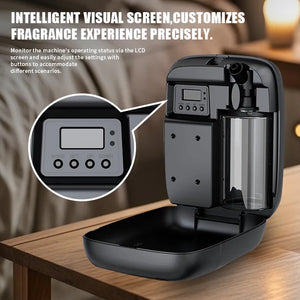
Vaayu at Rs 11,999 for the reception and waiting hall — waterless cold-air nebulisation with no standing water tank, up to 1000 m³, a 400ml fill lasting about seventy-five days, app control with 1h/4h/8h/24h timers, under 38 dB, auto-stop and a key-lock. The
Aangan at Rs 25,999 only for an atrium or a whole floor. Free shipping above Rs 499, and a diffuser is not an air purifier.
Straight answer
Our reed diffusers are barely noticed past the first metre of reception. What should we actually change?
1. Change where they are, not how many there are. A reed diffuser is a passive evaporative product. Oil climbs the reeds by capillary action and leaves from the exposed length at the top, and the rate it leaves at is decided by four things: how much oil surface is in the neck of the bottle, how many reeds are standing in it, how thick the oil is, and how warm the room is. Not one of those four has any knowledge of your floor plan. A reed is at its working level within roughly a metre of the bottle, and past that it is diluted by every cubic metre of air between the bottle and the person. That is the format, not a fault, and it is why your receptionist can smell it and the person in the furthest seat cannot.
2. Do the free diagnosis before you decide anything. Walk the three distances — at the desk, at four metres, in the furthest seat — and write one line at each. Count the reeds actually standing in the bottle, because in every clinic I have visited at least one bottle has three reeds in it and a sheaf of unused ones in a drawer. Flip them, which redistributes the saturated length and gives you a short, real lift for a day or two. And look directly above the bottle: if an air-conditioning supply grille is blowing across the neck, it is drying the exposed reeds and carrying the vapour into the return air path instead of into the room, which is the single commonest siting mistake with reeds at a reception desk.
3. Then accept that the temperature is running the product, and that you cannot have that in a waiting hall. Evaporation rises with temperature, so the same bottle gives you more at four in the afternoon in May than at ten in the morning in December. In a reception that drifts from 24°C to 31°C across a day, the reed is quietly turning itself up and down according to the weather. For an administrative cabin that is of no consequence. For a public waiting hall, where the whole point of a background is that it is the same at nine and at six, it is the opposite of what you want, and
holding one level from opening to closing is not something a passive bottle can be asked to do.
4. Move the reeds to the volume they fit, where the ₹749 is exactly right. An administrative cabin of about eleven feet by ten with a 2.9 metre ceiling is 110 square feet, which is 110 divided by 10.76, or 10.2 square metres, times 2.9, or about thirty cubic metres. A single alcohol-free
reed diffuser is the correct product for that volume and the correct amount of money for it, and the person sitting in it is within a metre of the bottle all day. Records rooms, accounts desks, the practice manager's office and a doctor's own consulting-adjacent office all qualify.
Administrative and back-office rooms are the one part of a medical building where the reeds are not a compromise at all.
5. Size the hall with the sum rather than with more bottles. A 1,100 square foot reception and waiting hall with a 3.3 metre ceiling is 1,100 divided by 10.76, which is 102.2 square metres, times 3.3, which is about 337 cubic metres. The cabin is about 30. The hall is roughly eleven times the cabin, and the reed does not know that. Six more bottles are ₹4,494 and six more glass vessels of oil at reach height in a public area, and they are still a one-metre product bought six times. The
Vaayu at ₹11,999 covers up to 1000 cubic metres, holds one setting through the opening hours, runs under 38 dB and locks with a key so nobody passing adjusts it.
6. And before you spend either amount, make sure there is nothing to find. If the hall has a smell of its own — a dry drain trap, a bin, a soiled-linen route, an air-conditioning drain pan — then neither the reeds nor the machine is the answer, because
the free work comes first and covering a source removes the signal that told housekeeping something was wrong. Fragrance here is housekeeping and presentation. It is not a treatment, it does nothing clinical, a diffuser is not an air purifier, and consultation rooms, procedure rooms, dressing rooms, sample collection, laboratories, dispensing, imaging, oncology day-care and paediatric clinical areas stay fragrance-free with their doors shut.
A portion of every order supports girl-child education through Nanhi Kali.
TL;DR: the reeds are not broken. A reed's output is set by the bottle's neck, the reed count, the oil's viscosity and the room temperature, and never by the size of the hall, so it works for about a metre and then dilutes. Move them to the admin cabin, where thirty cubic metres and ₹749 are a genuine match. Size the hall with area divided by 10.76 times ceiling height, counting only the volumes a door closes, and put one machine on it.
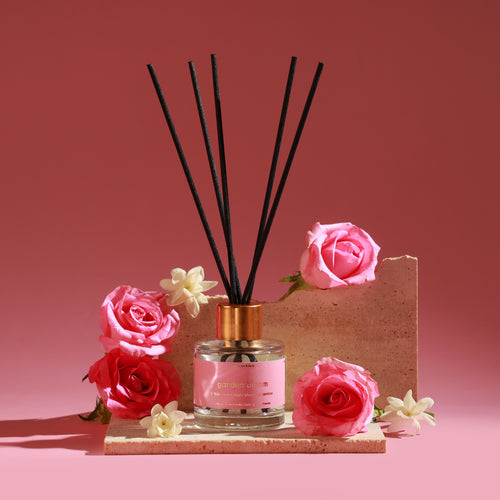
The right product, moved to the right room
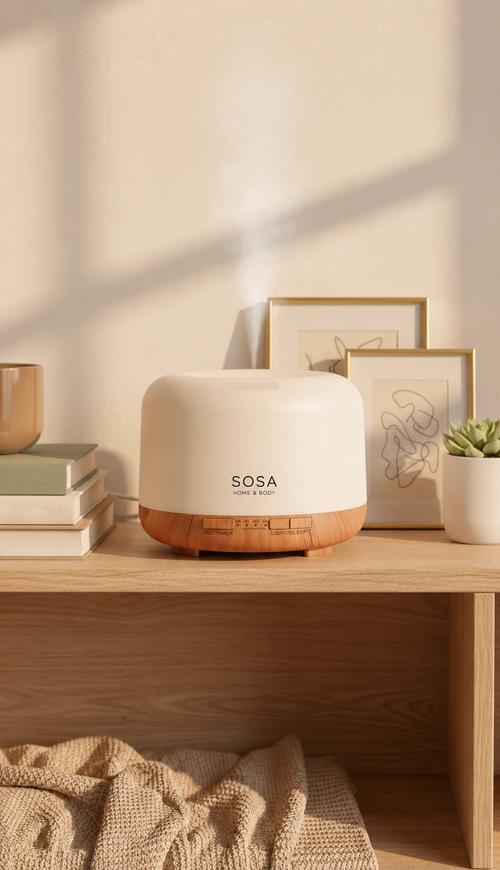
SOSA alcohol-free reed diffusers from ₹749
Alcohol-free, which genuinely matters in a medical building, and 24 to 72 hours to reach their working level.
A reed is a one-metre product and that is the format rather than a fault. In an administrative cabin of about thirty cubic metres it is exactly right and exactly the right money; in a 337 cubic metre waiting hall it is being asked to do something no passive bottle can do. Morning Freshness at ₹749,
Mountain Breeze at ₹849 and
Evening Calm at ₹799 are the alcohol-free bottles I would put on a records desk. For the hall itself the arithmetic points at the
Vaayu at ₹11,999, and a
full scenting range sits behind both. Free shipping above ₹499.
What a reed actually does, and the free diagnosis before you buy anything
I want to explain the mechanism properly, because once you have it the decision makes itself and you stop needing me. A reed diffuser is a capillary device with no energy input. The reeds are porous, the oil climbs them against gravity, and it leaves the system by evaporating off whatever length of reed is standing above the neck of the bottle. That is the entire machine. The only variables are the surface area of oil in the neck, the number and porosity of the reeds, the viscosity of the oil, the air temperature and whether anything is moving air across the exposed ends. Notice what is absent from that list: the volume of the room, the number of seats, the footfall and the ceiling height. A reed cannot respond to any of them because it has nothing to respond with. This is why reeds feel too weak in a large clinic waiting area is one of the commonest questions I am asked by clinics, and why the answer is never a stronger bottle. Everything in this section is free, takes under fifteen minutes, and tells you whether you have a reed problem, a siting problem or a volume problem — which are three different purchases, one of which is nothing.
1
THE FREE FIFTEEN MINUTES
The three distances, the reed count, and the grille above the bottle
Do these four things before you read any further, because they settle the question for a surprising number of clinics without a purchase. One: walk the three distances. Stand at the reception desk and note what you notice. Step back four metres and note it again. Sit in the furthest seat in the waiting hall and note it a third time. Write one line at each, with the time of day against it. If the first line says something and the third says nothing, you have confirmed the format's limit rather than a defect, and you now know exactly how much of your hall is actually being served. Two: count the reeds. In almost every clinic I walk into there are three or four reeds in a bottle sold with eight, and the rest are in a drawer behind the desk. Reed count is one of the four things that genuinely changes output, so put them all in, and then flip the whole bundle so the saturated ends are in the air. Flipping gives a real but short-lived lift, perhaps a day or two, because you have exposed a length of reed that is already wet. It is the only legitimate way to turn a reed up, and it tells you nothing about whether the format will reach your seating. Three: look directly above the bottle. At a reception desk there is very often an air-conditioning supply grille within a metre and a half, blowing down. That airstream dries the exposed reed ends faster than capillary action can resupply them, and it takes whatever does evaporate straight into the return path rather than into the room. Move the bottle two metres sideways, out of the supply throw and away from the return grille, and give it a day. Four: note the reception temperature at ten in the morning and at four in the afternoon. If the two readings are five or six degrees apart, your reed is being turned up and down by the weather, and in a public hall that is the opposite of a controlled background. None of these four costs a rupee and between them they produce a straight answer about what you are actually dealing with.
2
THE FOUR THINGS THAT CHANGE A REED, AND THE ONE THAT DOES NOT
Why six more bottles cost ₹4,494 and buy you nothing in a hall
The four dials on a reed diffuser are the reed count, the exposed length, the oil's viscosity and the air temperature, and the honest range between a badly set bottle and a well set one is modest.
Reed count and exposed length you control. Viscosity you do not, because it belongs to the formulation, and a heavier, more tenacious oil climbs more slowly and gives less. Temperature you half control through the air conditioning, and it is working against you precisely when your hall is busiest and warmest. There is no fifth dial for room size. So consider what the obvious next move actually buys. Six more bottles across a reception and waiting hall is 6 × ₹749, which is ₹4,494, and what you now own is a one-metre product bought six times. You also own six open glass vessels of fragrance oil, which in a public area is a housekeeping matter rather than a theoretical one: they are at reach height, they are knocked, they are topped up by somebody who has not read the label, and in any area where children wait — which in a multi-speciality clinic means most of the shared seating — a glass bottle of oil within arm's reach is a spill and ingestion risk that nobody needs to accept.
The alcohol-free formulation genuinely matters here and it is one of the reasons I am happy to sell reeds into a medical building at all: alcohol-free means no solvent odour and no flammable liquid sitting on a desk. It does not make the bottle larger or the room smaller. And the comparison people reach for next, a scented candle, is simply out of scope: an open flame in a healthcare facility is a fire-safety and insurance matter and I will not soften that. SOSA does not make a room spray either, and a spray is in any case a twenty-minute product in a twelve-hour building, which is
the morning-spray question in full. The pattern in all three cases is the same. The format sets the ceiling, and buying more of a format does not raise its ceiling.
3
MOVE THE REEDS, THEN SIZE THE HALL
Thirty cubic metres at ₹749, and 337 cubic metres with a sum behind it
Here is the whole recommendation in two halves, and the first half is a relocation rather than a purchase.
The reeds go to the administrative cabin. Eleven feet by ten with a 2.9 metre ceiling is 110 square feet; 110 divided by 10.76 is 10.2 square metres; times 2.9 is about thirty cubic metres. One alcohol-free bottle in a thirty cubic metre room with one or two people sitting within a metre of it all day is the format working exactly as designed, and ₹749 is exactly the right amount of money for it. Records rooms, accounts, the practice manager's office, the staff tea point and a doctor's own non-clinical office all qualify, and
the case for scenting back-office areas at all is worth reading before you do more than one of them. Then the hall, with the sum shown.
Floor area in square feet divided by 10.76 gives square metres; multiplied by ceiling height in metres gives cubic metres; and you count only the volumes a door closes, which in a multi-speciality clinic removes forty to sixty per cent of the plan area because every clinical room is fragrance-free with its door shut. A 1,100 square foot reception and waiting hall at 3.3 metres is 102.2 square metres and therefore about 337 cubic metres. The
Vaayu at ₹11,999 is rated to 1000 cubic metres, so one unit covers that hall with real headroom: waterless cold-air nebulisation and no standing water tank, which matters in a building open twelve hours a day that would otherwise need a named person emptying, rinsing and drying a reservoir daily; a 400ml fill lasting about seventy-five days, so five fills a year; app control and 1h/4h/8h/24h timers so it runs your opening hours and stops; under 38 dB, which is quieter than the reception's own air conditioning; auto-stop; and a key-lock, which is the reason a machine can stand in a public waiting hall at all. The
Aangan at ₹25,999 covers up to 3,000 cubic metres and is for an atrium or a whole floor; proposing it for a 337 cubic metre hall is overselling and
the Vaayu-or-Aangan comparison says so plainly. The ultrasonic
Sukoon at ₹1,899,
Boond at ₹899 and
Megh at ₹3,499 are water-based, hold standing water and add 30 to 50 millilitres of water an hour to the air, which is honest for one cabin with a named owner and wrong for public clinical property.
The instruction I would give whoever owns this decision: do not buy a seventh bottle. Move the bottles you already own to a room they fit, write the hall's cubic metres on the purchase note, and let the sum rather than the sales conversation decide what goes into the hall.
Move it, multiply it, or size the hall: the three options side by side
The same decision as a table, with what each option actually changes and what it cannot change. Print it and take it to whoever signs the purchase note, because the middle column is the one that ends the argument about buying more bottles.
Print this
What each option changes, what it cannot change, and what it costs
| The option |
What it genuinely changes |
What it cannot change |
Cost |
| Put every reed in the bottle and flip them ★ |
Exposed reed length, which is one of the four real dials. A short, genuine lift for a day or two |
Reach. The bottle is still a one-metre product and the furthest seat is still outside it |
₹0 |
| Move the bottle out of the air-conditioning throw |
Stops the supply air drying the exposed ends and carrying the vapour into the return instead of the room |
The volume of the hall, which is what the person in the furthest seat is sitting in |
₹0 |
| Move the reeds to the administrative cabin |
Puts a 30 m³ product in a 30 m³ room, with somebody sitting within a metre of it all day |
Anything at all about the waiting hall, which still has 337 m³ and no source in it |
₹0, you own them |
| Buy a fresh alcohol-free reed set for that cabin |
A clean bottle and clean reeds, 24 to 72 hours to establish, no solvent odour, no flame |
The hall. One bottle or seven, the format's ceiling is the same |
From ₹749 |
| Buy six more bottles for the hall |
Six more one-metre zones, six more glass vessels of oil at reach height in a public area |
The arithmetic. Six times a one-metre product is not a room-sized product |
₹4,494 |
| Do the sum: area ÷ 10.76 × ceiling height |
Turns the hall from an opinion into a number — 1,100 sq ft at 3.3 m is about 337 m³ |
Nothing, because it is arithmetic. It is also the step most clinics skip. Worked for 3,000 sq ft
|
₹0 |
| One Vaayu on the hall, set low |
One steady level across 337 m³ for the opening hours, under 38 dB, key-locked, timed |
A source. If the hall smells of something, fix that first — a machine over a source gives you two smells |
₹11,999 |
| Never |
A stronger bottle, a spray at the desk, or reeds inside a consultation or paediatric clinical area |
Nobody owns this row. A glass bottle of oil at reach height in children's seating is a housekeeping risk, not a plan |
— |
Shop this guide
The cabin, the hall, and the bottles that belong in each
The SOSA principle
A reed's output is set by the neck of the bottle, the reed count, the oil's viscosity and the room temperature. Not one of those four has ever heard of your floor plan. So the fix is a relocation and a sum, not a seventh bottle.
Thirty cubic metres and ₹749 are a genuine match. Three hundred and thirty-seven cubic metres and ₹4,494 are not.
Where ₹749 is exactly right, and what the hall costs once you have done the sum
Start by doing the free fifteen minutes and then leaving the building alone for a week, because a reed you have just flipped and relocated needs a few days before it tells you anything true. Day one: all the reeds into the bottle, the bundle flipped, the bottle moved two metres clear of any supply or return grille. Day two: the three distances walked again at the same hour, with one line written at each. Day three: the reception temperature noted at ten and at four. Day four to day seven: the reeds moved to the administrative cabin and left alone, because an alcohol-free bottle needs 24 to 72 hours to reach its working level and judging it on the first evening is judging it mid-climb. At the end of that week you will know which of three things you have. If the hall was fine all along and only the desk was noticeable, you have nothing to buy. If the hall has a smell of its own at some hour of the day, you have a tracing job rather than a fragrance job, and the morning-good, evening-stale pattern is where I would start. And if the hall is clean, neutral and simply has nothing in it past the desk, you have a volume problem, which is the only one of the three that a machine answers.
Two things about the money, because this is the part where clinics usually go wrong in both directions. The first is that the reeds you already own are not a sunk cost to be rescued by buying more of them. They are a correct product in the wrong room, and moving them costs nothing and makes them correct. A single alcohol-free bottle in a thirty cubic metre administrative cabin is one of the few fragrance purchases in a medical building I would call unambiguously good value: ₹749, no machine, no tank, no electricity, no setting to be fiddled with, and one person sitting inside its working radius for eight hours. Morning Freshness at ₹749, Mountain Breeze at ₹849 and Evening Calm at ₹799 are the three I would put on a records desk, and a reed diffuser in any of them is replaced rather than topped up, because topping up a bottle with clogged reeds gives you a full vessel and no output. The second is that the hall is a different order of problem and should be costed as one rather than approached in ₹749 increments. Seven bottles is ₹5,243 spent on a format that cannot do it. One machine is ₹11,999 spent on a format that can. The gap between those two numbers is smaller than most people expect and the difference in what you get is not marginal, and I would rather say that plainly than sell you bottles I know will not reach the seating.
And then the hall itself, in the detail somebody signing a purchase order will want. The Vaayu is ₹11,999 and the argument for it in a clinic is a housekeeping argument rather than a clinical one: waterless cold-air nebulisation, so there is no standing water tank to be emptied, rinsed and dried every day by a named person in a building that runs twelve hours. If that person does not exist in your facility, do not buy a water tank at all, which is what rules the ultrasonic Sukoon at ₹1,899, Boond at ₹899 and Megh at ₹3,499 out of public clinical property; those three stay honest for a single cabin where one person owns the daily routine, and the Sukoon arrives with three 15ml Hotel Collection scents included. Coverage up to 1000 cubic metres with the sum done properly, which for a 1,100 square foot hall at 3.3 metres is about 337 cubic metres and therefore one unit with headroom rather than two. A 400ml fill lasts about seventy-five days, so five fills a year, and a 300ml refill at ₹1,799 keeps the arithmetic simple: about seven 300ml bottles a year per machine, which is roughly ₹12,600, and procurement can model that in ten minutes. App control and 1h/4h/8h/24h timers so the facilities team sets the schedule once and the centre head never touches it; under 38 dB; auto-stop; and the key-lock, which is why it can stand in a public hall. The bottle for a medical facility should be the lightest thing in the box, and the rule to hold it to is that a patient should not be able to tell you what the fragrance is, only that the place did not smell of anything unpleasant. Public areas only: entrance, reception, shared and departmental waiting, inter-departmental corridors, lift lobbies, administration and the café corner. Consultation and examination rooms, treatment and procedure rooms, day-care surgery, dressing rooms, sample collection, laboratories, dispensing, sterile stores, imaging, oncology day-care and paediatric clinical areas stay fragrance-free with their doors shut, and the full fragrance-free list with the reason for each entry is worth reading before you site anything.
A reed knows the temperature of the room and the width of its own neck, and nothing else. If your hall is eleven times the cabin, the bottle has no way of finding that out — so move it to the cabin and give the hall a sum.
— Sonal Sahani, SOSA
The SOSA edit
The same decision compressed into tiers for a purchase note, with what each one costs and when it earns its place. Three of the five tiers are free, and the only tier that involves spending on the hall is the last one.
The SOSA edit
Three free tiers, one bottle, and one machine
| Tier |
What is in it |
When it earns its place |
Cost |
| 1. The free fifteen minutes ★ |
Every reed into the bottle and the bundle flipped; the bottle moved clear of the supply and return grilles; the three distances walked and written down; the reception temperature noted at ten and at four |
Today. No quotation, no purchase order, and for some clinics it is the whole answer |
₹0 |
| 2. The relocation |
The reeds you already own moved to the administrative cabin, records room, accounts desk or practice manager's office — roughly 30 m³, one person inside the working radius all day |
This week. It turns a wrong-room product into a right-room one at no cost |
₹0 |
| 3. The check for a source |
The hall walked at nine, at two and at six with one line written each time, and anything found traced rather than covered. The free work first
|
Before any purchase. A machine over a source gives patients two smells rather than one |
₹0 |
| 4. A fresh reed diffuser for the cabin |
Alcohol-free, no solvent odour, no flame, 24 to 72 hours to establish. Morning Freshness ₹749, Evening Calm ₹799, Mountain Breeze ₹849 |
When the bottle you moved is clogged or nearly empty. Replace rather than top up |
From ₹749 |
| 5. Vaayu — the hall, once |
Waterless, no standing water tank, up to 1000 m³ against the hall's 337, 400ml lasting about 75 days, app and timers, under 38 dB, key-lock, four scents included |
Only after tiers one to three, and only if the hall is clean and genuinely empty past the desk. Public areas, opening hours, one low setting |
₹11,999 |
| Not on the list at any price |
A seventh bottle for the hall, a spray at the desk, or reeds anywhere inside a clinical or paediatric clinical area |
Never. Six times a one-metre product is not a room-sized one, and SOSA does not make a room spray |
— |
Honest notes for buyers: this page is about what a passive reed diffuser can and cannot physically do in a large room, which is a product-format question rather than a clinical one. On fragrance itself, fragrance in a medical facility is housekeeping and presentation, never treatment. Nothing here claims that a fragrance reduces anxiety, aids recovery, improves sleep, cleans or disinfects air, or has any clinical effect whatsoever, because it does not and a diffuser is not an air purifier. Scenting belongs to the entrance, reception, shared waiting areas, inter-departmental corridors and administrative rooms. Consultation and examination rooms, treatment and procedure rooms, day-care surgery, dressing rooms, blood- and sample-collection rooms, laboratories, pharmacy dispensing, sterile stores, imaging rooms, oncology day-care and paediatric clinical areas should be left fragrance-free. A persistent smell is information about a dry drain trap, a bin, a soiled-linen route or an air-conditioning drain pan: find it and fix it rather than covering it. On the machines: the
Vaayu at ₹11,999 is waterless cold-air nebulisation with no standing water tank, covering up to 1000m³ or roughly 2,000–3,000 sq ft, with a 400ml tank lasting about 75 days, app control, 1h/4h/8h/24h timers, under-38dB running, auto-stop and a key-lock for public areas. The
Aangan at ₹25,999 covers up to 3,000m³ and connects to HVAC for a whole floor or an atrium. The ultrasonic
Sukoon,
Boond and
Megh are water-based, hold standing water and add 30–50 ml of water an hour to the air, which suits a single administrative cabin with a named person emptying and drying the tank daily and is unsuitable for public clinical property. An alcohol-free
reed diffuser needs 24–72 hours to establish and suits a small lobby rather than a large waiting hall. Candles are not appropriate in a healthcare facility because an open flame is a fire-safety matter. SOSA does not make a room spray. The Hotel Collection scents are SOSA's own interpretations inspired by the world's finest hotels; SOSA is an independent Indian fragrance house, not affiliated with or endorsed by any hotel brand. A portion of every order supports girl-child education through Nanhi Kali.
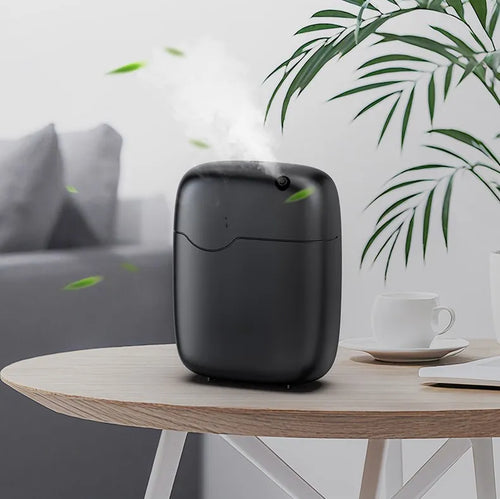
For the hall, after the sum is on paper
SOSA Vaayu ₹11,999
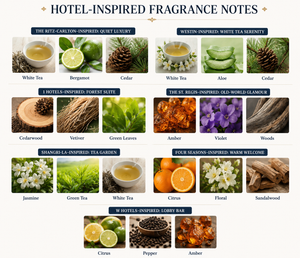
The reeds are not the wrong product, they are in the wrong room. A 1,100 sq ft reception and waiting hall at 3.3 metres is about 337 cubic metres, and 337 cubic metres is a machine's job rather than a bottle's. The Vaayu is rated to 1000 cubic metres, so it covers that hall once, with headroom, on one low setting for the opening hours. Waterless cold-air nebulisation with no standing water tank, a 400ml fill lasting about seventy-five days, app control with 1h/4h/8h/24h timers, under 38 dB, auto-stop, key-lock, and four hotel-inspired scents in the box so the first month's trial costs nothing. Public areas only, clinical rooms fragrance-free.
A note from Sonal
The clinic that taught me to answer this question properly was a polyclinic in Pune with seven reed bottles along the length of its reception counter, which the owner had bought one at a time over about eighteen months as each one failed to solve the problem. He had spent a little over five thousand rupees working his way towards a conclusion the first bottle had already given him, and when I pointed out that his waiting hall was roughly eleven times the volume of the room the format was designed for, he was not annoyed; he was relieved, because he had privately decided the fault was his own. We moved six of the seven bottles to the records room, the accounts desk, the practice manager's office and the staff tea point, where they are still working and where they are exactly the right amount of money, and we left one on the counter because he liked it there.
I have stopped describing reeds as weak, because that word puts the blame in the wrong place and it sends people shopping for a stronger bottle. A reed is not weak. It is passive, and passive means its output is decided by the bottle and the weather rather than by you, which is a completely reasonable thing in a room the size of an office and a completely unreasonable thing in a hall with forty seats in it. The format has a ceiling and no amount of money raises it, and I would rather a clinic heard that from the person selling the bottles than worked it out over eighteen months and seven purchases. It is also the clearest example I know of why spray, reeds or a machine is the right question to ask before any of the three is bought, rather than after two of them have been.
I would rather sell one bottle into the right room and one machine into a hall that has already been walked and found clean than seven bottles into a building that was never going to notice them. Everything is made and supported from Pune, and a part of every order funds girl-child education through Nanhi Kali. You get a space that smells like somewhere looked after; a girl gets a classroom. That equation has always felt right to me.
Frequently asked questions
Why can nobody smell our reed diffusers past the first metre of reception?
Because a reed diffuser is a passive capillary device and its output is set by the surface area of oil in the neck of the bottle, the number of reeds standing in it, the viscosity of the oil and the air temperature. None of those four scales with the size of the room, so the working level sits within roughly a metre of the bottle and everything beyond that is dilution. It is the format's ceiling rather than a fault in your bottle, and buying more bottles does not raise it.
Will adding more reeds or flipping them make a difference in a large waiting hall?
It will make a small, genuine and short-lived difference, and it is worth doing because it is free. Put every reed supplied with the bottle into it, because most clinics have three or four in and the rest in a drawer, then flip the bundle so the saturated length is exposed. Expect a lift for a day or two. It will not carry the bottle to the furthest seat, because exposed reed length is one dial and room volume is not a dial at all.
Where should reed diffusers go in a clinic instead?
The administrative cabin, the records room, the accounts desk, the practice manager's office or a doctor's own non-clinical office. A room of about eleven feet by ten with a 2.9 metre ceiling is roughly thirty cubic metres, which is the volume the format was designed for, and the person sitting in it is inside the working radius all day. Alcohol-free matters in a medical building, and clinical rooms, dressing rooms, sample collection and paediatric clinical areas stay fragrance-free.
How do we work out what the waiting hall actually needs?
Divide the floor area in square feet by 10.76 to get square metres, multiply by the ceiling height in metres, and count only the volumes that a door closes, since every clinical room is fragrance-free with its door shut. An 1,100 square foot reception and waiting hall with a 3.3 metre ceiling comes out at about 337 cubic metres. Write that number on the purchase note and let it decide the machine rather than letting a brochure decide it.
Is a scented candle or a spray a reasonable alternative at the desk?
No, on two separate grounds. An open flame in a healthcare facility is a fire-safety and insurance matter, so candles are simply out of scope and I will not soften that. A spray is a twenty-minute product in a twelve-hour building, so it has gone before the mid-morning queue arrives, and SOSA does not make a room spray in any case. If the hall genuinely needs a steady background, that is a timed machine on a low setting in public areas only, and it is housekeeping rather than any clinical effect.
Move the bottle, then do the sum
Thirty cubic metres is a bottle. Three hundred and thirty-seven is a machine — and the reed was never going to know the difference
Alcohol-free reeds from ₹749, needing 24 to 72 hours to reach their working level, and exactly right for an administrative cabin. The Vaayu is ₹11,999: waterless cold-air nebulisation with no standing water tank, up to 1000 m³ or roughly 2,000–3,000 sq ft, a 400ml tank lasting about seventy-five days, Bluetooth app control with 1h/4h/8h/24h timers, under 38 dB, auto-stop and a key-lock for public areas, supplied with four hotel-inspired fragrances. The Aangan is ₹25,999 for 8,000–10,000 sq ft. Free shipping above ₹499, and a portion of every order supports girl-child education through Nanhi Kali.
See the Vaayu · ₹11,999 Alcohol-free reeds · from ₹749
Continue the read
More from SOSA
Editorial standards & sources
Product facts used in this guide. SOSA Vaayu Rs 11,999: waterless cold-air nebulising diffuser, no water reservoir, coverage up to 1000m3 (approximately 2,000-3,000 sq ft), 400ml refillable tank lasting up to about 75 days per fill, Bluetooth app plus onboard control, 1h/4h/8h/24h timer scheduling, adjustable intensity, under 38 dB, DC 12V/1A at 5W, 165 x 80.5 x 215 mm and 0.9 kg, freestanding or wall or HVAC mounted, auto-stop and key-lock, CE, RoHS and SGS certified, supplied with four hotel-inspired fragrances. SOSA Aangan Rs 25,999: HVAC-connected or standalone commercial nebulising diffuser, coverage up to 3,000m3 (roughly 8,000-10,000 sq ft), 800ml reservoir, metal body, programmable schedules, under 42 dB. Ultrasonic machines are water-based, hold standing water and consume 30-50 ml of water an hour: Sukoon Rs 1,899 (500ml, 270-320 sq ft, 16-18 hours on low, three 15ml Hotel Collection scents included), Boond Rs 899 (300ml), Megh Rs 3,499 (6 litres). Hotel Collection water-based fragrance 15ml Rs 299, 100ml Rs 999, 300ml Rs 1,799. Alcohol-free reed diffusers from Rs 749, requiring 24-72 hours to reach their working level. Free shipping above Rs 499. Coverage arithmetic: cubic metres equal floor area in square feet divided by 10.76 and multiplied by ceiling height in metres, counting only the volumes that are actually scented. This guide makes no medical, therapeutic or clinical claim of any kind for fragrance: a diffuser does not purify, disinfect or clean air, and does not treat, calm or affect any patient or condition. Fragrance is housekeeping and presentation. Clinical areas should be left fragrance-free, and a persistent odour should be traced to its source and corrected rather than covered. SOSA is not affiliated with or endorsed by any hotel brand. Prices subject to change - see the live product pages.

 The range · both endsfrom ₹899Shop →