



Why not yet: the sour note of shoe odour is short-chain fatty acids. A sweet or floral fragrance over it produces a specific, recognisable blend that reads as concealment.
Why yes afterwards: chest height, in the airflow of the opening front door, no cooking oil to clog the reeds, and no switch to remember in a room nobody stands in.
2. Because sweet over sour is the worst possible pairing. Shoe odour is dominated by short-chain fatty acids — isovaleric, butyric, propionic — produced by bacteria metabolising trapped foot sweat. Your nose blends rather than subtracts, and sweet, gourmand or heavily floral accords sit particularly badly against fatty, sour notes. The sweetness gives the sour note contrast and makes it more legible rather than less. This is the exact combination people associate with a badly kept corridor, and it is why a strongly scented entrance often reads as more suspicious than an unscented one.
3. Because it also wastes the product. A reed diffuser is designed to give a clean room a quiet character over six to eight weeks. It is a background layer, deliberately modest in output. Asking it to out-emit six pairs of damp shoes in a small unventilated hall means you burn through the bottle, get a poor result, and conclude the fragrance is weak. It is not weak; it is being asked to do something no fragrance can do.
4. So fix the cabinet — it is a weekend, not a purchase. Empty it. Dry every pair for a full day and night with the insoles out. Wash the insoles and dry them completely. Wash the cabinet interior, bin the felt liners, and leave it open until the board is dry. Drill vent rows near the bottom and top of each door, or commit to leaving one ajar. Then set the rule that nothing goes in on the day it was worn, and rotate pairs on alternate days so each gets a genuine drying cycle. Confirm with the thirty-minute test: leave the flat, come back, judge the first breath honestly, because you cannot smell your own entrance from inside it.
5. And then yes — and it is a genuinely good spot. Once the cabinet is clear, the top of it is close to ideal: roughly chest height so the throw is at nose level rather than ankle level, directly in the airflow of the opening front door, far from any cooking oil that would clog the reeds, and in a room where nobody stands long enough to operate a machine. A reed diffuser from ₹749 is exactly the right tool for that.
Made in India, composed by an ISIPCA Versailles-trained perfumer — and a portion of every order supports girl-child education through Nanhi Kali.
Why sweet over sour is the worst combination in home fragrance
People imagine odour behaves like sound, where a loud signal drowns a quiet one. Olfaction does not work that way. Present two odour sources at once and you perceive a blended character rather than the stronger one replacing the weaker — which is the entire basis of perfumery when the blend is intended, and a problem when it is not. Shoe odour is built on short-chain fatty acids, which are fatty, sour and low. A sweet floral or gourmand fragrance is built on notes that contrast with exactly that. Contrast makes a note more perceptible, not less, so the sweetness effectively points at the sour note. The result is a specific impression most people recognise instantly and read, correctly, as something being covered.
The second problem is a matter of rates rather than character. A shoe cabinet holding damp footwear is a source with continuous output, refreshed every evening when the day's pairs go in. A 50ml reed diffuser is a deliberately modest, steady emitter designed to give a clean room a background over six to eight weeks. Setting those two against each other is not a fair fight and it is not what the product is for. What actually happens is that people add more reeds, then buy a larger bottle, then conclude the fragrance is poor — when the fragrance was never the variable. You are asking a background layer to do the work of a drying rack.
What has to be true before the answer becomes yes
 Once the cabinet is clearFrom ₹849Shoe odour is a bacterial process and moisture is its rate control. A closed shoe worn all day needs roughly a full day and night in moving air before the footbed is dry through, and it dries far faster with the insole pulled out. Empty the cabinet, dry everything, wash the insoles in warm soapy water and dry them completely, and then set two rules: nothing goes in on the day it was worn, and no pair is worn on consecutive days. Two pairs rotated each get a full drying cycle; one pair worn daily never does. This alone removes most of the smell in most flats.
Symptom to cause: is the cabinet ready for a diffuser?
This table answers one question: does your entrance want fragrance, drying, carpentry or a plumber? Getting that wrong is how people spend money and stay annoyed.
| What you notice | Most likely cause | How to confirm it | What actually fixes it |
|---|---|---|---|
| Sour or cheesy note anywhere in the hall ★ | Live shoe odour — bacteria producing short-chain fatty acids in damp footwear | Smell inside individual shoes; then leave for thirty minutes and judge the first breath back | Not ready. Dry, rotate and wash insoles first — fragrance now makes it worse. |
| A wave of smell when the cabinet door opens | Saturated headspace in an unventilated box, displaced by the door swing | Open the door with your face away, count to five, then lean in | Not ready. Vent the doors top and bottom, or leave one ajar |
| Cabinet smells even when empty | Sorption into the board and felt liners — a secondary reservoir | Empty it, air it a day, then smell the bare interior | Not ready. Wash the interior, bin the liners, dry the board wide open |
| First breath on returning reads as neutral | The source is genuinely dealt with | Repeat the thirty-minute test on two different days, one of them humid | Ready. The cabinet top is now one of the best spots in the flat. |
| Fragrance already there smells heavy, sharp or "off" | It is blending with a residual shoe note rather than replacing it | Move the same diffuser to a genuinely clean room and smell it there | Clear the entrance first; choose dry or woody rather than sweet when you return it |
| Earthy or mushroom-like smell, or staining behind the unit | Mould or damp in the wall or board — a health issue, not an odour | Pull the cabinet away from the wall and inspect plaster, skirting and the back panel | Find the moisture source and remove the growth. No fragrance belongs here. |
| If none of these fit: check whether a bathroom opens onto the same hall. A dry P-trap in a rarely used bathroom is a plumbing matter, gets blamed on the shoes constantly, and is never a fragrance problem. | |||
Reeds · always-on roomsFrom ₹749Shop →  Sukoon · when you want a switch₹1,899Shop →
  Hotel Collection · the scentFrom ₹299Shop →
And then, why the spot is good
Height. Most shoe cabinets sit somewhere between eighty centimetres and a metre tall, which puts the neck of a diffuser and the exposed length of the reeds at roughly chest height. That matters more than people expect. Fragrance placed at floor level — on a shoe rack's bottom shelf, on the floor beside the door — has to rise before anyone meets it, and it mixes with the dustiest, least pleasant layer of air in the room on the way. Placed at chest height it reaches a standing person's nose directly, in the first second or two after they cross the threshold, which is precisely the moment an impression is formed.
Airflow, and what is not there. The front door swinging open is the strongest predictable air movement in an entrance, and a diffuser standing in that path gets its throw carried into the room rather than sitting in a dead pocket. Capillary wicking drives reeds, and evaporation rises with both temperature and airflow, so a spot with gentle, regular air movement performs better than a still corner. Just as important is what a cabinet top does not have: no cooking oil aerosol to coat and clog the fibre, which is the fastest way to kill a reed diffuser; no direct sun to overheat the liquid; and no small children or pets at that height. Keep it a hand or two back from the edge so an opening door does not knock it, and stand it on a coaster — oil-based fragrance marks wood and melamine.
What to put there, and how much. Dry, green and woody profiles read as architecture at a threshold, while sweet ones read as air freshener. Mountain Breeze — Himalayan pine, sage and cedar — at ₹849 for 50ml or ₹1,349 for 130ml is the one I would choose for an entrance, with Morning Freshness at ₹749 as the cooler, brighter alternative. Six reeds for a normal hall, three or four in a compact one: the reed count is the volume dial, and it is easier to add a reed later than to un-scent a small entrance. A 50ml runs 6–8 weeks and a 130ml 14–18, and when the throw drops while the bottle is still half full, replace the reeds rather than the liquid — fibre clogs over months. If your entrance opens straight into a large living space and you want the whole volume scented before guests arrive, the Sukoon at ₹1,899 with a water-based Hotel Collection scent from ₹299 covers roughly 270–320 sq ft on a switch. Reed fragrance is oil-based; the two are not interchangeable, and there is no hotel-inspired reed diffuser.
The honest order
I would rather you bought nothing today, spent a weekend on the cabinet, and bought something in a fortnight that actually works where you put it.
| Step | What to do | When | Cost |
|---|---|---|---|
| 1. Remove the source | Empty the cabinet, dry every pair 48 hours with insoles out, wash the insoles, wash and dry the interior | Before anything else | ₹0 |
| 2. Move the air | Bring the entrance into the daily five-to-ten-minute cross-draught rather than leaving it a dead pocket | Daily, five to ten minutes | ₹0 |
| 3. Deal with what holds it | Vent rows top and bottom of each door, felt liners binned, rotation on alternate days, nothing stored damp | Weekly to monthly | ₹0 |
| 4. Then the always-on layer ★ | A SOSA reed diffuser — a permanent background standing on the clean cabinet top — chest height, in the door's airflow, no switch | 50ml 6-8 weeks · 130ml 14-18 | from ₹749 |
| 5. Or the on-demand layer | Sukoon with a Hotel Collection scent — a pre-arrival scent for the whole volume when the entrance opens straight into the living room | Run it when you want it | ₹1,899 |
Versailles
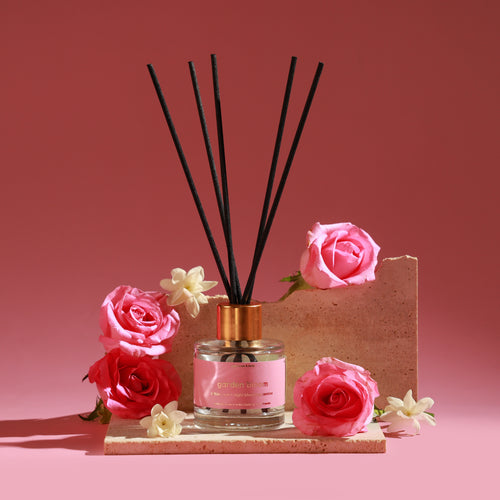
This is the article where I tell you not to buy from me this week, and I would rather do that than have someone stand a bottle of Garden Bloom on a cabinet full of damp trainers and conclude that my fragrance smells strange. It will smell strange. It is being blended, in real time, with isovaleric acid. That is not a fault in the fragrance; it is what happens when you add something to something else.
The part I do want to sell you on is the placement, once the prerequisite is met. I genuinely think a clean shoe cabinet top is among the two or three best fragrance positions in an Indian flat — chest height, in the airflow of the opening door, no cooking oil to clog the reeds, and a room nobody stands in, which is exactly the case for a reed rather than a machine. Nobody switches on a diffuser in a hallway. They walk through it.
So: fix the cabinet, then buy the bottle, and keep it dry and green rather than sweet. And keep it quieter than you think you want. A hall that announces its fragrance reads as a cover-up even when there is nothing left to cover, and the effect you actually want is a guest noticing that your home smells good without being able to point at the reason. A portion of every order funds a girl's classroom through Nanhi Kali.
Frequently asked questions
- Removing shoe odour first — the full drying and rotation routine.
- Why a closed cabinet still smells — concentration, not containment.
- Choosing the right entrance profile — dry and woody over sweet.
- Reed or Sukoon for an entrance? — the full comparison.
- Brand: the SOSA founder story.
SOSA products & prices (verified August 2026): Hotel Collection water-based ultrasonic diffuser fragrance 15ml ₹299 · 100ml ₹999 · 300ml ₹1,799 · Pack of 7 (15ml, all fragrances) ₹1,799; refills 100ml from ₹999. Seven scents: The Ritz-Carlton-inspired (white tea · bergamot · cedar), Westin-inspired (white tea · aloe · cedar), 1 Hotels-inspired (cedarwood · vetiver · green leaves), The St. Regis-inspired (amber · violet · woods), Shangri-La-inspired (jasmine · green tea · white tea), Four Seasons-inspired (citrus · floral · sandalwood), W Hotels-inspired (citrus · pepper · amber). Diffusers: Boond 300ml ₹899 · Sukoon 500ml ₹1,899 · Megh 6L ₹3,499. Water-based, phthalate-free, composed to IFRA standards for home diffusion; 3–6 drops per tank. Made in India, Pune. The Hotel Collection scents are SOSA's own interpretations inspired by the world's finest hotels; all hotel names are trademarks of their respective owners and are used only to describe the scent style — SOSA is an independent Indian fragrance house, not affiliated with or endorsed by any hotel brand. Prices and availability subject to change — see the live product pages.