
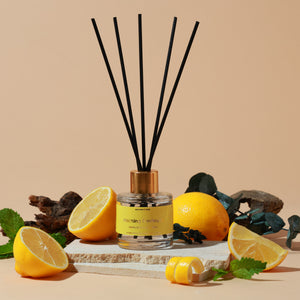
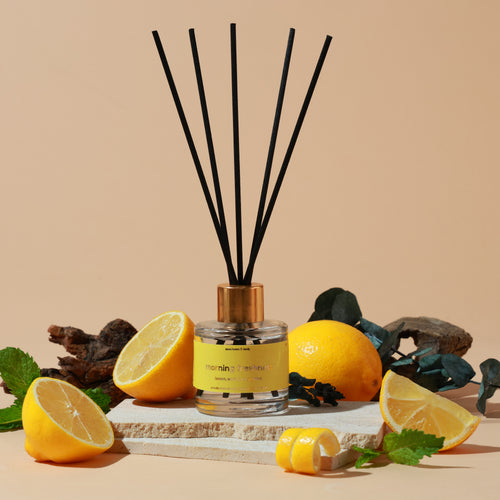
 Morning Freshness ₹749
 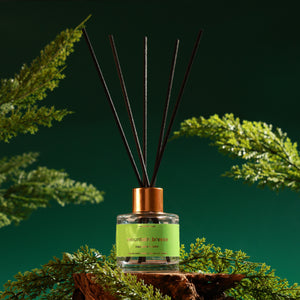 Mountain Breeze ₹849
 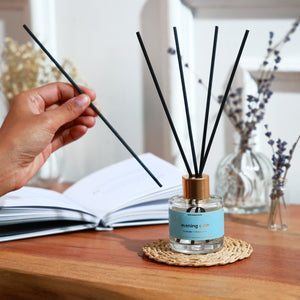 Evening Calm ₹799
  Garden Bloom ₹799
  Oil refill 300ml ₹2,399
Reason one is heat. Sun through glass warms the oil directly, so evaporation speeds up and a 50ml lands nearer six weeks than eight.
Reason two is light on the oil over weeks. Fragrance materials are light-sensitive; a sunlit bottle can darken and read differently by the end of its run.
The fix is free. Track where the beam lands for one day, mark it, and stand the bottle behind that line — on an inner surface, on a tray.
2. Reason one — heat, and it costs you weeks. A beam on the glass warms the oil above the room's temperature, and warmer oil leaves the reed surface faster. A 50ml quoted at 6–8 weeks lands near the bottom of that range.
3. Reason two — light, and it costs you the composition. Fragrance materials are sensitive to prolonged light. An oil standing in a sunbeam for weeks can darken in the glass and read differently by the end of the bottle than the same oil kept in shade. This is slow, it is not dramatic, and it is entirely avoidable.
4. Bright is not the same as direct. You do not need a dim room. A sitting room full of daylight is a perfectly good place for a diffuser as long as no patch of sun actually lands on the bottle.
5. Find the beam once, then forget it. Look at the surface at eleven, at two and at five on a clear day, and note where the light reaches furthest. Stand the bottle behind that line.
6. Fragrance oil is flammable. Away from direct sun also means away from diyas, candles and any open flame — and out of reach of children and pets, on a tray, because the oil marks wood and stone.
7. If a bottle has already spent a summer in the sun, replace the oil rather than the vessel. A 300ml refill at ₹2,399 is roughly ₹7–8 per ml against ₹15–17 for a fresh 50ml, and the glass and reeds you own are still perfectly good.
Everything is composed and handmade in small batches in Pune, tested through 45°C summer heat and 85% monsoon humidity, and a portion of every order supports girl-child education through Nanhi Kali.
Part one — two reasons, not one
Nearly every care line on a fragrance product says to keep it out of direct sunlight, and nearly every reader takes it as a single instruction about heat. It is two instructions wearing one coat, and separating them is the whole value of this page — because they act on different timescales and produce different symptoms.
 Evening Calm₹799 · 50mlThe second reason has nothing to do with temperature. A fragrance composition is a set of materials chosen for how they behave together, and many of them are sensitive to prolonged light. That is why care guidance across fragrance — ours included — says out of direct sun, not merely out of hot places. The effect is gradual: an oil standing in a beam for weeks can darken in the glass, and late in its run it can read differently from the same oil kept shaded. You would not notice it on a Tuesday. You notice it when the bottle you have had since April no longer smells quite like a fresh one.
Part two — heat effect and light effect, separated
Seven things a sunbeam touches, split by which of the two mechanisms is responsible. These are directions of effect, not measurements, and no timescale is claimed for either.
| What the sun is acting on | The heat half of the effect | The light half of the effect | What you would actually notice |
|---|---|---|---|
| Oil left in the glass ★ | Warms above room temperature, so it leaves the reeds faster | Prolonged exposure can shift colour and character | A level dropping early, and a darker bottle by summer's end |
| Bottle life in weeks | Shortened — a 50ml lands near six rather than eight | No direct effect on how long it lasts | Refilling sooner than the range led you to expect |
| The bright top notes | The lightest materials leave first and leave sooner | Sustained light acts on them too | The settled character arrives earlier than usual |
| The six fibre reeds | Wick faster while warm; more oil drawn up per day | Little that you would see | A wet line that sits high, and a bottle emptying under it |
| How loud the room reads | Slightly more vapour, usually lost to open windows | Nothing | Quieter than the falling level suggests |
| The colour of the oil | Not the cause | This is the light half, working slowly | A visible difference against an unexposed bottle |
| The glass, the reeds, the tray | Nothing to worry about | Nothing to worry about | All of them reusable — buy oil, not a new set |
| The honest caveat: I am not going to tell you how many days of sun it takes to change an oil, or by how much, because no honest figure exists for your window, your glass and your season. What I will say is that both mechanisms are real, both are avoidable at no cost, and neither is a defect. Longevity ranges — 6–8 weeks for a 50ml, 14–18 for a 130ml at six reeds — are typical rather than guaranteed and sit at the short end in warm, sunlit rooms. No temperature, humidity or sunshine figure is quoted here for any city; the only test conditions that exist are SOSA's own, 45°C and 85% relative humidity. | |||
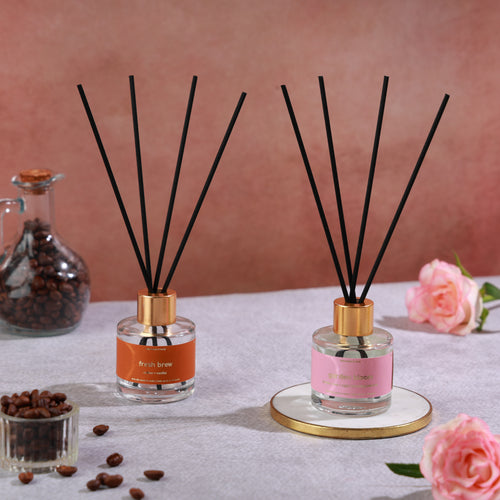
Morning Freshness · bright and dry, for a daylit room₹749Shop → 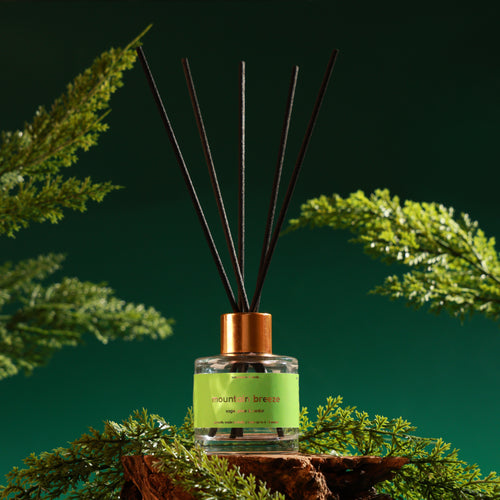 Mountain Breeze · the longer bottle for a warm bright hall₹849Shop →
  Oil refill 300ml · replace the oil, keep the glass₹2,399Shop →
Part three — when the sun is not what went wrong
Having made the case, I should be clear about how much sunlight explains, which is less than people hope once they have a culprit. The commonest rival explanation is your own nose. You stop registering a constant smell in a room you live in — ordinary olfactory adaptation, hardest at home, on a fragrance you chose yourself. Moving the bottle into shade will not change it. I will not give it a timescale or promise a technique that resets it. The free checks are the honest ones: leave the flat and come back in, or ask whoever arrives next what they notice at the door. Keep the curve in mind too. The first three days of a new bottle are the loudest it will ever be — freshly soaked reeds, the lightest top notes going at once — then a settle, then a plateau that holds to the end. The plateau is the product.
The second rival is airflow, and it is worth separating from sunlight because the two often share a location. A bottle on a sill is usually near an openable window; when that window is open, moving air strips vapour off the reeds faster than they release it and carries it outside rather than around the room. That is a distribution problem, not a light problem, and shade will not solve it. The same applies to a bottle in the throw of a vent or a fan. If you move the diffuser out of the sun and the room still reads quiet, look at what is moving the air, and at how much air there is: past roughly 250–300 sq ft of connected open volume, one bottle is doing a job it was not built for, and the answer is a second source rather than a bigger one.
The third case is the one where nothing in the range is the answer. If the reason you are auditing your diffuser is a smell you want gone — a drain, a bin, a damp cupboard, cooking that has settled into the sofa — then sunlight is a distraction. A reed diffuser adds a fragrance that sits alongside whatever is already in your air. It does not remove, neutralise, absorb, mask, purify or filter anything, and SOSA sells no air purifier and no dehumidifier. Find the source, ventilate or extract, then add fragrance, in that order. A room that still smells musty a day after cleaning is telling you something in it is wet, which is a building question rather than a shopping one.
Part four — what to do about your window
Six window situations, the move each one needs, and what it costs. Most of these lines end in nothing.
| Your situation | What I would do | What changes | What it costs |
|---|---|---|---|
| West-facing window, bottle on the sill ★ | Move it to an inner console, a metre back, on a tray | Both mechanisms stop at once — heat and light | ₹0 |
| Bright all day, no beam reaches the shelf | Leave it alone — this is already correct | Nothing. Bright indirect light is not the problem | ₹0 |
| Only surface in the room catches afternoon sun | Slide it along the same surface, behind the light line | The beam passes in front of the bottle rather than on it | ₹0 |
| Sheer curtain, sun still visible on the glass | Treat it as unshaded and move the bottle | A sheer does not block light; a lined curtain does | ₹0 |
| Bottle has spent a summer in the window | Keep the vessel and reeds, buy oil 300ml ₹2,399 | Fresh oil, your own glass, ₹7–8 per ml against ₹15–17 | ₹2,399, and roughly 8–11 months of it |
| Bright warm hall, buying for the first time | Mountain Breeze 130ml on an inner surface, six reeds | 14–18 weeks instead of 6–8, out of the light | ₹1,349 |
Versailles
The line "keep out of direct sunlight" appears on almost every fragrance product ever sold, and I think it is largely ignored because it is never explained. People read it as packaging boilerplate about heat, and heat is only half of it. The half that goes unsaid is the one I care about most, because it is about whether the thing in the glass in week ten is still the thing I composed.
We made choices to survive Indian conditions — a heat-stable coconut-derived CCT carrier rather than the phthalate solvents that push fragrance hard off a reed in week one and then degrade in warmth by about week six. A smaller opening, a longer flatter plateau. It buys resilience against a hot room. It does not buy immunity to a bottle standing in an afternoon beam for two months, and I would rather say that than imply the formulation makes placement irrelevant.
So the ask is small. Spend ten minutes once, find where the light falls, put the bottle behind that line. Everything else about a bright flat is fine — daylight is not an enemy of home fragrance, and a sunny sitting room is a lovely room to scent. Made in small batches in Pune, tested through 45°C heat and 85% humidity, and a part of every order funds a girl's classroom through Nanhi Kali.
Frequently asked questions
- Where to keep it in a hot flat — placement as a heat decision, room by room.
- Does heat make the oil evaporate faster? — the duration effect, and why coastal air pulls the other way.
- Citrus, floral or woody for a hot summer and how many bottles a 700 sq ft 2BHK needs.
- Why can't I smell my reed diffuser? — the diagnostic page when light is not the culprit.
- Brand: the SOSA founder story.
SOSA range, specifications and prices used in this guide (verified from the live store, 27 August 2026): Reed diffusers — alcohol-free, phthalate-free, paraben-free and IFRA-compliant compositions on a heat-stable coconut-derived (CCT) carrier, low-VOC, in a refillable glass bottle with six fibre reeds; flip weekly. 50ml lasts 6–8 weeks and 130ml lasts 14–18 weeks; there is no 100ml reed diffuser size. Morning Freshness (Malabar lemon · peppermint · Nilgiri eucalyptus) 50ml ₹749 · 130ml ₹1,249; Garden Bloom (British rose · night-blooming jasmine) ₹799 · ₹1,299; Evening Calm (Kashmir lavender · chamomile) ₹799 · ₹1,299; Fresh Brew (Coorg coffee · Kerala vanilla) ₹849 · ₹1,349; Mountain Breeze (Himalayan pine · sage · Indian cedar) ₹849 · ₹1,349. Duo sets ₹1,498–₹1,598 for 2 × 50ml and ₹2,498–₹2,598 for 2 × 130ml. Oil-only refills 300ml ₹2,399 · 500ml ₹3,499 — the glass vessel and reeds are not included, and replacement reeds are not sold as a separate product. Machines: Boond 300ml ₹899 (~150 sq ft, about 6 hours a fill) · Sukoon 500ml ₹1,899 (270–320 sq ft, 16–18 hours on low, three 15ml fragrances included) · Megh 6L ₹3,499 (~215 sq ft — a runtime and humidity machine that covers less than a Sukoon, never a coverage upgrade) · waterless Vaayu ₹11,999 · Safar ₹3,999 (a car and travel product) · Aangan ₹25,999 · Meenar ₹38,500. The water-based Hotel Collection for ultrasonic machines (15ml ₹299 · 100ml ₹999 · 300ml ₹1,799 · pack of seven 15ml ₹1,799) cannot be used in a reed bottle or a Vaayu. Below ₹749: jar candles ₹379, Sandalwood or Smoked Oudh candle ₹449, wax melts ₹474 (a burner is required and not included), mugs ₹474, bubble and taper candles ₹569, Amber Rose candle ₹599, ceramic trinket dish and candle two-pack ₹664. A reed diffuser adds fragrance to a room. It does not clean, purify or filter air, remove or neutralise cooking, damp or smoke smells, reduce humidity, or change how anyone feels. A reed diffuser adds no moisture to the air; ultrasonic machines work by aerosolising water and therefore do. A persistent musty smell indicates moisture that needs finding and drying, and SOSA sells no dehumidifier or air purifier. Ventilate or extract first; add fragrance second. Evaporation rate rises with warmth and falls with humidity, and airflow carries scent away from the bottle — so performance varies with season, ventilation, ceiling height and room use; longevity figures are typical ranges, not guarantees. Not noticing a constant fragrance is ordinary olfactory adaptation; the reliable checks are leaving the room and returning, or asking someone who has just arrived. Strength figures are positions on SOSA’s own internal scale, not an industry standard. Fragrance oil is flammable — keep bottles away from open flame and out of direct sunlight, and out of reach of children and pets. Composed and handmade in small batches in Pune, India; tested through 45°C summer heat and 85% monsoon humidity. Free shipping above ₹499. A portion of every order supports girl-child education through Nanhi Kali. Prices subject to change — see the live product pages.