
What that room needs instead: an opening of its own — even a small window ajar on the sheltered side — and a fan aimed along the rack rather than at the ceiling. The door stays shut against the rest of the flat only if the room has its own way out for the air. If it has no window at all, the door has to stay open and the fan has to push air through it, and honestly, a room with no opening is the wrong room to dry in.
Where the fragrance goes: the living room and the bedroom you sleep in. Morning Freshness ₹749 for 50ml, three reeds to start.
The honest gap: nothing SOSA makes removes moisture from air — no dehumidifier, no purifier, no odour eliminator — and there is no clean-linen or fresh-laundry accord in the reed range. If either is what you were hoping for, this page is not going to end with it.
2. That room needs an opening and a fan, in that order of importance. Air has to be able to leave. A window ajar on the sheltered side, a ventilator open, an exhaust fan if the room has one. Then a fan — ceiling on low, or a table fan set to travel along the line of clothes rather than at them — because moving air across wet fabric is what actually dries it.
3. Keep the door shut, but only if the room can breathe on its own. A shut door on a room with its own opening is excellent: the water leaves outward instead of drifting down the corridor. A shut door on a sealed internal room is the worst configuration in this article. If the spare room has no window at all, leave the door open, run the fan so it pushes air out through the doorway, and consider drying somewhere that does have an opening.
4. Space the clothes and dry in two batches. Garments touching each other dry at the pace of the wettest one in the middle. This costs nothing and it shortens the window during which the room can smell of anything.
5. Put the fragrance in the rooms you actually occupy. Morning Freshness at ₹749 in the living room; Evening Calm at ₹799 with three reeds beside the bed if you want the bedroom handled too. That is where you are, and fragrance running into a room nobody is in is the single largest waste in home scenting.
Alcohol-free, phthalate-free, IFRA-compliant, composed in Pune. A portion of every order supports girl-child education through Nanhi Kali.
Why a closed room with wet fabric is the worst case in the whole subject
People choose the spare bedroom for exactly the right social reason and exactly the wrong physical one. Socially it is perfect: the clothes are out of sight, the door shuts, guests never see a rack. Physically it is the least suitable room in the flat, because everything that makes a room good for hiding laundry makes it bad for drying laundry. Below are the three things that stack, and they compound rather than add.
 Evening Calm₹799No internal door seals. Under it, around it, and every time somebody goes in for a towel, the drying room's air joins the flat's air — which is why the corridor and the bedroom next door start reading damp even though the clothes are nowhere near them. This is the point at which most people go looking for a fragrance, and it is the point at which the useful move is a door discipline instead: shut it, open the room's own window, and run the fan while you are out. Once the migration stops, the rooms you sleep and sit in become ordinary rooms again, and ordinary rooms are where a diffuser does good work. Evening Calm at 8.9 is the softest thing we make and the one I would put beside a bed at three reeds.
Getting air to move through that room specifically
Ventilating a drying room in monsoon is not the same problem as ventilating one in March, and pretending otherwise is where most advice falls apart. The outside air during heavy rain is already carrying a great deal of water, so opening a window is doing less moisture removal than it would in a dry month. It is still worth doing — exchanging air still carries the odour outward and still prevents the room from reaching the near-saturated state that stalls drying — but the lever with real travel in it is air movement across the fabric, not air exchange with the outdoors.
So: a fan, aimed along the rack rather than at it, so that it runs down the line of garments and continuously replaces the saturated layer of air sitting against each one. On low is fine and often better, because you want sustained movement rather than a gale for twenty minutes. Run it while the flat is empty, which is one of the very few things in this cluster that genuinely benefits from an unoccupied room. If the spare bedroom has an attached bathroom with an exhaust fan, dry the load in there with the exhaust running and the bathroom door shut: a small room with mechanical extraction beats a larger room without it, and the smaller volume is not the disadvantage it sounds like when the air is actually leaving.
A word on the door, because the advice sounds contradictory and is not. Shut the door if the room has its own opening, so the water leaves outward. Leave it open if the room is internal and sealed, so the water at least disperses instead of concentrating, and put the fan in the doorway pushing air out of the room. And if you have the choice at all, dry where there is an opening. A covered balcony with the flat's balcony door shut is better than any internal room, because it is functionally outdoor drying with the rain kept off.
| Room | What is happening in it | Fragrance here? | What to do |
|---|---|---|---|
| Spare bedroom (drying) | Several litres of water leaving fabric into a low-exchange volume; the slow drying is what produces the note | No — empty room, wettest air, and a mixture rather than a fix | Window ajar, fan along the rack, door shut, clothes spaced |
| Corridor outside it | Receiving the leak under and around the door every time it opens | Not usually — it is a passage, not a place you sit | Door discipline. Fix the leak rather than scenting the passage |
| Living room | Where you actually are for hours at a stretch, and the room guests read first | Yes — this is the purchase | Morning Freshness ₹749, or ₹1,249 for 130ml above 150 sq ft |
| Your bedroom | Closed for long stretches, occupied at predictable hours, and the room where damp migration is most noticed | Yes, at a low dose | Evening Calm ₹799 at three reeds — 8.9, the softest in the range |
| Bathroom | Small, humid, and used briefly but constantly | Yes, and it is the most efficient placement in the house | Two or three reeds in a 50 sq ft bathroom can make a 50ml run close to three months |
Living room · Morning Freshness₹749Shop → 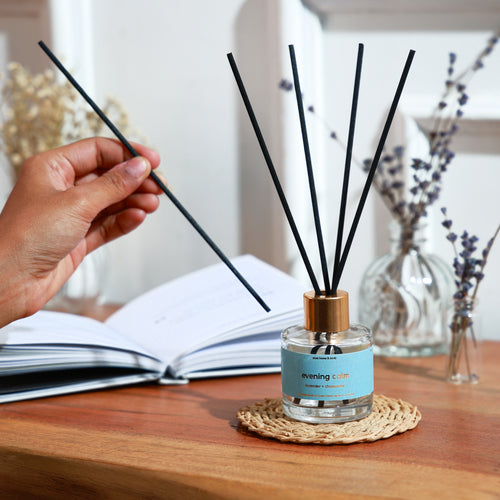 Bedroom · Evening Calm₹799Shop →
  Both · Day & Night duo₹1,498Shop →
The empty-room problem, and the dose question behind it
A reed diffuser has no reservoir it holds back. Every millilitre eventually leaves the bottle through the reeds and into the room, which is why nothing is truly wasted in the sense of being thrown away — but it is also why where the bottle stands decides whether that oil did anything for you. In a drying room, the answer is no. In a corridor you pass through four times a day, mostly no. In the living room where you sit from eight until eleven every evening, yes, and the same ₹749 has bought a completely different amount of value. This is a placement question rather than a product question, and it is the one most worth getting right before you spend anything.
Then dose, because in a humid month it behaves differently. Six reeds is full projection and three is a soft background level that roughly doubles the bottle's life. In monsoon I would start every reader at three, for a physical reason rather than a thrifty one: saturated air carries fragrance molecules less readily, so the scent hangs closer to the bottle and to you, and the same dose that reads as pleasant in a dry February can read as thick in August. When somebody says a fragrance is cloying, they are usually describing a concentration rather than a composition. Pull two reeds out, wait a day, and judge again. It costs nothing.
And one expectation worth resetting, because it drives a lot of unnecessary second purchases. You are not supposed to smell your own diffuser continuously. Olfactory receptors adapt to an unchanging stimulus within minutes, so a home fragrance is designed to register on arrival and at transitions — walking in from the corridor, coming out of the shower, sitting down after dinner. If you can smell it constantly in your own living room, the dose has overshot the volume. If you cannot smell it at all but a visitor remarks on it, it is working exactly as intended and you are simply adapted to your own home. In monsoon this gets confused with the damp: the flat reads damp when you walk in because you are un-adapted for about ninety seconds, and that is real information about the drying, not evidence that the diffuser has failed.
What to buy for the rest of the flat — and what I would not buy
Nothing on this list is for the drying room. If you are only prepared to change one thing this week, change the airflow in there and buy nothing at all; that is the change with the most effect per rupee, and it costs no rupees. If the drying is under control and the flat still feels grey and closed in the evening, this is the order I would spend in. The last row is the honest gap and it is worth reading before you buy, not after.
| Buy | What it is | Where it goes and why | Price |
|---|---|---|---|
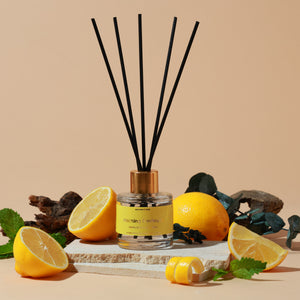
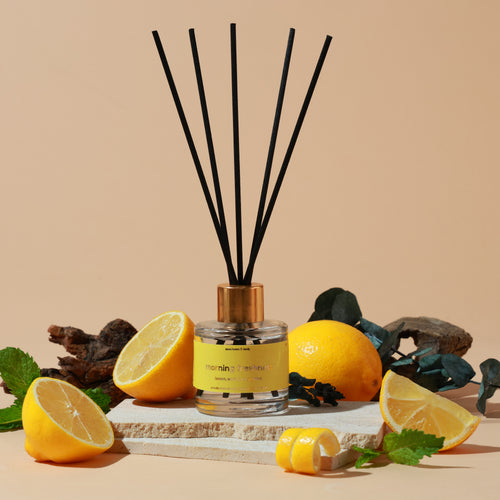
| 1. Morning Freshness 50ml ★ | Malabar lemon, peppermint, eucalyptus globulus — bright, 9.0 | The living room. Bright citrus contrasts with heavy air rather than adding to it. Three reeds to start | ₹749 |
| 2. Evening Calm 50ml | Kashmir lavender, chamomile, soft musk drydown — 8.9, the softest we make | Beside the bed, at three reeds. The bedroom is the room damp migration is noticed in, and it wants quiet rather than bright | ₹799 |
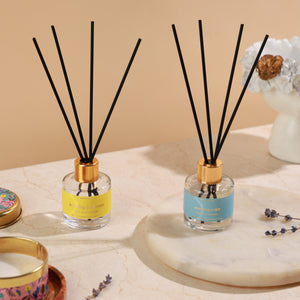
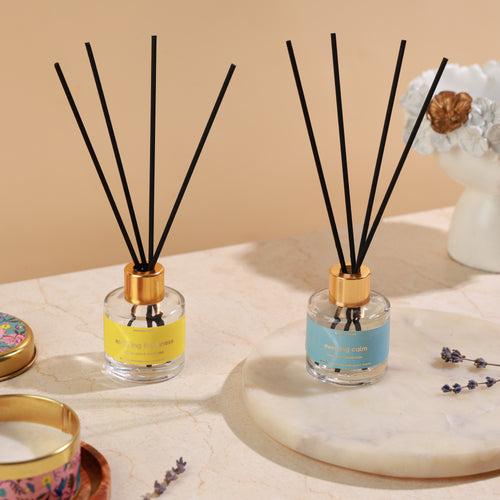
| 3. Day & Night duo | Both of the above, two 50ml bottles | If you are solving the living room and the bedroom in one go. Not a boxed set and not a discount structure — simply two bottles | ₹1,498 |
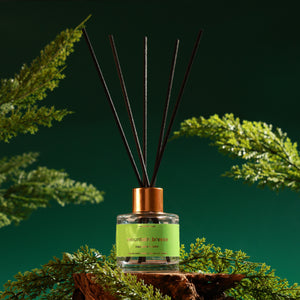
| 4. Mountain Breeze 50ml | Himalayan pine, sage, Indian cedar — dry and resinous, 9.4 | If citrus reads as too sharp, or for a study. It makes a room feel dry rather than bright, which some people prefer in rain | ₹849 |
| Not this: anything in the drying room, and no candle near a rack | A bottle in there scents nobody and mixes with the note you are trying to lose. And a lit candle beside drying fabric is not advice we give at all — fragrance oil is flammable and hanging clothes move in a draught | Said plainly rather than left for you to discover | — |
| The honest gap: no moisture product, no clean-linen scent | SOSA sells no dehumidifier, air purifier or odour eliminator, and the reed line has no fresh-laundry, cotton or aquatic accord | If line-dried cotton is the smell in your head, none of our five is it. The nearest honest answers are Morning Freshness for brightness and Evening Calm for soft clean skin | ₹749 / ₹799 |
Versailles
The spare-room question arrives every year and it always has the same shape: the clothes are hidden, the door is shut, and the whole floor smells faintly of laundry anyway. The instinct is to put something fragrant in the room where the smell is loudest. That instinct is exactly backwards, and I would rather say so than take the order.
Two things are going on. The room is the source, so anything you add there is a second layer on a live problem rather than a replacement for it. And the room is empty, so the fragrance is being released at nobody — which is the thing I find hardest to watch, because the bottle is doing precisely what it was built to do and none of it is reaching a person. Move the same bottle fifteen feet into the living room and it is suddenly a good purchase.
What I would genuinely do in your flat: open something in that room, put a fan along the rack, shut the door, and check the clothes at the halfway mark rather than the end. Then Morning Freshness in the living room at three reeds, because bright citrus is the register that reads as dry air when the weather will not. Everything is composed in Pune, and a part of every order funds a girl's classroom through Nanhi Kali.
Frequently asked questions
- Drying indoors in a Mumbai monsoon — the full sequence, stated honestly.
- Why the house smells damp — the mechanism on its own, with nothing to buy.
- What to fix before adding fragrance — the bedroom version of this page.
- Fresh without becoming too perfumed and the 1BHK with no choice.
- The best fresh fragrance for a Mumbai flat and citrus, green or floral when it feels damp.
- Reed diffuser vs Sukoon in monsoon — why an ultrasonic machine is the harder argument in a damp flat.
- A small flat through weeks of continuous rain — the whole system in one place.
- Brand: the SOSA founder story.
SOSA reed diffusers — facts verified August 2026: Five scents, all alcohol-free, on a heat-stable CCT (caprylic/capric triglyceride) base rather than DPG, phthalate-free, paraben-free, IFRA-compliant, 0 ppm formaldehyde, six fibre reeds in a refillable glass bottle, composed and made in Pune, India. Morning Freshness (Malabar lemon · peppermint · eucalyptus globulus) 50ml ₹749 · 130ml ₹1,249 · 9.0 on the SOSA strength scale; the eucalyptus globulus base slows lemon evaporation three to four times, giving 6–8 weeks rather than the usual 10–14 day citrus fade. Evening Calm (Kashmir lavender · chamomile · soft musk) 50ml ₹799 · 130ml ₹1,299 · 8.9, the softest in the range. Garden Bloom 50ml ₹799 · 130ml ₹1,299 · 8.9. Mountain Breeze (Himalayan pine · sage · Indian cedar) 50ml ₹849 · 130ml ₹1,349 · 9.4. Fresh Brew 50ml ₹849 · 130ml ₹1,349 · 9.5. 50ml suits rooms up to about 150 sq ft and runs 6–8 weeks; 130ml suits above that and runs 14–18 weeks; two or three reeds in a 50 sq ft bathroom can make a 50ml last close to three months. Six reeds is full projection, three is a soft level and roughly doubles bottle life. Duos: Day & Night ₹1,498, Fresh & Grounded ₹1,548, Warmth & Bloom ₹1,598. Refills 300ml ₹2,399 · 500ml ₹3,499, oil only and not a first purchase. Machines: Boond ₹899 (300ml, up to about 150 sq ft), Sukoon ₹1,899 (500ml, 270–320 sq ft, 16–18 hours on low), Megh ₹3,499 (six litres and around 100 hours of runtime but only about 215 sq ft of coverage, which is less than the Sukoon — a runtime machine, never a coverage upgrade). Reed oil and the water-based Hotel Collection are separate physical systems and are not interchangeable in either direction; there is no hotel-inspired reed diffuser. The reed line contains no oud, sandalwood, vetiver, amber, aquatic or clean-linen accord. Climate-tested through 45°C heat and 85% RH monsoon humidity. Free shipping above ₹499. SOSA is an independent Indian fragrance house and is not affiliated with or endorsed by any hotel brand. Prices subject to change — see the live product pages.