


Move the bottle off the through-line. A diffuser standing in the current between two openings scents nothing and empties weeks early — you lose in both directions at once.
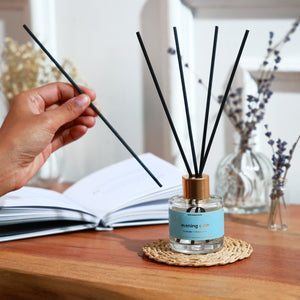
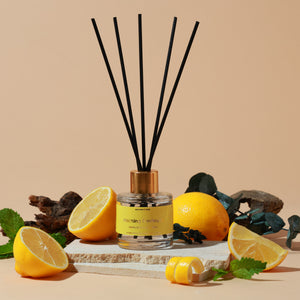
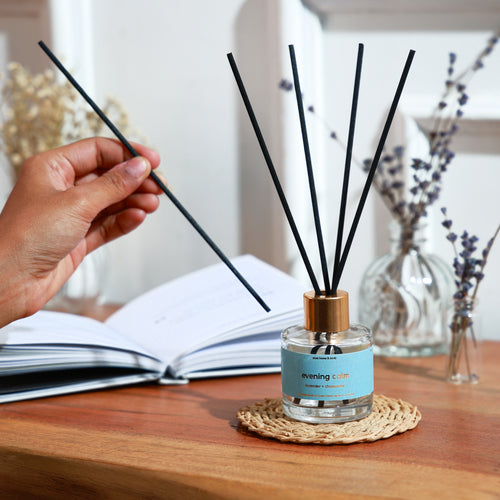
Buy for the room with a door. A bedroom you can shut is where a passive diffuser genuinely works: Evening Calm 50ml ₹799 or Morning Freshness ₹749.
Do not buy a bigger bottle, more reeds or a stronger scent for this. A 130ml lasts longer and reaches no further, and a machine's mist leaves an open window exactly as vapour does — a Sukoon at ₹1,899 is worth buying for timed control, never as an answer to a draught.
- The straight answer
- Part one — what cross-ventilation is doing to your bottle
- Part two — map your flat's through-line
- Part three — every source of moving air, ranked
- Part four — the four purchases not to make
- Part five — the still hours, and what to expect from them
- Part six — your ventilated flat, by plan
- A note from Sonal
- FAQs
2. Nothing is wrong with the bottle, the oil or the composition. The same bottle in a closed bedroom will read clearly within an hour. This is the most reliable proof available and it costs nothing to run.
3. Move the bottle out of the through-line first. Follow the current from one opening to the other; the bottle must not be anywhere along it. Put it in a still pocket to the side — an alcove, the lee of a partition, an inner-wall console — at waist-to-chest height, on a tray.
4. Then move the money. Buy for the room whose door shuts. Evening Calm 50ml ₹799 in the bedroom beats any amount spent on the living room in a flat like yours.
5. Reset the expectation — half the complaint is a timing mismatch. A cross-ventilated flat reads in its still hours: early morning before you open up, late evening once everything is closed, and days when the weather keeps the windows shut.
6. Do not buy a bigger bottle for this. At six reeds a 130ml projects identically to a 50ml; size is the duration control, reed count the volume control, and reach comes from exposed reed surface rather than reservoir size. You would be buying more weeks of the same quiet.
7. Do not add reeds either. They cannot overcome an exchange of air, they cost bottle life roughly in proportion — nine reeds runs a 50ml down in about five weeks rather than eight — and the evenings when you close everything up become too much.
8. Buy a machine only for control. A Sukoon at ₹1,899 covers 270–320 sq ft, runs 16–18 hours on low and has timers, so you can scent a closed room at a chosen hour. Its mist leaves an open window as readily as vapour does, and it adds moisture, because it aerosolises water, where a reed diffuser adds none.
Composed and handmade in small batches in Pune, tested through 45°C summer heat and 85% monsoon humidity, and a portion of every order supports girl-child education through Nanhi Kali.
Part one — what cross-ventilation is doing to your bottle
Cross-ventilation is a genuine architectural virtue, and flats that have it are usually the pleasanter ones to live in. It is also, for this one product, the most underestimated force in the building. Almost every "my diffuser stopped working" question is a room problem wearing a product's clothes, and this is the biggest room problem of them all. Three things happen at once.
 Morning Freshness₹749 · 50mlMoving air across a wet reed carries vapour away, and a surface constantly being cleared evaporates faster than one in still air. So a bottle in the through-line is not merely failing to scent the room — it is spending itself faster while it fails. This is the detail that convinces people, because it is visible: if the oil level is dropping noticeably ahead of the 6–8 weeks a 50ml should give and the room still reads quiet, you have found your cause. Two symptoms, one mechanism — and moving the bottle two feet sideways out of the current addresses both, for nothing.
Part two — map your flat's through-line
Every cross-ventilated flat has one or two dominant paths, and they shift through the day as different openings are used. Walk yours with this table; the bottle goes anywhere except along the line you find.
| The pair of openings | When it is running | Where the current goes | Where the bottle goes instead |
|---|---|---|---|
| Balcony door and the opposite bedroom or kitchen window ★ | Most of the day in mild weather; the dominant path in most flats | Straight across the living room, through the middle | An alcove or inner-wall console well to one side of that line |
| Main door and a rear or kitchen window | Every time the front door opens, and all day if you leave it ajar | Through the entry and down any passage towards the back | Never near the entry. Deep inside a room off the passage |
| Two windows on opposite walls of one room | Whenever both are open — the classic cross-ventilated bedroom | Wall to wall, low across the room | On the third wall, out of the line, at waist-to-chest height |
| Balcony door and the bathroom exhaust | Whenever the exhaust is switched on | From the balcony through the flat and out through the duct | Away from both. The exhaust is a small, tireless opening |
| Kitchen chimney and any open window | While you are cooking, and for as long as it runs afterwards | Towards the hob and up the duct | The far end of the room from the hob, always |
| A stairwell or lift-lobby door on a landing | Intermittently, but strongly — pressure differences in the core | Under the front door and through the flat | Not in the hall. A bottle by the door is scenting the landing |
| The honest caveat: this is a way of walking your own flat, not a measurement — currents depend on which openings are in use, on the weather and on how your building sits, and any of these paths can dominate on a given day. Moving the bottle off the through-line improves distribution and slows consumption; it does not make a ventilated room behave like a closed one, and no placement will. A reed diffuser adds a fragrance alongside what is already in your air; it cleans, purifies and removes nothing. | |||
Evening Calm · for the bedroom, which is the room that works₹799Shop → 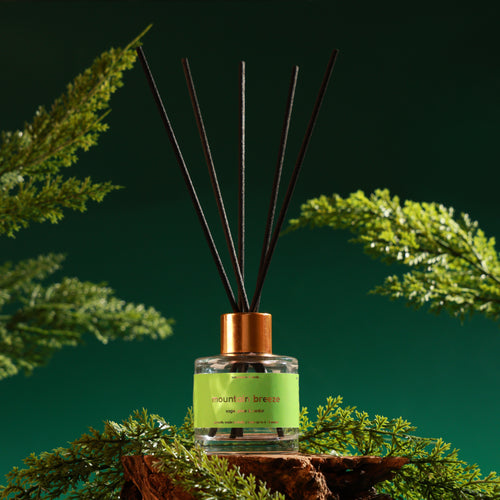 Mountain Breeze · dry and green for a still corner₹849Shop →
  Sukoon · buy it for the timer, not for the draught₹1,899Shop →
Part three — every source of moving air, ranked
Cross-ventilation is the largest of these but rarely the only one. Each row is a separate mechanism, each does something different to the bottle, and the fixes are not interchangeable.
| Source of moving air | What it does to the room | What it does to the bottle | The fix |
|---|---|---|---|
| A through-line between two opposite openings ★ | Replaces the air continuously; nothing accumulates | Strips the reed surface — early empty as well as a quiet room | Move off the line; scent a room with a door instead |
| An open balcony door on its own | A large, permanent opening — an unbounded room | Fast consumption if the bottle is anywhere near it | Move deep inside; judge the room with it shut |
| Ceiling fan | Mixes the room evenly, which helps distribution | Faster evaporation, especially in the downdraught | Keep the bottle out from directly under it |
| Bathroom exhaust or kitchen chimney | A small opening that never stops pulling while it runs | Quietly drains a nearby bottle into a duct | Distance. Never on the same run of counter or wall |
| Air conditioning | Seals the room, which helps — but makes a directed draught | Cold dry air over the reeds raises consumption | Out of the blow line; the sealed room is a genuine gain |
| Front door onto a stairwell or lobby | Intermittent but strong exchanges with the core | Little, unless the bottle lives in the hall | Do not keep the main bottle by the entrance |
| The honest caveat: these are directions of effect, not measured rates — moving air carries fragrance away and raises evaporation from the reed surface, warmth raises it further, high humidity slows it. How much depends on your flat, the season and how the openings are used, and no figure is claimed. The 6–8 and 14–18 week ranges assume six reeds. Nothing here implies a reed diffuser affects air quality, humidity or how anyone feels. | |||
Part four — the four purchases not to make
This part of the page costs SOSA money, and it is the part I would most like you to read. Every one of these is a reasonable response, and every one pushes on the wrong side of the equation. The first is a larger bottle. A 130ml at ₹1,249–₹1,349 lasts 14–18 weeks instead of 6–8, but at six reeds it projects exactly as a 50ml does — reach comes from exposed reed surface, not the reservoir beneath it. You would be buying four months of the same quiet instead of two.
The second is extra reeds. Reed count is a genuine volume control, but it cannot outrun an exchange of air, and it costs bottle life roughly in proportion: nine reeds runs a 50ml down in about five weeks rather than eight. Worse, it sets a trap for the evenings when you close everything up, because that same room with the windows shut is then far more than you wanted. Six is our calibration, and in a flat like yours it is already right.
The third is a stronger composition. Fresh Brew sits at 9.5 and Evening Calm at 8.9 on SOSA's own internal scale at six reeds — our scale, not an industry standard and not a quality ranking. That difference changes the character of what is in the room; it does not change the physics of a room exchanging its air. A fuller scent in a through-draught is a fuller scent leaving through the window.
The fourth is a machine, and this one needs care, because a machine is sometimes the right purchase — for a different reason from the one people have in mind. An ultrasonic diffuser has a fan and a switch, so it fills a room quickly; but mist leaves an open window exactly as vapour does, and a machine running in a cross-ventilated living room is a fast way to scent your balcony. Where a Sukoon at ₹1,899 earns its price is control: 270–320 sq ft, 16–18 hours on low, remote and steady, 2H and 4H timers, so you can scent a closed room at a chosen hour. It works by aerosolising water, so it adds moisture where a reed diffuser adds none, and it takes only the water-based Hotel Collection — reed oil never goes into a machine, machine fragrance never into a reed bottle. And the Megh at ₹3,499, reached for because it is the largest, covers about 215 sq ft — less than a Sukoon, a runtime and humidity machine rather than a coverage upgrade.
Part five — the still hours, and what to expect from them
Half of this complaint is not about airflow at all; it is about when the flat is being judged. A cross-ventilated home is not uniformly ventilated across the day, and the hours when it is closed are the hours in which a reed diffuser does exactly what it was built to do. Those hours are predictable: before you open up in the morning, once everything is shut for the night, on days when heat or rain keeps the windows closed. Walk into the living room at seven, before the balcony door goes back, and you will find out what your bottle has been doing all night. That is the true reading, and you will never get it at four in the afternoon with a breeze coming through.
The corollary saves money: the room you close is the room to spend on. In a ventilated flat the bedroom is not a consolation prize but the only volume that behaves properly, and ₹799 there does more for how your home reads than ₹1,349 in the living room. If that door also stays shut through the day, run three or four reeds rather than six — a closed room accumulates what a ventilated one loses. Two rooms, two settings, one product.
Set the curve straight too. A new bottle is loudest in its first three days — freshly soaked reeds, the lightest top notes leaving at once — then settles to a plateau that holds until the oil is gone. The plateau is the product; the spike was never the baseline. In a ventilated flat the spike may be the only stretch you consciously notice, which is why so many people here describe a bottle as having "stopped working" at the point it started working properly.
Part six — your ventilated flat, by plan
Six versions of this flat, what to do in each, and what it costs. Two of the six end in spending nothing.
| Your flat and how you live in it | What to do | What I would buy | Cost |
|---|---|---|---|
| Openings on opposite sides, open most of the day ★ | Scent the bedroom instead, and judge the flat at night | Evening Calm 50ml, six reeds | ₹799 |
| Bottle sits in the line between two openings | Move it sideways into a still pocket and wait a fortnight | Nothing yet | ₹0 · and often the whole fix |
| Open by day, shut from evening onwards | Keep six reeds; judge the room after nine, not at four | Mountain Breeze 50ml in a still corner | ₹849 |
| Bedroom door shut all day as well as at night | Run three or four reeds there, not six | Morning Freshness 50ml | ₹749 · and it will outlast 6–8 weeks |
| You want the living room scented at a chosen hour | A control problem, not a strength problem | Sukoon on a timer, water-based fragrance only | ₹1,899 · it adds moisture; reeds add none |
| You were about to buy a 130ml or a third bottle | Do not. Size buys weeks; a third source buys nothing in moving air | Nothing | ₹0 · genuinely |
Versailles
The flat I liked best of all the ones I have lived in had windows on three sides and a balcony door that I never closed. It was cool through most of the year without a fan, and I could not get a reed diffuser to read in the main room for love or money. I was the person making them, and I still spent two months quietly suspecting my own oil.
What eventually settled it was moving a bottle from the living room to the bedroom for a week. The same bottle, the same six reeds, the same age. It read clearly within the first evening. There was nothing wrong with the composition or the carrier or the reeds; there was a great deal of moving air between my sofa and the sky, and a passive diffuser has no answer to that. I stopped trying, moved my main bottle permanently behind a door, kept a small one in the alcove by the entry where the air genuinely sits still, and started judging the flat at seven in the morning before I opened anything.
I think about that flat every time somebody asks whether to upgrade to the bigger bottle. It would have kept me quietly disappointed for four months instead of two, and I would have thanked whoever recommended it. Position and expectation are free; everything else in the shop is beside the point for this particular problem. If your flat has real cross-ventilation you have something most people would trade for, and one room in it that will hold a fragrance beautifully. Spend ₹749 or ₹799 there, take the reeds down to three or four if that door stays shut, and let the ventilated half smell of the outdoors, which it is going to do regardless. Made in small batches in Pune, and a part of every order funds a girl's classroom through Nanhi Kali.
Frequently asked questions
- It works with the windows closed and disappears when the balcony is open — the short version of this diagnosis, in one Bengaluru living room.
- A bedroom door that stays shut — the opposite room, and how many reeds to run in it.
- Why a long passage carries nothing and whether one 130ml covers a combined living-dining.
- High ceilings in a small flat — the other measurement nobody takes before buying.
- Brand: the SOSA founder story.
SOSA range, specifications and prices used in this guide (verified from the live store, 27 August 2026): Reed diffusers — alcohol-free, phthalate-free, paraben-free and IFRA-compliant compositions on a heat-stable coconut-derived (CCT) carrier, low-VOC, in a refillable glass bottle with six fibre reeds; flip weekly. 50ml lasts 6–8 weeks and 130ml lasts 14–18 weeks; there is no 100ml reed diffuser size. Morning Freshness (Malabar lemon · peppermint · Nilgiri eucalyptus) 50ml ₹749 · 130ml ₹1,249; Garden Bloom (British rose · night-blooming jasmine) ₹799 · ₹1,299; Evening Calm (Kashmir lavender · chamomile) ₹799 · ₹1,299; Fresh Brew (Coorg coffee · Kerala vanilla) ₹849 · ₹1,349; Mountain Breeze (Himalayan pine · sage · Indian cedar) ₹849 · ₹1,349. Duo sets ₹1,498–₹1,598 for 2 × 50ml and ₹2,498–₹2,598 for 2 × 130ml. Oil-only refills 300ml ₹2,399 · 500ml ₹3,499 — the glass vessel and reeds are not included, and replacement reeds are not sold as a separate product. Machines: Boond 300ml ₹899 (~150 sq ft, about 6 hours a fill) · Sukoon 500ml ₹1,899 (270–320 sq ft, 16–18 hours on low, three 15ml fragrances included) · Megh 6L ₹3,499 (~215 sq ft — a runtime and humidity machine that covers less than a Sukoon, never a coverage upgrade) · waterless Vaayu ₹11,999 · Safar ₹3,999 (a car and travel product) · Aangan ₹25,999 · Meenar ₹38,500. The water-based Hotel Collection for ultrasonic machines (15ml ₹299 · 100ml ₹999 · 300ml ₹1,799 · pack of seven 15ml ₹1,799) cannot be used in a reed bottle or a Vaayu. Below ₹749: jar candles ₹379, Sandalwood or Smoked Oudh candle ₹449, wax melts ₹474 (a burner is required and not included), mugs ₹474, bubble and taper candles ₹569, Amber Rose candle ₹599, ceramic trinket dish and candle two-pack ₹664. A reed diffuser adds fragrance to a room. It does not clean, purify or filter air, remove or neutralise cooking, damp or smoke smells, reduce humidity, or change how anyone feels. A reed diffuser adds no moisture to the air; ultrasonic machines work by aerosolising water and therefore do. A persistent musty smell indicates moisture that needs finding and drying, and SOSA sells no dehumidifier or air purifier. Ventilate or extract first; add fragrance second. Evaporation rate rises with warmth and falls with humidity, and airflow carries scent away from the bottle — so performance varies with season, ventilation, ceiling height and room use; longevity figures are typical ranges, not guarantees. Not noticing a constant fragrance is ordinary olfactory adaptation; the reliable checks are leaving the room and returning, or asking someone who has just arrived. Strength figures are positions on SOSA’s own internal scale, not an industry standard. Fragrance oil is flammable — keep bottles away from open flame and out of direct sunlight, and out of reach of children and pets. Composed and handmade in small batches in Pune, India; tested through 45°C summer heat and 85% monsoon humidity. Free shipping above ₹499. A portion of every order supports girl-child education through Nanhi Kali. Prices subject to change — see the live product pages.