


Mechanism two — a closed envelope: door shut, windows shut, almost nothing exchanging with outside. Nothing is being carried out of the room, so what the reeds release stays in it.
Mechanism three — an un-adapted nose: you arrive from a corridor, a living room or outside. Your receptors have not been adapting to that air for hours, so you get the one honest reading of the day.
The bill, and the thing not worth buying: the same machine dries the air, which speeds evaporation, so the bottle will run out sooner in that room. And if the night reading is too strong, the fix is to pull two reeds out, which costs nothing. Do not buy a softer bottle before you have tried a smaller dose.
2. The room is a closed envelope, so nothing is being taken away. During the day the door is open, the windows may be open, and any air that leaves carries the fragrance with it. At night the exchange with outside falls to almost nothing. The reeds go on releasing at much the same rate, but the room stops losing what they release — and a room that is being circulated and not emptied is the ideal case for this product.
3. You arrive with a nose that has not been in that air. Olfactory receptors adapt to an unchanging stimulus within minutes; the signal keeps arriving but the brain stops reporting it, which is why you can smell somebody else's home and not your own. Walking into the bedroom at ten at night from a corridor, a kitchen or the street gives you the single most honest reading you will get all day. Part of "stronger at night" is genuinely the room. Part of it is that you are, for two minutes, a visitor.
4. Expect a shorter bottle in that room, and do not read it as a fault. The AC dries the air as it cools, and dry moving air speeds evaporation. The conditions that make the bedroom read well are the same conditions that consume the bottle. Better distribution and shorter life have one cause between them.
5. If it is more than you want, take reeds out before you do anything else. Six reeds is full projection and belongs in a living room. Three is a soft bedside level and roughly doubles the life of the bottle. In a sealed, recirculating bedroom, six is the commonest over-dose in this whole category, and the correction is free.
Alcohol-free, phthalate-free, made in Pune. A portion of every order supports girl-child education through Nanhi Kali.
The three mechanisms, taken separately
These get collapsed into one another constantly, and separating them is useful because they respond to different corrections. If the cause is circulation, moving the bottle changes things. If the cause is the closed envelope, the reed count changes things. If the cause is your own adaptation, nothing about the product is involved at all — and knowing which one you are dealing with saves a purchase.
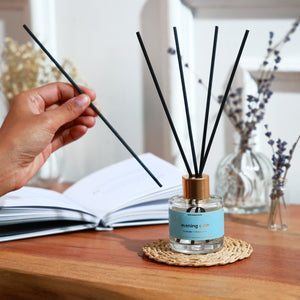
 Evening Calm₹799This is the mechanism that is genuinely interesting, because it is the one that flatters the product. A reed diffuser is a passive object: no fan, no mist, no power. Its entire distribution depends on the room's own air movement, which in a shut, still bedroom is very little. Start a split unit and the room acquires a circulation loop — air pulled in at the top, cooled, pushed back across the ceiling and down. Fragrance that was pooling near the bottle is picked up and spread through the volume, so the far side of the bed reads much closer to the bedside table than it did an hour earlier. The effect arrives within a few minutes and holds for as long as the unit is running.
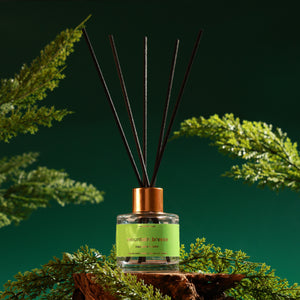
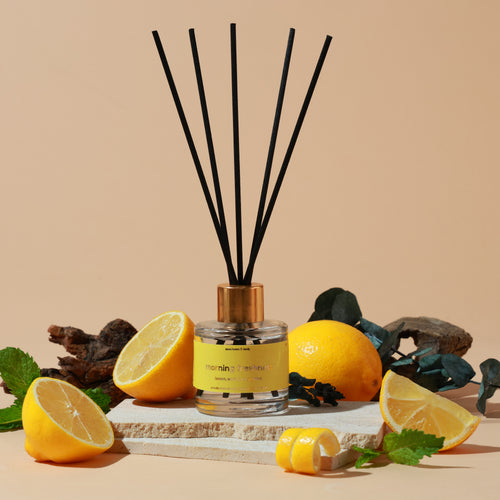
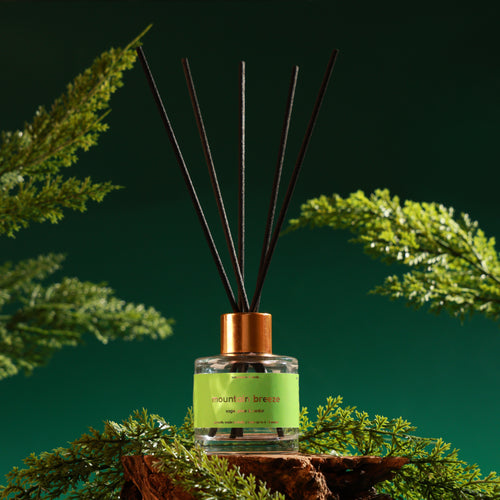
 Mountain Breeze₹849An AC does not bring in outside air; it cools the air already in the room. So the moment the door and windows close, the exchange with the rest of the flat and with the street falls away to whatever leaks around the frames. During the day that exchange is the enemy of every home fragrance in India — air that leaves a room takes the fragrance with it, and no product at any price outpaces an open window. At night the enemy simply goes away. The reeds release at their own rate into a volume that is no longer being emptied, and the concentration the room can hold rises accordingly. This is why a night-only AC bedroom is worth buying for, and an open living room is not.
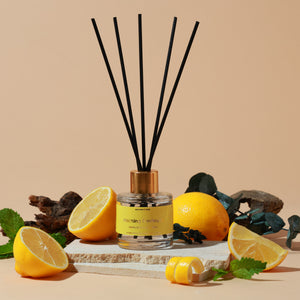
 Morning Freshness₹749The third mechanism is not in the room at all. Olfactory receptors adapt to a constant, unchanging stimulus within minutes: the signal keeps arriving, the brain stops reporting it because nothing about it has changed. It is the reason you cannot smell your own home and can smell everyone else's within a second of the door opening. When you spend the evening in the living room and then walk into the bedroom, you arrive with receptors that have been reporting a different set of smells, and for a short while you can read the bedroom properly. A home fragrance is supposed to be noticed on arrival and at transitions rather than perceived continuously, so this is not a distortion — it is the product doing exactly what it was designed to do.
The half nobody mentions: the same machine shortens the bottle
An air conditioner cools partly by condensing moisture out of the air and draining it away, which is why the room feels drier after an hour and why there is water coming out of a pipe on the balcony. Drier air takes up volatile material more readily than saturated air does, and drier air in motion more readily still, because it keeps carrying away what has just evaporated from the reed surface instead of letting it sit there. So the two features that make the bedroom read beautifully — circulation and low humidity — are also the two features that make the bottle finish sooner. They are not separate phenomena to be balanced against each other. They are the same phenomenon read from two ends.
I say this because the alternative is a customer who concludes there is something wrong with the product. There is not. Every millilitre in a reed diffuser eventually leaves the bottle through the reeds and into the room; nothing is held back and nothing is thrown away. A bottle that empties faster in a nightly-AC bedroom has not lost anything — it has simply delivered the same contents over a shorter period, into a room that was set up to make the most of them. The only genuine waste in this category is fragrance released into a room with nobody in it, which is a question of placement and hours rather than of the bottle.
One more honest note in the same direction. If the bedroom also runs warm during the day — a west-facing flat, an upper floor, an afternoon with the windows shut and the AC off — the heat is a second accelerator on top of the dryness, and the two stack. Heat should never change how a fragrance smells, which is a formulation matter and the reason every SOSA reed sits on a heat-stable CCT carrier rather than DPG, which can crack and go bitter above 40°C. But nothing in a formulation prevents heat from speeding evaporation. That part is physics and I would rather say so.
| Variable | 3 pm — door open, AC off | 11 pm — door shut, AC running | Effect on what you smell |
|---|---|---|---|
| Air movement in the room | Drift only; fragrance pools near the bottle | A circulation loop driven by the unit | Even distribution instead of a plume — the largest single factor |
| Exchange with outside | Open door, possibly open windows; air leaves and takes fragrance with it | Almost none; the AC cools the air already there | The room stops losing what the reeds release |
| Your own adaptation | You have been in and out all day, receptors adapted | You arrive from elsewhere, briefly un-adapted | The honest reading of the day happens on the way in |
| Humidity | Whatever the flat is | Lower; the unit condenses moisture out | Faster evaporation — better projection now, shorter bottle later |
| Occupancy | Usually nobody in the room | You, for eight hours | The hours worth spending fragrance on, and the reason to flip in the evening |
| What you should change | Nothing. An empty open room cannot be fixed with product | Reed count, if the reading is too strong | The free correction beats the paid one nearly every time |
If the night reading is too strong — and if only you can smell it
Two opposite complaints arrive from this same room, and both have answers that cost nothing. The first is that the bedroom becomes too much once the door closes. That is almost always a dose problem rather than a composition problem: a closed recirculating room concentrates whatever you give it, and six reeds is a setting designed for a living room with people moving through it. Pull three out, keep them dry in the box, and give the room two days. Almost any composition read at too high a concentration flattens into a single sweet or sharp impression, which is what people mean when they call something an air freshener — while the same oil at a lower dose reads as layered, because the nose has room to resolve the separate materials in it.
The second complaint is the reverse and quieter: everybody who visits mentions the bedroom and you cannot detect a thing. That is expected and it is not a fault. Sensitivity to individual aroma materials varies enormously between people — specific anosmia to certain musks affects a meaningful share of the population — and on top of that you are adapted to your own home in a way no guest is. If visitors remark on it, the diffuser is working for everybody but you, and the honest advice is to leave it alone rather than to raise the dose until you can smell it. Raising the dose until the owner can perceive it is the single most reliable way to make a house unpleasant for everybody else.
There is also a sequencing point that belongs on any page about a closed bedroom. Fragrance does not remove a smell. If the room has an odour you dislike — damp, a shoe cupboard, cooking that has travelled down the corridor — adding a pleasant one produces a mixture rather than a cancellation, and the mixture is frequently worse than either component because the brain now has two things to track. Deal with the source, air the room properly at some point in the day, and only then let the diffuser do its job. SOSA makes no odour eliminator, no air purifier and no dehumidifier, and I am not going to imply one.
What to do about it, including the option of doing nothing
Most people arriving at this question do not need to buy anything, and the table below is arranged to say so before it says anything else. The paid answers underneath are for the reader who has diagnosed the room correctly and wants the night hours to read differently rather than louder.
| Do this | What it is | When it is the right answer | Cost |
|---|---|---|---|
| 1. Take three reeds out ★ | Six is full projection; three is a soft bedside level and roughly doubles the life | First, always, if the night reading is more than you want | ₹0 |
| 2. Move it out of the AC's discharge | In the room's airflow, at or below nose height, not in the blast, not in sun | If the bottle is emptying visibly faster than the label suggests | ₹0 |
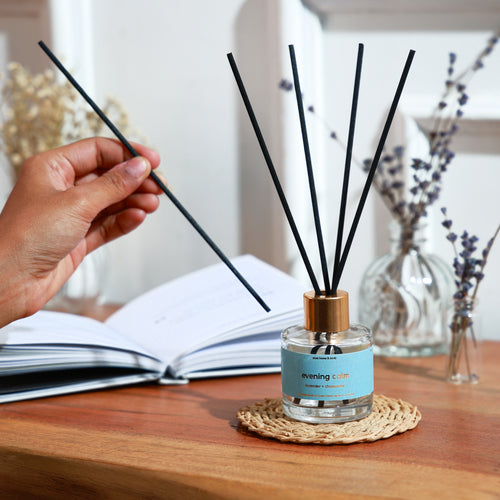
| 3. Evening Calm 50ml | Kashmir lavender, chamomile, soft musk drydown — 8.9, the softest we make | If you want to go down the strength scale as well as down the dose | ₹799 |
| 4. Mountain Breeze 50ml | Himalayan pine, sage, Indian cedar — 9.4, dry and green rather than sweet | If what reads as "too strong" is really "too sweet" | ₹849 |
| The honest gap: a bottle that is quiet by day and strong at night | It does not exist and cannot. A reed releases continuously and has no off switch, no timer and no schedule — SOSA sells no plug-in, no timer and no automatic system. The only night-weighted lever is when you flip the reeds. If you genuinely need fragrance confined to particular hours, that is a machine's job rather than a reed's, and Sukoon at ₹1,899 or Boond at ₹899 for a bedroom is the honest alternative | Stated plainly, because it is the product people assume exists | ₹899–₹1,899 |
Versailles
This question arrives with a suspicion attached — that something is inconsistent, that the bottle is behaving oddly, that perhaps the fragrance is stronger than it should be. It is worth saying clearly: nothing about the composition changes between afternoon and night. The oil is the same oil. What changes is that the room acquires a fan, stops leaking, and gets a fresh nose walked into it.
Of the three, the one I find most useful to explain is the first, because it is the only case in an Indian flat where a reed diffuser gets help it cannot generate for itself. A reed is a passive object. Its weakness is distribution — the far corner is always quieter than the bedside table. An air conditioner in a closed room fixes precisely that weakness for eight hours a night, free, and it is the reason I am comfortable recommending a ₹799 bottle for a bedroom rather than a machine.
And the third mechanism is the one I would want a reader to take away, because it applies far beyond this room. You are the worst possible judge of your own home's smell. Every complaint that begins "it has stopped working" should be tested by leaving for a quarter of an hour and walking back in, before a single rupee is spent. Everything is composed in Pune, and a part of every order funds a girl's classroom through Nanhi Kali.
Frequently asked questions
- When to flip the reeds — the evening, and the reason why.
- Windows open by day, AC at night — you already own a fragrance environment.
- Fewer reeds in a sealed bedroom? — the free correction, in full.
- Finishing faster in the heat — two accelerators, both normal.
- The lowest-effort night setup — and when to switch Sukoon on.
- Reed or Sukoon for a night-only bedroom — the honest split.
- Do I need it running all day? — and the economics of a night-only bedroom.
- Brand: the SOSA founder story.
SOSA reed diffusers — facts verified August 2026: Five scents, all alcohol-free, on a heat-stable CCT (caprylic/capric triglyceride) base rather than DPG, which can crack and go bitter above 40°C; phthalate-free, paraben-free, IFRA-compliant, 0 ppm formaldehyde, six fibre reeds rather than rattan in a refillable glass bottle, composed and made in Pune, India. Morning Freshness 50ml ₹749 · 130ml ₹1,249 · 9.0, with a eucalyptus globulus base that slows lemon evaporation three to four times. Evening Calm 50ml ₹799 · 130ml ₹1,299 · 8.9, the softest in the range. Garden Bloom 50ml ₹799 · 130ml ₹1,299 · 8.9, with indole held below the fecal threshold so jasmine stays floral above 30°C. Mountain Breeze 50ml ₹849 · 130ml ₹1,349 · 9.4. Fresh Brew 50ml ₹849 · 130ml ₹1,349 · 9.5, the deepest. Longevity 6–8 weeks on 50ml and 14–18 weeks on 130ml; 50ml suits rooms up to about 150 sq ft and 130ml above that. Six reeds is full projection, three is a soft bedside level and roughly doubles the life. Flip cadence every 3–5 days, or 5–7 days for Garden Bloom. Cost per day roughly ₹13 for Morning Freshness or Garden Bloom 50ml and ₹15 for Evening Calm, Mountain Breeze or Fresh Brew 50ml. Duos: Day & Night ₹1,498, Fresh & Grounded ₹1,548, Warmth & Bloom ₹1,598. Refills 300ml ₹2,399 · 500ml ₹3,499, oil only and not a first purchase. Machines: Boond ₹899 (300ml, up to about 150 sq ft, around 6 hours, USB, night light), Sukoon ₹1,899 (500ml, 270–320 sq ft, 16–18 hours on low, three 15ml scents included), Megh ₹3,499 (six-litre tank, around 100 hours, but only about 215 sq ft — a runtime and humidity machine, never a coverage upgrade). Climate-tested through 45°C heat soak and 85% relative humidity. The reed line contains no oud, sandalwood, vetiver or amber; Smoked Oudh and Sandalwood exist as ₹449 jar candles. SOSA sells no room spray, air purifier, dehumidifier, odour eliminator, plug-in, timer or subscription, and every SOSA spray is a car perfume. Reed oil and the water-based Hotel Collection are separate systems and are not interchangeable in either direction. Free shipping above ₹499. SOSA is an independent Indian fragrance house and is not affiliated with or endorsed by any hotel brand. Prices subject to change — see the live product pages.