
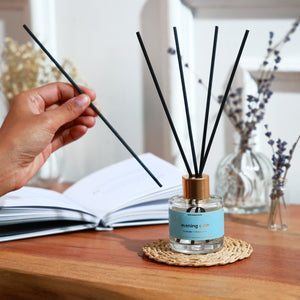
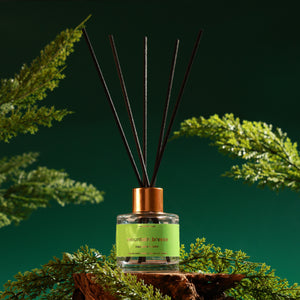
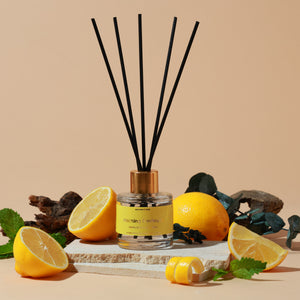


Then count your reeds. Six fibre reeds is full projection; three is a soft bedside level and roughly doubles the life. Half the “it is too weak” letters I get are three reeds in a six-reed bottle.
Then move the bottle. Corners, recesses, shelf backs and curtain folds are dead air. A source in dead air produces exactly this complaint.
Ask a guest. If a visitor notices it from the doorway and you cannot, the diffuser is working for everyone but you, and no purchase changes that.
When a machine is genuinely the answer: when nobody notices after all of the above, or when you want the room brought up on a schedule. Then Sukoon ₹1,899 covers 270–320 sq ft using water, and Safar ₹3,999 is waterless and undiluted but named and sold as a car and travel diffuser with no published room coverage. Between them and Vaayu ₹11,999 at 1000 m³, SOSA has no mid-sized waterless bedroom nebuliser.
2. Do the adaptation test before anything else. Leave the room for fifteen minutes, do something unrelated, and walk back in. Judge it in the first three seconds, before your receptors settle again. Almost everybody who writes to me about a “weak” diffuser has been evaluating it while sitting beside it, which is the one condition in which it is guaranteed to be imperceptible.
3. Then count the reeds. Every SOSA bottle ships with six fibre reeds. Six is full projection; three is a soft bedside level and roughly doubles the life. Plenty of people put in three because it looked neater, then conclude a fortnight later that the fragrance is weak. Put all six in and flip them every three to five days — flipping alone gives a noticeable lift and costs nothing.
4. Then move the bottle. Recesses, corners, the backs of shelves and the folds of curtains are dead air, and a reed has no fan to escape them with. Put it where air already travels — a bedside table near the doorway, a chest of drawers, a metre from where you sit — but never in the direct blast of a running split AC, which strips the lightest materials within days.
5. Then ask somebody. A guest arriving from outside is un-adapted, which is exactly the state you were in when the hotel impressed you. If they notice it, you are finished and you have spent nothing. If they notice nothing after steps two to four, then you have reached the ceiling of passive capillary diffusion and a machine is an honest purchase rather than an upsell.
Alcohol-free, phthalate-free, paraben-free, IFRA-compliant, 0 ppm formaldehyde, six fibre reeds in a refillable glass bottle. Free shipping above ₹499, and a portion of every order supports girl-child education through Nanhi Kali.
The three checks, in order, before any purchase
These are ordered by how often they turn out to be the answer, not by how satisfying they are to read. None of them costs anything, all of them can be done today, and between them they resolve a very large share of the letters that begin “my bedroom does not smell like a hotel”. Work through them in sequence and reassess after each rather than doing all three at once, because otherwise you will not learn which one was the problem — and knowing that is worth more than the fix.
 Evening Calm₹799Almost always the second. Olfactory receptors adapt to a constant, unchanging stimulus within minutes — the signal still arrives, and the brain stops reporting it because nothing has changed. It is the same reason you cannot smell your own home until you come back from a week away. The test is not to sniff harder; it is to leave the room for fifteen minutes and walk back in. Two related facts worth knowing. If everybody else can smell it and you cannot, that is expected rather than a fault: sensitivity to individual materials varies enormously between people, and you are additionally adapted to your own bedroom. And if you can smell it constantly, hour after hour, while sitting in the room, the dose has overshot the volume — that is a case for fewer reeds, not a different scent.
 Morning Freshness₹749More reeds is stronger and shorter, which is not the same as better — but if you want more and you have three in, you are running the bottle at a bedside setting and judging it as a room setting. Six is full projection. Three roughly doubles the life. In a 120 sq ft room with the door closed, six is usually right if you want presence and three if you want quiet. There is a second effect people mistake for failure: the first days run hot because the reeds are saturating and the lightest materials leave first, and by week three you are smelling the heart and base — the composition as designed. That is settling rather than fading. Flipping the reeds every three to five days restores projection without opening a new bottle, and it is the cheapest lift available.
 Garden Bloom₹799A reed adds no airflow of its own, so it depends entirely on the room’s own currents — which means where you put it is not decoration, it is specification. Corners, recesses, the backs of shelves and curtain folds are dead air and will strand the fragrance at the source. Put it where air already travels: a bedside table, a chest near the doorway, a metre from where you sit. Avoid the direct outgoing stream of a split AC, which strips the top notes within days. Then close the door for the hours you want the room to smell, and ventilate freely when it is empty — an open door is a continuous loss, and no product on this page can outrun it. A running AC in a closed room is an advantage here, because it recirculates the same air past the source and distributes what little a passive format produces.
What a reed does better than any machine, and it is not a consolation prize
It would be easy to write this page as a delay on the way to a machine. It is not. A reed diffuser is passive capillary diffusion — oil climbing six fibre reeds and evaporating from their surface — and there are things about that mechanism which every machine in this range gives up. It is completely silent. Not quiet: silent, with no motor, no piezo hum and no air pump, which in a bedroom at night is not a small consideration. It uses no electricity and needs no socket, so it can go on a bedside table with nothing trailing from it. There is no tank to fill, no battery to charge, no timer to set and no app. It cannot be left running by mistake, because there is nothing to leave running.
It also has one property that is genuinely difficult to buy: it stays where you put it. Because it adds no air, a reed does not creep down a corridor, does not reach a housemate who would rather it did not, and does not surge. If you want one room fragranced and the rest of the flat left alone, the reed is not the compromise version of that — it is the correct engineering answer, and the cheapest one. And at roughly ₹13 to ₹15 a day for a 50ml running six to eight weeks, the sticker price is a fairer purchase than it first appears; a ₹749 bottle that runs for two months is a different object from a ₹749 ornament.
The honest limitation is equally clear and I will not soften it. A reed cannot be switched off, and it produces a fragrant zone rather than a fragranced room. The concentration is highest at the bottle and falls with distance; that is the design and not a defect, and no reed at any price behaves otherwise. If what you want is scent presence arriving at you across the room, on a schedule, at a level you choose, then you want a different mechanism and the rest of this page is for you. What you do not want is a more expensive reed, because there is no such thing as a stronger one in the sense you mean.
| Intervention | What it changes | How often it is the answer | Cost |
|---|---|---|---|
| The adaptation test ★ | Nothing about the room — it corrects the measurement | Very often. Most “it stopped working” letters are this | ₹0 |
| Three reeds to six, flipped every 3–5 days ★ | Roughly doubles output; shortens the bottle correspondingly | Very often, and it is the dial that came in the box | ₹0 |
| Bottle out of dead air, door closed for occupied hours | Puts the source in the room’s circulation and reduces losses | Often, especially in rooms with the door habitually open | ₹0 |
| Ceiling fan on its lowest speed | Converts still air into circulating air — borrowed transport | Sometimes, and it costs less than a second bottle | ₹0 |
| A correctly-sized 50ml reed | 50ml is specified up to ~150 sq ft, 6–8 weeks, six fibre reeds | When there is no diffuser yet, or the current one is genuinely finished | ₹749–₹849 |
| Sukoon | Adds a wet plume — genuine reach, 270–320 sq ft, on demand, 16–18 hours on low | When the free checks failed, or you want it on a schedule | ₹1,899 |
| Safar | Undiluted oil, dry mist, 3 speeds, 1/2/3-hour auto-off. No published coverage. Named and sold as a car and travel diffuser | When water is ruled out and short defined sessions are what you want | ₹3,999 |
| Vaayu | 1000 m³, roughly 2,000–3,000 sq ft — not a 120 sq ft purchase | Only for a whole floor, an open-plan living-dining, a villa, a clinic or a reception | ₹11,999 |
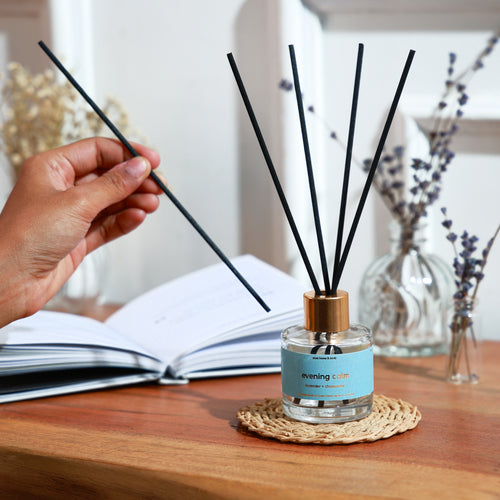 Softest · Evening Calm₹799Shop → Deepest woody · Mountain Breeze₹849Shop →
  Only if the checks fail · Sukoon₹1,899Shop →
When the answer genuinely becomes yes
There are three situations in which I stop trying to talk people out of a machine, and they are worth stating precisely so you can tell whether you are in one of them. The first is when nobody notices. If you have run the checks, put all six reeds in, moved the bottle, kept the door shut for the evening, and a visitor arriving from outside still detects nothing, you have reached the ceiling of passive capillary diffusion. That ceiling is structural. A different scent will not raise it and neither will a more expensive reed.
The second is when you want control over the hours. A reed cannot be switched off; it runs into an empty room as readily as an occupied one, and it cannot be made to greet you at seven in the evening. If your actual requirement is “on when I am home, off when I am not”, no amount of adjusting will get you there and a device with a switch is the correct purchase. Sukoon ₹1,899 runs on demand for 16–18 hours on low from a 500ml tank; Safar ₹3,999 has three speeds and a 1, 2 or 3-hour auto-off, and its output is pure undiluted oil rather than oil carried in water, which is most of why nebulised output reads as more intense.
The third is when you want the fragrance to arrive at you across the room rather than surround the bottle — genuine presence, evenly distributed, the thing a lobby has. That is transport, and transport has to be bought. Which brings me to the thing I would rather you heard from me: what you are paying for at the higher price is transport, control and evenness, not a better smell. A ₹749 reed and an ₹11,999 nebuliser can run related fragrances and produce entirely different room experiences, and the difference is the machine. If the composition you own already smells right at the bottle, your money should go on delivery rather than on another bottle.
What to spend, in order — and the gap in the range
Free first, cheap second, machine third, and the thing SOSA does not make stated on the last row. If you reach the bottom of this table and none of it fits, that is information rather than a failure — and it is better learned here than after a delivery.
| Step | What it is | When it is the right answer | Price |
|---|---|---|---|
| 1. Adaptation test, six reeds, out of the corner, door closed ★ | The three free checks, run one at a time so you learn which one mattered | Always first. For a meaningful share of readers this is the entire answer | ₹0 |
| 2. A 50ml reed | Passive capillary, six fibre reeds, refillable glass, specified up to ~150 sq ft, 6–8 weeks, about ₹13–₹15 a day. Evening Calm 8.9 is the softest, Fresh Brew 9.5 the deepest | When there is no diffuser in the room yet, or the current bottle is genuinely finished | ₹749–₹849 |
| 3. Sukoon | Ultrasonic water mist, 500ml, 270–320 sq ft, 16–18 hours on low, three 15ml Hotel Collection scents included | When a visitor notices nothing after the free checks, or you want the room on demand. Accepts dilution, humidity and refilling | ₹1,899 |
| 4. Safar | Waterless cold diffusion of undiluted oil. 20ml, 2000 mAh Type-C, 3 speeds, 1/2/3-hour auto-off, up to 10h continuous or ~30h intermittent, 6.9 cm. Named and sold as a car and travel diffuser, with bedside and hotel room among its stated uses | When water is ruled out entirely and short, defined, undiluted sessions are what you want. No room-coverage figure has been published, and it needs recharging | ₹3,999 |
| Not this: Megh | 6L tank, about 100 hours of runtime, but only ~215 sq ft — less coverage than the ₹1,899 Sukoon | A runtime and humidity machine. Never buy it as a coverage upgrade | ₹3,499 |
| The honest gap | SOSA makes no mid-sized waterless bedroom nebuliser. Between Safar at personal scale and Vaayu ₹11,999 at 1000 m³ — roughly 2,000–3,000 sq ft, against your 120 — nothing is sized for one room | Said plainly, because “real coverage, one bedroom, no water” is exactly what this range cannot deliver | — |
Versailles
This is the page I would want a member of my own family to read, because it is the one that most often ends without a purchase. A great many people asking whether they need a machine are describing a healthy diffuser, a room they cannot judge, and three reeds where six were needed. Selling into that is easy and it is the fastest way I know to lose somebody permanently, because the machine arrives, the room smells the same, and now they have spent ₹1,899 to confirm that the problem was never the equipment.
The part I would underline is the fifteen minutes. It sounds trivial and it is the single most useful instruction in this whole cluster. Your receptors stop reporting a constant smell within minutes; you are structurally incapable of judging your own bedroom from inside it. Leave, come back, and take the first three seconds seriously. Or ask a friend, who is un-adapted — which, incidentally, is a large part of why the hotel impressed you in the first place. You were a guest there too.
And when the answer really is a machine, I will not pretend our range covers every version of it. Sukoon at ₹1,899 is the honest answer for most bedrooms and its price is water. Safar is the hotel mechanism at personal scale, sold as a car and travel diffuser, with no published room coverage. Vaayu is built for a floor. There is nothing in between, and if that gap is where your requirement sits, you deserve to know it now. Everything is composed in Pune, and part of every order funds a girl’s classroom through Nanhi Kali.
Frequently asked questions
- Just the bedroom, not the house — zoning, and the door as equipment.
- Hotel fragrance in 100 sq ft — specification against expectation.
- Projection in a 10 × 10 room — why over-dosing is the real risk.
- A 10 × 12 bedroom — the closed-door hours rather than the square footage.
- Small waterless diffuser versus a reed — undiluted oil and moved air.
- Only while I am in the room — the control page, in detail.
- A hotel suite without fragrancing the house — containment in practice.
- Small room, big projection and reed versus Safar, scored.
- Brand: the SOSA founder story.
SOSA facts verified August 2026: Reed diffusers (passive capillary diffusion) — Morning Freshness ₹749/₹1,249, Evening Calm ₹799/₹1,299, Garden Bloom ₹799/₹1,299, Mountain Breeze ₹849/₹1,349, Fresh Brew ₹849/₹1,349; 50ml suits rooms up to about 150 sq ft and lasts 6–8 weeks, 130ml suits above 150 sq ft and lasts 14–18 weeks; six fibre reeds rather than rattan in a refillable glass bottle, six for full projection and three for a soft bedside level with roughly double the life, flipped every 3–5 days, about ₹13–₹15 a day; strength scale — Evening Calm 8.9 softest, Garden Bloom 8.9, Morning Freshness 9.0, Mountain Breeze 9.4, Fresh Brew 9.5 deepest; refills 300ml ₹2,399 and 500ml ₹3,499, oil only and never a first purchase; heat-stable CCT carrier rather than DPG, alcohol-free, phthalate-free, paraben-free, IFRA-compliant, 0 ppm formaldehyde, tested at 45°C and 85% RH, composed in Pune. Ultrasonic water mist — Boond ₹899 (300ml, up to ~150 sq ft, ~6 hours, USB), Sukoon ₹1,899 (500ml, 270–320 sq ft, 16–18 hours on low, three 15ml Hotel Collection scents included), Megh ₹3,499 (6L tank, ~100 hours, ~215 sq ft — less than Sukoon, never a coverage upgrade). Waterless cold-air nebulising — Safar ₹3,999 (20ml bottle, 2000 mAh Type-C, 3 speeds, 1/2/3-hour auto-off, up to 10 hours continuous or around 30 hours intermittent per charge, 6.9 cm; named and sold as a car and travel diffuser, with car, handbag, desk, bedside and hotel room among its stated uses; no room-coverage figure has been published) and Vaayu ₹11,999 (up to 1000 m³, roughly 2,000–3,000 sq ft, 400ml tank lasting about 90+ days, Bluetooth app with 1h/4h/8h/24h windows, under 38 dB, 5W, CE/RoHS/SGS). Between Safar and Vaayu there is no mid-sized waterless bedroom nebuliser in the SOSA range, and this guide states that rather than stretching a product to cover it. Hotel Collection oils are water-based and ultrasonic-only: 15ml ₹299 (a refill, never a first purchase), 100ml ₹999, 300ml ₹1,799. Reed oil and Hotel Collection oil are not interchangeable in either direction and there is no hotel-inspired reed diffuser. Free shipping above ₹499. A portion of every order supports girl-child education through Nanhi Kali. SOSA is an independent Indian fragrance house; the Hotel Collection scents are SOSA’s own interpretations inspired by the world’s finest hotels, and SOSA is not affiliated with, endorsed by or a supplier to any hotel brand. Prices subject to change — see the live product pages.