

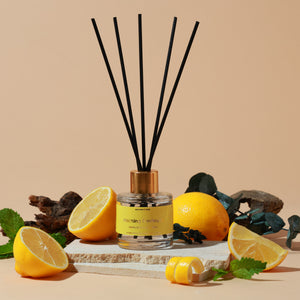

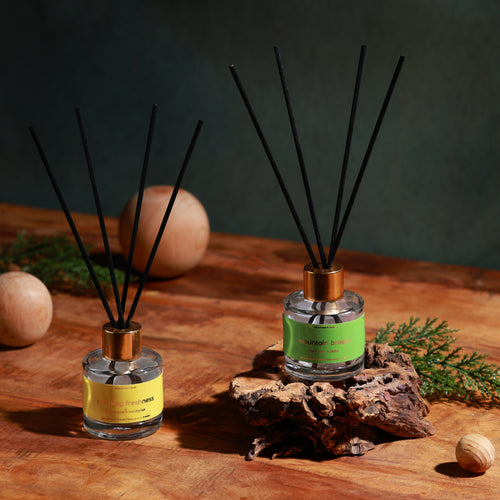
For continuity: a reed. Morning Freshness ₹749, roughly ₹13 a day, running whether you remembered it or not.
The crossover truth: a machine has a running cost the reed does not — refills, power, water, the act of filling it. A reed has no off switch and evaporates into an empty room. Neither is universally cheaper.
The two honest gaps: the Megh at ₹3,499 is not a coverage upgrade — around 215 sq ft, less than the Sukoon. And if the extraction over your hob is undersized, neither product is your answer and we would rather you spent the money there.
Never mix them: reed oil cannot go into an ultrasonic machine and the water-based Hotel Collection oils cannot go into reeds. There is no hotel-inspired reed diffuser.
2. For the specific job of speed, buy the machine. Sukoon at ₹1,899 covers 270–320 sq ft from a 500ml tank and runs 16–18 hours on low. Twenty minutes into a closed living room is enough. Three 15ml Hotel Collection scents are included, so the first evening costs nothing further.
3. For every other hour of the week, the reed is the better object. It is continuous and uncontrolled: no switch, no socket, no water, no filling, no maintenance beyond flipping the reeds every three to five days. In a home where people arrive unannounced and the living room is in use at unpredictable hours, always-already-running beats fast.
4. Understand the cost trade in both directions. A reed is roughly ₹13 to ₹15 a day and has no off switch, so it evaporates into an empty room whenever the flat is empty. A machine wastes nothing while switched off but has a running cost the reed does not have — refills, power, water, and the ten seconds of filling it that somebody has to remember. Neither is universally cheaper, and the honest tiebreaker is how many hours a day the room is genuinely occupied.
5. Do not try to make one behave like the other. Reed oil cannot go into an ultrasonic machine and the water-based Hotel Collection oils cannot go into a reed bottle. They are different physical systems, and mixing them either damages the machine or does nothing at all. There is no hotel-inspired reed diffuser at SOSA, and there is no reed-scented ultrasonic oil.
Sukoon includes three 15ml Hotel Collection scents. Reeds are alcohol-free, phthalate-free, paraben-free, IFRA-compliant, 0 ppm formaldehyde, six fibre reeds, refillable glass, composed in Pune. Free shipping above ₹499, and a portion of every order supports girl-child education through Nanhi Kali.

Speed, continuity and cost — the three differences that are real
Almost everything written comparing reeds and machines compares them on strength, which is the least useful axis there is. Both can fill a room; the SOSA strength scale exists precisely so that people can choose down it rather than assuming louder is better. What actually separates the two formats is control, effort and where the money goes, and those three decide the answer for a household that cooks Indian food and wants the living room pleasant afterwards.
 Sukoon₹1,899An ultrasonic machine puts fragrance into the air actively, and in a closed room of 270–320 sq ft that is a matter of minutes rather than hours. A reed diffuser cannot do this at any price. Its output is evaporation from six fibre sticks into whatever movement the room already has; adding reeds raises the level over days and flipping them gives a modest burst, but there is no lever to pull at half past seven. This is not a defect — it is the definition of a continuous, passive device — and it is the single reason the machine wins the speed question outright. If your problem is a specific twenty minutes, buy the switch.
 Morning Freshness₹749The machine's advantage disappears the moment nobody presses the button, and in a real Indian household somebody is always arriving at a time nobody planned for. A reed asks for nothing: no power, no water, no filling, no switch, no hardware, no thought. It is the right answer whenever the room is occupied for long, unpredictable stretches, whenever the household does not want another device on the shelf, and whenever the budget is a single purchase rather than an ongoing one. Morning Freshness at ₹749 also happens to be the register furthest from cooked food, and its eucalyptus base slows the lemon's evaporation three to four times, which is what turns the usual ten-to-fourteen-day citrus fade into 6–8 weeks.
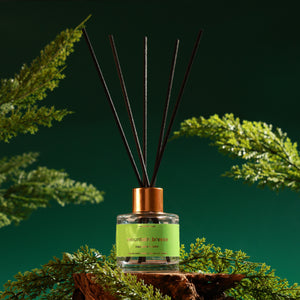
 Mountain Breeze₹849This is the honest part of the comparison and both halves cut. The machine costs ₹1,899 once and then keeps costing: Hotel Collection refills at ₹999 for 100ml or ₹1,799 for 300ml, plus power, plus water, plus somebody remembering to fill it. The reed costs ₹749 to ₹849 for six to eight weeks, which is roughly ₹13 to ₹15 a day, and it spends that whether anyone is home or not, because it has no off switch. Nothing is thrown away — every millilitre eventually leaves the bottle through the reeds — but oil evaporating into an empty flat is the one genuine waste in this category, and a reed cannot avoid it. Three reeds instead of six halves the rate and roughly doubles the life, which is the only lever the format has.
The method this whole family of questions shares
Everything in this cluster about Indian cooking resolves to the same three-step order, and it is worth setting down once in full because the product choice sits at the end of it rather than at the start. Source first. The chimney or exhaust goes on before the oil is hot and stays on for ten minutes past the last tempering, because aerosol keeps lifting from hot surfaces after the flame is out; the kitchen door closes during the heavy part if the flat has one. Every droplet caught here never lands on a cushion. Ventilation second. Two openings on different walls for ten minutes — air needs an inlet and an outlet, and one window on its own moves surprisingly little. That clears the airborne fraction quickly, and it is the highest-leverage free action available. Then close the flat, because a room in the middle of an air exchange cannot hold anything you add to it.
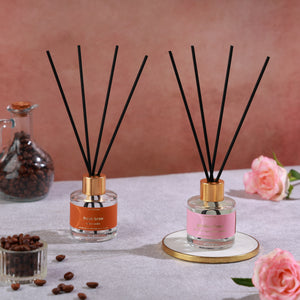
Fragrance third, and only third. What it does at that point is genuine and worth paying for: it gives the room a second, clearly separate character to sit alongside whatever is still releasing from the soft furnishings. What it does not do — ever, in any form, from any brand — is remove an odour. Adding a pleasant smell to an unpleasant one produces a mixture, not a cancellation, and the mixture is frequently worse than the original because the brain now has two things to track. That is why the register matters so much in this family: a bright dry citrus stays legibly separate from cooked food, and a warm sweet gourmand merges with it. It is also why we tell people that Fresh Brew, one of our own, is the wrong bottle for a living room an hour after dinner.
The last piece of the method is about textiles, and nobody enjoys hearing it. The reason the flat smells of cooking again long after the windows were opened is that fabric is the reservoir. Cushion covers, curtains, upholstery and even painted walls hold the deposited fraction and let it go slowly for hours. Washable covers, curtains that occasionally go through the machine, and a habit of not leaving the kitchen open through a long fry do more for a cooking-heavy home than any second bottle. Fragrance is the last twenty per cent of this problem, and it is very good at that twenty per cent.
Reed diffuser versus Sukoon, scored on the things that actually differ
The comparison as I would give it to a friend, with the winner named in each row rather than hedged. The last two rows are the ones most comparisons leave out.
| What you are comparing | Reed diffuser | Sukoon ₹1,899 | Winner |
|---|---|---|---|
| Speed after cooking ★ | Cannot be accelerated. Level set in advance by reed count | Minutes in a closed room of 270–320 sq ft | Sukoon |
| Control and timing | None. It runs whether you are home or not | On, off, low, and 16–18 hours on a 500ml tank | Sukoon |
| Effort | Flip the reeds every 3–5 days. Nothing else | Fill, switch on, refill, clean the tank | Reed |
| Unplanned arrivals | Already running before the doorbell | Does nothing unless someone pressed it | Reed |
| Purchase price | ₹749–₹849 for 50ml, ₹1,249–₹1,349 for 130ml | ₹1,899, three 15ml scents included | Reed |
| Running cost | ~₹13–₹15 a day, continuous, no off switch | Refills ₹999 / ₹1,799, plus power and water — but only while running | Depends on occupied hours |
| Scenting an empty room | Unavoidable. Three reeds halves the rate | Avoidable entirely — switch it off | Sukoon |
| Removing a cooking smell | No | No | Neither. Extraction and airing do that |
Speed · Sukoon₹1,899Shop → 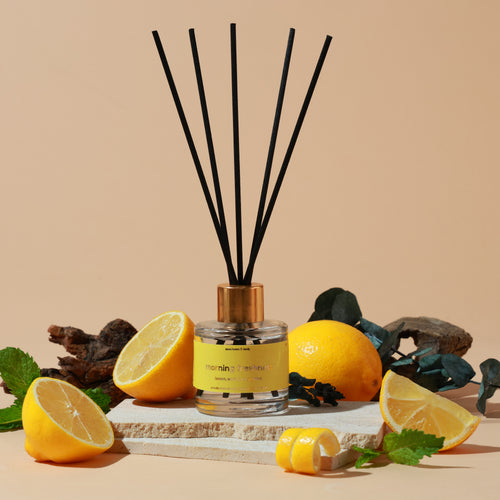 Continuity · Morning Freshness₹749Shop →
 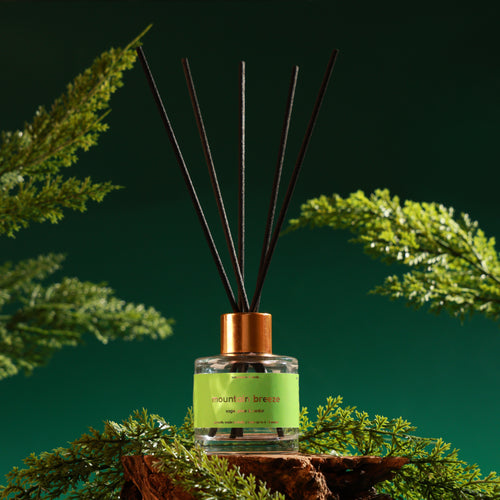 Unsweet · Mountain Breeze₹849Shop →
The money, honestly, and the purchase we would talk you out of
A reed diffuser costs roughly ₹13 a day for a 50ml Morning Freshness or Garden Bloom and about ₹15 for Mountain Breeze, Fresh Brew or Evening Calm. Stating it that way is fairer than the sticker price, because ₹749 running six to eight weeks is a different object from a ₹749 ornament. The 130ml at ₹1,249–₹1,349 runs 14–18 weeks and is better value per week, though only if the room genuinely needs it — a 130ml in a small sitting area is over-specified, and the honest recommendation there is the 50ml with fewer reeds. A 300ml refill at ₹2,399 is oil alone and is not a first purchase; it is for the bottle and reeds you already own.
I will not quote a per-day figure for the machine, because it would be invented. What Sukoon costs to run depends entirely on how many hours you run it, and a household using it for twenty minutes before guests will go through a 100ml bottle of Hotel Collection at ₹999 very differently from one running it every evening. What I can say plainly is that the ₹1,899 is the beginning of the spending rather than the end of it, and that the ₹749 is very nearly the end of it for six to eight weeks. Both of those are useful to know before you decide.
And one purchase to avoid, because our own range is easy to misread here. The Megh at ₹3,499 has a six-litre tank and around a hundred hours of runtime, which sounds like the senior product — but it covers only about 215 sq ft, which is less than the Sukoon's 270–320. It is a runtime and humidity machine. If you are buying for coverage in a large living room, the cheaper machine is the bigger one, and we would rather lose the difference than have somebody discover that after paying it. Similarly, the ₹299 15ml Hotel Collection bottle is a refill and not an entry point; it does nothing at all without the machine.
What to buy for a cooking-heavy home
The whole answer in buying order, with the last row reserved for the thing that outperforms everything above it and that we do not sell.
| Buy | What it is | When it is the right answer | Price |
|---|---|---|---|
| 1. Morning Freshness 50ml ★ | Malabar lemon, peppermint, eucalyptus — the register furthest from cooked food, ~₹13 a day | The default for a living room in use at long, unpredictable hours. Up to ~150 sq ft, 6–8 weeks | ₹749 |
| 2. Sukoon | 500ml, 270–320 sq ft, 16–18 hours on low, three 15ml Hotel Collection scents included | When speed and control are the requirement — an evening-only living room, or twenty minutes before guests | ₹1,899 |
| 3. Morning Freshness 130ml | The same composition sized above 150 sq ft, 14–18 weeks | Larger living rooms and open-plan ends of a flat. Better value per week if the room needs it | ₹1,249 |
| 4. Mountain Breeze | Himalayan pine, sage, cedar at 9.4 — dry, resinous, no sweetness | If anyone in the house reads citrus as a cleaning product. 130ml ₹1,349 | ₹849 |
| 5. Boond | 300ml, up to ~150 sq ft, around 6 hours, USB, night light | A bedroom, not a living room. The honest small machine, and not a substitute for the Sukoon's coverage | ₹899 |
| The honest gap: the two things that beat both | Extraction that starts before the pan is hot, and ten minutes of cross-ventilation. Neither is a SOSA product. Also: Megh ₹3,499 is around 215 sq ft — less than Sukoon — and is not a coverage upgrade | Do the free steps first, every time. If the chimney is undersized, spend there rather than here and we would rather say so | ₹0 / ₹3,499 |
Versailles
I am asked to settle this question more often than any other, usually in the form "which one is better", and the reason I will not answer it that way is that the two products are not competing for the same job. One is a device with a switch and the other is a device without one, and everything else follows from that single sentence. If you need a room to change in twenty minutes, buy the switch. If you want a home that is simply pleasant whenever anybody walks into it, buy the thing that never has to be remembered.
The part I insist on, on every page in this family, is the order. Source, then ventilation, then fragrance. I have never made a product that removes a smell and I do not intend to imply that I have. What a good composition does after a heavy dinner is give the room a second thing to be, clearly and separately, and that is a real and worthwhile job — but it is the third job, and doing it first is how people end up with a scented version of the problem they started with.
If you take one commercial thing from this page, take the Megh point. It is our largest tank and it covers less floor area than the machine that costs half as much. Somebody will buy it for a big living room this month on the assumption that bigger is stronger, and I would rather that person read this paragraph first and buy the Sukoon. Everything we make is composed in Pune, tested through a 45°C heat soak and an 85% humidity soak, and a part of every order funds a girl's classroom through Nanhi Kali.
Frequently asked questions
- Tadka twice a day — what there is to do once the ventilating is done.
- A 1BHK that smells of breakfast until lunch — small volumes have nowhere for the aerosol to go.
- Fried fish through a whole 2BHK — a high-deposition case, handled honestly.
- The chimney works and the sofa still smells — fabric is the reservoir.
- Should you avoid sweet fragrances — largely yes, and the reason is register.
- Citrus, floral or woody — the four registers scored.
- One AC across kitchen and living room — one air volume, one decision.
- A reed a few feet from the kitchen — yes, with one honest caveat.
- Cook at 7, guests at 8 — the hour, minute by minute.
- Brand: the SOSA founder story.
SOSA facts verified August 2026: Machines — Boond ₹899 (300ml, up to ~150 sq ft, around 6 hours, USB, night light), Sukoon ₹1,899 (500ml, 270–320 sq ft, 16–18 hours on low, three 15ml Hotel Collection scents included), Megh ₹3,499 (six-litre tank, around 100 hours runtime, about 215 sq ft — a runtime and humidity machine, never a coverage upgrade over the Sukoon), Safar ₹3,999, Vaayu ₹11,999, Aangan ₹25,999, Meenar ₹38,500. Hotel Collection oils are water-based and ultrasonic-only: 15ml ₹299 (a refill, never a standalone purchase), 100ml ₹999, 300ml ₹1,799, pack of seven ₹1,799; the fresh answers there are the Westin-inspired White Tea Serenity and the Ritz-Carlton-inspired Quiet Luxury. Reed oil cannot go into an ultrasonic machine and Hotel Collection oil cannot go into reeds; there is no hotel-inspired reed diffuser. Reeds — five scents, alcohol-free, heat-stable CCT carrier rather than DPG, phthalate-free, paraben-free, IFRA-compliant, 0 ppm formaldehyde, six fibre reeds in a refillable glass bottle, composed and made in Pune. Morning Freshness (Malabar lemon · peppermint · eucalyptus globulus) ₹749 / ₹1,249 · 9.0. Evening Calm (Kashmir lavender · chamomile · soft musk) ₹799 / ₹1,299 · 8.9, the softest. Garden Bloom (British rose · night-blooming jasmine) ₹799 / ₹1,299 · 8.9. Mountain Breeze (Himalayan pine · sage · Indian cedar) ₹849 / ₹1,349 · 9.4. Fresh Brew (Coorg coffee · Kerala vanilla · caramel) ₹849 / ₹1,349 · 9.5, the deepest. 50ml suits rooms up to about 150 sq ft and lasts 6–8 weeks; 130ml above that, 14–18 weeks; roughly ₹13–₹15 a day. Six reeds is full projection, three is a soft level lasting roughly twice as long, flipped every three to five days. Duos ₹1,498–₹1,598 (₹2,498–₹2,598 in 130ml). Refills 300ml ₹2,399 · 500ml ₹3,499, oil only and not a first purchase. Climate-tested through 45°C heat and 85% RH. The reed line contains no oud, sandalwood, vetiver or amber, though Smoked Oudh and Sandalwood exist as ₹449 jar candles. Free shipping above ₹499. A portion of every order supports girl-child education through Nanhi Kali. SOSA is an independent Indian fragrance house; the Hotel Collection scents are SOSA's own interpretations inspired by the world's finest hotels and SOSA is not affiliated with or endorsed by any hotel brand. Prices subject to change — see the live product pages.