


What to do instead: move it out of the flow path — off the line between the balcony door and the opposite window — and close the door an hour before you want the room to smell of something.
When to change product: if the door is open all day and shut all evening, a Sukoon at ₹1,899 run in the closed hours fits the room better than an always-on bottle.
2. Move it out of the flow path. This is free and it is the biggest single lever. Draught does not fill a room evenly. It runs in a line from the opening to whatever other opening it can find, and anything standing in that line is stripped and carried straight out. Take the bottle off that line. In practice: not on the console facing the balcony, not on the sill, not beside the door — but on the wall the air is not running along, ideally in the pocket behind the direction of flow, at chest height.
3. Shut the door an hour before you want the room to smell of something. A reed diffuser is always on, so the moment the air stops being replaced it starts building concentration again. An hour of a closed room at 0.2 to 0.5 air changes is enough for the room to read. This is the single most useful habit for anyone with a balcony, it costs nothing, and it converts an unsolvable problem into a schedule.
4. Expect the bottle to run shorter, and budget for it. Evaporation rises with heat and airflow. A draughty room is not only harder to scent, it also empties the bottle faster — the open door bills you twice. A 130ml at ₹1,249 that would run to eighteen weeks in a closed air-conditioned bedroom should be expected at the fourteen-week end here, and less again in a genuinely windy flat on a high floor.
5. If the door is open all day and shut all evening, change product rather than quantity. That is the commonest Indian pattern and it argues for a switch. A Sukoon at ₹1,899, rated to about 270–320 sq ft, runs when you turn it on — so it works during the closed hours you actually occupy the room, rather than evaporating all afternoon into a breeze while nobody is home. It runs the water-based Hotel Collection at 3 to 6 drops a tank, so a 15ml at ₹299 lasts a long time; total to start, ₹2,198.
Made in India, composed by an ISIPCA Versailles-trained perfumer — and a portion of every order supports girl-child education through Nanhi Kali.
Air changes, and why they beat bottle size
Every coverage figure in home fragrance is an equilibrium figure. A reed diffuser evaporates fragrance into a room at a more or less constant rate; the room loses fragrance at a rate set by how fast its air is replaced; and the concentration you can smell is where those two settle. A closed room exchanges roughly 0.2 to 0.5 of its air an hour. A cross-ventilated one exchanges three to eight. Take a 150 sq ft room at nine feet — about 1,350 cubic feet. Closed, at 0.3 changes an hour, roughly 400 cubic feet of scented air leave every hour. With the balcony door open and a window opposite, at five changes an hour, about 6,750 cubic feet leave. That is around sixteen times as much air to keep charged, from a source that has not changed at all.
This is why the instinct to buy a bigger bottle fails so completely, and it is worth understanding rather than just accepting. A 50ml and a 130ml stand the same six reeds of the same length, and it is the exposed fibre that evaporates — the extra liquid sits behind it as reserve. Millilitres buy weeks. Reeds buy strength. Neither buys resistance to a draught. Going from three reeds to six roughly doubles the input, which is real but nothing like a factor of sixteen. And the draught works the other side of the ledger too, because evaporation rises with airflow and with heat: the same bottle that lasts eighteen weeks in a closed air-conditioned bedroom will land at fourteen or below beside an open balcony. You get less scent and fewer weeks for the same ₹1,249, which is the honest reason to fix the ventilation pattern rather than the purchase.
What actually works
 One is enoughFrom ₹749Both instincts fail for the same reason: they add to the input side of an equation whose output side has grown by roughly sixteen times. A second 130ml at ₹1,249 roughly doubles what is entering the room, against air leaving many times faster than that. You would notice the expense long before you noticed the fragrance. The bigger bottle is worse still, because it does not even double the input — a 130ml and a 50ml on six reeds evaporate at the same rate, and the difference between them is entirely how many weeks the reserve lasts. If someone recommends a larger bottle for a draughty room, they are guessing.
Sizing by space — rooms that lose their air
Every row here is about ventilation rather than floor area. Two of them are rooms to spend nothing on, and none of them is solved by a larger bottle.
| Space | What it needs | How many | Cost |
|---|---|---|---|
| 150 sq ft room, balcony door open by day, shut in the evening ★ | Normal and workable — one bottle out of the flow path, and shut the door an hour before you want it | One | from ₹1,249 |
| 150 sq ft room with the balcony door and an opposite window both open | True cross-ventilation at three to eight air changes an hour — the whole room of air is replaced every eight to twenty minutes and a passive source cannot hold it | One Sukoon, run in the closed hours | ₹1,899 |
| A room where the door stands open only overnight while you sleep | Ordinary. Place the bottle away from the doorway and judge it in the evening rather than at 5am | One | from ₹1,249 |
| The balcony itself | Nothing. It is outdoor air with no ceiling to hold anything — this is the clearest "buy nothing" in the whole cluster | None | ₹0 |
| 200 sq ft living room with a permanently open balcony | Two problems at once, and only one is a sizing problem. Fix the schedule before you buy the second bottle for the area | One, then reassess | from ₹1,249 |
| A bedroom where the door is open in monsoon and shut in summer | Nothing extra. Move the bottle you own into whichever room is closed that season | None | ₹0 |
| A note on all of the above: the 150 sq ft coverage figure is measured closed and still. Nothing above is a criticism of the product — it is what a passive evaporative source is, and a switch rather than a bottle is the honest answer to a room that is deliberately being aired. | |||
One room · the unitFrom ₹749Shop → 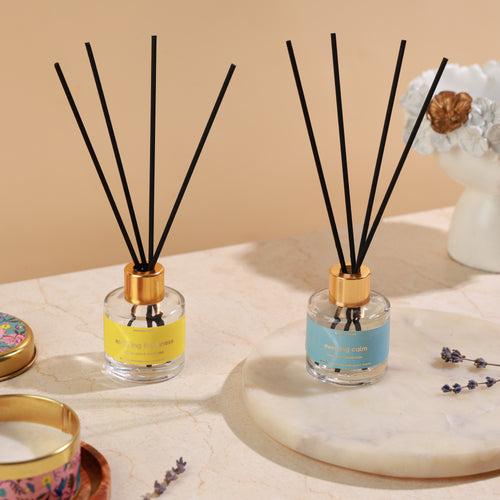 Two rooms · better value₹1,498Shop →
  Large room · a switch₹1,899Shop →
Placement, timing and the cost of a draught
Find the flow line before you decide anything else. Open the balcony door on a breezy evening and hold a light scarf or a sheet of paper at chest height in a few places across the room. Where it moves, that is the channel; where it hangs still, that is where the bottle belongs. Usually the channel runs from the balcony to the nearest opposite opening — a window, the passage door, a kitchen hatch — and the still pocket is on a side wall or in the corner behind the direction of flow. This takes two minutes and it does more for a draughty room than any product decision on this page.
Then set the reeds for the room you have when it is closed, not when it is open. There is a temptation to run six reeds permanently to fight the draught, and it is a poor trade: it does not win the fight and it shortens the bottle by roughly four weeks. Set the reed count for the closed room — three or four in a bedroom, five or six in a 150 sq ft main room — and let the open hours be what they are. If you want a lift for a particular evening, flip the reeds once when you shut the door; that brings the saturated length up and gives an immediate and genuine increase, without committing you to a permanently faster burn.
Then budget honestly for the shorter bottle. Airflow and heat both raise evaporation rate, so the same 130ml at ₹1,249 that reaches eighteen weeks in a closed air-conditioned bedroom should be planned at the fourteen-week end beside an open balcony — roughly ₹89 a week rather than ₹78. Keeping it out of direct sunlight matters more here than elsewhere too, because a balcony-facing shelf is often the sunniest spot in the flat and sunlight both fades the fragrance and heats the oil. A 300ml refill at ₹2,399 fills a 130ml roughly twice and is the cheaper way to absorb a faster running rate; it is also the moment to fit fresh reeds, since dusty outside air clogs fibre sooner than clean indoor air does.
What to buy
The reed rows here are unchanged by the door — that is the point. The Sukoon row is the only one that genuinely answers a ventilation problem.
| Buy | What it covers | Lasts | Price |
|---|---|---|---|
| One 50ml | A single reed diffuser — a smaller balcony-side room, or a first attempt where you are unsure how much the draught will take | 6–8 weeks | from ₹749 |
| One 130ml | The value size — the main position, placed out of the flow line — plan on the fourteen-week end rather than eighteen | 14–18 weeks | from ₹1,249 |
| The duo | Day & Night duo — two rooms solved at once if the balcony room is only one of your problems | 6–8 weeks each | ₹1,498 |
| Sukoon ★ | 500ml ultrasonic — a room that is aired all day and closed all evening — a switch matched to the room's own schedule | Runs when you switch it on | ₹1,899 |
| 300ml refill | The running cost — the cheaper way to absorb a faster running rate, and it brings fresh reeds for dusty outside air | Roughly 2 × 130ml fills | ₹2,399 |
Versailles
I get asked this most in Mumbai and Chennai, and the message underneath the question is usually "which bigger one should I buy". None of them. An open balcony door is not a size problem and there is no bottle that fixes it. A closed room turns over a fifth to a half of its air an hour; open the door and let it cross-ventilate and it is three to eight times over. Nothing passive competes with that, and I would rather say so than take ₹1,249 for a second bottle that will disappoint you.
What I would actually do is free. Find where the air runs and stand the bottle somewhere else — most people put it on the console facing the balcony, which is the worst spot in the room. Then shut the door an hour before people arrive. That hour is worth more than any purchase, because the moment the air stops being replaced the concentration climbs again on its own.
And if the door is genuinely open all day, buy the machine instead of another bottle. A reed diffuser has no off switch, which is exactly why it is the right product in a closed bedroom and the wrong one in a room that is being aired for eight hours. The Sukoon at ₹1,899 does nothing until you turn it on. That is not a downgrade from reeds — it is a different tool for a room with a different habit. A portion of every order funds a girl's classroom through Nanhi Kali.
Frequently asked questions
- A home with strong cross-ventilation — the same problem, flat-wide.
- A room with a window open all day — whether it is worth scenting at all.
- A second diffuser, or just more reeds? — the free fix, first.
- The complete sizing and quantity guide — every home type, three builds.
- Brand: the SOSA founder story.
SOSA products & prices (verified August 2026): Hotel Collection water-based ultrasonic diffuser fragrance 15ml ₹299 · 100ml ₹999 · 300ml ₹1,799 · Pack of 7 (15ml, all fragrances) ₹1,799; refills 100ml from ₹999. Seven scents: The Ritz-Carlton-inspired (white tea · bergamot · cedar), Westin-inspired (white tea · aloe · cedar), 1 Hotels-inspired (cedarwood · vetiver · green leaves), The St. Regis-inspired (amber · violet · woods), Shangri-La-inspired (jasmine · green tea · white tea), Four Seasons-inspired (citrus · floral · sandalwood), W Hotels-inspired (citrus · pepper · amber). Diffusers: Boond 300ml ₹899 · Sukoon 500ml ₹1,899 · Megh 6L ₹3,499. Water-based, phthalate-free, composed to IFRA standards for home diffusion; 3–6 drops per tank. Made in India, Pune. The Hotel Collection scents are SOSA's own interpretations inspired by the world's finest hotels; all hotel names are trademarks of their respective owners and are used only to describe the scent style — SOSA is an independent Indian fragrance house, not affiliated with or endorsed by any hotel brand. Prices and availability subject to change — see the live product pages.