





The governing principle: moving fragrance across a large volume costs energy. A reed’s central design decision is that it spends none — no motor, no heat, no pressure — so it can never buy transport. Everything good about it and everything limited about it come from the same line in the brief.
What the reed’s brief buys you: no power, no water, no filling, no charging, no cleaning, no schedule, no noise, nothing to break, about ₹13–₹15 a day, and a glass object rather than an appliance. No machine at any price matches that list.
What a lobby system’s brief buys: volume rating, even concentration, scheduling and servicing. The domestic version of that category is Vaayu at ₹11,999 — waterless cold-air nebulising, rated up to 1000 m³ or roughly 2,000–3,000 sq ft, 400ml tank, app scheduling on 1h/4h/8h/24h windows, under 38 dB, wall or HVAC mountable. In one bedroom it is the wrong purchase and nine-tenths wasted.
The honest gap: between Safar ₹3,999 — named and sold as a car and travel diffuser, no published room coverage — and Vaayu, SOSA has no mid-sized waterless bedroom nebuliser.
2. Because transport costs energy, and the reed’s founding decision is to spend none. Getting fragrance from a source to a person thirty metres away means moving air, and moving air means a motor, a compressor or a building’s ventilation. A reed has no motor and no compressor. It emits by evaporation from six wetted fibre reeds and then relies on whatever the room does by itself. That is the whole mechanism, and its ceiling is structural rather than a matter of formulation.
3. A lobby system is written to an entirely different brief. Rated to a cubic volume. Mounted freestanding or into the building’s ventilation. Scheduled to run heavily at check-in and lightly at three in the morning. Key-locked so a guest cannot alter it. Serviced by staff. It is a piece of building services equipment that happens to smell nice, and it is priced and maintained accordingly.
4. Which is why “lobby projection at home” is usually the wrong ambition, not the wrong product. A lobby is an enormous volume with constant air exchange and hundreds of un-adapted noses arriving every hour. Your bedroom is a small closed volume containing one adapted nose. The same intensity in that room would be overwhelming, and a diffuser you can smell continuously in your own home is in fact set too strong for the space.
5. If you genuinely want a building scented, the category exists and it is honest about its size. Vaayu at ₹11,999 is a waterless cold-air nebuliser rated up to 1000 m³ — roughly 2,000 to 3,000 sq ft — and it earns that price on an open-plan living-dining, a whole floor, a villa, a clinic, a salon, a showroom or a reception. In one 120 sq ft bedroom it is the wrong purchase and I will say so every time.
Alcohol-free, phthalate-free, paraben-free, IFRA-compliant, 0 ppm formaldehyde. Free shipping above ₹499, and a portion of every order supports girl-child education through Nanhi Kali.
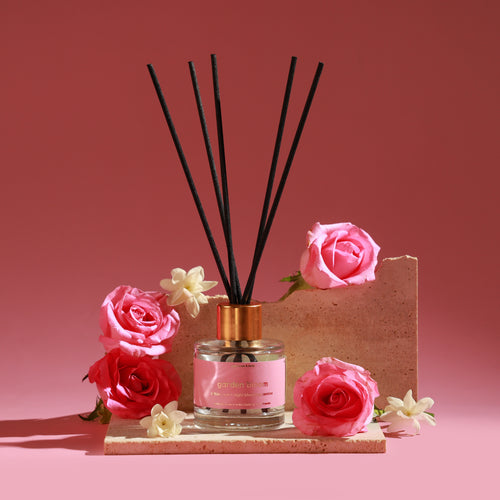
Two design briefs, written out as they would actually read
The clearest way to settle this is to write both specifications down and notice that neither contains the other. An engineer given the first brief would arrive at something very like a reed diffuser; an engineer given the second would arrive at something very like a commercial nebuliser. Nothing in the middle is a failure of ambition. They are answers to different questions.
 Mountain Breeze₹849Requirements: no mains power, no battery, no water, no heat, no moving parts, silent, safe to leave unattended indefinitely, no maintenance beyond a few minutes a week, no failure modes, must look like an object on a console table, must run for six to eight weeks on a 50ml at roughly ₹13–₹15 a day, must survive 45°C and 85% humidity without the composition turning. Solution: capillary wicking through six porous fibre reeds — fibre rather than rattan, whose irregular channels wick unevenly in Indian humidity — with evaporation from the wetted surface as the emission mechanism, and a heat-stable CCT carrier so the oil is not the weak link. Accepted consequences: output is bounded by the wetted surface and the room’s conditions; concentration falls with distance; there is no on-off switch. Every one of those is a signed-off trade, not an oversight.
 Vaayu class₹11,999Requirements: a stated coverage in cubic metres, even concentration across that volume, programmable run windows so intensity tracks occupancy, adjustable output, tamper resistance, quiet enough not to intrude, mountable into the building’s ventilation, serviceable, and the same fragrance available in bulk for years so a returning guest recognises it. Solution: waterless cold-air nebulising — pressurised air shatters undiluted oil into a dry micro-mist that travels with the airflow the building already has. No water, no dilution, no heat, no added humidity, no white dust. Vaayu is the domestic-scale member of this family: up to 1000 m³, a 400ml tank lasting up to about 90+ days, Bluetooth app and onboard buttons, 1h/4h/8h/24h windows, key-lock, under 38 dB, 5W, CE, RoHS, SGS. Accepted consequences: a plug, a device on the wall or floor, a refill schedule, and a price that only makes sense against a large volume.
 Sukoon₹1,899This is the sentence that makes the whole comparison make sense. Fragrance does not travel across a room for free; something has to move the air, and moving air takes energy. A reed spends zero and therefore gets zero transport — and in exchange asks you for nothing at all. An ultrasonic machine spends mains electricity on a piezo plate that shatters a water-and-oil mixture into a visible wet mist, which is why Sukoon genuinely covers 270–320 sq ft — and in exchange asks for a socket, a tank, refilling, added humidity and, in hard-water cities, the occasional film of white mineral dust. A cold-air nebuliser spends energy compressing air and asks for charging or power and a device on the shelf. The bill always arrives; only the currency changes.
What a lobby is actually solving for, and why almost none of it applies at home
Strip the romance away and a lobby scenting brief is a set of unglamorous operational problems. The volume is enormous and the air exchange is constant — doors open every few seconds, ventilation runs continuously, and any fragrance introduced is being removed almost as fast as it arrives, so output has to be sustained rather than dramatic. The audience is entirely un-adapted: a guest walks in from a car park having smelled nothing like it, which is the single biggest reason the effect lands, and it is the one variable you can never reproduce in your own home because you live there. And the fragrance must be identical this year and next, in bulk, because recognition on a second visit is the actual commercial objective. Consistency is doing as much work as intensity.
There is a further design decision most people never notice, and it is the one I find most instructive. You cannot find the diffuser in a hotel. There is usually no object in the room to find, because the scent is introduced into the building’s moving air rather than released from something on a table. That means there is no gradient to walk up and no source to locate — the fragrance appears to be a property of the space itself. In a home, by contrast, the source is visible, and that changes the psychology entirely: a beautiful glass bottle with six reeds in it is furniture and part of the pleasure, whereas a hidden machine would just be scent with no author. This is a genuine reason to want a reed rather than a device, and it never appears in a comparison table.
So “lobby projection at home” imports a set of requirements you mostly do not have. You are not solving for hundreds of un-adapted arrivals, you are solving for one adapted person and the occasional guest. You are not solving for constant air exchange, you are solving for a closed door. You are not solving for brand recognition across years, though keeping one scent for a year is genuinely the most luxurious thing you can do at home and costs nothing. The part of the lobby experience that transfers is evenness and consistency. The part that does not is scale. Recognising which half you actually wanted is the entire purchase decision.
| Specification line | Reed diffuser — passive capillary | Lobby-class machine — waterless cold-air nebulising |
|---|---|---|
| Rated space | 50ml up to ~150 sq ft; 130ml above 150 sq ft | Vaayu up to 1000 m³ — roughly 2,000–3,000 sq ft |
| Concentration profile | Highest at the bottle, falling with distance — a fragrant zone | Broadly even across the rated volume — a fragranced space |
| Energy | None. No socket, no battery, works in a power cut | 5W mains, or a rechargeable battery in the personal-scale Safar |
| Noise | Silent — there is nothing to measure | Under 38 dB on Vaayu, which its own page calls quiet enough for a bedroom |
| Control | Reed count only. It cannot be switched off | App plus onboard buttons, 1h/4h/8h/24h windows, chosen days, adjustable intensity, key-lock |
| Maintenance | Flip six fibre reeds every 3–5 days. Nothing else, ever | 400ml tank up to about 90+ days, plus mounting, power and servicing |
| Payload | Neat oil evaporating from fibre | Undiluted oil shattered into a dry micro-mist — no water, no humidity, no white dust |
| Running cost | About ₹13–₹15 a day on a 50ml, electricity nil | ₹11,999 up front, then oil and power |
| The honest gap: between Safar ₹3,999 — personal scale, named and sold as a car and travel diffuser, no published room-coverage figure — and Vaayu’s 2,000–3,000 sq ft, SOSA has no mid-sized waterless bedroom nebuliser. Nothing in the catalogue is “a Vaayu for one room”. | ||
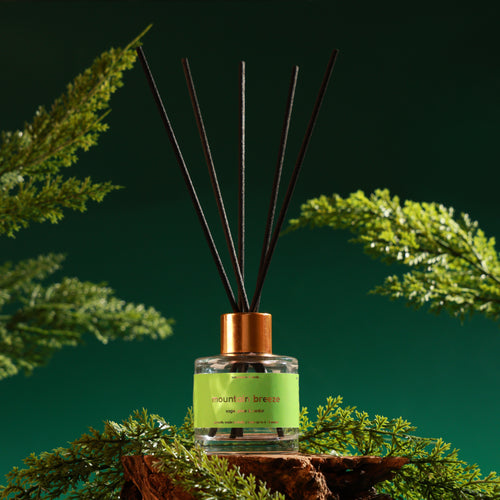 A room · Mountain Breeze₹849Shop →
  A bedroom, powered · Sukoon₹1,899Shop →
  The oils · Hotel Collection₹999Shop →
Why the reed’s brief is worth respecting rather than apologising for
In a category that talks constantly about strength, it is worth naming what the reed wins outright. It is the only format that works when the power is out, which in a great many Indian homes is not a theoretical advantage. It is the only format with no failure mode — nothing to burn out, no pump to clog, no plate to descale, no battery to degrade after two years. It is the only format that cannot be forgotten, in either direction: you cannot leave it running, and you cannot fail to switch it on. It is the only format with no consumable other than the oil itself, no water, no filter, no cartridge. And it is the only one that goes wherever you want it — a bathroom windowsill, a shelf with no socket within four metres, a guest room used twice a year.
Then there is the object. A refillable glass bottle with six fibre reeds is a piece of furniture that happens to emit fragrance; it does not need to be hidden, apologised for or explained. Machines, however carefully designed, remain devices. In a bedroom that difference is not trivial, and it is one of the two reasons I keep a reed on my own bedside table — the other being that it makes no sound whatsoever, which matters more at two in the morning than any coverage figure.
And there is a maintenance point that people discover only in the second year. A machine has a service life and a cleaning routine; a reed diffuser has neither. Four minutes every three to five days to flip the sticks — which re-wets the dry upper length and restores the lift — and a refill when the bottle runs low. That is the entire ownership burden, and it is the reason a reed is still working, unremarkably, in the guest room three years after purchase. Being fair to the reed is not brand loyalty. It is noticing that the specification it meets is a genuinely difficult one to meet, and that no machine meets it.
What to buy, in order — and the rung that does not exist
Chosen by the brief you are actually writing rather than by how impressive the specification reads. The last row is the honest gap in the range, and it is the row that stops this being a simple ladder.
| If your brief is | What it is | When it is the right answer | Price |
|---|---|---|---|
| 1. Silent, unpowered, unattended ambient scent ★ | A reed diffuser — six fibre reeds, refillable glass, 50ml up to ~150 sq ft for 6–8 weeks, 130ml above that for 14–18 | Bedrooms, bathrooms, guest rooms, studies, anywhere with no socket — and anywhere you do not want an appliance. About ₹13–₹15 a day | ₹749–₹1,349 |
| 2. Even coverage of one bedroom, water acceptable | Sukoon — ultrasonic water mist, 500ml, 270–320 sq ft, 16–18 hours on low, three 15ml Hotel Collection scents included | The value answer for a real bedroom, accepting dilution, humidity, refilling and a plug | ₹1,899 |
| 3. The hotel mechanism at personal scale, no water | Safar — waterless cold-air nebulising, undiluted oil, 20ml, 2000 mAh Type-C, up to 10 hours continuous or ~30 intermittent, 3 speeds, 1/2/3-hour auto-off, 6.9 cm. Named and sold as a car and travel diffuser, with bedside and hotel room among its stated uses | Desks, bedsides, travel. No published room-coverage figure, and it is not always-on — it runs on a timer and needs recharging | ₹3,999 |
| 4. An actual building brief | Vaayu — up to 1000 m³ or roughly 2,000–3,000 sq ft, 400ml tank up to about 90+ days, app plus onboard control, 1h/4h/8h/24h windows, key-lock, under 38 dB, wall or HVAC mount | Open-plan living-dining, a whole floor, a villa, a clinic, a salon, a showroom, a reception — or genuinely wanting one machine to scent the whole flat. Not one bedroom | ₹11,999 |
| Never as a size upgrade: Megh | 6L tank, around 100 hours of runtime, about 215 sq ft of coverage | Less coverage than the ₹1,899 Sukoon. A runtime and humidity machine — the biggest tank is not the strongest machine | ₹3,499 |
| The honest gap | No mid-sized waterless bedroom nebuliser exists at SOSA — nothing between Safar and Vaayu, so a reader who wants the lobby mechanism in one room has no purpose-built option | Said plainly, because it is the reason this ladder has a missing rung rather than a neat middle | — |
Versailles
I am asked some version of this question every week, and it almost always arrives with an apology attached — as though wanting a lobby feeling were greedy, or as though the reed had let somebody down. Neither is true. You are comparing a domestic object to a piece of building services equipment, and the honest response is not to make the object feel inadequate but to explain what each one was drawn up to do.
When we designed the reed line, the arguments were never about projection. They were about whether a carrier would survive a Delhi May — DPG can crack and go bitter above 40°C, which is why we pay more for CCT — and whether fibre reeds would wick evenly through a Mumbai August where rattan fades at the dry end. Those are the problems a reed diffuser exists to solve, and getting them right is genuinely difficult. Nobody ever asks about them, because when they are right the product simply works for six weeks and says nothing.
So no, a reed is not designed for lobby projection, and I would not want it to be. The moment you ask a reed to project you have to give it a motor, and then you have given away the silence, the independence from power, the absence of anything to fill, and the fact that it looks like glass rather than like a gadget. If you want the lobby mechanism, buy the machine that was drawn up for it and buy it at the right size — and if that size is a bedroom rather than a floor, be aware that our own range has a missing rung in the middle. Everything is composed in Pune, and part of every order funds a girl’s classroom through Nanhi Kali.
Frequently asked questions
- Can a reed make an entire bedroom smell like a hotel? — the answer in the first sentence.
- Strong beside the bottle, weak from the bed — the distance-decay page.
- I added more reeds and it still is not hotel-like — why the ceiling is structural.
- Two reeds or an upgrade? — two bottles give two zones, not one room.
- Flipping the reeds constantly — a 3–5 day cadence, not a daily fix.
- A fragrant corner instead of a scented room — emission, transport and removal.
- Are reeds the wrong format for me? — sometimes yes, said plainly.
- When to stop searching for a stronger reed — the checklist.
- Did I actually need active scenting? — the family pillar.
- Brand: the SOSA founder story.
Facts verified August 2026: Three diffusion mechanisms are described — passive capillary (reed diffusers), ultrasonic water mist (Boond ₹899, 300ml, up to ~150 sq ft, ~6 hours, USB, night light; Sukoon ₹1,899, 500ml, 270–320 sq ft, 16–18 hours on low, three 15ml Hotel Collection scents included; Megh ₹3,499, 6L tank, ~100 hours runtime, ~215 sq ft, which is less coverage than Sukoon) and waterless cold-air nebulising (Safar ₹3,999, 20ml bottle, 2000 mAh Type-C battery, up to 10 hours continuous or around 30 hours intermittent, 3 speeds, 1/2/3-hour auto-off timer, 6.9 cm, named and sold as a car and travel diffuser with car, handbag, desk, bedside and hotel room among its stated uses, no published room-coverage figure; Vaayu ₹11,999, coverage up to 1000 m³ or roughly 2,000–3,000 sq ft, 400ml refillable tank lasting up to about 90+ days, Bluetooth app and onboard buttons, 1h/4h/8h/24h run windows, choice of days, adjustable mist intensity, key-lock, under 38 dB, freestanding or wall/HVAC mount, 5W, CE, RoHS, SGS). Aangan ₹25,999 and Meenar ₹38,500 are HVAC systems for 8,000–10,000 and 12,000–18,000 sq ft respectively and are commercial equipment, never a home recommendation. SOSA reed diffusers: five scents, 50ml ₹749–₹849 lasting 6–8 weeks and suiting rooms up to ~150 sq ft, 130ml ₹1,249–₹1,349 lasting 14–18 weeks and suiting above 150 sq ft, six fibre reeds included and flipped every 3–5 days, about ₹13–₹15 a day, heat-stable CCT carrier rather than DPG, alcohol-free, phthalate-free, paraben-free, IFRA-compliant, 0 ppm formaldehyde, refillable glass bottle, climate-tested at 45°C and 85% RH, composed in Pune. SOSA strength scale: Evening Calm 8.9, Garden Bloom 8.9, Morning Freshness 9.0, Mountain Breeze 9.4, Fresh Brew 9.5. Hotel Collection fragrance oils are water-based and ultrasonic-only at 15ml ₹299 (a refill), 100ml ₹999, 300ml ₹1,799 and a pack of seven at ₹1,799; they cannot be used in reed diffusers and reed oil cannot be used in ultrasonic machines, so no hotel-inspired reed diffuser exists. No health, air-quality, allergy or antimicrobial claims are made, and fragrance does not remove a smell — source, then ventilation, then fragrance. Free shipping above ₹499. A portion of every order supports girl-child education through Nanhi Kali. SOSA is an independent Indian fragrance house; the Hotel Collection scents referenced here are SOSA’s own interpretations inspired by the world’s finest hotels, and SOSA is not affiliated with, endorsed by or a supplier to any hotel brand. Prices subject to change — see the live product pages.