

How often: every 3–5 days for most of the range, every 5–7 days for Garden Bloom. Not daily, and not on a schedule you have to remember more than twice a week.
How many reeds: three in a closed AC bedroom. Six is a living-room setting and overshoots a sealed room. Three is a soft bedside level and roughly doubles how long the bottle lasts.
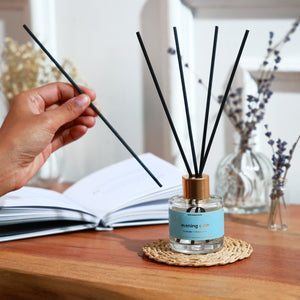
The thing not worth doing: flipping every day. It does not make the room stronger for longer — it spends the bottle faster for a slightly higher average. And there is no automatic or timed reed system at SOSA, no plug-in and no timer; the flip is a hand on a bottle twice a week, which is the entire maintenance burden of this product.
2. Do not flip in the morning on your way out. That is the commonest habit and the least useful one, because the strongest hours of the cycle are then spent in an open room with nobody in it. Fragrance evaporating into an empty room is the single largest source of waste in home fragrance, and a morning flip deliberately concentrates the waste.
3. Understand what the AC is doing, because it cuts both ways. A running air conditioner recirculates the air within a closed room, which distributes the fragrance evenly and is a large part of why a bedroom reads strongest at night. It also dries that air, which speeds evaporation. So an AC bedroom is simultaneously a better distribution environment and a faster-consuming one, and both halves are worth knowing before you decide anything.
4. Keep the cadence at three to five days. Every 3–5 days for most of the range and every 5–7 for Garden Bloom. Flipping daily does not give you a permanently stronger room; it gives you a slightly higher average and a noticeably shorter bottle. Two fixed evenings a week is enough for anybody.
5. Use three reeds, not six, and change the dial before you change the bottle. Six fibre reeds come in the box. Six is full projection and belongs in a living room; three is a soft bedside level and roughly doubles the life of the bottle. In a sealed, recirculating bedroom, three is almost always the right number, and it costs nothing to try.
Alcohol-free, phthalate-free, made in Pune. A portion of every order supports girl-child education through Nanhi Kali.
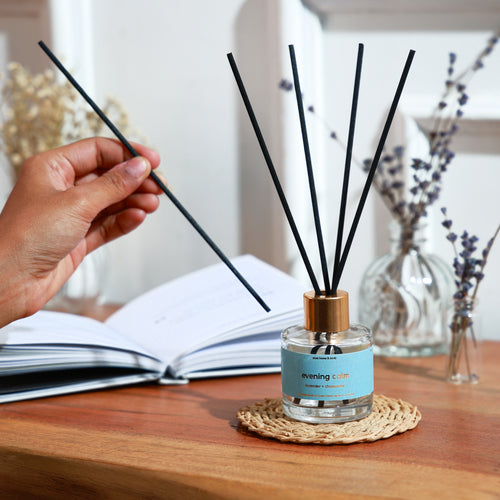
What flipping actually does to a reed, and why it is a burst rather than a reset
A fibre reed works by capillary action: oil climbs the reed from the bottle, and evaporation happens from whatever length of it is standing in the air. Over a few days the exposed upper section gives up its lightest, most volatile material and slows down, while the buried end stays fully saturated. Turning the reed over swaps a tired surface for a wet one, which is why the room lifts within the hour and why the lift then tapers as the newly exposed length starts to behave like the old one. It is not a reset and it is not a refill. It is a few hours of restored projection, bought from the same bottle.
That is worth stating plainly because of the anxiety underneath the question. A great many people notice a diffuser is loud in the first week and quiet by the third and conclude something has gone wrong. Nothing has. The opening days run hot because the reeds are still saturating and the lightest materials leave first; what you have in week three is the heart and base of the composition, which is how it was designed to sit in a room. It is not fading, it is settling, and a flip restores projection without opening a new bottle. If you were about to buy a replacement, flip first and wait a day.
The second half of the diagnosis is your own nose. Olfactory receptors adapt to an unchanging stimulus within minutes, so you stop reporting a smell you are sitting inside long before it stops arriving. This is exactly why you can smell other people's homes and not your own. Before you decide the reeds need flipping, leave the room for a quarter of an hour and walk back in; if it reads properly on the way in, the bottle is fine and the flip can wait for its scheduled evening. A visitor is a better instrument than you are.
 Evening Calm₹799A reed diffuser has no fan. In a still room the fragrance sits in a slow plume around the bottle and reaches the rest of the room by drift, which is why placement matters so much for reeds and so little for machines. Switch on a split AC in a closed bedroom and the room acquires a circulation pattern: air is drawn in, cooled and pushed back out, over and over, within the same four walls. The fragrance stops being a plume and becomes the property of the whole room. That is the single best distribution condition a reed diffuser gets in an Indian flat, and it is available to you for eight hours a night at no extra cost. An evening flip is simply the decision to put your best few hours of projection inside that window.
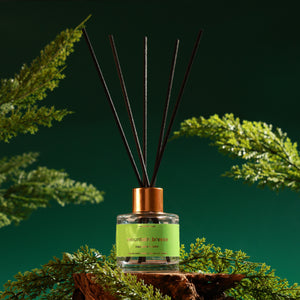
 Mountain Breeze₹849An air conditioner cools by condensing moisture out of the air, so a room that has run one for a few hours is a drier room. Dry air takes up volatile material more readily than saturated air does, and moving dry air more readily still. The consequence is honest and unglamorous: a bedroom on nightly AC will empty a bottle faster than the same bedroom simply shut. Expect better distribution and a shorter bottle life together, because they have the same cause. This is not a reason to avoid the AC or to buy a larger bottle. It is a reason to run three reeds rather than six, which roughly doubles the life and, in a sealed recirculating room, costs you almost nothing in perceived strength.
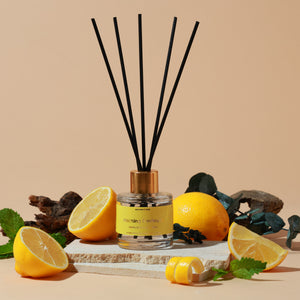
 Morning Freshness₹749Everything in home fragrance eventually reduces to occupancy. A reed diffuser cannot be switched off, so it runs all day whether the bedroom is used or not — that is a genuine limitation of the format and I would rather name it than pretend otherwise. What you can control is when the strongest few hours happen, and a flip is the only lever you have. Spend it on the evening. If the room is entered at ten and slept in until six, an evening flip means the projection curve and the occupancy curve overlap instead of missing each other by twelve hours. It is the free half of this entire page.
Why the evening beats the morning, and why bedtime is not quite right either
There is a smaller distinction inside the answer that is worth having. Flipping as you climb into bed is much better than flipping on your way to work, but it is still slightly late, because you are then standing in the room while the burst builds. The nicer version is to flip when you finish dinner and shut the bedroom door behind you, so that the AC has had a while to distribute it and the room is already even when you walk in. A home fragrance is designed to be noticed on arrival and at transitions — walking in, coming out of the bathroom, sitting down after a long day — rather than perceived continuously. Arriving into a settled room is the whole effect. Watching it arrive is not.
The other reason to prefer the earlier evening is that it removes the flip from the part of the day you are least likely to do it. A ritual attached to dinner survives; a ritual attached to being half asleep does not. This is the same argument as putting the diffuser somewhere it is never moved: the setup that requires nothing of you is the one that still works in six weeks. Nobody has ever abandoned a reed diffuser because the composition disappointed them. They abandon it because it drifted into the category of things that need attending to.
One caution that belongs here rather than anywhere else. If the bedroom has a diya, an agarbatti or a candle in it at any point in the evening, keep the diffuser well away from all three. Fragrance oil is flammable and a reed diffuser is an open vessel of it, so distance is not a formality. That applies to the bedside table more than most surfaces, because it is where a candle usually ends up.
| When you flip | Where the burst lands | Whether you are in the room | Verdict |
|---|---|---|---|
| Early evening, before the room closes ★ | The closed, recirculating, occupied hours | Yes, from the moment you walk in | The right answer. Arrive into a room that has already settled |
| At bedtime, once you are in the room | Mostly the sleeping hours | Yes, but adapted within minutes | Good, not best. You miss the arrival, which is when it registers |
| Morning, on your way out | An empty, open bedroom | No | The commonest habit and the most wasteful one |
| Mid-afternoon | An empty room, partly recovered by evening | No | Harmless, but you have spent the lift on nobody |
| Every day, whenever you remember | A slightly higher average, permanently | Sometimes | Not an upgrade. It shortens the bottle for a small gain |
Softest · Evening Calm₹799Shop → 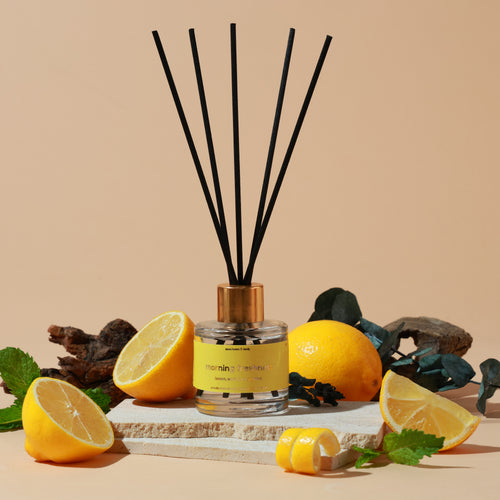 Bright · Morning Freshness₹749Shop →
 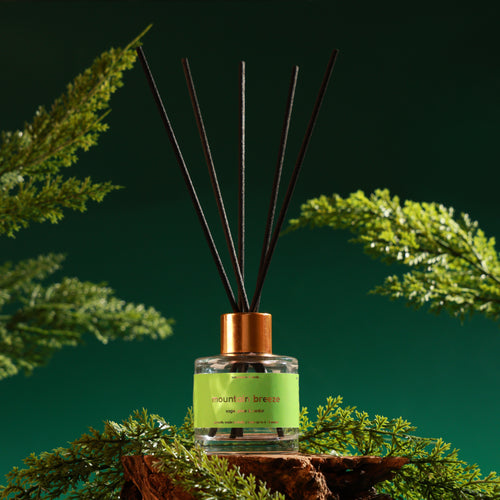 Green · Mountain Breeze₹849Shop →
Cadence — three to five days, and why daily is the wrong instinct
The cadence is every three to five days across most of the range, and every five to seven for Garden Bloom, whose heavier floral materials take longer to work up a fresh reed. That interval exists because a flipped reed needs time to give up its new surface; flip again before it has and you are turning a wet reed over to expose another wet reed, which produces very little and costs you oil. Daily flipping buys a modestly higher average projection and a materially shorter bottle, and in a small closed bedroom the higher average is usually not even something you want.
There is a related instinct worth talking people out of, because it is expensive. If the room seems quiet, the reflex is to add reeds — four, five, all six. More reeds is stronger and shorter, which is not the same thing as better. Six reeds is a living-room dose. In a sealed bedroom of ordinary size it usually overshoots, and the complaint that follows a few days later is that the fragrance has become cloying, which is nearly always a description of concentration rather than of the composition itself. The same oil at a lower dose reads as layered, because the nose has room to separate the materials in it. Restraint is the cheapest luxury signal there is.
Practical care, briefly, because it belongs to the same weekly minute. Handle the reeds by the dry end and wipe the neck of the bottle when you flip, since a little oil always runs down. Do not wipe a reed with a wet cloth. Keep the bottle out of direct sun and off a sill. Choose a spot nothing needs to be cleaned around, because a diffuser that gets moved daily performs worse, spills eventually and slowly becomes something you resent. And keep the unused reeds dry in the box — they are the reserve you draw on if you ever move the bottle to a larger room.
What to buy for a night-only AC bedroom — and what not to
The shopping list here is short, and the last row of it is deliberately not a product. A night-only AC bedroom needs one 50ml bottle, three reeds and a habit; it does not need a bigger bottle, a second device, or anything that promises to do the flipping for you.
| Buy | What it is | When it is the right answer | Price |
|---|---|---|---|
| 1. Evening Calm 50ml ★ | Kashmir lavender, chamomile, soft musk drydown — 8.9, the softest we make | The default bedside bottle. Three reeds, flipped in the evening | ₹799 |
| 2. Morning Freshness 50ml | Malabar lemon, peppermint, eucalyptus globulus — 9.0, bright | If you want the bedroom to read clean and light rather than quiet | ₹749 |
| 3. Mountain Breeze 50ml | Himalayan pine, sage, Indian cedar — 9.4, deep woody | For anybody who finds florals and lavender oppressive | ₹849 |
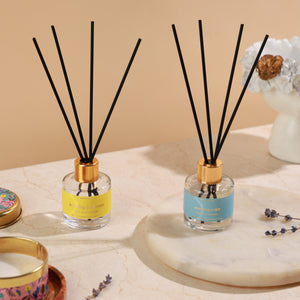
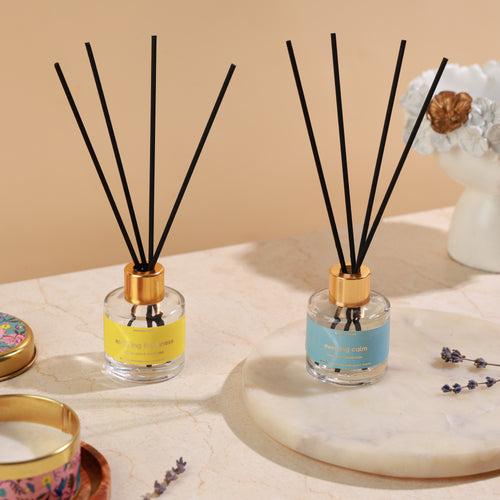
| 4. Day & Night duo | Morning Freshness and Evening Calm as two 50ml bottles — not a set or a box | Only if you are doing a second room at the same time | ₹1,498 |
| The honest gap: anything that flips the reeds for you | There is no timer, no automatic or scheduled reed system, no plug-in and no subscription at SOSA, and no product of any kind that raises projection only during the hours you are asleep. A reed cannot be switched off. Flipping oftener is not an upgrade and a larger bottle does not release faster — it simply holds more | Said plainly, because this is the thing people most expect to be able to buy | ₹0 |
Versailles
The flip is the only interaction a reed diffuser asks of you, and almost nobody is told when to do it, so people default to the morning because that is when they are tidying. It is a reasonable instinct and it is the wrong hour. The best few hours a bottle produces should not be spent on an empty room, and in a house where the bedroom is used from ten at night, the empty room is exactly what a morning flip buys.
What makes the night-only AC bedroom interesting to me as a perfumer is that it is the one place in an Indian flat where a reed diffuser gets ideal conditions and a penalty at the same time. The recirculation is a gift — it does the distribution work that a reed cannot do for itself. The dryness is the bill. Knowing both keeps you from misreading either: you are not imagining that the room smells better at night, and you are not imagining that the bottle goes faster in that room than in another one.
So: three reeds, an evening flip on two fixed days, and nothing else. If a page about home fragrance can save somebody from buying a second bottle they did not need, it has done more for them than the first one did. Everything is composed in Pune, and a part of every order funds a girl's classroom through Nanhi Kali.
Frequently asked questions
- Why the bedroom smells stronger at night — three real mechanisms, not one.
- Windows open by day, AC at night — the commonest Indian pattern there is.
- Fewer reeds in a sealed bedroom? — yes, and by how much.
- Finishing faster in the heat — two accelerators, both normal.
- The lowest-effort night setup — and when to switch Sukoon on.
- Reed or Sukoon for a night-only bedroom — the honest split.
- Do I need it running all day? — and the economics of a night-only bedroom.
- Brand: the SOSA founder story.
SOSA reed diffusers — facts verified August 2026: Five scents, all alcohol-free, on a heat-stable CCT (caprylic/capric triglyceride) base rather than DPG, which can crack and go bitter above 40°C; phthalate-free, paraben-free, IFRA-compliant, 0 ppm formaldehyde, six fibre reeds rather than rattan in a refillable glass bottle, composed and made in Pune, India. Morning Freshness 50ml ₹749 · 130ml ₹1,249 · 9.0, with a eucalyptus globulus base that slows lemon evaporation three to four times. Evening Calm 50ml ₹799 · 130ml ₹1,299 · 8.9, the softest in the range. Garden Bloom 50ml ₹799 · 130ml ₹1,299 · 8.9, with indole held below the fecal threshold so jasmine stays floral above 30°C. Mountain Breeze 50ml ₹849 · 130ml ₹1,349 · 9.4. Fresh Brew 50ml ₹849 · 130ml ₹1,349 · 9.5, the deepest. Longevity 6–8 weeks on 50ml and 14–18 weeks on 130ml; 50ml suits rooms up to about 150 sq ft and 130ml above that. Six reeds is full projection, three is a soft bedside level and roughly doubles the life; two or three reeds in a 50 sq ft bathroom can make a 50ml last nearly three months. Flip cadence every 3–5 days, or 5–7 days for Garden Bloom. Cost per day roughly ₹13 for Morning Freshness or Garden Bloom 50ml and ₹15 for Evening Calm, Mountain Breeze or Fresh Brew 50ml. Duos: Day & Night ₹1,498, Fresh & Grounded ₹1,548, Warmth & Bloom ₹1,598. Refills 300ml ₹2,399 · 500ml ₹3,499, oil only and not a first purchase. Machines: Boond ₹899 (300ml, up to about 150 sq ft, around 6 hours, USB, night light), Sukoon ₹1,899 (500ml, 270–320 sq ft, 16–18 hours on low, three 15ml scents included), Megh ₹3,499 (six-litre tank, around 100 hours, but only about 215 sq ft — a runtime and humidity machine, never a coverage upgrade). Climate-tested through 45°C heat soak and 85% relative humidity. The reed line contains no oud, sandalwood, vetiver or amber; Smoked Oudh and Sandalwood exist as ₹449 jar candles. SOSA sells no room spray, air purifier, dehumidifier, odour eliminator, plug-in, timer or subscription, and every SOSA spray is a car perfume. Reed oil and the water-based Hotel Collection are separate systems and are not interchangeable in either direction. Free shipping above ₹499. SOSA is an independent Indian fragrance house and is not affiliated with or endorsed by any hotel brand. Prices subject to change — see the live product pages.