

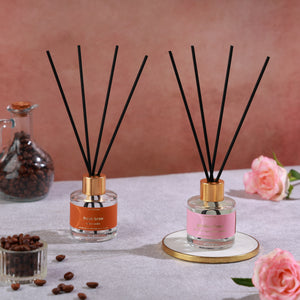



The one-off cost: Sukoon ₹1,899 once, covering 270–320 sq ft with three 15ml Hotel Collection scents included, or Safar ₹3,999 once — named and sold as a car and travel perfume diffuser — plus oil in both cases.
What I will not do: compute a running cost for a machine. SOSA publishes no oil-consumption rate for Sukoon, Safar or Vaayu, so any per-day figure I gave you would be invented. I would rather leave the comparison incomplete and honest.
The counterweights, both directions: a machine needs power, needs filling or charging, and has a service life. A reed is silent, needs nothing, works in a power cut and never breaks.
When a second reed genuinely is right: a long or L-shaped room used at both ends, two rooms that are really one volume, wanting different scents in different zones, or a budget short of a machine. Not evenness across one open room.
The honest gap: between Safar ₹3,999 and Vaayu ₹11,999, rated to 1000 m³ or roughly 2,000–3,000 sq ft, there is no mid-sized waterless bedroom nebuliser.
2. Which means the second bottle buys a second zone, not a fuller room. Put another diffuser across the room and you get two peaks with a valley in between; the middle of the room is the farthest point from both sources and neither is pushing anything towards it. You cannot fix a transport problem by increasing emission, and a second bottle is purely an increase in emission. This is the single most expensive misunderstanding in home fragrance, because it is repeatable — people buy a second, then a third, and each one is a rational response to a wrong diagnosis rather than a foolish decision. Anybody told that a diffuser scents a room would reasonably conclude that two would scent it more.
3. Now the money, with the figures that actually exist. A 50ml reed costs ₹749–₹849 and runs six to eight weeks, which is roughly ₹13 a day for Morning Freshness or Garden Bloom and roughly ₹15 for Evening Calm, Mountain Breeze or Fresh Brew. Two bottles in one room is roughly ₹26–₹30 a day and it does not stop, because a reed is a consumable. Sukoon is ₹1,899 once — about the price of two and a bit reed bottles — and covers 270–320 sq ft on a 500ml tank for 16–18 hours on low, with three 15ml Hotel Collection scents in the box. Safar is ₹3,999 once.
4. And here the comparison has to stop being a comparison, which I would rather say than fudge. A machine also consumes oil, and SOSA publishes no oil-consumption rate for Sukoon, Safar or Vaayu. That means I cannot honestly tell you what a machine costs per day, and any figure I offered would be a guess dressed as arithmetic. So the truthful summary is this: the reed's recurring cost is known and certain; the machine's is unknown to me. What is certain about the machine is the one-off — ₹1,899 or ₹3,999 — and what is certain about two reeds is that the meter never stops. Weigh that asymmetry yourself rather than letting me resolve it with an invented number.
5. The counterweights, in both directions, because they are what actually decide this. A machine needs a power socket or a charger, needs its tank filled or its battery topped up, needs switching on, and has a service life — there is a plate or a pump in it that will eventually stop. Safar's timer runs 1, 2 or 3 hours and then stops, so it is not set-and-forget. Against that, a reed diffuser is silent, uses no power, has nothing to fill or charge and nothing to remember, works during a power cut, is an object rather than an appliance, and it never breaks. If you value that list, the honest recommendation shifts — and there is a middle path: keep the reed and buy a machine, rather than buying a second reed. That is what I would do.
Alcohol-free, phthalate-free, made in Pune. A portion of every order supports girl-child education through Nanhi Kali.

The three ways you could spend this money
You framed it as two options and there is a third that people rarely consider, so here are all three, each judged on what it delivers rather than on what it costs. Notice that only one of them changes the mechanism, and the mechanism is the thing your complaint is actually about.
 Mountain Breeze₹849₹749–₹849 for a 50ml, or ₹1,249–₹1,349 for a 130ml, which runs 14–18 weeks instead of 6–8 and reaches no further whatsoever — bottle volume is a duration specification, not a coverage specification. Two bottles in one room is roughly ₹26–₹30 a day indefinitely, and what you get for it is a second concentration peak with a valley in the middle. If your room is long, L-shaped or used at both ends, that second peak is genuinely useful and this is the right purchase. If your room is one open volume and you want it consistent, this is the purchase that will bring you back here in two months about a third bottle.
 Sukoon₹1,899Two mechanisms sit here and they are not the same thing. Ultrasonic — Boond ₹899 up to about 150 sq ft, Sukoon ₹1,899 for 270–320 — vibrates a water-and-oil mixture into a visible wet mist that moves through the room; the oil is diluted, the output adds humidity and hard water can leave a white mineral dust. Waterless cold diffusion — Safar ₹3,999 — shatters undiluted oil into a dry micro-mist with no water, no dilution, no heat and no added humidity, which is the more elegant mechanism. Safar is named and sold as a car and travel perfume diffuser; SOSA's page also lists a handbag, desk, bedside and hotel room. No room coverage figure is published for it and I will not invent one, and with a 1, 2 or 3-hour timer and a battery to recharge it is not something you leave running for a season.
 300ml refill₹2,399Before either purchase: all six reeds, halve the distance between the bottle and where you sit, nose height on a surface, out of the draught but not in a dead corner, door shut — and the ceiling fan on low, which is the best free advice in this subject, because a fan supplies exactly the transport a reed lacks. It shortens the bottle; say that to yourself and decide knowingly. Then, if the reed keeps its place, deal with the repurchasing rather than the physics: a 300ml refill at ₹2,399 is roughly six 50ml fills for the glass and reeds you already own, and running three reeds instead of six roughly doubles the life of every fill.
The arithmetic, and the number I will not make up
Let me lay the money out cleanly, because you deserve figures rather than adjectives. A 50ml reed at ₹749–₹849 running six to eight weeks is roughly ₹13–₹15 a day. That is a fairer way to read the price than the sticker, because a ₹749 bottle that runs for two months is a different kind of purchase from a ₹749 object. A second bottle in the same room makes it roughly ₹26–₹30 a day, and — this is the part people underestimate — that figure does not decay. It is not an investment with a payback period. It is a subscription you have taken out on a room, and you renew it every six to eight weeks for as long as you want two zones.
On the other side, the one-off numbers are simple. Boond is ₹899, about the price of one reed bottle. Sukoon is ₹1,899, about two and a bit. Safar is ₹3,999, about five. Sukoon includes three 15ml Hotel Collection scents, which is worth noticing in a cost comparison, because it means the machine does not immediately require a second purchase to be usable. But every machine consumes oil while it runs, and SOSA has published no oil-consumption rate for any of them. Without that, there is no honest way to convert a machine into a per-day figure and set it beside the reed's ₹13–₹15. I could produce a number that looked authoritative. It would be fiction, and it would be fiction in a direction that happens to suit a shop, which is the worst kind.
So the comparison ends deliberately unfinished, and here is what remains true inside it. The reed's cost is small, certain and permanent. The machine's cost is larger, one-off, and followed by a consumable whose rate I cannot quote to you. If your instinct is that a machine will work out cheaper over a couple of years, that instinct is reasonable and I cannot prove it for you. If your instinct is that you would rather keep a known small recurring cost than take on an unknown one plus a device that can fail, that is equally reasonable. What I would not do is let anybody make this decision on the basis of a per-day figure that nobody has measured — and I have noted internally that this is a gap we ought to close, because it shapes exactly this question for a great many people.
A second reed against a machine, term by term
Every dimension that matters when the money is real, with the reed given full credit on the rows it wins and the machine given it on the rows it wins. The last row is the gap in our own range.
| Term | A second reed diffuser | An active machine | Which wins |
|---|---|---|---|
| Evenness across one room | Two peaks with a valley between. Neither source moves air | Moved air, which is what evenness is made of | Machine, structurally and without argument |
| Up-front cost | ₹749–₹849 for 50ml, ₹1,249–₹1,349 for 130ml | Boond ₹899 · Sukoon ₹1,899 · Safar ₹3,999 | Reed, on the day |
| Recurring cost | Roughly ₹13–₹15 a day per bottle, permanently. Known and certain | Consumes oil at a rate SOSA does not publish. Not estimated here | Undecidable honestly — and saying so is the point |
| Power and maintenance | None whatsoever. Nothing to fill, charge, switch on or remember | A socket or a charger, a tank to fill, a switch, and a service life | Reed, decisively |
| During a power cut | Keeps working, because it never started | Stops, unless it is Safar with charge left in it | Reed |
| Reliability | It never breaks. There is nothing in it to break | Has a lifespan; ultrasonic plates scale up in hard water | Reed |
| Two scents in one room | Easy and rather good — one register by the bed, another by the door | One machine, one scent at a time | Reed |
| Control — on, off, stronger, quieter | Reed count only, and it responds over hours rather than minutes | Speeds, timers and scheduling. Safar has three speeds and a 1 / 2 / 3-hour timer | Machine |
| Keeping your existing fragrance | Yes — the same composition, refillable at ₹2,399 for roughly six 50ml fills | No. Reed oil cannot go into a machine and machine oil cannot go into reeds | Reed, and this surprises people badly |
| The honest gap | Between Safar ₹3,999 — named and sold as a car and travel diffuser, with no published room coverage — and Vaayu ₹11,999 at 1000 m³ or roughly 2,000–3,000 sq ft, SOSA has no mid-sized waterless bedroom nebuliser | Neither. It does not exist | |
Once · Sukoon₹1,899Shop → 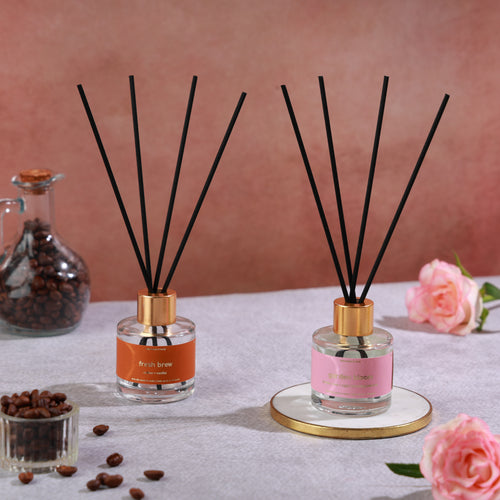 Six 50ml fills · refill₹2,399Shop →
  ₹13–₹15 a day · Mountain Breeze₹849Shop →
When the second reed genuinely is the right buy — and it sometimes is
I have spent most of this page arguing against a purchase, so let me be equally clear about when I would tell you to make it. If your room is long, or L-shaped, or genuinely used at both ends — a bed at one end and a desk at the other, say — then two bottles are not an attempt at evenness, they are two correctly sited point sources serving two places where you actually are. That is a good arrangement and it is what a passive diffuser is for. The same applies to two rooms that are really one volume, such as a bedroom opening onto a study, where a single source would always be favouring one of them.
The second good case is scent rather than coverage. Two registers in one home is a genuinely better experience than one register everywhere, because a home that smells identical in every corner stops registering as smelling of anything within about a week — receptors adapt to a constant stimulus within minutes, and the whole pleasure of home fragrance lives at the transitions. One composition by the bed and a different one by the door gives you a change to cross. A machine cannot do that; it runs one scent at a time. If part of what you want is variety, a second reed is the better purchase and the machine is not competing for the same job.
And the third case is simply budget and temperament. If ₹1,899 is not available right now, or if you do not want another appliance in a bedroom — another socket, another thing to fill, another thing that will eventually stop working — then a second reed is a perfectly rational choice made with open eyes, provided you buy it knowing that it gives you a second zone rather than a filled room. What I object to is not the purchase. It is the purchase made on a diagnosis that will send you back for a third. If you are buying a second reed for one of the three reasons above, buy it with my blessing. If you are buying it because the first one "isn't filling the room", put the money somewhere it can change the mechanism.
What I would actually do with your money
In order, from nothing upwards, with the recommendation falling where the honest reading puts it. Remember at every step what the money is buying: transport, control and evenness, rather than a better smell. A ₹749 reed and a ₹1,899 machine can run related registers and produce completely different rooms, and the difference is not the quality of the fragrance.
| Step | What it is | When it is right | Price |
|---|---|---|---|
| 1. The free fixes, before you spend a rupee ★ | Six reeds, halve the distance, nose height, out of the draught, door shut, ceiling fan on low | Always first. The fan is the transport a reed structurally lacks and it costs nothing but bottle life. A meaningful share of readers stop here and keep the money | ₹0 |
| 2. Sukoon — the honest recommendation if evenness is the goal | Ultrasonic, 500ml, 270–320 sq ft, 16–18 hours on low, three 15ml Hotel Collection scents included. One payment, roughly the price of two and a bit reed bottles | When you want one room consistent rather than two corners strong, and never to be skipped on the way to something dearer. Water-diluted, adds humidity, can leave white mineral dust in hard water, needs power and filling, and has a service life | ₹1,899 |
| 3. 300ml refill — the honest recommendation if the reed keeps its place | Roughly six 50ml fills for the bottle and six fibre reeds you already own. Oil only | The real answer to repurchase fatigue, and cheaper per fill than buying bottles. Only for somebody who already owns the glass. Three reeds instead of six roughly doubles the life of every fill | ₹2,399 |
| 4. A second reed, for the right reason | Evening Calm ₹799 at 8.9 or Mountain Breeze ₹849 at 9.4 — a second register rather than a second attempt | A long or L-shaped room used at both ends, two rooms that are one volume, or wanting different scents in different zones. Silent, no power, nothing to charge, works in a power cut, never breaks | ₹749–₹849 |
| 5. Safar, with the disclosure attached | Waterless cold diffusion of undiluted oil, 20ml, cordless, 2000 mAh, three speeds, 1 / 2 / 3-hour timer, 6.9 cm. Named and sold as a car and travel perfume diffuser | When undiluted oil with no water and no added humidity matters more than unattended runtime. No room coverage figure is published for it and none is invented here. Not set-and-forget | ₹3,999 |
| The two not worth your money: Megh, and the gap | Megh ₹3,499 has a six-litre tank and around 100 hours of runtime and covers only about 215 sq ft — less than the ₹1,899 Sukoon. It is a runtime and humidity machine, never a coverage upgrade | And between Safar and Vaayu ₹11,999, rated to 1000 m³ or roughly 2,000–3,000 sq ft, SOSA has no mid-sized waterless bedroom nebuliser. Nothing in the range is a Vaayu for one room | — |
Versailles
The reason I wanted to answer this one carefully is that it is a page where a shop has an obvious incentive to be vague. Two bottles is a bigger order than one machine, and one machine is a bigger order than nothing at all, and either answer can be made to sound reasonable if you keep the numbers soft. So here are the hard ones: ₹13–₹15 a day per 50ml bottle, six to eight weeks each, ₹1,899 for Sukoon once, ₹3,999 for Safar once — and no published oil-consumption rate for any machine we sell, which means I genuinely cannot complete the comparison and will not pretend to.
That last admission bothers me more than it will bother you. It is exactly the number this decision needs, we do not have it in a form I would stand behind, and it shapes dozens of questions like yours. Writing "I don't know" in the middle of a buying guide is not comfortable, and it is still the only thing to write, because a fabricated per-day figure would be doing the reader's arithmetic for them with an invented input.
What I would do in your position is stop before either purchase and run the fan on low for a week with the door shut and all six reeds in. If that gets you the room you wanted, you have saved between ₹749 and ₹3,999 and I would rather you kept it. If it does not, then buy the mechanism rather than the quantity — Sukoon at ₹1,899, once — and keep the reed you already have on the bedside table, because the two objects fail in opposite directions and only one of them still works when the power goes. A reed diffuser is the only fragrance in your home that is running right now without anybody having decided so. That is worth something, and it is why I never recommend retiring one. Everything is composed in Pune, and a part of every order funds a girl's classroom through Nanhi Kali.
Frequently asked questions
- Amazing near the bottle, nothing from the bed in 120 sq ft — the free fixes, then the ladder.
- 10 × 12, all the reeds, flipped regularly — you have done everything right.
- Perfect in the bathroom, invisible in the bedroom — the experiment that proves your oil is fine.
- One by the door, one by the bed, still no cloud — two hills, no plateau.
- Larger bottles, same walk-past result — duration is not coverage.
- Same style, more powerful method — what can and cannot carry across.
- Every part of the bedroom, not the whole flat — three options, weighed honestly.
- 150 sq ft with a ceiling fan and a balcony — you may need to buy nothing at all.
- Passive device, active expectation — the pillar, and the close of the whole subject.
- Brand: the SOSA founder story.
SOSA facts verified August 2026: Reed diffusers are supplied in 50ml and 130ml only — 50ml suits rooms up to about 150 sq ft and lasts 6–8 weeks, 130ml suits rooms above 150 sq ft and lasts 14–18 weeks, at roughly ₹13 a day for Morning Freshness and Garden Bloom and roughly ₹15 for Evening Calm, Mountain Breeze and Fresh Brew. Six reeds is full projection; three is a soft bedside level and roughly doubles the life; two or three reeds in a 50 sq ft bathroom can make a 50ml last nearly three months; flip the reeds every 3–5 days. Morning Freshness ₹749 / ₹1,249 · Evening Calm ₹799 / ₹1,299 · Garden Bloom ₹799 / ₹1,299 · Mountain Breeze ₹849 / ₹1,349 · Fresh Brew ₹849 / ₹1,349. Duos: Day & Night ₹1,498, Fresh & Grounded ₹1,548, Warmth & Bloom ₹1,598 in 50ml × 2. Strength scale, perceived intensity rather than quality: Evening Calm 8.9 softest, Garden Bloom 8.9, Morning Freshness 9.0, Mountain Breeze 9.4, Fresh Brew 9.5 deepest. Six fibre reeds rather than rattan, heat-stable CCT carrier rather than DPG, alcohol-free, phthalate-free, paraben-free, IFRA-compliant, 0 ppm formaldehyde, refillable glass bottle, tested at 45°C and 85% RH, composed in Pune. Refills 300ml ₹2,399 — roughly six 50ml fills — and 500ml ₹3,499, oil only. Machines: Boond ₹899 (300ml, up to about 150 sq ft, ~6h, USB, night light) · Sukoon ₹1,899 (500ml, 270–320 sq ft, 16–18h on low, three 15ml Hotel Collection scents included) · Megh ₹3,499 (6L, ~100h runtime but only ~215 sq ft, never a coverage upgrade) · Safar ₹3,999, a waterless cold-diffusion device named and sold as a car and travel perfume diffuser, with a 20ml bottle, a 2000 mAh Type-C battery giving up to 10 hours continuous or around 30 intermittent, three speeds, a 1 / 2 / 3-hour auto-off timer and a height of 6.9 cm · Vaayu ₹11,999, a waterless cold-air nebuliser rated to 1000 m³, roughly 2,000–3,000 sq ft, with a 400ml tank and app control, and the wrong purchase for one bedroom. Reed oil, the water-based Hotel Collection and pure fragrance oil are not interchangeable across these mechanisms. No health, air-quality, allergy, sleep or mood claims are made anywhere on this page. Free shipping above ₹499. SOSA is an independent Indian fragrance house; the Hotel Collection is SOSA's own interpretation inspired by the world's finest hotels and SOSA is not affiliated with or endorsed by any hotel brand. Prices subject to change — see the live product pages.