


For projection in a small bedroom: you need a type that moves air. That rules out passive capillary, which adds none. Ultrasonic gives you air movement cheaply with water; cold-air nebulising gives it to you with undiluted oil and no water.
Three questions to ask any listing: does it add air of its own? Is the oil diluted before it leaves the machine? Can it be switched off or scheduled? Those three answers tell you more than any strength claim.
Read the coverage figure, not the tank size. Megh ₹3,499 has a six-litre tank and about a hundred hours of runtime but covers roughly 215 sq ft — less than the ₹1,899 Sukoon at 270–320. Bigger is not stronger.
The honest gap: in the waterless category SOSA offers Safar ₹3,999 — personal scale, named and sold as a car and travel diffuser, no published room coverage — and Vaayu ₹11,999 at 2,000–3,000 sq ft. There is nothing sized for one bedroom in between.
2. Ultrasonic water mist is the cheap, effective version. A piezo plate vibrates a water-and-oil mixture into a visible wet plume. That plume both delivers fragrance and stirs the room, which is why Sukoon at ₹1,899 can publish a coverage figure of 270–320 sq ft while a reed cannot publish one at all in the same sense. The cost is that the oil is diluted in water, the output adds humidity, the tank needs filling, and in hard-water cities it can leave a fine white mineral dust.
3. Waterless cold-air nebulising is the type hotels use. Pressurised air shatters undiluted oil into a dry micro-mist that stays suspended and travels with the room’s own airflow. No water, no dilution, no heat, no added humidity, no white dust. This is the honest answer to “why doesn’t my home smell like a hotel”, and it is a technology answer rather than a fragrance answer.
4. In a small bedroom, over-specification is a feature and over-dosing is the real risk. A 120 sq ft closed room reaches a perceptible level quickly and holds it, so a machine rated well beyond it should be run low rather than high. The most common failure in a small room is not weakness — it is a fragrance that flattens into a single sweet or sharp impression because the concentration is too high for the nose to resolve the separate materials.
5. And know that the type you probably want at the size you actually have does not exist here. Waterless, room-sized, one bedroom: between Safar at personal scale with no published room coverage and Vaayu at 2,000–3,000 sq ft, SOSA has no mid-sized waterless bedroom nebuliser. That is the gap, and it is why the honest recommendation for most bedrooms remains the ultrasonic one.
Free shipping above ₹499, and a portion of every order supports girl-child education through Nanhi Kali.

The three types, named properly — this is the vocabulary
Every home diffuser ever sold belongs to one of three families, and they are not variations on a theme. They are different physics with different failure modes and different published specifications. Learn the three names and the category stops being confusing, because you will be able to tell within five seconds of opening a product page which one you are looking at.
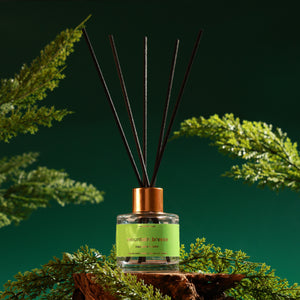
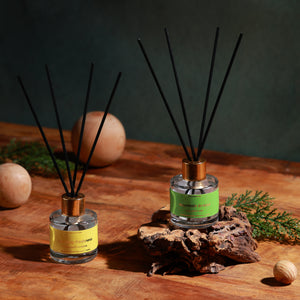
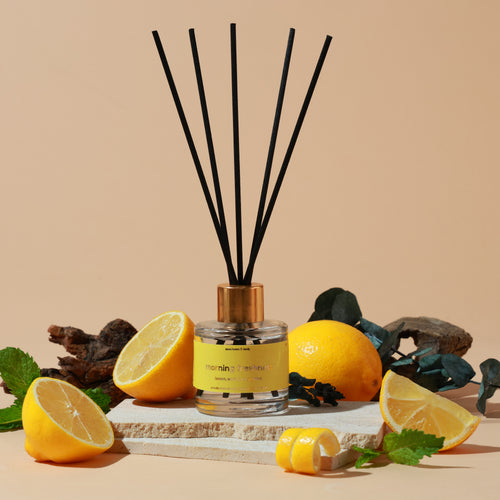
 Mountain Breeze₹849Oil climbs six fibre reeds by capillary action and evaporates from their surface at whatever rate the room’s temperature, humidity and airflow allow. No energy goes in and no air is moved, so concentration is highest at the bottle and falls away with distance — a fragrant zone rather than a fragranced room. That is the design, not a defect, and it is what buys you silence, no power, no water, no charging and no schedule at about ₹13–₹15 a day. Sizing is by room: 50ml for up to about 150 sq ft lasting 6–8 weeks, 130ml above that lasting 14–18. Reed count is the only dial — six for full projection, three for a soft bedside level with roughly double the life.
 Sukoon₹1,899A piezoelectric plate vibrates at high frequency under a water-and-oil mixture and throws it off as a visible wet mist. Because it produces a plume it moves air, and because it moves air it covers a room — a genuine step up in reach. The compromises are inherent to the type rather than to any brand: the oil is diluted in water, the output adds humidity, the tank must be refilled, and in a hard-water city dissolved minerals are left behind as a pale film when the water evaporates. SOSA’s three are Boond ₹899 up to ~150 sq ft, Sukoon ₹1,899 at 270–320 sq ft, and Megh ₹3,499 at only ~215 sq ft.
 Safar₹3,999Pressurised air is forced past a nozzle and shatters undiluted fragrance oil into a dry micro-mist that travels with the room’s own airflow. No water, no dilution, no heat, no added humidity, no white dust. This is the technology luxury hotels actually use, frequently mounted to the ventilation system. SOSA has two: Safar ₹3,999 — a 20ml bottle, 2000 mAh Type-C battery, up to 10 hours continuous or around 30 intermittent per charge, three speeds, a 1/2/3-hour auto-off, 6.9 cm — and Vaayu ₹11,999 at up to 1000 m³. Safar is named and sold as a car and travel diffuser and has no published room-coverage figure, so it is personal and small-space scenting, not a room machine.
What “projection” actually is, and why more oil does not buy it
Projection is the distance at which a fragrance remains perceptible, and it is produced by two things multiplied together: how much leaves the device per hour, and how far the room carries it before it settles or is exchanged away. People shop for the first and ignore the second, which is why the standard response to a patchy room — buy something stronger — so often fails. In a room with no air movement, raising the output raises the concentration near the source and leaves the far corner very nearly where it was. You have not projected further; you have made the near field louder.
The second half, the carrying, is where the three types genuinely separate. A dry mist of undiluted oil is lighter than a wet ultrasonic droplet, so it stays suspended longer and has more time to be moved around the volume before it lands. A wet droplet is heavier and tends to fall, which is why an ultrasonic machine dampens the surface below it and a nebuliser does not. And a reed produces neither — only vapour, drifting on whatever convection the room offers. Same oil, three completely different residence times in the air, and residence time is most of what you experience as projection.
There is a third factor that no equipment addresses, and it is worth naming before you spend. You adapt. Olfactory receptors stop reporting an unchanging stimulus within minutes, so the person living with a fragrance is exactly the person who cannot judge its projection. A visitor is a better instrument than you are. Before buying on the grounds that your current setup is weak, leave the room for fifteen minutes and walk back in, or ask somebody what they notice at the door. A meaningful share of readers who write to me about weak projection have homes that everyone else finds beautifully scented, and finding that out costs nothing.
| Type | How it works | Search term | Projection in a small bedroom | What it costs you | SOSA products |
|---|---|---|---|---|---|
| Passive capillary | Oil climbs six fibre reeds and evaporates. No air added | “reed diffuser” | A fragrant zone, not a fragranced room. Steep gradient with distance | Nothing — silent, unpowered, no water, no charging, ~₹13–₹15 a day | Five reeds, ₹749–₹849 (50ml) · ₹1,249–₹1,349 (130ml) |
| Ultrasonic water mist ★ | Piezo plate throws an oil-and-water mixture as a wet plume | “ultrasonic” or “cool mist diffuser” | Genuine room coverage on demand — the value answer | Water, dilution, added humidity, refilling, possible white mineral dust | Boond ₹899 · Sukoon ₹1,899 · Megh ₹3,499 |
| Waterless cold-air nebulising | Pressurised air shatters undiluted oil into a dry mist | “waterless diffuser”, “cold-air nebuliser” | The hotel mechanism. Safar is personal scale with no published room figure | Price, a small pump sound, recharging (Safar) or installation (Vaayu) | Safar ₹3,999 · Vaayu ₹11,999 |
| Coverage, compared honestly | The figure that matters, where one is published | “coverage sq ft” | Boond ~150 · Sukoon 270–320 · Megh ~215 · Vaayu 1000 m³ (2,000–3,000 sq ft) | Megh has the biggest tank and the second-smallest coverage. Read the figure, not the litres | Safar: no published figure at all |
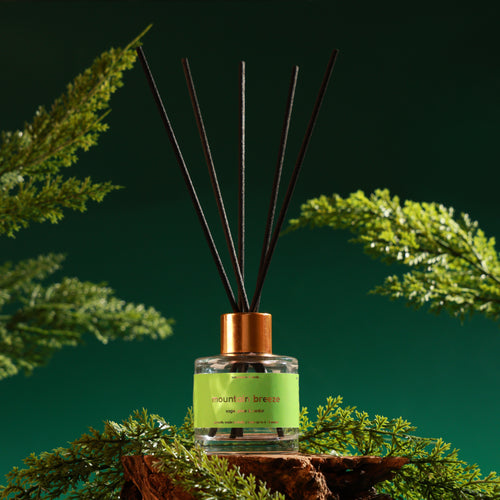 Passive · Mountain Breeze₹849Shop → Ultrasonic · Sukoon₹1,899Shop →
  The oils · Hotel Collection₹999Shop →
How to read a diffuser listing in thirty seconds
First, find the mechanism. If the listing mentions reeds or sticks, it is passive capillary. If it mentions a tank in millilitres or litres, water, or a “cool mist”, it is ultrasonic. If it says waterless, nebulising, cold-air or pure oil, it is the third type. If the listing does not say, look at what it asks you to put in it: water plus a few drops means ultrasonic, neat oil means nebulising. That one detail tells you almost everything about how it will behave in your bedroom.
Second, find the coverage figure and ignore everything adjacent to it. Tank size is runtime, not reach. Our own range is the clearest illustration I can give you: Megh at ₹3,499 has a six-litre tank and around a hundred hours of runtime, and covers roughly 215 sq ft — less than the ₹1,899 Sukoon at 270–320. It is a runtime and humidity machine and never a coverage upgrade. Price is not a proxy for reach either, and a large body does not mean a large room.
Third, ask what happens when no figure is published. When a manufacturer gives no coverage figure, the honest reading is that the product was not specified for a room — not that it is secretly powerful. That is precisely the position with Safar: it is genuine cold-air nebulising, it is a well-made device, and it is named and sold as a car and travel diffuser with bedside and hotel room among its stated uses, but SOSA has published no square-foot figure for it and I will not invent one. If a published number is what you need to decide, the number lives on Sukoon. And if what you want is waterless and room-sized and one bedroom, that product is the hole in this range, sitting between Safar’s personal scale and Vaayu’s 2,000–3,000 sq ft.
What to buy for projection in a small bedroom, in order
By type rather than by product, cheapest honest option first. The last row is the honest gap, and on a vocabulary page it deserves the plainest possible statement: the words you have just learned describe a product category in which SOSA has no bedroom-sized entry.
| Step | What it is | When it is the right answer | Price |
|---|---|---|---|
| 1. Six reeds, better placement, closed door, tested on the walk-in ★ | The free adjustments, plus the only honest measurement — a visitor, or yourself after fifteen minutes out of the room | Always first. It also settles whether your problem is projection or adaptation | ₹0 |
| 2. Passive capillary, sized correctly | 50ml up to ~150 sq ft, 130ml above; six fibre reeds; 6–8 or 14–18 weeks | When you want a silent, unpowered, permanent presence and accept a zone rather than a filled room | ₹749–₹1,349 |
| 3. Ultrasonic water mist — Sukoon ★ | 270–320 sq ft published, 16–18 hours on low, three 15ml Hotel Collection scents included | The type most small bedrooms should buy: real projection, real control, a published figure, ₹1,899 | ₹1,899 |
| 4. Cold-air nebulising — Safar | Undiluted oil, waterless, 3 speeds, 1/2/3-hour auto-off, cordless, 20ml, 6.9 cm | When water is ruled out or you want the hotel mechanism at personal scale. Named and sold as a car and travel diffuser; no published room coverage | ₹3,999 |
| 5. Cold-air nebulising — Vaayu | 1000 m³, 400ml tank, app scheduling, under 38 dB, wall or HVAC mountable | A whole floor, an open-plan living-dining, a villa, a clinic or a showroom. Not one bedroom | ₹11,999 |
| The honest gap | A bedroom-sized waterless nebuliser, which SOSA does not make. The type jumps from personal scale with no published coverage straight to 2,000–3,000 sq ft. Megh ₹3,499 does not fill it either — ~215 sq ft, less than Sukoon | Said plainly, so your next search is not for a product that does not exist | — |
Versailles
The most useful thing I can give a reader in this cluster is not a product. It is three phrases. Passive capillary. Ultrasonic water mist. Waterless cold-air nebulising. Once you have those, you can walk into any shop or any search result and know within seconds what you are looking at and what it will do in your room — and you will stop typing “strongest”, which is a word that appears in marketing copy and never in a specification.
I would also ask you to read coverage figures sceptically, including ours. Megh is the easiest product in our own range to misread: six litres, a hundred hours, ₹3,499, and less coverage than the ₹1,899 Sukoon. It is a runtime machine and it is honest about that, but if you were shopping on tank size you would buy it for the wrong reason.
And where a figure is missing, say so rather than guessing. We have not published a room-coverage number for Safar, which is named and sold as a car and travel diffuser, so I describe it as personal and small-space scenting and leave it there. Above it, Vaayu is 1000 m³, which is a floor rather than a bedroom. The middle of that type is empty in our range, and telling you that is more useful than selling you either end of it. Everything is composed in Pune, and part of every order funds a girl’s classroom through Nanhi Kali.
Frequently asked questions
- Just the bedroom, not the house — zoning as a strategy rather than a compromise.
- 100 sq ft and 10 × 10 — the same footprint, two different questions.
- A 10 × 12 bedroom — the closed-door hours rather than the size.
- Do I really need a machine? — often no, and here is the test.
- Waterless vs reed — undiluted oil plus moved air.
- Only while I’m in the room — the control page.
- A hotel suite, contained — keeping it in one room.
- Reed vs Safar — the head-to-head, scored honestly.
- Brand: the SOSA founder story.
Facts verified August 2026: Passive capillary — SOSA reed diffusers, five scents, 50ml ₹749–₹849 for rooms up to ~150 sq ft lasting 6–8 weeks, 130ml ₹1,249–₹1,349 above 150 sq ft lasting 14–18 weeks, six fibre reeds included (six for full projection, three for a soft bedside level and roughly double the life), flipped every 3–5 days, about ₹13–₹15 a day, heat-stable CCT carrier, alcohol-free, phthalate-free, paraben-free, IFRA-compliant, 0 ppm formaldehyde, refillable glass, tested at 45°C and 85% RH, composed in Pune; strength scale Evening Calm 8.9, Garden Bloom 8.9, Morning Freshness 9.0, Mountain Breeze 9.4, Fresh Brew 9.5; duos from ₹1,498; refills 300ml ₹2,399 and 500ml ₹3,499, oil only and never a first purchase. Ultrasonic water mist — Boond ₹899 (300ml, up to ~150 sq ft, ~6 hours, USB, night light), Sukoon ₹1,899 (500ml, 270–320 sq ft, 16–18 hours on low, three 15ml Hotel Collection scents included), Megh ₹3,499 (6L tank, ~100 hours, ~215 sq ft — less than Sukoon, and never a coverage upgrade). Waterless cold-air nebulising — Safar ₹3,999 (20ml bottle, 2000 mAh Type-C, up to 10 hours continuous or around 30 hours intermittent per charge, 3 speeds, 1/2/3-hour auto-off, 6.9 cm, named and sold as a car and travel diffuser with bedside and hotel room among its stated uses, no published room-coverage figure) and Vaayu ₹11,999 (up to 1000 m³ or roughly 2,000–3,000 sq ft, 400ml tank lasting up to about 90+ days, Bluetooth app plus onboard buttons, 1h/4h/8h/24h run windows, choice of days, adjustable intensity, key-lock, under 38 dB, freestanding or wall/HVAC mount, 5W, CE, RoHS, SGS). Between Safar and Vaayu there is no mid-sized waterless bedroom nebuliser in the SOSA range. Hotel Collection oils are water-based and ultrasonic-only — 15ml ₹299 (a refill), 100ml ₹999, 300ml ₹1,799, pack of 7 ₹1,799 — and cannot be used in reed diffusers or waterless nebulisers, nor reed oil in ultrasonic machines; there is no hotel-inspired reed diffuser. No health, air-quality, allergy or antimicrobial claims are made, and fragrance does not remove a smell: source, ventilation, then fragrance. Free shipping above ₹499. A portion of every order supports girl-child education through Nanhi Kali. SOSA is an independent Indian fragrance house; the Hotel Collection scents referenced here are SOSA’s own interpretations inspired by the world’s finest hotels, and SOSA is not affiliated with, endorsed by or a supplier to any hotel brand. Prices subject to change — see the live product pages.