
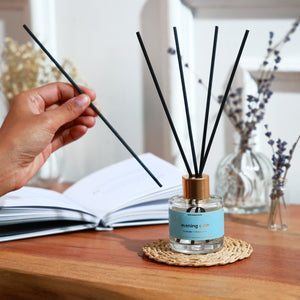

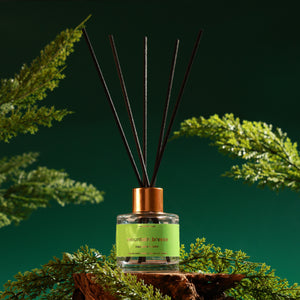

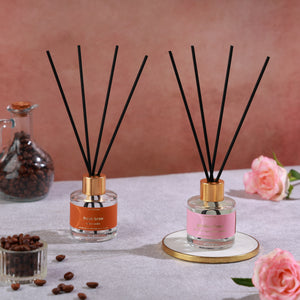
What to do with the finding: stop adjusting the bottle and start adjusting the room. Ceiling fan on low is the single best free change, because a fan supplies the moving air a reed has no way of producing. It shortens the bottle’s life, and that is a fair trade to make with your eyes open.
Then: halve the bottle-to-person distance, set it at or just below nose height on a surface, keep it out of a draught but out of a dead corner too, and close the door.
The honest gap: at six reeds you are already at the top of the dial. There is no seventh setting, and no bottle size adds one — 130ml lasts longer, it does not travel further.
2. You have found the top of the only dial the bottle has. Reed count sets how much fragrance leaves the glass per hour. Six is full. There is no seventh setting that changes the nature of the device, and adding sticks from an old set does not create one — it produces a room people describe as cloying rather than one they describe as large.
3. The variable you have not touched is the air. Once a molecule leaves a reed it can only travel two ways: by molecular diffusion, which is far too slow to cross metres of a room in any useful time, or by being carried on air the room is already moving. The second does effectively all the work, and it is not something the bottle contributes to at all. That is the untested variable, and it is free to test.
4. Test it in this order: fan, distance, height, door. Ceiling fan on the lowest setting, door closed, bottle out of the direct downdraught. Then halve the gap between the bottle and where you actually sit. Then put it at or slightly below nose height on a surface rather than on the floor or a high shelf. Then keep the door shut for the hours that matter, because containment is half the equation and costs nothing.
5. Consider taking reeds back out. If six did not buy reach, six is buying a shorter bottle. Three reeds gives a soft, entirely pleasant bedside level and roughly doubles the life; two or three in a 50 sq ft bathroom can make a 50ml last close to three months. Flip whatever you keep in every three to five days, not daily — a flip restores output for a few hours and adds no range.
Alcohol-free, phthalate-free, IFRA-compliant, 0 ppm formaldehyde, six fibre reeds, refillable glass bottle, composed in Pune. Free shipping above ₹499, and a portion of every order supports girl-child education through Nanhi Kali.
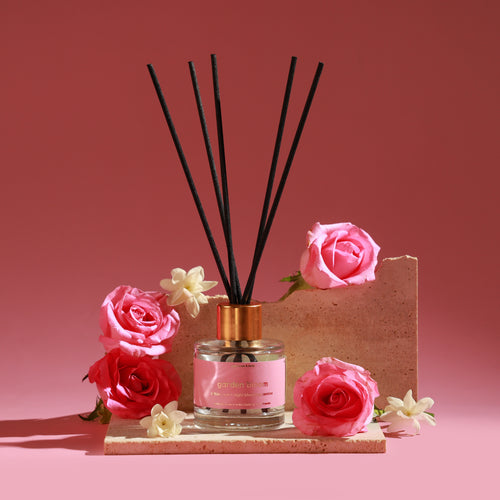
What your experiment actually measured, and why the result is worth having
Take the two states you have observed and put them side by side, because the comparison is the whole answer. In state one you had some smaller number of reeds in the bottle. In state two you had six. Between the two, the fragrance beside the bottle got noticeably stronger — most people report this clearly. And the place where it stopped being noticeable moved outward by, at most, a pace. The peak roughly doubled and the edge moved a hand’s width. Those two observations together are not a puzzle; they are a measurement of the shape of the falloff, and the shape is steep.
A steep falloff is what a point source in a still room produces. All of the fragrance enters the air at one place, and from that place it is immediately being mixed into a very much larger volume. Doubling the amount entering makes the strongest point stronger, but the dilution is doing its work over the same distance in the same way, so the curve simply rides higher without changing its slope. To move the edge of the zone by a metre with dose alone, you would need to raise the peak by far more than doubling. Six reeds cannot do it. Twelve would not do it either — they would only make standing beside the bottle unpleasant, which is what people mean when they say a diffuser has gone cloying.
There is a second thing your experiment quietly ruled out, and it is worth naming because it is the thing people worry about privately. It ruled out the fear that you were given a weak bottle. A weak bottle is weak at close range too. Yours is strong at close range, which means every millilitre in that glass is leaving through the reeds exactly as designed. The oil is not evaporating into thin air and disappearing on you — it is all being delivered, just to a smaller volume than you wanted. The only genuine waste in a reed diffuser is oil evaporating into a room nobody is sitting in, and that is a placement and occupancy question rather than a product one.
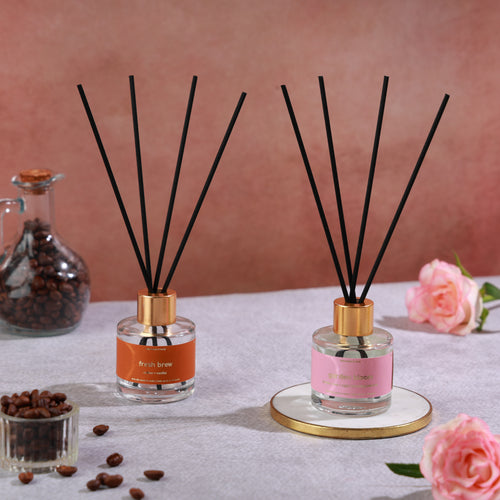
 Fresh Brew₹849Emission is how much fragrance leaves the bottle per hour, and reed count is its main control. You have now taken that control to maximum. Notice that this also rules out the next three purchases people usually make, because all three are the same move in disguise: a bigger bottle raises nothing at the same reed count, a stronger composition raises the amount of odorous material per millilitre, and a second diffuser raises total output in the room. Every one of them raises emission. None of them changes the geometry you have just measured. Fresh Brew is the deepest thing we compose at 9.5 on the SOSA strength scale, and in a large open room it produces exactly the same shape of zone as the softest.
 300ml refill₹2,399If you have also been flipping the reeds, that is another variable closed off. A flip presents freshly saturated fibre to the air and restores output for a few hours — it is a real effect, and every three to five days is the right cadence rather than every morning, which just wastes oil. But note what it restores: output. It is another turn of the same emission dial, briefly. It has never in the history of the object added a metre of range. Worth knowing too: the first days of a new bottle always run hot, because the fibres are saturating and the lightest materials leave first. Week three is the heart and the base — the composition as designed. That is settling, not fading.
 Evening Calm₹799There is one variable left that costs nothing to eliminate, and it is you. Receptors adapt to a constant stimulus within minutes: the signal keeps arriving and the brain stops forwarding it. Sitting in the room is a constant stimulus. Walking through it is a change, and change is what the nose is built to report — which is why the same reader will smell it strongly on the way in and not at all ten minutes later. So before you decide the room is unfragranced, leave for fifteen minutes and walk back in, and then ask somebody who does not live there. A visitor is a better instrument than a resident. If a guest remarks on it unprompted, the room is scented and you are simply adapted to it.
Why the ceiling you hit is structural rather than a matter of quantity
A reed diffuser has no fan, no pump, no heat and no power. Oil climbs the fibres by capillary action and evaporates off their exposed surface at whatever rate the room’s temperature, humidity and airflow allow. There is no point in that sequence where the device gives anything velocity. The fragrance appears above the reeds and then waits for the room to move it. That is the design rather than a shortcoming, and it is inseparable from why people keep buying them: silent, no socket, nothing to fill or charge, nothing to remember, works straight through a power cut, never breaks, and about ₹13 to ₹15 a day for an object on a table rather than an appliance on a table.
So the honest description of what you own is a device that produces a fragrant zone rather than a fragranced room. You can make that zone stronger with reeds, you can put it wherever you like, and you can decide how long it lasts. What you cannot do is make it spread, because spreading is transport and transport needs moving air. This is why the ceiling you found feels so absolute: it is not a limit on how much fragrance the bottle can give you, it is a limit on what kind of thing the bottle is. And it is why the next fix is free rather than expensive — you do not need a better bottle, you need some air.
One more consideration specific to Indian homes, because it changes what to expect as conditions shift. Saturated humid air carries fragrance less readily than dry air, so in a humid spell the scent hangs closer to the source and the zone tightens. Heat does the opposite to the bottle: a warm room evaporates the reeds faster, so the bottle empties sooner without reaching further. Neither of these is the oil changing. It is the same composition on a different evaporation curve, which is exactly why our reeds sit on a heat-stable CCT carrier rather than DPG — DPG can crack and turn bitter above 40°C, which is an ordinary afternoon here.
The variables, and which ones your test has already closed
Everything that could plausibly be causing what you are seeing, with an honest verdict on each. The point of the table is not to sell you the last row — it is to show you that the first four rows are done, and that the untested ones are the free ones.
| Candidate cause | Verdict | Why |
|---|---|---|
| Not enough reeds | Ruled out by your test ★ | You are at six, which is full projection and the top of the dial |
| A weak or spoiled bottle | Ruled out | It is strong beside the glass, so the oil is intact and the reeds are wicking |
| Reeds not flipped often enough | Ruled out if you flip every 3–5 days | A flip restores output for hours. It has never added range |
| Bottle too small | Not the cause | Volume is a duration figure, not a coverage figure — 130ml lasts 14–18 weeks instead of 6–8 and reaches identically |
| You are adapted to it | Test this — it is free | Leave for fifteen minutes and walk back in, then ask a visitor |
| Distance, height and containment | Very likely contributing | Halve the distance, set it at nose height on a surface, close the door |
| No moving air in the room | The untested variable | A ceiling fan on low supplies the transport a reed structurally lacks. It shortens bottle life |
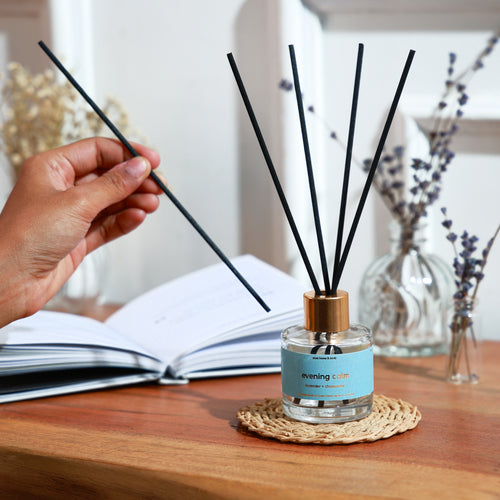

What to change now, in order, starting with the things that cost nothing
The ceiling fan, on low. This is the most useful sentence on the page. Run it at its lowest setting with the door shut and the bottle out of the direct downdraught, and give it half an hour before judging. A fan is transport: it takes the vapour that is sitting above your reeds and puts it into a slow circulation that carries it to the rest of the room. It does the thing your six reeds structurally cannot do, and it does it for nothing. The cost is calendar — moving air over the reeds evaporates them faster, so a 50ml that would have run eight weeks may run closer to six. Knowing that is what makes it your decision rather than my recommendation.
Then close the distance and fix the height. Since you own a zone, the sensible response is to sit inside it rather than to ask it to come to you, and halving the gap between the bottle and where you actually are does more than any change of scent. Put it at or slightly below nose height on a surface — not on the floor, where the fragrance sits below you, and not on a high shelf, where you stand beneath it and never in it. A bedside table or the end table by the sofa is not a compromise; it is the correct use of a point source.
Then look at where the air goes and where it leaves. Keep the bottle off a windowsill and away from an open balcony door, because air that leaves the room takes the fragrance with it — the bottle is not weaker, the room is being flushed. Keep it out of the direct blast of a split AC, which strips the reeds and throws everything at one wall. But do not tuck it into a sealed dead corner either, where nothing circulates to pick it up. A running AC in a closed room is actually helpful, because recirculation distributes reasonably well, which is why a bedroom often smells strongest at night — the trade-off is that dry air speeds evaporation.
And consider taking two reeds out. This is counter-intuitive advice on a page about adding them, and it is the advice I would give a friend. If six did not buy you reach, six is only buying you a shorter bottle. Four reeds will keep the zone strong enough for anyone sitting within a metre or two of it and will noticeably extend the calendar. Three gives a soft, complete, entirely pleasant bedside level and roughly doubles the life. Two or three in a 50 sq ft bathroom can make a 50ml last close to three months — one of the best-value placements in the house, though for efficiency rather than for masking anything, since fragrance does not remove a smell.
If the requirement is genuinely the whole room, here is the honest ladder
Some readers will do all the free things and be delighted, and that is the outcome I would prefer. Others will find that what they actually want is fragrance present across the whole room at a level they never have to walk towards — and that is a legitimate requirement which a passive device is not built to meet. Here is the ladder, cheapest first, with the gap in our own range stated rather than hidden.
| Do this | What it is | When it is the right answer | Price |
|---|---|---|---|
| 1. Fan, distance, height, door ★ | Ceiling fan on low, bottle halved in distance and set at nose height, door closed | First, always. A large share of readers stop here and never spend anything | Free |
| 2. Take two reeds out | Four instead of six, or three for a bedside level | Since six did not buy reach, it is only buying a shorter bottle | Free, and it gives weeks back |
| 3. A 130ml if the room is above ~150 sq ft | 14–18 weeks instead of 6–8, in the size band built for larger rooms | When the annoyance is repurchasing rather than reach. It lasts longer; it does not travel further | ₹1,249–₹1,349 |
| 4. Sukoon ultrasonic | 500ml, 270–320 sq ft, 16–18 hours on low, three 15ml Hotel Collection scents included | When you want the room rather than a zone within it, on demand and switchable off | ₹1,899 |
| 5. Safar waterless | Undiluted oil, no water and no added humidity, cordless, three speeds, a 1 / 2 / 3-hour timer. Named and sold as a car and travel diffuser, with no published room coverage figure | When you want waterless cold diffusion at personal scale and accept recharging and a timer that stops | ₹3,999 |
| The honest gap: nothing sits between them | There is no mid-sized waterless bedroom nebuliser in the SOSA range. Vaayu at ₹11,999 is rated to 1000 m³, roughly 2,000–3,000 sq ft, and is the wrong purchase for one bedroom | Named plainly, because Sukoon at ₹1,899 is very often the correct bedroom answer and must not be skipped on the way to something dearer | ₹1,899 |
Versailles
Whenever this message arrives, the sentence before it is always some version of I love how it smells, I just wish more of the room smelled like it. That is a compliment with a logistics problem attached, and I would much rather have it than the alternative. Nobody puts all six sticks into a fragrance they dislike.
What I want you to take away is that you have done the responsible thing. You changed one variable, took it to its limit, and looked at the result honestly instead of assuming something was faulty. Most people at this point buy a second bottle, which raises output again and produces two strong areas with a quiet stretch between them. You are one step ahead of that purchase, and I would rather you spent the next half hour with a fan and a closed door than the next ₹800 on the same axis.
And I would defend the object you own. A reed diffuser is silent, needs no power, has nothing to fill or charge, cannot be left switched on, works right through a power cut, and never breaks — for about ₹13 to ₹15 a day. Every machine I sell beats it on reach and loses to it on all of that. Everything is composed in Pune, and a part of every order funds a girl’s classroom through Nanhi Kali.
Frequently asked questions
- Will more reed sticks reach further? — higher, not further, and why.
- Projection or just evaporation? — where the extra oil really goes.
- Five reeds to ten and still nothing — doubling the dose does not double the sensation.
- How many reeds do I actually need? — a dosing method rather than a number.
- Does over-reeding just finish it faster? — the arithmetic, shown.
- More reeds vs better diffusion — the comparison, scored.
- Every reed in the box, still not strong — the same finding, framed as a result.
- Keep adding for monster projection? — no, and here is what that word describes.
- When to stop adding reeds — the stopping rule as a checklist.
- Brand: the SOSA founder story.
SOSA facts verified August 2026: Reed diffusers in 50ml and 130ml only — Morning Freshness ₹749 / ₹1,249, Evening Calm ₹799 / ₹1,299, Garden Bloom ₹799 / ₹1,299, Mountain Breeze ₹849 / ₹1,349, Fresh Brew ₹849 / ₹1,349. 50ml suits rooms up to ~150 sq ft and lasts 6–8 weeks; 130ml suits above 150 sq ft and lasts 14–18 weeks; roughly ₹13–₹15 a day. Six fibre reeds, not rattan, in a refillable glass bottle on a heat-stable CCT carrier, alcohol-free, phthalate-free, paraben-free, IFRA-compliant, 0 ppm formaldehyde, tested at 45°C and 85% RH, composed in Pune. Refills 300ml ₹2,399 · 500ml ₹3,499, oil only and never a first purchase. Machines: Boond ₹899 (300ml, ≤~150 sq ft, ~6h), Sukoon ₹1,899 (500ml, 270–320 sq ft, 16–18h on low, three 15ml Hotel Collection scents included), Megh ₹3,499 (6L, ~100h runtime, only ~215 sq ft), Safar ₹3,999 (waterless cold diffusion of undiluted oil, 20ml, 2000 mAh, up to 10 hours continuous or ~30 hours intermittent, three speeds, 1 / 2 / 3-hour timer, 6.9 cm — named and sold as a car and travel diffuser, with no published room coverage figure), Vaayu ₹11,999 (up to 1000 m³, roughly 2,000–3,000 sq ft, 400ml, under 38 dB). Hotel Collection oils are water-based and ultrasonic-only; reed oil cannot be used in an ultrasonic machine and there is no hotel-inspired reed diffuser. Fragrance does not remove an unwanted smell — deal with the source, then ventilate, then fragrance. No health, air-quality or allergy claim is made or implied. Free shipping above ₹499. SOSA is an independent Indian fragrance house and is not affiliated with or endorsed by any hotel brand. Prices subject to change — see the live product pages.