




Boundaries are drawn by doors and airflow, not by walls. An archway is not a boundary; a shut door is.
One Sukoon per zone at ₹1,899 — never two in one zone, never one straddling two.
2. One machine per zone, and only one. A Sukoon at ₹1,899 covers 270–320 sq ft, and a connected public zone of 400-odd sq ft still works from one well-placed unit because the air is moving within it. Two machines in one zone gives you a strong end and a normal end.
3. An archway is not a boundary. A door is. Half walls, wide openings, beams and level changes all look like divisions on a plan and do almost nothing to air. If you can walk between two spaces without touching anything, they are one zone.
4. The passage is the boundary, not a zone. It is the layer where your zones exchange air, which is exactly why it should stay empty. Put a machine there and you are scenting the seam rather than either side of it.
5. Zones should differ in intensity before they differ in scent. The clearest zoning most homes ever achieve is one fragrance at five to six drops in the public zone and three in the bedrooms. Change the scent as well if you like — but change it to a relative, not a stranger.
Made in India, composed by an ISIPCA Versailles-trained perfumer — and a portion of every order supports girl-child education through Nanhi Kali.

What a zone actually is, and where its edges are
The useful definition is physical rather than architectural. Air inside a room is constantly stirring — thermal currents off walls and bodies, movement from people walking, a fan, an AC — and anything volatile released into it spreads through that whole body of air within minutes. Between two spaces the exchange is much slower, and how much slower depends entirely on what connects them. A wide opening with no door barely slows it at all, which is why a living room and a dining area under one ceiling are a single zone even at 450 sq ft. A shut door slows it almost to nothing. So the map of your zones is the map of your doors, and it changes every time somebody shuts one. This is also why floor area is a poor guide: two 200 sq ft bedrooms are two zones, while a 450 sq ft open public area is one.
The second half of zoning is the part almost nobody plans for, which is what happens at the boundaries. Your nose adapts fast — sit in a scented room for fifteen minutes and you largely stop registering it — so the moments you actually experience a home fragrance are the moments of change: the front door opening, the step from a passage into a bedroom, the walk from the bedroom back into the living area in the morning. Those transitions are the product. If both sides of a boundary carry the same scent at the same strength, the transition is invisible and the whole flat becomes background within a day. If the two sides are unrelated, the transition is jarring and the passage between them smells of a blend nobody chose. The target is a noticeable but coherent step: same family, different intensity.
The three zoning decisions in a 3BHK
 SOSA Sukoon₹1,899This takes two minutes and settles most of the plan. Close every internal door in the flat and walk it. Everything you can still move between without opening something is one zone. In a typical 3BHK that gives you the entrance, living and dining as a single zone — plus the kitchen if it is open — and each bedroom as its own. Four zones. Now mark the ones somebody actually occupies for an hour at a stretch; usually three. Each of those gets one Sukoon at ₹1,899. Nothing else on the plan needs deciding.
Where the boundaries actually fall
Every likely division in a 1,200–1,600 sq ft 3BHK, and whether it is a genuine zone edge. Coverage ratings assume a closed room without a strong draught, so a fan or an AC running hard will effectively shrink a zone rather than extend it.
| Boundary | Real zone edge? | What it means | What to do |
|---|---|---|---|
| Bedroom door, shut ★ | Yes — the strongest edge there is | Air exchange drops to almost nothing | One Sukoon inside, 3–4 drops, 2H timer |
| Bedroom door, open | No | The room joins the passage and drains into it | Shut it while the machine runs, or accept that you are scenting the corridor |
| Archway between living and dining | No | A wide opening barely slows air at all | One machine for both, placed near the join rather than at either end |
| Open kitchen counter | No, for fragrance | Same air — but a far stronger competing source | One zone, machine at the far end, run it after cooking |
| Sliding partition to a study | Sometimes | A real edge when shut, none when open | Run the study on its own only when the partition is closed |
| Passage between the halves | It is the seam | Where the zones exchange air | Nothing goes here. It borrows from both sides |
| Note on intensity: the most effective zoning in most 3BHKs is not two scents but two doses — five to six drops in the public zone and three in the bedrooms. If you do also change the scent, change it to a relative that shares a note, not to something unrelated. | |||
Sukoon · one per zone₹1,899Shop →  Hotel Collection · two of sevenFrom ₹299Shop →
 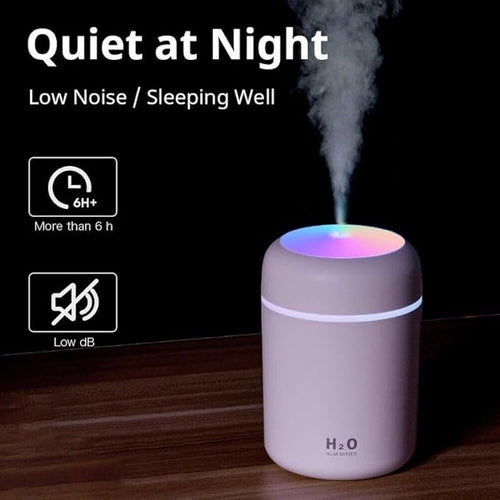 Boond · a small zone₹899Shop →
Drops, transitions and running zones on different schedules
Zoning by dose is the first thing to get right and it costs nothing. Five to six drops of Hotel Collection per tank in the public zone, three to four in a bedroom, three in a small one. Three to six drops per tank is the general guidance; the reason bedrooms sit lower is that they are a fraction of the volume behind a shut door, so the same number of drops produces a much higher concentration — and it does so around somebody lying still, who is the least tolerant audience a fragrance has. If you notice the scent as you are falling asleep, remove a drop rather than moving the machine.
Placement then decides whether a zone is served evenly or lopsidedly. In the public zone, put the machine near the middle of the connected volume rather than at one end — if the living and dining areas run through an archway, a console close to that join reaches both, while a machine at the far end of the living room leaves the dining table out of it. Keep everything about a metre off the floor, a foot clear of walls and curtains, and out of the direct path of a ceiling fan or a split AC, which pushes mist to one wall instead of distributing it. In the bedrooms, two to three feet clear of the bedhead.
Schedules are the third zoning tool and the most underused. Zones do not need to run at the same time: the public zone on the 4H timer from early evening, each bedroom on 2H an hour before it is used, nothing overnight and nothing while the flat is empty. That puts the fragrance where the people are, roughly halves consumption and sharpens the transitions. Rinse a tank when you change scents, use filtered water in hard-water cities, and never substitute raw essential or carrier oils, which will foul the plate.
What zoning a 3BHK costs
Zoning is mostly free — it is a way of deciding, not a thing to buy — but it does determine how many machines you end up with. Here is the arithmetic by zone count, with every total checked.
| Setup | What you get | Covers | Total |
|---|---|---|---|
| One zone | One Sukoon ₹1,899 — includes 3 × 15ml scents | The public zone only | ₹1,899 |
| Two zones | Two Sukoons ₹1,899 × 2 | Public zone + master | ₹3,798 |
| Three zones ★ | Three Sukoons ₹1,899 × 3 — 9 × 15ml scents | Public zone + two bedrooms | ₹5,697 |
| Four zones, cheaper | Three Sukoons ₹5,697 + a Boond ₹899 in the small one | Every zone in the flat | ₹6,596 |
| Four zones | Four Sukoons ₹1,899 × 4 | Every zone, evenly | ₹7,596 |
Versailles
Zoning is the only piece of home-fragrance theory I think is genuinely worth learning, because it replaces a hundred small decisions with one drawing. Shut the doors, count what is still connected, and buy that many machines. Everything else follows.
The idea I find hardest to get across is that the boundaries are the point. People plan their homes room by room and assume the experience of a fragrance happens inside each room, when in fact adaptation takes care of that within a quarter of an hour. What you actually experience is the doorway — arriving home, stepping into a bedroom at eleven at night, coming out of it at seven in the morning. Design those three moments and the rooms take care of themselves.
So: one Sukoon per occupied zone, two related scents, five to six drops in public and three in private, nothing in the passage. Three machines for most 3BHKs, ₹5,697, and it will read as more considered than a flat with five. A portion of every order supports girl-child education through Nanhi Kali.
Frequently asked questions
- Best fragrance combination for a 3BHK — the two scents that hold the zones together.
- Where to place diffusers in a 3BHK — position by position, including the corridor.
- How many diffusers do you need per room? — the per-room physics.
- Two diffusers in adjacent rooms — how to stop them fighting.
- Brand: the SOSA founder story.
SOSA products & prices (verified August 2026): Hotel Collection water-based ultrasonic diffuser fragrance 15ml ₹299 · 100ml ₹999 · 300ml ₹1,799 · Pack of 7 (15ml, all fragrances) ₹1,799; refills 100ml from ₹999. Seven scents: The Ritz-Carlton-inspired (white tea · bergamot · cedar), Westin-inspired (white tea · aloe · cedar), 1 Hotels-inspired (cedarwood · vetiver · green leaves), The St. Regis-inspired (amber · violet · woods), Shangri-La-inspired (jasmine · green tea · white tea), Four Seasons-inspired (citrus · floral · sandalwood), W Hotels-inspired (citrus · pepper · amber). Diffusers: Boond 300ml ₹899 · Sukoon 500ml ₹1,899 · Megh 6L ₹3,499. Water-based, phthalate-free, composed to IFRA standards for home diffusion; 3–6 drops per tank. Made in India, Pune. The Hotel Collection scents are SOSA's own interpretations inspired by the world's finest hotels; all hotel names are trademarks of their respective owners and are used only to describe the scent style — SOSA is an independent Indian fragrance house, not affiliated with or endorsed by any hotel brand. Prices and availability subject to change — see the live product pages.