


The most expensive: a draught, because you pay twice — the fragrance is carried out of the room and the bottle empties weeks early.
The most invisible: soft furnishing. Curtains, upholstery, rugs and mattresses absorb fragrance molecules readily; a bottle tucked into a fabric corner scents the fabric.
What waste does not include: normal evaporation. Oil going down at the expected rate is the product working. A 50ml is meant to last 6–8 weeks and a 130ml 14–18.
2. Get it out of the sun and off hot surfaces. Direct sunlight through a window heats the oil, thins it, and raises evaporation well above the rate the composition was dosed for. A west-facing sill in a Delhi May is the worst place in the house. Shade, and away from the top of a fridge or a set-top box.
3. Give it an arm's length of clear space, especially from fabric. Curtains, upholstery, cushions, rugs, a mattress — soft furnishings soak up fragrance molecules very efficiently. A bottle standing against a curtain is scenting the curtain.
4. Put it where the air is stirred a few times an hour. Dead air is a waste too: the fragrance is released, hangs in a foot-wide envelope around the glass and slowly degrades there without ever crossing the room.
5. Then flip all six reeds, and only then consider spending. A weekly flip restores the delivery rate the bottle was built for. If the room is still quiet after all five steps, the honest answers are more reeds (which does cost bottle life), a louder composition, or a second bottle — in that order.
6. Do not treat a bigger bottle as the fix. A 130ml holds more oil and runs 14–18 weeks against 6–8; at the same six reeds it projects the same. Buying size to solve waste simply gives you more fragrance to lose.
Composed and handmade in small batches in Pune, and a portion of every order supports girl-child education through Nanhi Kali.
Part one — output, delivery, and the gap between them
Two different quantities get called "strength" and it is worth separating them. Output is how much fragrance leaves the reeds in a day, and it is set by three things you can count: the exposed reed surface, the volatility of the composition, and the temperature. Delivery is how much of that output actually arrives at a nose in the room. The gap between the two is waste, and in an ordinary Indian flat it is much larger than people imagine. That gap is also the only part of the system you can improve for nothing — raising output costs you weeks off the bottle or the price of a new one, while closing the gap costs a rearrangement on a Sunday afternoon.
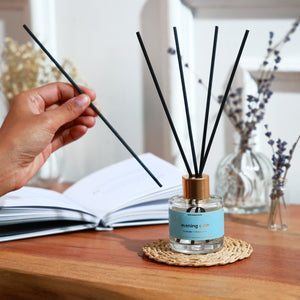
 Evening Calm₹799 · 8.9/10This is the waste nobody warns you about. Textiles are extremely good at picking fragrance out of the air — it is the same property that makes a wardrobe hold the smell of a sari for years. A bottle standing against a full-length curtain, wedged between sofa cushions, on a bedside table pressed into a heavy headboard, or on a low table surrounded by rugs, is handing a large share of its daily output to the fabric within a foot of it. The fabric does eventually give some of it back, faintly and slowly, which is why a heavily furnished room can smell pleasant and yet never smell of the diffuser. Give the bottle an arm's length of clear air on at least two sides, and prefer a hard surface with space around it to a soft, enclosed nook — however much better the nook looks.
Part two — the four wastes, costed
The fourth waste is the quiet one: dead air. A bottle in an alcove, inside a display cabinet, behind a door that stays shut all day or on a shelf nobody passes releases its fragrance into a pocket of air that is never carried anywhere. Nothing is lost to the outside; it simply never arrives. Here are all four side by side, with what each costs you in fragrance reaching the room and in weeks off the bottle. The week figures are our own working guidance against a 50ml rated at 6–8 weeks with six reeds, not laboratory measurements.
| The waste | Where it happens | Effect on the room | Effect on bottle life | The free correction |
|---|---|---|---|---|
| Draught ★ | Under a split AC, in front of a fan, on a windowsill in a breeze | Severe — carried out of the room in one direction | Severe — a 50ml can finish weeks early | Move a couple of metres out of the air path |
| Sun and heat | West-facing sills, glass-topped tables in light, on top of a fridge | Moderate — plus the composition reads unbalanced | Severe in summer — thinner oil evaporates faster | Shade, and a metre inward from the glass |
| Absorption into fabric | Against curtains, in cushions, beside an upholstered headboard | Moderate and constant — the fabric gets it, you do not | None — the oil is used at its normal rate | An arm's length of clear air on two sides |
| Dead air | Alcoves, closed cabinets, rooms shut all day, unused corners | Severe — fragrance pools within a foot of the glass | None, or slightly longer — which reads as a virtue and is not | Move it where people pass, or leave the door ajar |
| The honest caveat: none of these four is a fault in the product, and correcting all four does not raise output — it raises how much of the existing output reaches you. If your bottle is in a shaded, draught-free, uncluttered spot with air moving past it, has been flipped, and the room is still quieter than you want, then you have a genuine strength question rather than a waste question, and the answers cost something: more reeds at a cost in weeks, a louder composition, or a second source. | ||||
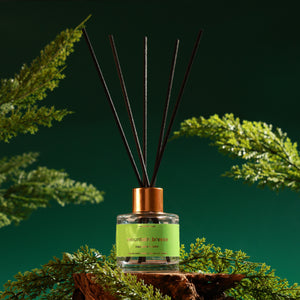
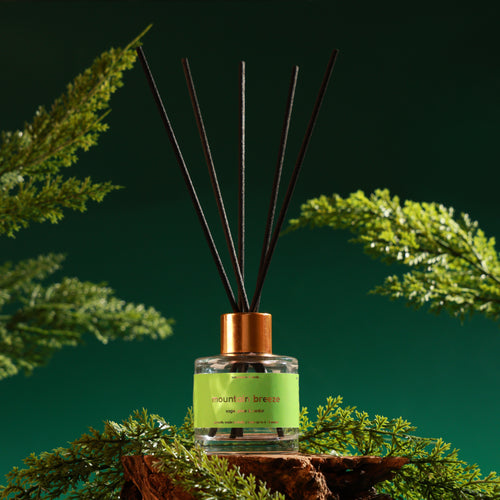
Mountain Breeze · 9.4/10from ₹849Shop → 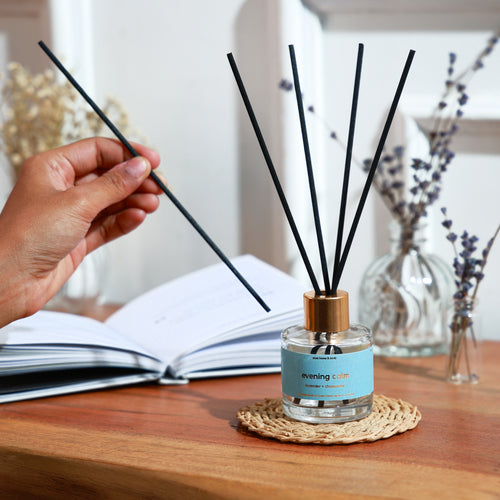 Evening Calm · small roomsfrom ₹799Shop →
  Oil refill · 300ml₹2,399Shop →
Part three — the twenty-minute audit
Do this once, properly, and you will not need to do it again until you move house. Stand where you normally sit or work in the room and look at the bottle from there. Is anything between you and it — a sofa back, a plant, a stack of books? Now walk to it and put a hand where the reeds are. Can you feel air moving? A little is right; a steady stream on your palm is a draught. Look up: is there a fan directly overhead, an AC vent aimed at the shelf, a downlight sitting close above the reeds? Look sideways: how far is the nearest curtain, cushion or rug? If the answer to that last one is less than an arm's length, you have found your biggest single loss and it takes ten seconds to fix. Finally, check the light — sit in the room at four in the afternoon, which in most Indian flats is when the sun actually reaches surfaces that look shaded at ten in the morning.
Then run the wet-line test, because it tells you whether the problem is upstream of all of this. Lift one reed with gloved fingers and find the boundary between the oil-soaked part and the dry part. High and dark means the reed is saturated and stalled — flip all six. Barely above the oil line means the reed is not wicking and wants refreshing. Normal, with a quiet room, means the loss is happening between the reed and you, which is what this whole article is about. Reeds are the consumable and the oil is the stable part, and the commonest mistake is the reverse of that: people replace oil and keep reeds for a year. Our refills are oil only — you reuse your own glass vessel and your own reeds — and we do not sell reeds separately, which is a genuine gap in our range. The guidance is to refresh them every few months, and never to pour a ₹2,399 refill through reeds that stopped working in the monsoon.
One last waste worth naming, because it is a habit rather than a place: fragrance layered over cooking. If you diffuse into a kitchen that has just produced a tadka, you are not adding fragrance to a neutral room — you are creating a third smell that nobody composed and that reads as heavy and confused. The sequence that works is extractor on, window open for ten minutes, close up, and give it half an hour before you expect the diffuser to be the thing you smell. This costs nothing either, and it saves a good many people from concluding that a perfectly good bottle is somehow wrong.
Part four — what to buy once the leaks are closed
Assume you have done the audit and the room is still quieter than you want. Now the spending decisions are honest ones, because you know you are buying output rather than paying to lose more of it. Here is how I would read each remaining symptom.
| What you are seeing | The waste behind it | Free fix, first | If that fails, buy | Price |
|---|---|---|---|---|
| Bottle dropping fast, room smells of nothing ★ | Draught, sun, or both | Move out of the air path and into shade | Nothing — this is free to fix | ₹0 |
| Strong at the bottle, absent three feet away | Dead air, or absorption into nearby fabric | Clear space around it; move it where people pass | Nothing yet — repeat the audit in 48 hours | ₹0 |
| Everything correct, room still under-scented | No waste left — this is a true output limit | Flip all six reeds and wait two days | Add two to four reeds, accepting fewer weeks | ₹0, costs bottle life |
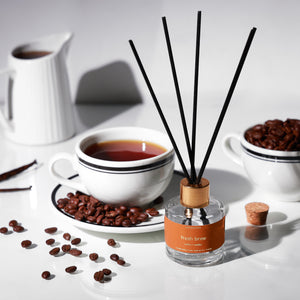
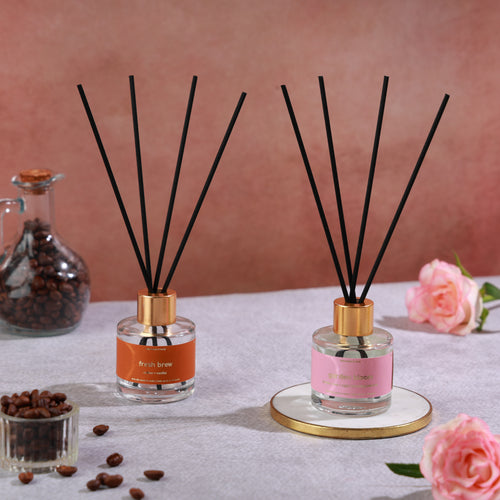
| Right room, wrong character — soft where you want full | Composition, not waste | None — this cannot be fixed by placement | Fresh Brew 9.5 or Mountain Breeze 9.4 | ₹849 |
| Large connected living-dining, one bottle in the middle | Distance, not waste — a point source cannot cover it | Move it to the busiest end rather than the centre | A second bottle, or a Warmth & Bloom duo | From ₹1,598 |
| Running high reed counts and the cost is mounting | None — this is just running cost | Drop back to six on ordinary days | 300ml oil refill, roughly ₹7–8 per ml | ₹2,399 · 8–11 months |
| You want scent on demand, not constantly | Format mismatch — reeds cannot surge | None | Boond for a small room, Sukoon for a large one | ₹899 / ₹1,899 |
Versailles
There is a version of this brand where I use phthalate solvents. They are cheap, they are legal in most markets, and they push fragrance off a reed with real force. Week one would be spectacular. Then the Indian summer gets into the bottle and by week six the composition has degraded into something faintly acrid, and the customer decides that reed diffusers are a con. I have smelled that arc many times in other people's products, and I did not want it in mine.
So we are phthalate-free on a heat-stable CCT base, and the trade is stated openly: a smaller opening, a longer and flatter plateau. That plateau is the product. It also means the waste on this page matters more here than it would elsewhere — if you are running a composition that does not shout, you cannot afford to give half of it to a curtain.
Every audit item above is free, and I would rather you did all four and bought nothing than bought a second bottle to stand in the same sunlit draught. Everything is composed and handmade in small batches in Pune, tested through 45°C heat and 85% humidity, and a part of every order funds a girl's classroom through Nanhi Kali.
Frequently asked questions
- Does moving it improve scent throw? — the traffic map, and how to find it.
- The best placement for strong throw — every surface in a home, ranked.
- The four currencies of strength and does flipping make it stronger?
- The complete guide to stronger performance and the full strength guide.
- Brand: the SOSA founder story.
SOSA reed diffuser range & prices (verified August 2026): alcohol-free, phthalate-free, paraben-free and IFRA-compliant compositions on a heat-stable coconut-derived (CCT) carrier, low-VOC, supplied in a refillable glass bottle with six fibre reeds; 50ml lasts 6–8 weeks and 130ml lasts 14–18 weeks. Morning Freshness (Malabar lemon · peppermint · Nilgiri eucalyptus) 50ml ₹749 · 130ml ₹1,249 · 9.0/10; Garden Bloom (British rose · night-blooming jasmine) 50ml ₹799 · 130ml ₹1,299 · 8.9/10; Evening Calm (Kashmir lavender · chamomile) 50ml ₹799 · 130ml ₹1,299 · 8.9/10; Fresh Brew (Coorg coffee · Kerala vanilla) 50ml ₹849 · 130ml ₹1,349 · 9.5/10; Mountain Breeze (Himalayan pine · sage · Indian cedar) 50ml ₹849 · 130ml ₹1,349 · 9.4/10. Reed diffuser refills are oil only — you reuse your own vessel and reeds: 300ml ₹2,399 (roughly 8–11 months) · 500ml ₹3,499 (roughly 14–18 months), about ₹7–8 per ml against ₹15–17 per ml for a 50ml bottle. Duo sets ₹1,498–₹1,598 for 2 × 50ml and ₹2,498–₹2,598 for 2 × 130ml. Strength figures are positions on SOSA’s own internal strength scale, not an industry standard. Replacement reeds are not sold as a separate SKU; SOSA guidance is to refresh reeds every few months. The reed line is separate from the water-based Hotel Collection for ultrasonic machines (15ml ₹299 · 100ml ₹999 · 300ml ₹1,799) and the two are not interchangeable. Diffusers: Boond 300ml ₹899 · Sukoon 500ml ₹1,899 · Megh 6L ₹3,499 · waterless Vaayu ₹11,999. Composed and handmade in small batches in Pune, India; tested through 45°C summer heat and 85% monsoon humidity. Free shipping above ₹499. A portion of every order supports girl-child education through Nanhi Kali. Prices subject to change — see the live product pages.