
 Misty Mornings ₹379
  Everyday Beautiful Mug ₹474
 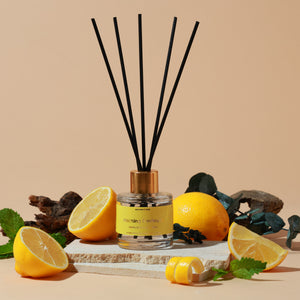 Morning Freshness ₹749
 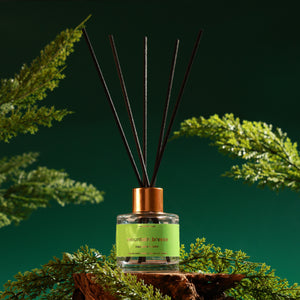 Mountain Breeze ₹849
 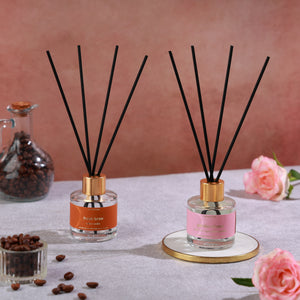 Warmth & Bloom duo ₹1,598
Visibility outranks distance. Inside any group that will see each other's gifts — a team, a floor of neighbours, a set of aunts — the same gift for everyone beats a better gift for some. The variance is what gets noticed, not the level.
Derive the number from your list, not from a norm. Total budget ÷ names, then adjust by tier. 2 × ₹1,299 = ₹2,598 and 10 × ₹749 = ₹7,490 gives ₹10,088 across twelve names.
The case for spending less is real. An over-scaled gift creates an obligation the other person did not ask for — most sharply when it goes upward to a senior, or downward to someone who works for you.
2. ₹379–₹474 is the courtesy band. Neighbours, a colleague two desks away, someone returning a gesture. A jar candle at ₹379 runs roughly 15–18 hours; an Everyday Beautiful Mug is ₹474. Both are complete objects that ask nothing further of the recipient.
3. ₹749–₹849 is the standard obligation gift and covers most names. A 50ml reed diffuser: a refillable glass bottle of fragrance oil, six fibre reeds, no flame and no socket, 6–8 weeks of life. It clears the ₹499 free-shipping line, which the ₹379 candle on its own does not.
4. ₹1,249–₹1,598 is for close family and for households. A 130ml at ₹1,349 runs 14–18 weeks; a two-bottle duo at ₹1,598 covers two rooms. Note that 130ml buys duration, not reach — it lasts longer, it does not project further.
5. Where people will compare, the same gift for everyone. This overrides the tier logic. Variance inside a visible group is what causes trouble; the absolute level rarely does.
6. Cap the gift that goes upward. A boss, a landlord, a senior relative in a professional relationship — above roughly ₹799 an upward gift starts to read as something other than a courtesy, and that is a reason to stay low rather than a reason to be embarrassed.
7. For anyone who works for you, cash comes first. House help, a driver, building staff. Cash is flexible and it is what most people would choose; an object alongside is a courtesy and never a substitute.
Everything is composed and handmade in small batches in Pune, and a portion of every order supports girl-child education through Nanhi Kali.
Part one — the two variables
Most gifting advice treats spending as a single dial running from acquaintance to immediate family. That dial exists and everybody already knows how to turn it. The second variable is the one that actually causes the arguments, and almost nobody names it.
 Everyday Beautiful Mug₹474Some gifts are received privately and some are received in a room where four other people are opening theirs. In the second case the recipient is not evaluating your gift against a standard — they are evaluating it against the gift beside it. Within a visible group, the difference between gifts is the message, and the level is close to invisible. This is why a team of eight all receiving the same ₹749 bottle works better than a team where three receive ₹1,299 and five receive ₹749, even though the second version costs you more. The same applies to a set of aunts, a floor of neighbours, and any family group that assembles in one house. At the courtesy end, an Everyday Beautiful Mug at ₹474 repeats perfectly well across a whole group.
Part two — the grid, by name type
The two axes applied to the name types that appear on almost every Indian Diwali list. No figure appears here for any gift outside our own range — the argument is about scale and comparison, and attaching prices to other categories would only confuse it.
| Who is on the list | Will they compare gifts | The band I would use | What that buys | What overspending does here |
|---|---|---|---|---|
| Parents, in-laws, a household you visit ★ | Sometimes, against a sibling's gift | ₹1,249–₹1,349 | 130ml, 14–18 weeks | Little risk. The real ceiling is their shelf space |
| Aunts, uncles and cousins in one family group | Yes, strongly — they meet | ₹749–₹849, identical | A 50ml each, one scent for all | Creates comparison inside a family that has to keep meeting |
| A team or an office list | Yes, and immediately | ₹749 identical | One SKU, one order | Variance is the failure here, not the level |
| Neighbours on your floor | Yes — they talk | ₹379–₹474 | Jar candle, wax melts or a mug | A large neighbour gift starts a return obligation nobody wanted |
| Your boss, a landlord, a senior | No, but read differently | ₹379–₹799, capped deliberately | Candle, or one 50ml | Above this an upward gift changes meaning |
| House help, a driver, building staff | Often yes, across a building | Cash first; ₹449–₹749 alongside | Cash, plus a candle or a 50ml | The error is not the amount — it is an object instead of cash |
| Someone whose home you have never seen | Rarely | ₹749–₹799 | The least polarising scent, 50ml | Spending more on a guess buys a bigger guess |
| The honest caveat: these bands describe an obligation list, which is what most Diwali gifting is. An affection gift — the one or two people you are genuinely delighted to buy for — obeys none of this and should not be forced into a grid. Buy those two whatever suits them. The grid exists so that the other twelve names stop consuming the attention those two deserve. | ||||
 Cloud trinket dish · top of the courtesy band₹664Shop →
 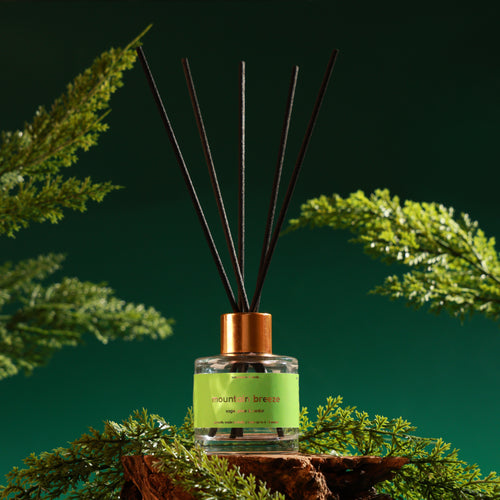 Mountain Breeze · standard band, for anyone anti-floral₹849Shop →
 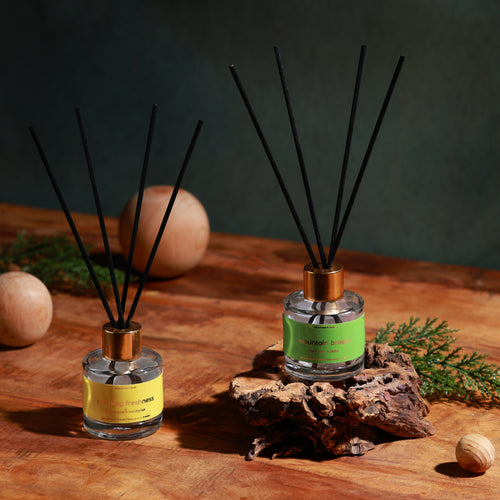 Fresh & Grounded duo · close-family band₹1,548Shop →
Part three — the case for spending less
There is a version of this question that is really asking for permission to spend less, and it deserves a direct answer. An over-scaled gift is not a neutral act of generosity; it transfers a problem to the person receiving it. They now have to decide what to do next Diwali, and the honest options are to match you, to fall visibly short, or to withdraw slightly from the exchange. None of those is a gift. This is most acute in two directions. Upward — to a boss, a landlord, a senior professional contact — a large gift changes category, and the recipient may be obliged to decline it or to disclose it. Downward, to someone who works for you, a costly object can read as a substitute for the cash or the bonus that is the real convention, which is a far worse outcome than giving something small alongside an envelope.
The second argument for less is structural rather than social. Diwali gifting is list management, and a list is carried in car boots, up staircases, into crowded doorways. Every rupee you add tends to add bulk, fragility or both, and the practical ceiling on a Diwali circuit is not your budget but what fits in a boot and can be handed over in thirty seconds. A 50ml bottle at ₹749 is roughly the largest gift that stays effortless at quantity. Past that you begin buying things you have to plan around. If you are visiting six homes across a weekend, twelve identical small gifts are a solved problem and six carefully chosen large ones are an afternoon of logistics.
And the third argument is the one nobody wants to hear: on most lists, the amount is not the thing that is wrong. The list is too long. Fourteen names accumulated over a decade, of which three are people you have not spoken to since last Diwali, will make any budget feel inadequate. The arithmetic is unkind but clear — 11 × ₹749 = ₹8,239 against 14 × ₹749 = ₹10,486, and the difference is three names that exist because nobody removed them. I would rather you gave eleven people something in the standard band than fourteen people something in the courtesy band, and that is a decision about the list, not about generosity.
Part four — four questions, in order
Run each name through these in sequence and the number produces itself. The order matters: visibility comes first because it can collapse a dozen individual decisions into one.
| Ask in this order | If yes | If no | What it does to the number |
|---|---|---|---|
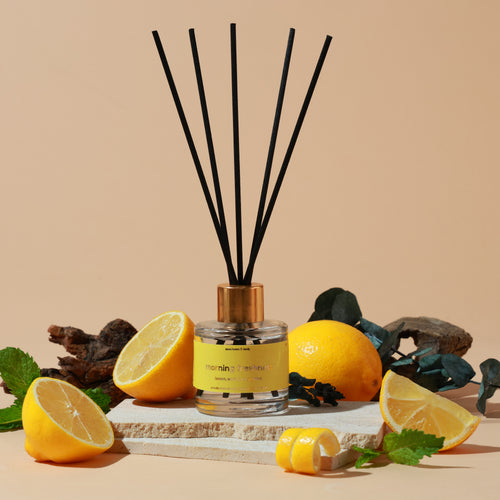
| 1. Will anyone else on the list see this gift beside theirs? ★ | Fix one SKU for that whole group — Morning Freshness ₹749 — and stop deciding per person | Decide this name on its own | Removes variance and usually lowers the total |
| 2. Do they work for you? | Cash first, in an envelope. An object only alongside | Continue | Takes the object out of the primary role entirely |
| 3. Is the gift going upward — a boss, a landlord, a senior? | Cap it at ₹379–₹799 on purpose | Continue | Lowers the ceiling deliberately, not apologetically |
| 4. Do you know their home — rooms, children, whether anyone lights candles? | Spend at the top of the band and choose on the room | Stay at ₹749–₹799 and pick the least polarising scent | Not knowing is a reason to spend less, not more |
| 5. Will you gift this person again next year? | Set a level you can repeat: one scent, one size, every year | Treat it as a one-off and decide freely | Repeatability caps the figure permanently |
| 6. Is your total divided by your names below the courtesy band? | Cut names, not rupees. 11 × ₹749 = ₹8,239 | Buy, and stop reading | The list is the variable. It always was |
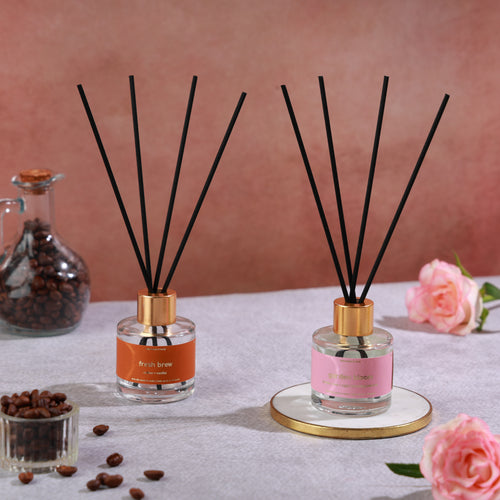
Versailles
The question I am asked most often in the gifting season is not which scent. It is is this enough. And what people mean by it is almost never a question about money — it is a question about whether they will be judged. I have no useful answer to the second question and I am not going to invent one, because nobody can tell you how a gift will be taken.
What I can do is separate the two axes, because doing that turns an anxious decision into a boring one. Once you accept that a group which compares must receive the same thing, most of the anxiety has nowhere left to live. You are no longer ranking your relatives. You are buying one product several times.
I sell reed diffusers, so treat the recommendation with the scepticism it deserves. But notice which way the advice runs: three bands rather than fourteen decisions, the same product repeated, and a list you are allowed to shorten. That is not the shape of advice designed to increase what you spend. It is the shape of advice designed to get you out of the shop.
Frequently asked questions
- Is it rude to give everyone the same gift — the visibility rule, in full.
- Someone gave you an expensive gift — why matching the value escalates it.
- Should you give your boss a gift and what not to gift.
- The Diwali gifting etiquette guide — the whole subject in one page.
- Brand: the SOSA founder story.
SOSA range & prices used in this guide (verified from the live store, 27 August 2026): Reed diffusers — alcohol-free, phthalate-free, paraben-free, IFRA-compliant compositions on a heat-stable coconut-derived (CCT) carrier, in a refillable glass bottle with six fibre reeds; 50ml lasts 6–8 weeks, 130ml lasts 14–18 weeks. Morning Freshness 50ml ₹749 · 130ml ₹1,249; Garden Bloom ₹799 · ₹1,299; Evening Calm ₹799 · ₹1,299; Fresh Brew ₹849 · ₹1,349; Mountain Breeze ₹849 · ₹1,349. Duo sets: Day & Night ₹1,498, Fresh & Grounded ₹1,548, Warmth & Bloom ₹1,598 (2 × 50ml); ₹2,498–₹2,598 (2 × 130ml). Oil-only refills 300ml ₹2,399 · 500ml ₹3,499 (vessel and reeds not included). The least expensive SOSA reed diffuser is ₹749 — no reed diffuser exists below that price in any size. Below it: scented jar candles from ₹379 (roughly 15–18 hours), Sandalwood or Smoked Oudh jar candle ₹449, wax melts ₹474 (a burner is needed and is not included), ceramic mugs ₹474, ribbed and face mugs and taper candles ₹569, Amber Rose candle ₹599, ceramic trinket dish ₹664, candle two-pack ₹664 (roughly 30–36 hours). Machines: Boond 300ml ₹899 · Sukoon 500ml ₹1,899 · Megh 6L ₹3,499 (~215 sq ft, a runtime and humidity machine rather than a coverage upgrade) · waterless Vaayu ₹11,999 · Safar car and travel diffuser ₹3,999. The water-based Hotel Collection (15ml ₹299 · 100ml ₹999 · 300ml ₹1,799) is a fragrance for an ultrasonic machine, not a standalone gift. SOSA publishes no bulk or corporate gifting terms — there is no discount slab, no minimum order quantity, no stated GST-invoicing arrangement, no custom branding service and no published lead time — and SOSA sells no gift card, gift hamper, gift box or curated gift set. Larger orders should be discussed with SOSA directly through the contact page before committing. Gift wrapping, gift notes, direct-to-recipient shipping and delivery timing are unconfirmed — check at checkout rather than assuming them; no delivery date is promised anywhere in this guide. Per-head and total costs shown are arithmetic on the listed prices, not quotations. Fragrance adds scent to a room; it does not clean air, remove cooking or smoke smells, or change how anyone feels. Fragrance oil is flammable — keep any diffuser away from diyas, candles and open flame. Composed and handmade in small batches in Pune, India; tested through 45°C summer heat and 85% monsoon humidity. Free shipping above ₹499. A portion of every order supports girl-child education through Nanhi Kali. Prices subject to change — see the live product pages.