



Four? Only when all three bedrooms are slept in nightly. That is ₹7,596.
Nothing in the passage. Ever. It is a transit space with doors off it and it drains into whichever one is open.
2. One per bedroom that is actually slept in. The three bedrooms are three separate air spaces and nothing you put in one reaches the others. In most 3BHKs two of them are occupied nightly and the third is an office, a store or a room kept for visiting parents. Two machines, not three.
3. So three in total, and four only sometimes. Three Sukoons is ₹5,697 and is the right answer for a couple with one child, or two working adults and a guest room. Four at ₹7,596 is right for a household of five where every door has somebody behind it at night.
4. The passage gets nothing. It is the most tempting position in the flat and the least useful. Transit spaces have no still air to hold fragrance and lose it through every open door. Whatever you were going to spend on a corridor machine, put towards a bedroom.
5. A small third bedroom can take a Boond. If the third room is genuinely small — 100 to 140 sq ft, a child's room or a compact guest room — a Boond at ₹899 covers it. Three Sukoons plus a Boond is ₹6,596 and scents the entire flat.
Made in India, composed by an ISIPCA Versailles-trained perfumer — and a portion of every order supports girl-child education through Nanhi Kali.

Why a 3BHK behaves like two separate homes
Somewhere between a 2BHK and a 3BHK a flat stops being a set of rooms and becomes a set of zones. The change is architectural rather than numerical. A 3BHK almost always has an entrance that opens into a living area, a dining area attached to it and increasingly a kitchen that is open to both — one continuous volume of 350 to 500 sq ft that a guest experiences as a single space and that behaves, for fragrance purposes, exactly like a studio. Down a passage sit three bedrooms with doors, each 120 to 200 sq ft, each sealed from the others whenever those doors are shut. These two halves obey completely different rules and should be bought for separately. The public zone rewards one well-placed machine and punishes a second. The private half rewards exactly as many machines as there are occupied rooms and cannot be served by anything less.
The passage between them is where the money goes to die. It looks like a hub — it is central, everything connects to it, a machine there would appear to reach five rooms at once. In practice a corridor is a chimney with doors: narrow, constantly disturbed by people walking through it, and open at both ends. Fragrance released there does not distribute outwards into the bedrooms; it drains into whichever single door happens to be ajar and vanishes from everywhere else. If all the doors are shut it sits in a passage nobody stands still in. The correct approach is the exact inverse of the instinct: scent the rooms properly and let the passage borrow from them, which it does every time a door opens.
The three decisions in a 3BHK
 SOSA Sukoon₹1,899Walk the flat and shut every internal door. What you have left is the true count: one public zone, plus one per bedroom. That is four air spaces in a standard 3BHK. Now remove the rooms nobody sleeps in — the study, the store, the room with the treadmill and the winter quilts. In most 3BHKs one bedroom fails that test, which is how four becomes three. A Sukoon at ₹1,899 covers each of the survivors.
The zone-by-zone plan for a 3BHK
A 3BHK runs roughly 1,200–1,600 sq ft, but the table that matters counts zones rather than feet. Coverage figures assume a closed room without a strong draught — a ceiling fan on high, an open window or an AC running hard all cut effective reach, which argues for better placement rather than a bigger machine.
| Zone | Separate air space? | What goes there | Cost |
|---|---|---|---|
| Entrance / living / dining ★ | Yes — one, if open-plan | Sukoon (270–320 sq ft), placed towards the seating, away from the passage mouth | ₹1,899 |
| Master bedroom ★ | Yes — door shut nightly | Sukoon, on a chest of drawers a few feet from the bedhead | ₹1,899 |
| Second bedroom ★ | Yes, if slept in | Sukoon if it is a full-size room; Boond if it is under about 150 sq ft | ₹1,899 or ₹899 |
| Third bedroom | Yes, but usually empty | Nothing, if it is an office or a store. A Sukoon only if somebody sleeps there nightly | ₹1,899 or ₹0 |
| Passage / corridor | No — transit space | Nothing. It drains into whichever door is open and holds nothing when they are all shut | ₹0 |
| Kitchen (closed) / utility | Yes, but do not | Extractor and a window. Cooking wins against any diffuser, every time | ₹0 |
| Note on the corridor: the single commonest 3BHK mistake is one machine in the passage to "reach all the bedrooms". Scent flows out of rooms into corridors, not the other way round. Put the money in a bedroom and the passage will smell of it whenever the door opens. | |||
Sukoon · one per zone₹1,899Shop → 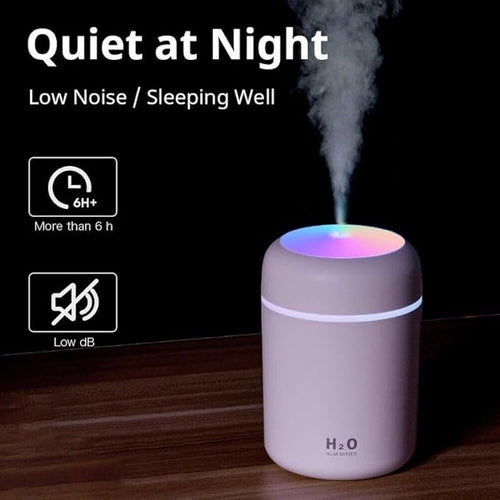 Boond · a small third bedroom₹899Shop →
  Hotel Collection · the scentFrom ₹299Shop →
Placement, drops and running three machines
The public-zone machine is the one that needs thought. Put it about a metre off the floor — a console, a sideboard, a low shelf — and towards the seating rather than towards the passage mouth. A diffuser placed near a corridor opening spends a third of its output feeding a space nobody occupies. In an open-kitchen layout, put the maximum distance the room allows between the machine and the hob, and run it after cooking rather than during. Keep it out of the direct line of the ceiling fan and the split AC, which pins mist against one wall instead of spreading it. Five to six drops per tank is right here.
The bedroom machines want the opposite of everything above. Three to four drops rather than six, the unit a couple of feet clear of the bedhead rather than beside it, and the 2H timer rather than an overnight run. A Sukoon will do 16 to 18 hours on low, which sounds like a benefit and mostly is not — a bedroom diffusing since morning smells of nothing to the person who has been in it and of far too much to anyone opening the door. Run it for the hour before bed and let it stop. The point of a bedroom machine is that you walk into something, not that you sleep inside a cloud.
With three machines you also acquire a schedule, and it saves real money. Do not run them all at once; run the public zone from early evening and start the bedrooms an hour before anyone goes to bed. That alone roughly halves consumption against continuous running, which matters when you are filling three tanks instead of one. Rinse each tank when you change scents, use filtered water in hard-water cities, and never substitute raw essential or carrier oils — they are too viscous to atomise and will foul the plate. Three to six drops of Hotel Collection per tank is the guidance.
What a 3BHK setup actually costs
The arithmetic in full, with every total checked. Each Sukoon ships with three 15ml fragrances of your choice, so the machine price is the day-one setup price — three machines arrive with nine bottles between them, which is more than the entire range.
| Setup | What you get | Covers | Total |
|---|---|---|---|
| The start | One Sukoon ₹1,899 — includes 3 × 15ml scents | Public zone only | ₹1,899 |
| The frugal pair | Two Sukoons ₹1,899 × 2 | Public zone + master | ₹3,798 |
| The right one ★ | Three Sukoons ₹1,899 × 3 — 9 × 15ml scents included | Zone + two bedrooms | ₹5,697 |
| Full coverage | Four Sukoons ₹1,899 × 4 | Zone + all three bedrooms | ₹7,596 |
| Running cost | A 100ml refill from ₹999, or 300ml ₹1,799 (~₹6/ml) | Months across three machines | from ₹999 |
Versailles
The question I am sent most often about a 3BHK arrives with a floor plan attached and a number already written on it — usually four, sometimes five. My answer is nearly always one fewer than the plan says, and the room I remove is the one with the desk in it.
What changes at this size is that the flat finally has a shape worth respecting. There is a public half that behaves like one room and a private half that behaves like three, and once you see the flat that way the machine count stops being a guess. The passage misleads almost everybody, because it looks like the place a fragrance would spread from. Corridors do not spread anything. They take.
So: one Sukoon for the zone, one for the master, one for the other bedroom that is genuinely slept in. ₹5,697, nine bottles of fragrance in the box, and a fourth machine only when the household grows into it. A portion of every order funds a girl's classroom through Nanhi Kali, which is a better home for ₹1,899 than a diffuser in an empty guest room.
Frequently asked questions
- Best diffuser setup for a 3BHK flat — the exact kit, itemised and costed.
- Three or four Sukoons for a 3BHK? — the verdict, and a test for the fourth.
- Where to place diffusers in a 3BHK — the corridor problem, solved.
- 3BHK scenting budget — machines, scents and running costs in full.
- Brand: the SOSA founder story.
SOSA products & prices (verified August 2026): Hotel Collection water-based ultrasonic diffuser fragrance 15ml ₹299 · 100ml ₹999 · 300ml ₹1,799 · Pack of 7 (15ml, all fragrances) ₹1,799; refills 100ml from ₹999. Seven scents: The Ritz-Carlton-inspired (white tea · bergamot · cedar), Westin-inspired (white tea · aloe · cedar), 1 Hotels-inspired (cedarwood · vetiver · green leaves), The St. Regis-inspired (amber · violet · woods), Shangri-La-inspired (jasmine · green tea · white tea), Four Seasons-inspired (citrus · floral · sandalwood), W Hotels-inspired (citrus · pepper · amber). Diffusers: Boond 300ml ₹899 · Sukoon 500ml ₹1,899 · Megh 6L ₹3,499. Water-based, phthalate-free, composed to IFRA standards for home diffusion; 3–6 drops per tank. Made in India, Pune. The Hotel Collection scents are SOSA's own interpretations inspired by the world's finest hotels; all hotel names are trademarks of their respective owners and are used only to describe the scent style — SOSA is an independent Indian fragrance house, not affiliated with or endorsed by any hotel brand. Prices and availability subject to change — see the live product pages.