
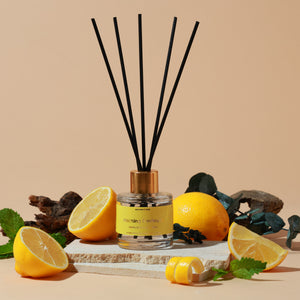
 Morning Freshness ₹749
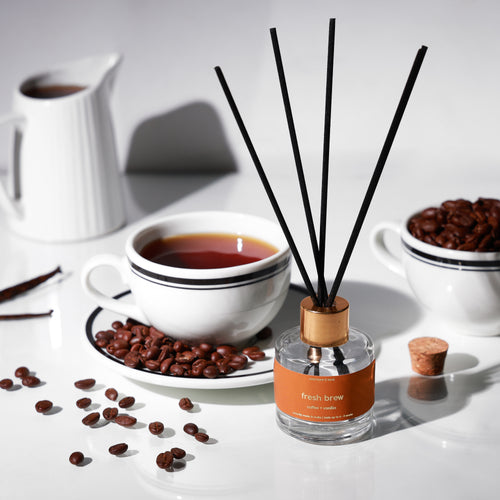
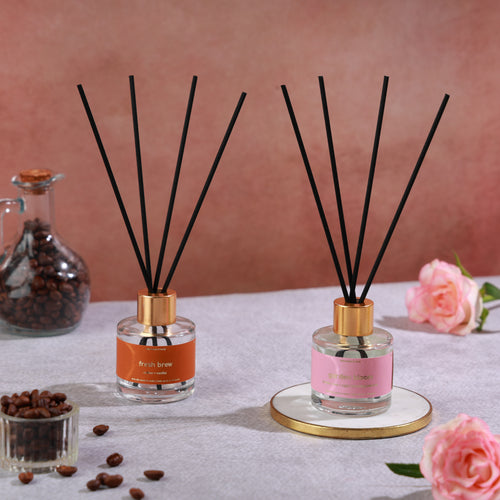
 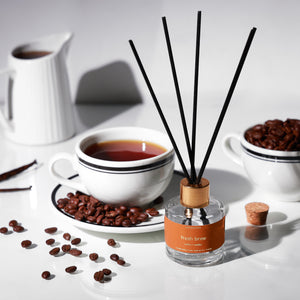 Fresh Brew ₹849
 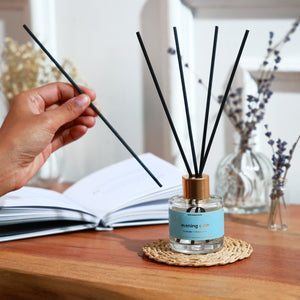 Evening Calm ₹799
  Oil refill 300ml ₹2,399
 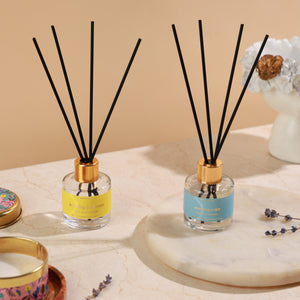 Day & Night duo ₹1,498
The plateau is the specification, not the spike. A 50ml holds it for most of its 6–8 weeks; a 130ml for most of its 14–18. Morning Freshness 50ml ₹749.
Do not add reeds in week two. Nine reeds runs a 50ml down in roughly five weeks instead of eight — weeks spent chasing a start-up condition.
Do not buy a bigger bottle either. At six reeds a 130ml projects exactly as a 50ml does. Size is the duration control; it buys weeks, never metres.
2. Roughly a week to ten days of visible decline. This is the part that produces the emails: the room goes from obvious to present to quiet, and it feels like something breaking. It is not.
3. Settled by about the end of week two. The reed is now in equilibrium — oil climbs at the rate it leaves — and the room holds a steady low level. A 50ml at ₹749 stays there for most of 6–8 weeks; the 130ml at ₹1,299 for most of 14–18.
4. Judge it in week three, from the doorway. Walk in from another room and take the first breath at the threshold. Sitting in the room all evening gives you no reading, because you stop registering a fragrance that never changes, hardest of all at home.
5. Buy nothing in the first month. Not extra reeds, not a bigger bottle, not a second scent. The commonest expensive mistake in home fragrance is buying against a start-up condition.
6. Flip the six reeds once a week, with gloves, on a tray. That maintains the plateau rather than restoring day one, and the lift you get from a flip lasting about a day is the expected span.
7. If week three gives you nothing even at the doorway, the cause is almost always position, airflow or room volume rather than the bottle. Move it before you spend.
Everything is composed and handmade in small batches in Pune, tested through 45°C summer heat and 85% monsoon humidity, and a portion of every order supports girl-child education through Nanhi Kali.
Part one — the three phases of a bottle
Every reed diffuser has the same shape to its life, and almost nobody sells it that way. There is a spike, a settle and a plateau, and only the third is a specification. Knowing which phase you are standing in answers most of the worry.
 Evening Calm₹799 · 50mlOver the following week to ten days the reed stops being a sponge and becomes a wick: what capillary action carries up the fibre comes to equal what evaporates off the surface, and the rate stops falling. This is the phase described as "it stopped working", and it is the product starting to work as designed. Two things make it feel steeper than it is. The composition has lost its brightest layer, so what remains is heart and base — rounder, lower, less announcing. And you have lived with the scent for a fortnight, so your own nose has quietly demoted it from news to furniture. Only one of those is happening in the bottle.
Part two — the first month, phase by phase
Sorted by how much each phase can honestly tell you about the bottle, rather than by the order you meet them in. The starred row is the only one worth forming an opinion in.
| Phase | What the reeds are doing | What the room reads like | What it tells you about your bottle | What to do |
|---|---|---|---|---|
| Week 3 to the end of the range ★ | Steady state — oil climbs at the rate it leaves | A flat, low, constant level you meet at the doorway | Everything. This is the specification you bought | Judge it now. If it reads at the threshold, spend nothing |
| Day 1 to day 3 | Six dry reeds saturating along their full length at once | The loudest it will ever be, often room-filling | Nothing useful — it is a start-up condition | Enjoy it, and write the date on the box |
| Day 4 to day 10 | The lightest top notes finishing; surface rate falling | A clear, sometimes steep decline | Nothing is wrong. This is the phase people panic in | Nothing. No extra reeds, no second bottle |
| Week 2 | Approaching equilibrium; heart and base notes leading | Rounder, lower, less announcing than week one | You are close to the real level but not quite on it | Flip all six reeds once, with gloves |
| The last week of the stated range | Liquid too low to keep the exposed length properly fed | A taper over several days, not a sudden stop | The bottle is genuinely finishing — correctly | Order the 300ml refill ₹2,399 or a fresh bottle |
| Past 8 weeks on a 50ml, or 18 on a 130ml | Reeds saturated and stalled, or the oil is simply done | Quiet even at the doorway, even to a visitor | Spent. This is the one case that is not perception | Refill the oil; refresh the reeds if they are darkened |
| The honest caveat: these phases are typical shapes rather than a schedule, and they move with the room. Warmth speeds the whole curve up and finishes the bottle sooner; a humid stretch slows evaporation from the reed surface, so the room reads quieter while the bottle lasts longer; a draught from an AC, a fan or an open balcony gives you a weak room and an early empty at once. Replacement reeds are not sold separately, so refreshing reeds means a new bottle rather than a spare set. | ||||
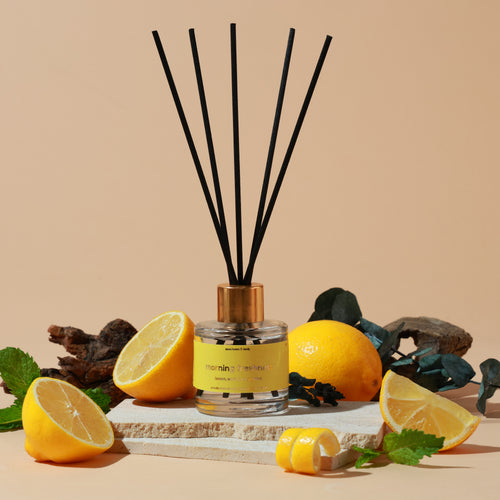 Morning Freshness · brightest opening, cleanest settle₹749Shop →
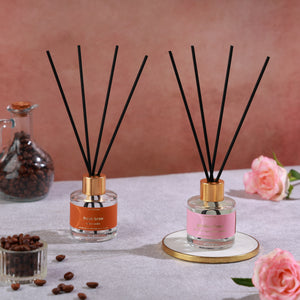
 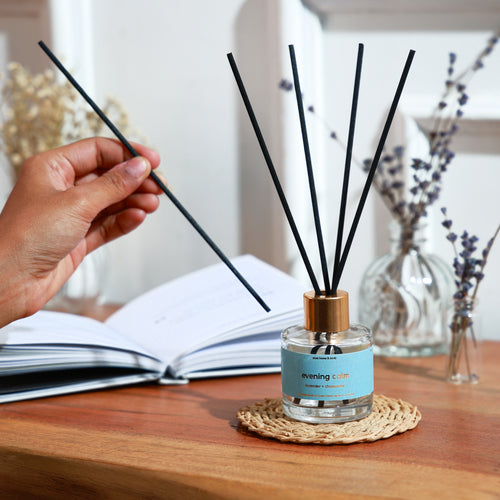 Evening Calm · the softest plateau, for a bedroom₹799Shop → Fresh Brew · the highest settled level in the range₹849Shop →
Part three — the trade we made, and where reeds are the wrong tool
There is a way to make the opening bigger, and I want to tell you what it costs. Phthalate solvents push fragrance hard off a reed, and they win week one convincingly. They also degrade in heat, and in an Indian summer a bottle carrying them can turn thin and slightly acrid by around week six — the smell people describe as "it went off". SOSA is phthalate-free on a heat-stable coconut-derived CCT carrier, and the honest description of that choice is a smaller opening in exchange for a longer, flatter plateau that still smells like itself at the end. If you remember a strong first week from some other bottle, you are remembering the part of the curve we deliberately gave up.
Some readers do not want a plateau at all. If what you want is the day-one level on purpose, at a moment of your choosing — before people arrive, or for an hour in the evening — a passive diffuser is the wrong instrument by design. No fan, no heat, no switch; constant and deliberately low is the entire specification. The honest answer there is a Sukoon at ₹1,899, bought for control rather than strength — 270–320 sq ft, 16–18 hours on low, remote and steady, 2H and 4H timers, three 15ml Hotel Collection fragrances in the box. It delivers fragrance by aerosolising water, so it adds moisture where a reed bottle adds none, and it takes only the water-based Hotel Collection: reed oil never goes into a machine and Hotel Collection never goes into a reed bottle.
The third thing is a short list of what not to do inside the first month, because each item costs money and none of them work. Do not add reeds in week two: nine reeds runs a 50ml down in roughly five weeks instead of eight, and you would be paying in weeks to chase a start-up condition that has already gone. Do not buy the 130ml expecting a stronger room; at six reeds it presents the same evaporating surface and reads the same. Do not move the bottle every other day, or you will never get two comparable readings. Above all, do not judge it from the sofa. The only readings worth having are the ones you take walking in from somewhere else, and the correct purchase in week two is nothing at all.
Part four — what to do at each point in the curve
Seven positions on the curve. Three of them cost nothing, which is the correct proportion for a first month.
| If this is your situation | What I would do | What it costs | The honest caveat |
|---|---|---|---|
| Day nine, the room has gone quiet, you are worried ★ | Nothing. Write the open date on the box and wait for week three | ₹0 | This is the single most common moment for an unnecessary purchase |
| Week three, it reads when you walk in but not when you sit | Nothing. That is the plateau behaving as it should | ₹0 | You stop registering a constant at home; the doorway is the honest reading |
| Week three, nothing even at the doorway | Move it first — inner wall, waist-to-chest, clear space, off any draught | ₹0 | Free fixes before paid ones, always. Position beats spending |
| Haven't bought yet and want to test the format | Morning Freshness 50ml, six reeds, in one room | ₹749 · 6–8 weeks | The least polarising in the range, and a small commitment to learn on |
| You want the settled level to sit higher | Change the composition, not the size — Fresh Brew 9.5, Mountain Breeze 9.4 | ₹849 · 50ml | Positions on SOSA's own scale at six reeds, not an industry standard |
| You want fewer restarts and longer between orders | The 130ml next time, bought for duration and nothing else | ₹1,249–₹1,349 | Same reach at six reeds — it buys weeks, not metres |
| Past the range, quiet even to a visitor, reeds darkened | Spent — 300ml oil refill into your own glass | ₹2,399 ≈ 8–11 months | About ₹7–8 per ml against ₹15–17. Reeds are not sold separately |
Versailles
The first bottles I sent to friends went with no note at all. Within a fortnight three messages said much the same thing: it was wonderful, and now it has stopped. Nothing had stopped. Every one of those bottles was in week two, doing precisely what the formula said. I had built the composition around the settled level and then let people meet it at its noisiest — my mistake, not theirs.
What I should have written on the box is that the opening belongs to the reeds and the plateau belongs to the perfumer. Anybody can make a loud first weekend; you push the solvent and you get it. Holding a level you would still want in week seven, in a Pune summer, with no phthalates and a base that does not turn, is the part that took the training.
So I would rather be judged late than early. Write the date on the box, ignore the bottle for a fortnight, then walk in from the corridor one evening and take the first breath at the door. That reading is worth more than everything you noticed in between. If it is there, we did our job; if it is not, move the bottle before you spend a rupee. Made in small batches in Pune, and a part of every order funds a girl's classroom through Nanhi Kali.
Frequently asked questions
- Why you smell it walking in but not sitting down — which of your two readings to trust.
- Weak bottle or adapted nose? — four checks, in order of how fast you can run them.
- Flipped the reeds and it came back for a day and plenty of liquid, almost no smell.
- When to stop tuning reeds and buy a Sukoon — the upgrade trigger is control, not strength.
- Brand: the SOSA founder story.
SOSA range, specifications and prices used in this guide (verified from the live store, 27 August 2026): Reed diffusers — alcohol-free, phthalate-free, paraben-free and IFRA-compliant compositions on a heat-stable coconut-derived (CCT) carrier, low-VOC, in a refillable glass bottle with six fibre reeds; flip weekly. 50ml lasts 6–8 weeks and 130ml lasts 14–18 weeks; there is no 100ml reed diffuser size. Morning Freshness (Malabar lemon · peppermint · Nilgiri eucalyptus) 50ml ₹749 · 130ml ₹1,249; Garden Bloom (British rose · night-blooming jasmine) ₹799 · ₹1,299; Evening Calm (Kashmir lavender · chamomile) ₹799 · ₹1,299; Fresh Brew (Coorg coffee · Kerala vanilla) ₹849 · ₹1,349; Mountain Breeze (Himalayan pine · sage · Indian cedar) ₹849 · ₹1,349. Duo sets ₹1,498–₹1,598 for 2 × 50ml and ₹2,498–₹2,598 for 2 × 130ml. Oil-only refills 300ml ₹2,399 · 500ml ₹3,499 — the glass vessel and reeds are not included, and replacement reeds are not sold as a separate product. Machines: Boond 300ml ₹899 (~150 sq ft, about 6 hours a fill) · Sukoon 500ml ₹1,899 (270–320 sq ft, 16–18 hours on low, three 15ml fragrances included) · Megh 6L ₹3,499 (~215 sq ft — a runtime and humidity machine that covers less than a Sukoon, never a coverage upgrade) · waterless Vaayu ₹11,999 · Safar ₹3,999 (a car and travel product) · Aangan ₹25,999 · Meenar ₹38,500. The water-based Hotel Collection for ultrasonic machines (15ml ₹299 · 100ml ₹999 · 300ml ₹1,799 · pack of seven 15ml ₹1,799) cannot be used in a reed bottle or a Vaayu. Below ₹749: jar candles ₹379, Sandalwood or Smoked Oudh candle ₹449, wax melts ₹474 (a burner is required and not included), mugs ₹474, bubble and taper candles ₹569, Amber Rose candle ₹599, ceramic trinket dish and candle two-pack ₹664. A reed diffuser adds fragrance to a room. It does not clean, purify or filter air, remove or neutralise cooking, damp or smoke smells, reduce humidity, or change how anyone feels. A reed diffuser adds no moisture to the air; ultrasonic machines work by aerosolising water and therefore do. A persistent musty smell indicates moisture that needs finding and drying, and SOSA sells no dehumidifier or air purifier. Ventilate or extract first; add fragrance second. Evaporation rate rises with warmth and falls with humidity, and airflow carries scent away from the bottle — so performance varies with season, ventilation, ceiling height and room use; longevity figures are typical ranges, not guarantees. Not noticing a constant fragrance is ordinary olfactory adaptation; the reliable checks are leaving the room and returning, or asking someone who has just arrived. Strength figures are positions on SOSA’s own internal scale, not an industry standard. Fragrance oil is flammable — keep bottles away from open flame and out of direct sunlight, and out of reach of children and pets. Composed and handmade in small batches in Pune, India; tested through 45°C summer heat and 85% monsoon humidity. Free shipping above ₹499. A portion of every order supports girl-child education through Nanhi Kali. Prices subject to change — see the live product pages.