
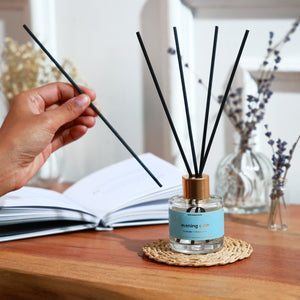



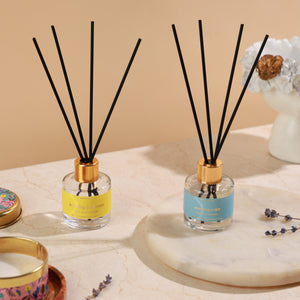
Why this is the strongest case for a machine in this whole cluster: a reed diffuser works by passive capillary action — oil climbing six fibre reeds and evaporating. It has no clock, no valve and no way to be ahead of you. Safar ₹3,999 has three speeds and a 1, 2 or 3-hour auto-off; Vaayu ₹11,999 runs 1h / 4h / 8h / 24h app windows on chosen days. Timing is the one job a reed genuinely cannot do.
The free half of the answer: come home to a closed room. Containment does more for an arrival moment than any upgrade, and it costs nothing.
Said kindly: part of what you are remembering is not buyable. You arrived at that hotel off a flight, un-adapted, into a room somebody else had made up. The scent was doing perhaps half the work.
The honest gap: Safar is named and sold as a car and travel diffuser with no published room-coverage figure; Vaayu is rated to 2,000–3,000 sq ft and is wrong for one bedroom. Between them SOSA makes no mid-sized waterless bedroom nebuliser.
2. The room must reach its level before you do. This is the sentence to keep. A closed room takes time to come up to an even, perceptible concentration, and then holds it for a good while after the source stops, because a closed room exchanges its air slowly. So a device that runs for an hour and finishes as your key turns is worth more than a device that runs for three hours starting when you sit down. Safar does this with a 1, 2 or 3-hour auto-off; Vaayu does it with app windows of 1, 4, 8 or 24 hours on chosen days; a reed cannot do it at all, because passive capillary flow has no clock.
3. Close the door on the room you want to arrive into. Containment is free, it is the largest single variable in this entire question, and almost nobody uses it deliberately. A closed bedroom reaches a noticeable concentration far faster than an open flat and holds it far longer. If you want the arrival at the bedroom door rather than the front door, this alone may finish the job.
4. Do the free experiment before you spend anything. Move your existing bottle out of the dead corner and into the path air already takes, but never into the direct blast of a split AC. Put all six reeds in rather than three. Then leave the flat for fifteen minutes and walk back in, and judge it on that walk-in only. If the walk-in is good and the sitting-inside is quiet, nothing is wrong — that is exactly how home fragrance is supposed to behave.
5. Then buy for the schedule, not for the strength. If the free version is not enough, the specification you are shopping for is a timer, and it is the specification almost no product page advertises. Sukoon ₹1,899 gives genuine on/off across a published 270–320 sq ft, at the cost of water, dilution, added humidity and filling a tank. Safar ₹3,999 gives undiluted oil, no water and a timer, and is named and sold as a car and travel diffuser with no published room-coverage figure.
Free shipping above ₹499, and a portion of every order supports girl-child education through Nanhi Kali.

Why the room has to be ready before you are
Everything in this question turns on one physical fact that nobody thinks about, because it is invisible: a room is a volume of air with a time constant. Put a source of fragrance into a closed bedroom and the concentration does not appear, it climbs — slowly at first, then evenly, as the room’s own convection distributes it. Stop the source and the concentration does not vanish, it decays, over a period governed by how often that room exchanges its air with the rest of the world. A hotel corridor has been scented since before breakfast. You are not walking into a device; you are walking into the accumulated result of one.
 Evening Calm₹799A reed diffuser is a passive capillary device: oil climbs six fibre reeds and evaporates from their surface at whatever rate the room allows. No power, no pump, no noise, no maintenance, no charging, nothing to remember — and that list is genuinely the reason it is the product I sell most of. But a device with no clock cannot be ahead of you. It is at the level the afternoon set it at, and that level is the same whether you are due home in ten minutes or ten days. For a permanent condition it is ideal. For a staged moment it is structurally the wrong tool, and I would rather say so here than sell you a bigger bottle.
 Sukoon₹1,899Sukoon at ₹1,899 is the honest value answer, because it is the cheapest device in the range with a genuine off state and a genuine on state. Switch it on as you leave in the morning and the bedroom has had all day; switch it on for an hour and you have a window. Its published coverage is 270–320 sq ft from a 500ml tank, 16–18 hours on low, and it ships with three 15ml Hotel Collection scents so there is nothing else to buy. The cost is water: diluted oil, added humidity, a tank to fill, and a possible white mineral film in a hard-water city.
 Hotel Collection₹999Pressurised air shatters undiluted oil into a dry micro-mist that travels with the room’s own airflow. No water, no dilution, no heat, no added humidity, no white dust — and this is the technology hotels actually use. Safar ₹3,999 is that mechanism at personal scale: a 20ml bottle, a 2000 mAh Type-C battery giving up to 10 hours continuous or around 30 intermittent per charge, three speeds, a 1, 2 or 3-hour auto-off, 6.9 cm tall. It is named and sold as a car perfume diffuser — car, handbag, desk, bedside and hotel room are all listed uses on its own page — and SOSA has published no room-coverage figure for it, so I will not tell you it fills a room.
The part of the memory that is not for sale, said plainly
I want to put this early rather than bury it, because it changes how the rest of the page reads. Some of what you are trying to recreate was never in the bottle. You walked into that hotel off a journey. You had been in an aeroplane, a taxi, a lift — three completely different sets of air — so your olfactory receptors were as un-adapted as they get. The bed had been made by somebody who was not you. There was no laundry drying in the corner, no cooking from an hour ago condensed onto the curtains, and nothing on your list for the evening. The fragrance was doing perhaps half the work and the circumstances were doing the rest.
That is not a reason to be disappointed and it is certainly not a reason to spend more. It is a reason to aim at the half that is reproducible, which turns out to be the more interesting half anyway: consistency, dryness, a single signature and a well-timed threshold. A hotel does not change its scent every six weeks. It runs one composition at one intensity for years, which is why regulars recognise it before they reach reception. You can have that at home for ₹749 a bottle and a decision to stop shopping.
There is one more thing on the un-buyable list, and it is the kindest fact in home fragrance: you will never smell your own home the way a visitor does. Olfactory receptors stop reporting a constant, unchanging stimulus within minutes — the signal still arrives, the brain simply stops mentioning it. This is why your friend’s flat has a smell and yours does not. It is also why the arrival moment matters so much: coming in from outside is the one time of day you are un-adapted enough to hear your own house. Build for that, and you will get the thing you are asking for. Sit in the room for two hours waiting to be impressed, and you will conclude the diffuser has stopped working when it has not.
| Format & mechanism | Can it be early? | Scheduling available | Room coverage | What it costs you |
|---|---|---|---|---|
| Reed diffuser ₹749–₹849 · passive capillary | No. It has no clock | None. Reed count only, responding over hours | A fragrant zone rather than a fragranced room; 50ml suits up to ~150 sq ft | Nothing at all — no power, no water, no charging, silent, ~₹13–₹15 a day |
| Boond ₹899 · ultrasonic water mist | Yes, if you switch it on before leaving | None onboard; runs about 6 hours from 300ml | Up to ~150 sq ft | Water, dilution, humidity, refilling, USB power |
| Sukoon ₹1,899 · ultrasonic water mist ★ | Yes — the cheapest genuine on/off in the range | None onboard; 16–18 hours on low from 500ml, so you set the hours | 270–320 sq ft, published | Water, dilution, added humidity, filling; three 15ml Hotel Collection scents included |
| Megh ₹3,499 · ultrasonic water mist | Yes | About 100 hours from a 6L tank | ~215 sq ft — less than the ₹1,899 Sukoon | A great deal of humidity. A runtime machine, never a coverage upgrade |
| Safar ₹3,999 · waterless cold-air nebulising ★ | Yes, precisely | 3 speeds and a 1, 2 or 3-hour auto-off; 10h continuous or ~30h intermittent per charge | No published figure. Personal and small-space scenting | Recharging, a small pump sound. Named and sold as a car and travel diffuser |
| Vaayu ₹11,999 · waterless cold-air nebulising | Yes, and it is the only true scheduler here | Bluetooth app plus onboard; 1h / 4h / 8h / 24h windows, chosen days, adjustable intensity, key-lock, under 38 dB | 1000 m³ — roughly 2,000–3,000 sq ft | ₹11,999, and nine-tenths of it wasted in one bedroom. Buy it for a whole floor |
On demand · Sukoon₹1,899Shop →  The oils · Hotel Collection₹999Shop →
 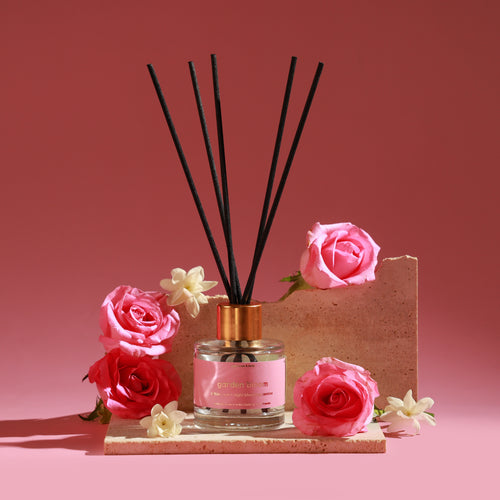 Always ready · Garden Bloom₹799Shop →
Building the arrival, in the order I would actually do it
Decide which door you mean. This sounds pedantic and it is the difference between success and a wasted ₹3,999. The front door of a flat is the hardest place in the home to stage a moment, because an entrance is the most turbulent point you own: it opens, air exchanges violently with the corridor, and anything placed there is repeatedly stripped and then met at close range. A bedroom door is the easiest, because the room behind it is small, closed and slow to exchange air. If you can accept the arrival happening thirty seconds later, at the bedroom door rather than the front one, everything about the problem becomes cheaper.
Then spend nothing for a week. Move the bottle slightly inside the room rather than on the entrance console, out of the draught but into the path air already takes, and never directly under a running split AC — that strips the top notes within days and leaves you with the base wondering where the fragrance went. Put all six reeds in if the room is 150 sq ft or more; keep it to three or four in a small sealed bedroom, where six is usually too many and “cloying” is nearly always a description of over-dosing rather than of the composition. Flip the reeds every three to five days. Then run the only test that matters: leave for fifteen minutes and walk back in. If it lands on the walk-in, you are done, and you have discovered that your problem was measurement rather than product.
If it does not land, buy the clock. For a bedroom, Sukoon at ₹1,899 is the sensible purchase and I recommend it more often than anything else in this cluster: real coverage, a real off switch, three scents in the box. Choose Safar at ₹3,999 when water is ruled out — a humid coastal flat, a room you do not want more moisture in — or when you want the pure undiluted oil that the hotel mechanism actually uses, accepting that it is sold as a car and travel device, that its longest timer is three hours, and that we publish no coverage figure for it. And here is where the range stops being able to help: between Safar and Vaayu there is no mid-sized waterless bedroom nebuliser. If what you want is waterless, scheduled, room-filling scent in 120 sq ft, nothing in this catalogue was built for exactly that, and Vaayu is not the answer merely because it is the next one up the price list.
What to buy for an arrival moment, in order
Free adjustments first, because a meaningful share of readers who write to me about this are fixed by a closed door and a walk-back test. Then the cheapest device that can genuinely be early. The last row is the gap in our own range, and on a scheduling page it deserves saying twice: the timer you want for a bedroom exists on a machine sized for a car, and on a machine sized for a floor, and on nothing in between.
| Step | What it is | When it is the right answer | Price |
|---|---|---|---|
| 1. A closed door and the fifteen-minute walk-back ★ | Containment plus the only measurement your own nose can make honestly. Six reeds if the room is large, three or four if it is small and sealed | Always first, and it costs nothing. It also tells you whether the problem was dose, placement or simply adaptation | ₹0 |
| 2. A reed diffuser, placed properly | Passive capillary, six fibre reeds, silent, unpowered, 6–8 weeks on 50ml, refillable glass | If what you actually want is a permanent quiet condition rather than a staged moment — and it is the only option here that never needs remembering | ₹749–₹849 |
| 3. Sukoon ★ | Ultrasonic water mist, genuine on/off, 270–320 sq ft published, 16–18 hours on low, three 15ml Hotel Collection scents included | The value answer for most bedrooms, if you accept water, dilution, added humidity and filling a tank | ₹1,899 |
| 4. Safar | Waterless cold-air nebulising of undiluted oil, 3 speeds, 1/2/3-hour auto-off, 2000 mAh Type-C, 20ml bottle, 6.9 cm | When water is ruled out, or the timer itself is the point. Named and sold as a car and travel diffuser; no published room coverage; needs recharging | ₹3,999 |
| 5. Vaayu | The only true scheduler: app plus onboard, 1h/4h/8h/24h windows, chosen days, 400ml tank lasting about 90+ days, under 38 dB | A whole floor, an open-plan living-dining, a large home, a villa, a clinic or a reception — or one machine doing the entire flat on a schedule. Not one bedroom | ₹11,999 |
| The honest gap | A scheduled, waterless machine built for one bedroom, which SOSA does not make. Safar is personal scale with no published coverage; Vaayu is rated to 2,000–3,000 sq ft. Nothing sits between them | Stated plainly, because it is why this page recommends Sukoon to most readers who ask for a timed arrival | — |
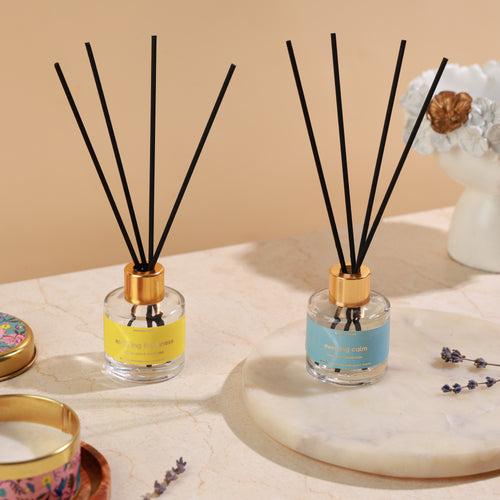
Versailles
This is the page in the whole cluster where I am least reluctant to point somebody at a machine, and I want to be clear about why. Almost every other version of “my home does not smell like a hotel” is answered by placement, reed count, or understanding that you have adapted to your own house. This one is not. You have asked for something to have already happened by the time you open the door, and a passive reed cannot be early, because it has no clock. That is not a fault I can talk you out of. It is arithmetic.
What I would still like you to do is spend a week on the free version first, because the fix rate is higher than you would expect. Close the bedroom door in the morning. Move the bottle out of the corner. Walk back in after fifteen minutes rather than sniffing from the sofa. A great many people who were about to buy a machine discover that what they had was a measurement problem — their home was fine, their nose had simply stopped mentioning it.
And I would like to say the warm thing rather than the commercial one. Part of what you loved about that hotel was that you were not in charge of it. Somebody else had made the bed, and you had arrived from somewhere, and you were between two lives for a night. No diffuser sells that, and I would think less of a page that pretended otherwise. What you can genuinely have is a room that is ready when you get there, in one scent you have chosen and kept, at a level that greets you rather than sits on you. That is available at ₹1,899, and quite often at ₹0. Everything is composed in Pune, and part of every order funds a girl’s classroom through Nanhi Kali.
Frequently asked questions
- My house smells boring after the hotel — novelty, adaptation, and the practical ladder.
- The holiday room — what is reproducible and what is not.
- The resort arrival moment — scale and scheduling, not strength.
- Why a ₹1,000 reed feels nothing like it — a ₹3,000 reed would feel the same.
- A signature smell for your home — one scent, kept for a year.
- That hotel smell every evening — occupancy hours and the cost of an empty room.
- A resort feeling in an Indian apartment — humidity, open windows and scale.
- You do not need a luxury home — a small room is easier, not harder.
- What to buy first — the whole order, cheapest honest option at the top.
- Brand: the SOSA founder story.
Facts verified August 2026: Passive capillary — SOSA reed diffusers, five scents, 50ml ₹749–₹849 for rooms up to ~150 sq ft lasting 6–8 weeks, 130ml ₹1,249–₹1,349 above 150 sq ft lasting 14–18 weeks, six fibre reeds included (six for full projection, three for a soft bedside level and roughly double the life), flipped every 3–5 days, about ₹13–₹15 a day, heat-stable CCT carrier rather than DPG, alcohol-free, phthalate-free, paraben-free, IFRA-compliant, 0 ppm formaldehyde, refillable glass, tested at 45°C and 85% RH, composed in Pune; duos ₹1,498–₹1,598 for 50ml × 2; refills 300ml ₹2,399 and 500ml ₹3,499, oil only and never a first purchase. Ultrasonic water mist — Boond ₹899 (300ml, up to ~150 sq ft, ~6 hours, USB, night light), Sukoon ₹1,899 (500ml, 270–320 sq ft, 16–18 hours on low, three 15ml Hotel Collection scents included), Megh ₹3,499 (6L tank, ~100 hours, ~215 sq ft — less than Sukoon, and never a coverage upgrade). Waterless cold-air nebulising — Safar ₹3,999 (20ml bottle, 2000 mAh Type-C, up to 10 hours continuous or around 30 hours intermittent per charge, 3 speeds, 1/2/3-hour auto-off, 6.9 cm, named and sold as a car and travel diffuser with bedside and hotel room among its stated uses, no published room-coverage figure) and Vaayu ₹11,999 (up to 1000 m³ or roughly 2,000–3,000 sq ft, 400ml tank lasting up to about 90+ days, Bluetooth app plus onboard buttons, 1h/4h/8h/24h run windows, choice of days, adjustable intensity, key-lock, under 38 dB, freestanding or wall/HVAC mount, 5W, CE, RoHS, SGS). Between Safar and Vaayu there is no mid-sized waterless bedroom nebuliser in the SOSA range. Hotel Collection oils are water-based and ultrasonic-only — 15ml ₹299 (a refill), 100ml ₹999, 300ml ₹1,799, pack of 7 ₹1,799 — and cannot be used in reed diffusers, nor reed oil in ultrasonic machines; there is no hotel-inspired reed diffuser. No health, air-quality, allergy or antimicrobial claims are made, no claim is made that fragrance improves sleep, mood or concentration, and fragrance does not remove a smell: source, ventilation, then fragrance. Free shipping above ₹499. A portion of every order supports girl-child education through Nanhi Kali. SOSA is an independent Indian fragrance house; the Hotel Collection scents referenced here are SOSA’s own interpretations inspired by the world’s finest hotels, and SOSA is not affiliated with, endorsed by or a supplier to any hotel brand. Prices subject to change — see the live product pages.