


Why a bedroom is easier than a hallway: small volume, few openings, slow air exchange. The same bottle that reads as thin in an entrance reads as generous in 120 sq ft behind a closed door, because concentration is a balance between what a source adds and how fast the room loses it.
Which means most readers here need less, not more. In a small sealed bedroom, six reeds is usually too many. Three gives a soft level and roughly doubles the bottle’s life — and a room you can smell continuously while sitting in it has overshot.
If you still want a machine: Sukoon ₹1,899 covers a published 270–320 sq ft, so in a bedroom it is over-specified and therefore controllable. Safar ₹3,999 is waterless and undiluted, with a 1/2/3-hour auto-off — and is named and sold as a car and travel diffuser.
The honest gap: Vaayu ₹11,999 is rated to roughly 2,000–3,000 sq ft and is the wrong purchase for one bedroom. Between it and Safar, SOSA makes no mid-sized waterless bedroom nebuliser at all.
2. Understand that an arrival is a step, not a level. You are not trying to make the bedroom smell strong; you are trying to make it smell different from the corridor. A boundary with a lower concentration on one side and a higher one on the other is what produces the moment. In an open-plan flat there is no boundary and therefore no arrival, no matter what you spend. A closed door is the cheapest discontinuity generator in the building.
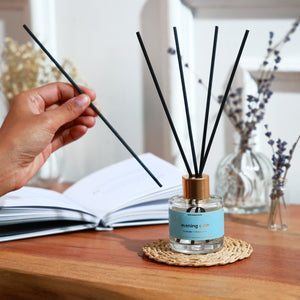
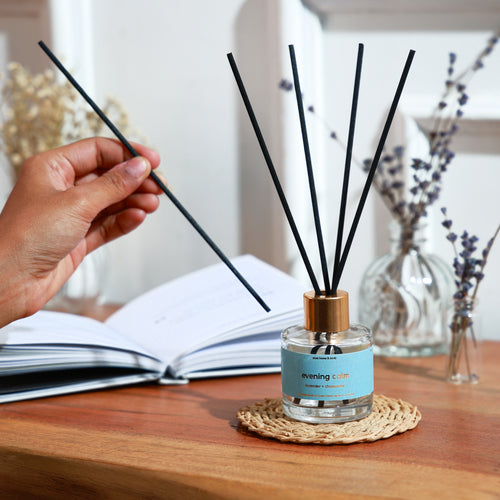
3. Then use less than you think. A small sealed room is a favourable environment, not a difficult one, and the commonest mistake in it is over-dosing. Six reeds is full projection for a living room; in 100 to 150 sq ft, three or four is usually right, gives a softer and more layered impression, and roughly doubles the bottle’s life. The test is simple: if you can smell it continuously while sitting on the bed, the projection has overshot the volume, and the arrival will be blunted rather than sharpened by adding more.
4. Place it away from the door, not beside it. Putting the bottle on the chest of drawers immediately inside the doorway is the same mistake as putting one on the front-door console: the pocket of air there is the part that gets exchanged each time the door swings. Put it further into the room, at chest or bedside height, in air that circulates gently — and never in the direct path of a split AC, which strips the lightest materials within days and leaves you with the base.
5. Judge it only on the walk-in. You adapt to your own bedroom within minutes of being in it, so sitting inside and sniffing tells you nothing. Leave for fifteen minutes with the door shut, come back, and grade it as you open the door. That is the only honest measurement available to you, and for a great many readers it turns out the setup was already working.
Free shipping above ₹499, and a portion of every order supports girl-child education through Nanhi Kali.
Three things a closed door does that no purchase can
I keep coming back to the door because it is the only free item in home fragrance that behaves like an upgrade. When somebody writes to me having spent ₹3,999 on a machine for a bedroom that was open to a corridor all day, the machine did not fail — it was asked to hold a level in a volume seven times larger than the one they were describing. Containment is not housekeeping advice. It is the physics of the question.
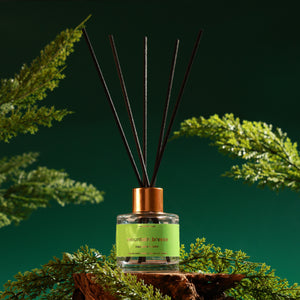
 Mountain Breeze₹849A reed diffuser is passive capillary diffusion: oil climbs six fibre reeds and evaporates from their surface at a rate set by the room’s temperature, humidity and airflow. That output is fixed — it does not know how big the room is. So the concentration you experience is entirely a function of the volume it has to fill and how fast that volume is replaced. A 50ml is specified for up to about 150 sq ft for exactly this reason, and a 50ml in a bedroom with the door open to a whole flat is doing the job it was built for in a space it was never sized for.
 Sukoon₹1,899A closed bedroom exchanges its air with the outside world slowly, which means the concentration does not vanish when a source is switched off — it decays over a period governed by that exchange rate. This is why an active machine works so well behind a closed door and so poorly in a corridor: run Sukoon for an hour in a shut bedroom and the room stays at a good level long after the mist has stopped. Its published coverage is 270–320 sq ft, so in a 120 sq ft bedroom it is over-specified — which is not a waste but a control advantage: run it low, run it briefly, and you set the level rather than accepting one.
 Hotel Collection₹999This is the part that is genuinely worth understanding. The nose responds to change far more readily than to level — which is why you stop noticing a constant smell within minutes and why a hotel lobby lands on arrival and not at hour three. An arrival moment therefore requires two different concentrations either side of a line you cross. A closed door is the only reliable way to produce that line in a home. If you want the effect and the door is open, you are not under-dosed; you have no boundary. And if you want it waterless, Safar ₹3,999 nebulises undiluted oil with three speeds and a 1, 2 or 3-hour auto-off — named and sold as a car and travel diffuser, with car, handbag, desk, bedside and hotel room among its stated uses, and no published room-coverage figure.
Why most people asking this need less, not more
Every family in this cluster has a page where the honest advice is to buy nothing, and in the bedroom family this is that page. A closed bedroom is the most favourable environment in a home for fragrance — small volume, few openings, slow exchange, and often a running air conditioner circulating the air within a sealed box, which distributes fragrance evenly and is the reason a bedroom usually smells strongest at night. Readers write to me convinced they need a machine, and describe a room in which the correct advice is to remove two reeds.
The over-dosing signal is worth learning because it is easy to misread. You are not supposed to smell your own bedroom continuously. Home fragrance is designed to be noticed on arrival and at transitions; constant perception in a room you are sitting in means the projection has overshot the volume. And over-dosing does not just waste oil — it flattens the composition. Almost anything at too high a concentration collapses into a single sweet or sharp impression, which is precisely what people mean when they say something smells like air freshener; the same oil at a lower dose reads as layered because the nose has room to resolve the separate materials. So the sequence in a small room is: fewer reeds first, then judge on the walk-in, then decide whether anything needs buying at all.
Two further things about air conditioning, since almost every Indian bedroom question involves one. A running split unit recirculates air inside a closed room, which is genuinely helpful — it evens out the concentration rather than leaving a fragrant pocket near the bottle. It also dries the air, which speeds evaporation, so the bottle empties a little faster. Both are fine. What is not fine is placing the diffuser in the unit’s direct blast, where high-velocity air removes fragrance rather than projecting it and strips the lightest, most volatile materials within days. Somewhere in the room’s circulation, not in its jet.
| Option & mechanism | What it gives you at the door | Control | Coverage | Cost and catch |
|---|---|---|---|---|
| A closed door ★ | The concentration step the whole effect depends on, plus a much smaller volume to fill | Total, and instant | Whatever the room is | ₹0. You have to actually close it |
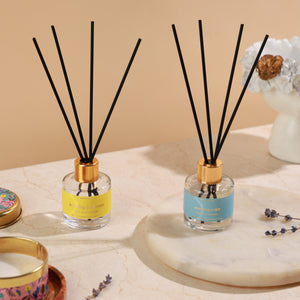
| Reed 50ml ₹749–₹849 · passive capillary ★ | A steady level in a closed 100–150 sq ft room; genuinely enough behind a shut door | Reed count only — three soft, six full — responding over hours | Up to ~150 sq ft, specified | Silent, no power, no water, no charging, ~₹13–₹15 a day. Cannot be switched off |
| Boond ₹899 · ultrasonic water mist | Moves air, so it evens a small room quickly | On/off; ~6 hours from 300ml | Up to ~150 sq ft | Water, dilution, humidity, refilling, USB power |
| Sukoon ₹1,899 · ultrasonic water mist | Over-specified for a bedroom, which makes it controllable rather than wasteful | Real on/off; 16–18 hours on low from 500ml | 270–320 sq ft, published | Water, dilution, added humidity, filling. Three 15ml Hotel Collection scents included |
| Megh ₹3,499 · ultrasonic water mist | Runs for a very long time; covers less ground than the machine at half the price | About 100 hours from a 6L tank | ~215 sq ft — less than the ₹1,899 Sukoon | A great deal of humidity. Never a coverage upgrade |
| Safar ₹3,999 · waterless cold-air nebulising | Undiluted oil as a dry mist — the hotel mechanism at personal scale, no added humidity | 3 speeds and a 1/2/3-hour auto-off; 10h continuous or ~30h intermittent per charge | No published figure. Personal and small-space scenting | Recharging, a small pump sound. Named and sold as a car and travel diffuser |
| Vaayu ₹11,999 · waterless cold-air nebulising | Far more than a bedroom can use | App plus onboard; 1h/4h/8h/24h windows, chosen days, under 38 dB | 1000 m³ — roughly 2,000–3,000 sq ft | The wrong purchase for one bedroom. Buy it for a whole floor or a large open plan |
Softest at 8.9 · Evening Calm₹799Shop → 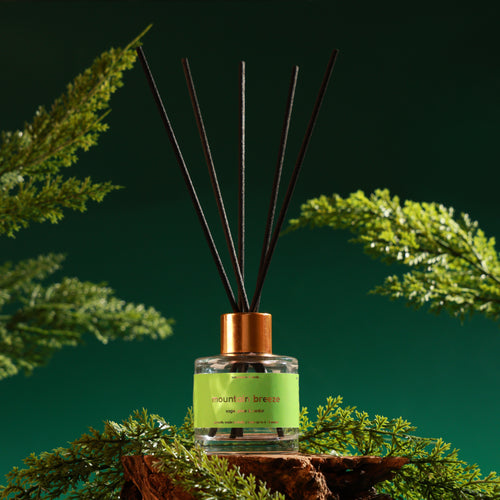 Dry and green · Mountain Breeze₹849Shop →
  On demand · Sukoon₹1,899Shop →
Closed hours, and the routine that actually produces the moment
The practical shape of this depends on when you want the moment. If you want it in the evening, the door should be shut through the afternoon — not because the diffuser needs the time, but because the room does; a closed volume climbs to an even level over hours and then holds it. If you want it in the morning, the door should be shut overnight, which most bedrooms are anyway. And if you want it both times, you want the door shut all day, which is also the cheapest way to stop the rest of the flat quietly consuming the fragrance you bought for one room.
There is one honest cost to a passive reed here that I will not talk around. A reed cannot be switched off. Capillary flow has no clock and no valve, so oil climbs and evaporates whether the room is occupied or not, and a bedroom empty for ten hours a day is receiving fragrance nobody is there to smell. That is not a defect — it is the same property that makes it silent, unpowered and maintenance-free — but if your occupancy hours are sharply defined, it is a real financial argument for an active device, and a much better argument than “it is stronger”. Removing reeds lowers output over hours rather than stopping it, because the reeds you take out are already saturated and the open bottle keeps evaporating.
And here is the range’s limit, said plainly on a page that lands squarely in it. If what you want is waterless, scheduled, room-filling scent in one bedroom, SOSA does not make it. Safar at ₹3,999 is the right mechanism at personal scale but is named and sold as a car and travel diffuser with no published room coverage; Vaayu at ₹11,999 is rated to 1000 m³ — roughly 2,000 to 3,000 sq ft — so in 120 sq ft nine-tenths of it is unused, and buying it because it is the next thing up the price list is the most expensive mistake available on this page. Between them there is nothing. Which is why, for most people asking this question, the honest answer is a closed door, a ₹749–₹849 reed at three reeds, and possibly Sukoon at ₹1,899 if you want an off switch and can accept water.
What to buy for a bedroom-door moment, in order
The free step is genuinely first here, not politely first. Then the smallest bottle at the lowest reed count, because a closed room amplifies whatever you put in it. A machine appears only when you want an off switch or the water is a problem, and the last row is the honest gap plus the two products in our own range I would talk you out of for this specific question.
| Step | What it is | When it is the right answer | Price |
|---|---|---|---|
| 1. Shut the door, then open it after fifteen minutes away ★ | Containment plus the only measurement your own nose can make honestly. The concentration step is what an arrival actually is | Always first. It is free, it is the biggest variable here, and for many readers it is the whole answer | ₹0 |
| 2. A 50ml reed at three or four reeds ★ | Passive capillary, six fibre reeds supplied, specified up to ~150 sq ft, refillable glass, flipped every 3–5 days. Three reeds is a soft level and roughly doubles the life | For almost every closed bedroom. Silent, unpowered, nothing to charge or fill, about ₹13–₹15 a day — and no machine here matches that list | ₹749–₹849 |
| 3. Sukoon, if you want an off switch | Ultrasonic water mist, 270–320 sq ft published, 16–18 hours on low, three 15ml Hotel Collection scents included | When you want to choose the hours. Over-specified in a bedroom, which makes it controllable — run it low and briefly. Accept water, dilution, humidity and filling | ₹1,899 |
| 4. Safar, if water is ruled out | Waterless cold-air nebulising of undiluted oil, 3 speeds, 1/2/3-hour auto-off, 2000 mAh Type-C, 20ml, 6.9 cm | Humid flats, or a bedroom you want no added moisture in. Named and sold as a car and travel diffuser, no published room coverage, three-hour maximum timer, needs recharging | ₹3,999 |
| Not this: Vaayu for one bedroom | Rated to 1000 m³, roughly 2,000–3,000 sq ft. In 120 sq ft nine-tenths of it is unused | It earns ₹11,999 on a whole floor, an open-plan living-dining, a villa, a clinic, a salon or a reception — not on one room | ₹11,999 |
| The honest gap | No mid-sized waterless bedroom nebuliser exists between Safar and Vaayu. And Megh ₹3,499, at about 215 sq ft, covers less than the ₹1,899 Sukoon and is a runtime and humidity machine rather than a coverage upgrade | Said out loud, because this page lands exactly in the hole in our own range | — |
Versailles
Of all the questions in this cluster, this is the one where I most often get to say “you do not need to buy anything”, and I enjoy it. A bedroom door is a free instrument. Shut, it turns a small room into a container that accumulates and holds; open, it becomes part of a flat and everything you put into it drains away. People spend ₹3,999 solving a problem that a latch solves, and then conclude that the product was disappointing.
The second thing I would like you to hear is about restraint, because a sealed bedroom flatters whatever you give it. Six reeds belongs in a living room. In 100 to 150 sq ft, three or four is usually right, it will read as more layered rather than less present, and the bottle will last roughly twice as long. If you can smell your bedroom continuously while you are sitting in it, that is not success — it is a level that has overshot the room, and it will blunt the very moment you are trying to build, because a nose responds to change and you have removed the change.
Where I will not pretend is the gap in our own range. If you want waterless, scheduled, room-filling fragrance in one bedroom, we do not make it. Safar is the right technology at personal scale and it is sold as a car and travel diffuser, which you deserve to know before you buy rather than after. Vaayu is superb and it is built for two to three thousand square feet, so putting it in a bedroom is not ambition, it is waste. The honest bedroom answer is usually a closed door, a ₹799 bottle running quietly at three reeds, and a walk-in fifteen minutes later. Everything is composed in Pune, and part of every order funds a girl’s classroom through Nanhi Kali.
Frequently asked questions
- How hotels do it in seconds — threshold concentration, scheduling and consistency.
- The “wow, your home smells amazing” effect — one scent, one entry room, ventilate before.
- Guests noticing before they sit down — placement slightly inside, out of the draught.
- Nice once you sit inside, but no immediate impact — the concentration gradient explained.
- Reed, spray or active diffusion — the first sixty seconds versus the evening.
- A signature scent at your own door — and the honest limitation of scenting for yourself.
- Why a lobby lands and your own home does not — adaptation, in full.
- Arrival effect or background scent — two setups mostly in tension.
- Stronger fragrance or better diffusion — the family pillar.
- Brand: the SOSA founder story.
Facts verified August 2026: Passive capillary — SOSA reed diffusers, five scents, 50ml ₹749–₹849 for rooms up to ~150 sq ft lasting 6–8 weeks, 130ml ₹1,249–₹1,349 above 150 sq ft lasting 14–18 weeks, six fibre reeds included (six for full projection, three for a soft bedside level and roughly double the life), flipped every 3–5 days, about ₹13–₹15 a day, heat-stable CCT carrier rather than DPG, alcohol-free, phthalate-free, paraben-free, IFRA-compliant, 0 ppm formaldehyde, refillable glass, tested at 45°C and 85% RH, composed in Pune; strength scale Evening Calm 8.9, Garden Bloom 8.9, Morning Freshness 9.0, Mountain Breeze 9.4, Fresh Brew 9.5; duos ₹1,498–₹1,598 for 50ml × 2; refills 300ml ₹2,399 and 500ml ₹3,499, oil only and never a first purchase. Ultrasonic water mist — Boond ₹899 (300ml, up to ~150 sq ft, ~6 hours, USB, night light), Sukoon ₹1,899 (500ml, 270–320 sq ft, 16–18 hours on low, three 15ml Hotel Collection scents included), Megh ₹3,499 (6L tank, ~100 hours, ~215 sq ft — less than Sukoon, and never a coverage upgrade). Waterless cold-air nebulising — Safar ₹3,999 (20ml bottle, 2000 mAh Type-C, up to 10 hours continuous or around 30 hours intermittent per charge, 3 speeds, 1/2/3-hour auto-off, 6.9 cm, named and sold as a car and travel diffuser with bedside and hotel room among its stated uses, no published room-coverage figure) and Vaayu ₹11,999 (up to 1000 m³ or roughly 2,000–3,000 sq ft, 400ml tank lasting up to about 90+ days, Bluetooth app plus onboard buttons, 1h/4h/8h/24h run windows, choice of days, adjustable intensity, key-lock, under 38 dB, freestanding or wall/HVAC mount, 5W, CE, RoHS, SGS). Between Safar and Vaayu there is no mid-sized waterless bedroom nebuliser in the SOSA range. Hotel Collection oils are water-based and ultrasonic-only — 15ml ₹299 (a refill), 100ml ₹999, 300ml ₹1,799, pack of 7 ₹1,799 — and cannot be used in reed diffusers, nor reed oil in ultrasonic machines; there is no hotel-inspired reed diffuser. SOSA sells no room spray or home spray; every SOSA spray is a car perfume. No health, air-quality, allergy or antimicrobial claims are made, no claim is made that fragrance improves sleep, mood or concentration, and fragrance does not remove a smell: source, ventilation, then fragrance. Free shipping above ₹499. A portion of every order supports girl-child education through Nanhi Kali. SOSA is an independent Indian fragrance house; the Hotel Collection scents referenced here are SOSA’s own interpretations inspired by the world’s finest hotels, and SOSA is not affiliated with, endorsed by or a supplier to any hotel brand. Prices subject to change — see the live product pages.