




- The direct answer
- Why heat and humidity change the odour picture
- Three things that actually change in Chennai's climate
- Zone by zone, in Chennai's conditions
- Source control and ventilation, before any fragrance
- What to buy, if anything
- A note from Sonal
- Questions about Chennai's climate and café odour
2. Humidity then slows how fast that release clears the room. Once a compound is in the air, high humidity reduces how readily it disperses and evaporates further, so odour that would clear quickly in dry air instead lingers — this is why the same source problem reads as worse in Chennai than it would in a drier climate.
3. Drains and grease traps need more frequent attention here, not more fragrance. Sustained heat means these sources are producing odour for longer stretches of the day and year; the honest fix is a cleaning and maintenance schedule matched to that reality, not a fragrance layered over the result.
4. The three-zone rule for fragrance doesn't change because the city is hotter. Chennai's climate is a reason to tighten source control and extraction — it is not a reason to scent the dining room, the counter or any area near food service.
5. Where fragrance does belong — the washroom and a genuinely separated entrance — the scale barely changes either. A reed diffuser sized to the room's actual square footage still does the job in Chennai; the climate argues for a shorter refill interval in a badly ventilated space, not a bigger machine.
Chennai's heat and humidity change how hard a café's source control and ventilation have to work — they don't change where fragrance belongs or how much of it a room needs.

Why heat and humidity change the odour picture
Most odour a café produces doesn't come from the air itself — it comes from a source releasing compounds into the air, and how fast that release happens depends heavily on temperature. Grease traps, floor drains, food waste, upholstery fibres and even sealants and paints all release their compounds faster as the surrounding temperature rises. Chennai spends more of the year at sustained high temperatures than most Indian cities this cluster writes about, and that sustained heat means these ordinary sources are working at a higher release rate for a larger share of the calendar, not just on the hottest afternoons.
Humidity does the opposite job on the other side of the process. Once a compound has left its source and entered the air, how quickly it disperses and thins out depends on how much moisture is already in that air competing for the same space. Chennai's coastal humidity rarely drops to the levels a drier city experiences even in its cooler months, so odour that has been released has fewer opportunities to clear on its own. The combination — faster release from a warmer source, slower clearing through more humid air — is what makes a Chennai café's odour problems read as more persistent than the same physical layout would produce elsewhere.
None of this changes what fragrance can or should do about it. A stronger or more frequent fragrance in the dining room doesn't slow the release from a drain or a grease trap, and it doesn't help humid air disperse anything faster — it simply adds a second scent to compete with whatever the heat and humidity are already producing. The honest response to Chennai's climate is more attention to the sources themselves and to the extraction that clears them, with fragrance kept to the same two zones this cluster recommends everywhere else.
Three things that actually change in Chennai's climate
 Morning Freshness₹749Sustained heat means these sources are releasing compounds for more hours of the day and more months of the year, so a maintenance schedule built for a temperate city will fall short in Chennai even when the equipment itself is identical.
Zone by zone, in Chennai's conditions
The zoning verdict below is unchanged from any other Indian city in this cluster — what changes in Chennai is how much attention the source and extraction columns need.
| Zone | Typical Chennai condition | Fragrance verdict | What actually needs attention |
| Dining room and counter | Warm for most of the year; any nearby drain or grease source releases faster than in a cooler city | Never scented | Source maintenance and extraction runtime, not fragrance |
| Kitchen and prep area | Sustained heat keeps grease and food-waste odour active for more of the day | Never scented | Exhaust sizing and schedule — a matter for the café's own kitchen consultant |
| Entrance or vestibule | Often open to Chennai's humid outdoor air unless genuinely separated | Sometimes | Only where a real air boundary exists between the entrance and the dining room |
| Retail area selling beans or equipment | Not exposed to the same drain or grease sources as dining | Usually | A dry, non-edible register at a modest scale |
| Washroom | A humid, warm room for most of the year, and often the site of the drain sources discussed above | Usually — but only once drains are addressed | Fix the source first; fragrance afterward reads as intended rather than as a cover |
| Chennai's climate raises how often the source and extraction columns need attention across every zone in this table — it does not move any zone from one fragrance column to another. | |||
Morning Freshness · washroom, dry register₹749Shop →  Sukoon · larger washroom suite₹1,899Shop →
  Vaayu · multi-zone Chennai property₹11,999Shop →
Source control and ventilation, before any fragrance
Never treat a Chennai café's persistent odour as a fragrance shortfall before the source has been checked — a drain, a grease trap or a waste point working overtime in sustained heat will beat any amount of ambient fragrance layered over the dining room.
Sometimes the honest fix is simply a shorter interval between cleanings or a longer daily extraction run, matched to how much more of the year Chennai spends at sustained high temperatures compared with a cooler city — this is a scheduling change, not a purchase.
Usually, once source control and extraction are actually matched to Chennai's conditions, the washroom and any genuinely separated entrance need no more fragrance than the same rooms would in a cooler, drier city — a 50ml reed diffuser at six reeds still covers up to 150 sq ft regardless of the weather outside.
What to buy, if anything
Matched to the two zones this cluster's own rules permit — the climate changes how much maintenance a café needs, not which zones can carry fragrance.
| Route | Premises | Why | What it costs |
| No fragrance, more frequent source maintenance | Dining room, counter and any area near food service | Heat accelerates release from drains and grease; fragrance doesn't slow it | ₹0 — a maintenance-schedule change |
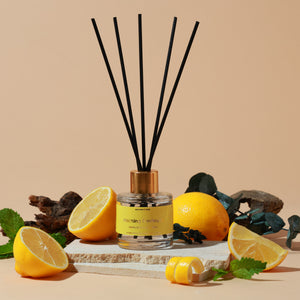
| Reed diffuser, Morning Freshness or Mountain Breeze | A washroom under 150 sq ft, once drains are addressed | A dry register that holds up against sustained humidity | ₹749–₹849 |
| Reed diffuser, 130ml | A larger washroom, 150–270 sq ft | Longer runtime without moving to a machine | ₹1,249–₹1,349 |
| Sukoon ultrasonic | A washroom suite or small retail corner, 270–320 sq ft | Steady coverage for a larger non-dining space | ₹1,899 |
| Vaayu, wall or HVAC mounted, zoned | A multi-zone Chennai property with genuinely separated areas | Independent scheduling once real air boundaries exist between zones | ₹11,999 per unit |
I get more questions from Chennai café owners about washroom odour than from almost any other city, and it's rarely a fragrance question underneath. The heat there is sustained in a way that keeps drains and grease traps working right through the year, and no amount of reed diffuser addresses a source that's actively producing odour faster than a cooler city's equivalent would.
My honest first question to a Chennai owner is always about the maintenance schedule, not the fragrance. A cleaning cadence that was set up for a milder climate, or copied from a sister property somewhere drier, is very likely falling short in Chennai's conditions — and no fragrance decision I could make would fix that gap.
Once the source side is genuinely handled, I treat a Chennai café exactly like I would any other city's — the washroom and a genuinely separated entrance can carry a light, dry register, and the dining room stays exactly as unscented as it would anywhere else. The climate changes the maintenance conversation, not the zoning one.
Questions about Chennai's climate and café odour
- How Does Mumbai Humidity Affect Odours Inside a Café? — a coastal city with a different humidity pattern.
- How Should a Bengaluru Café With Open Windows Approach Ambient Fragrance? — a cooler climate with its own ventilation question.
- Should an Air-Conditioned Gurgaon Café Approach Fragrance Differently From a Semi-Open Café? — a drier climate where sealed air changes the picture.
- Why Does My Café Smell Different in Summer, Monsoon and Winter? — the same heat-and-humidity mechanism, followed across a full year.
- Brand: the SOSA founder story.
SOSA products & prices (verified September 2026): Reed diffusers 50ml ₹749–₹849 (to 150 sq ft, 6–8 weeks at six reeds) · 130ml ₹1,249–₹1,349 (above 150 sq ft, 14–18 weeks) · reed refill 300ml ₹2,399. Ultrasonic: Boond ₹899 (~150 sq ft) · Sukoon ₹1,899 (270–320 sq ft, ships with three 15ml Hotel Collection fragrances) · Megh ₹3,499 (6L tank, ~100 hrs runtime, ~215 sq ft — a runtime machine, not a coverage upgrade). Waterless cold-air: Safar ₹3,999 (no published coverage figure) · Vaayu ₹11,999 (up to 1000 m³, roughly 2,000–3,000 sq ft; 400ml tank lasting about 90+ days; app and onboard control, 1h/4h/8h/24h run windows, adjustable intensity, key-lock, under 38 dB, freestanding or wall/HVAC mount, 5W, CE/RoHS/SGS) · Aangan ₹25,999 (8,000–10,000 sq ft). Hotel Collection water-based fragrance 15ml ₹299 · 100ml ₹999 · 300ml ₹1,799 is for ultrasonic machines; reed oil and Hotel Collection are not interchangeable. Reed diffusers are alcohol-free, phthalate-free, paraben-free, IFRA-compliant and low VOC, handmade in small batches in Pune. Every purchase funds a girl's education through Nanhi Kali. Prices and availability subject to change — see the live product pages.