




Hotel-style scenting is a method: how much fragrance is put into the air, how evenly it is distributed, for how many hours, and by what machine. You judge it from the far side of the room, and what it decides is whether the smell is there at all.
The one-sentence version: one is what it smells like; the other is how it occupies a room. A hotel-inspired scent in a passive diffuser gives you a fragrant zone. Hotel-style scenting is what gives you a fragranced room.
One kind correction, near the top: there is no hotel-inspired reed diffuser at SOSA, and nobody who went looking for one was being careless. The Hotel Collection is water-based and made for ultrasonic machines; reed oil sits on a CCT carrier and cannot go into one. Two physical systems, not one range with two lids.
The honest gap: hotel-style scenting in its true form is waterless cold-air nebulising. SOSA offers it at personal scale in Safar ₹3,999, which is named and sold as a car and travel diffuser and has no published room-coverage figure, and at building scale in Vaayu ₹11,999, rated to 2,000–3,000 sq ft and the wrong purchase for one bedroom. There is nothing in between.
2. Hotel-style scenting is a noun about a method. It describes the way a fragrance is introduced into a space: how much per hour, into air that is already moving, at a level held steady by a machine rather than by the weather, on a timetable, for years. Change nothing about the oil and change only this, and the room changes completely. That is the whole thesis of this cluster and it is defensible.
3. You almost certainly bought the first. Which is exactly what the market sold you, under a name that sounds like it includes the second. There is no dishonesty in the phrase “hotel-inspired” — it is accurate. The problem is that the word most people are actually searching for is scenting, and nobody teaches them that word before they spend.
4. The tell is where you have to stand. If you have to be near the bottle for it to be lovely, you have hotel-inspired scent. If it meets you at the door of a closed room without your looking for it, you have hotel-style scenting. That single test distinguishes the two more reliably than any specification sheet.
5. And the two are not a ladder. Hotel-style scenting is not “better” — it is a different purchase with real costs. It needs power or charging, it needs filling or refilling, it makes a sound, it is an appliance on the table, and it has to be remembered. A reed gives all of that up and gives you back silence, zero maintenance, no schedule and an object rather than a device, at about ₹13 to ₹15 a day. Neither wins. They answer different questions.
Alcohol-free, phthalate-free, paraben-free, IFRA-compliant, 0 ppm formaldehyde. Free shipping above ₹499, and a portion of every order supports girl-child education through Nanhi Kali.

The two terms, defined properly
Definitions are worth setting out slowly here, because this is the one page in the cluster where getting the words right does the work. Everything else follows from these two paragraphs, and once you own the distinction you will never again buy the wrong half of the problem.
 Hotel Collection₹999Definition: a fragrance built in the olfactory register used by luxury hotels. Typically a clean white-tea-and-woods family — bergamot lifting the top, white tea and aloe through the middle, cedar holding the base — because that structure reads as considered rather than as decorative, and because it is the least likely composition in perfumery to annoy a stranger. Judging it is a close-range activity: the nose near the source, asking whether the materials are real, whether the accord is built properly, whether the drydown is intact. This is a real skill and a real product and I would not have anybody dismiss it. It is simply an answer to a different question from the one you asked.
 The machinesfrom ₹899Definition: the practice of putting a fixed quantity of fragrance into a room’s moving air, at a controlled intensity, on a schedule, consistently over time. The technology that does it properly is waterless cold-air nebulising — pressurised air shatters undiluted oil into a dry micro-mist that travels with the room’s own airflow, with no water, no dilution, no heat, no added humidity and no white dust. That is what hotels actually run, frequently into the building’s ventilation rather than from an object on a table. It is why you can never find the diffuser in a hotel room: there often is not one to find, and that absence of a locatable source is a large part of why the effect reads as designed rather than added.
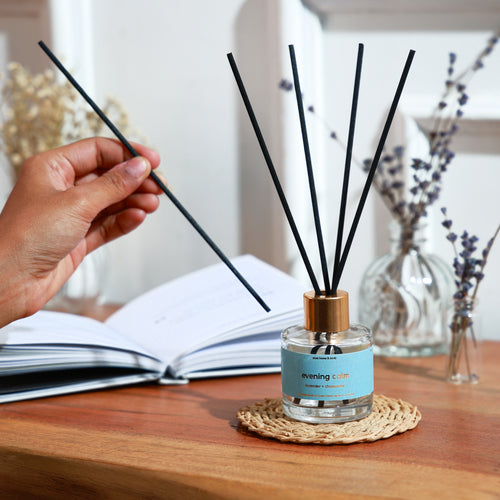
 Mountain Breeze₹849A reed diffuser is passive capillary diffusion: oil climbs six fibre reeds and evaporates from their surface at whatever rate the room’s temperature, humidity and airflow allow. No energy input, no air moved. It produces a fragrant zone rather than a fragranced room, and that is its design rather than its failure. And it wins outright on the axis nothing else can touch: it is completely silent, it has no plug, no battery, no tank, no schedule and nothing to remember, it costs about ₹13 to ₹15 a day, and it looks like an object on a console table rather than an appliance. No machine in this range or any other will ever give you that combination, and for a bedside or a small bathroom it is genuinely the better product.
Why the two got conflated, and why that is not your fault
Three things collapsed the distinction, and none of them is a reader’s error. First, the market sells the halves separately and names them nearly identically. A bottle labelled hotel-inspired is describing its contents accurately; it is simply describing the half that goes in a machine, in a category where the machine is optional and usually not mentioned on the same page. Second, the effect you are chasing has no source you have ever seen. When something impresses you in a hotel corridor there is no visible object to attribute it to, so the mind attributes it to the smell — the only part of the experience with a name. Nobody walks out of a lobby thinking about a nebuliser in a service cupboard.
Third, and most usefully, the honest answer is embarrassing for a fragrance house to say aloud: in the gap between a ₹1,000 reed and an ₹11,999 nebuliser running related material, most of what you are paying for at the higher price is not a better smell. It is transport, control and evenness. That is an uncomfortable sentence for anybody whose business is composing fragrance, and it is the reason the sentence is rarely printed. I would rather print it, because the alternative is a reader buying a fourth bottle to solve a problem no bottle has ever solved.
There is a fourth factor and it is worth naming because it saves people money: you arrive in a hotel un-adapted, and you live in your own home adapted. Olfactory receptors stop reporting a constant, unchanging stimulus within minutes, which is why you can smell your home only after being away from it. A meaningful part of the difference between the corridor and your hallway is that you walked into one with a suitcase and have been sitting in the other since Tuesday. That part of the gap costs nothing to close and cannot be bought at all — you close it by leaving and coming back, or by asking somebody else what they notice.
| Hotel-inspired scent | Hotel-style scenting | |
|---|---|---|
| What it is | A composition — an accord in the register hotels favour | A method — how much fragrance goes into moving air, how evenly, and for how long |
| What it decides | Whether you like the smell | Whether the smell is there at all, three metres away |
| Where you judge it | Close range — nose near the source | From the doorway of a closed room, ideally by somebody else |
| What you buy | Oil, in millilitres. Hotel Collection 100ml ₹999, 300ml ₹1,799 | Hardware. Sukoon ₹1,899 or Safar ₹3,999 |
| The vocabulary | Notes, accord, drydown, character, longevity | Concentration, evenness, coverage, schedule, air movement |
| The mechanism behind it | None — a composition has no mechanism, only a formula | Passive capillary, ultrasonic water mist, or waterless cold-air nebulising. Only the third is what hotels run |
| Failure mode | You dislike it, or it reads flat and cheap at too high a dose | You love it and cannot detect it from the bed |
| The thing not worth buying for either: Megh at ₹3,499. Six-litre tank, around 100 hours of runtime, about 215 sq ft of coverage — less than the ₹1,899 Sukoon. It is a runtime and humidity machine and never a coverage upgrade. | ||
Hotel-inspired scent · the oils₹999Shop →  Ultrasonic mist · Sukoon₹1,899Shop →
  Passive capillary · Evening Calm₹799Shop →
The four properties of hotel-style scenting, and where each one comes from
Presence is the first and the one people mean when they say “stronger”. It is simply enough material in the air at head height to be noticed without effort, and it comes from a mechanism putting material there at a set rate rather than from a composition being more intense. A reed can be turned up — six reeds rather than three is close to a doubling of output, and it is free — but the ceiling is the surface area of six fibre sticks and no composition raises it. Evenness is the second and the more interesting. It is the property that makes a space feel designed rather than decorated: the same impression at the door and at the far wall, with no gradient to walk up. Evenness comes from air being moved, which is precisely what a passive diffuser does not do.
Duration is the third, and it is where control stops being a luxury and becomes the point. A hotel does not run its system at a constant blast; it runs it in windows, at an intensity somebody chose. Safar gives you three speeds and a one, two or three-hour auto-off, which means it also cannot be left running all day and does need recharging — a genuine limitation worth knowing before you buy. Vaayu gives you app scheduling in one, four, eight or twenty-four-hour windows with a choice of days. A reed cannot be switched off at all, and that is its one real design limitation; pretending otherwise would cost me your trust for nothing.
Consistency is the fourth and the cheapest, and almost nobody does it. Hotels hold a single signature for years, which is why a regular guest recognises a lobby before they see the desk. At home the equivalent is picking one scent and staying with it long enough for it to become the smell of your house rather than this month’s smell — and using it in one or two places rather than everywhere, because a home that smells identical in every room stops registering as a smell within a week. That property costs nothing, requires no hardware, and is the single most hotel-like thing available to somebody who has decided not to buy a machine at all.
What each half costs — and the rung that does not exist
Set out as two purchases rather than one, because that is what they are. The last row is the honest gap in the range and it is the reason a single-bedroom reader cannot simply be pointed at the top of the ladder.
| Buy | Which half it is | When it is the right answer | Price |
|---|---|---|---|
| 1. Sukoon ★ | Mechanism plus composition in one box — ultrasonic water mist, 500ml, 270–320 sq ft, 16–18 hours on low, three 15ml Hotel Collection scents included | The only product here that answers both halves at once, and the value answer for a bedroom. You accept oil diluted in water, added humidity, refilling and possible white dust in a hard-water city | ₹1,899 |
| 2. A reed diffuser | Composition, delivered passively — six fibre reeds, refillable glass, silent, no power, nothing to fill, about ₹13–₹15 a day | When a fragrant zone is genuinely what you want: a bedside, a bathroom, a desk. It is the best product in the range at being unnoticeable as an object | ₹749–₹1,349 |
| 3. Safar | The hotel mechanism itself at personal scale — waterless cold-air nebulising of undiluted oil, 20ml, 2000 mAh Type-C, up to 10 hours continuous or around 30 intermittent, 3 speeds, 1/2/3-hour auto-off. Named and sold as a car and travel diffuser, with bedside and hotel room among its stated uses | When water is the deal-breaker and you want the true mechanism rather than an approximation. No published room-coverage figure, and not an always-on device | ₹3,999 |
| 4. Vaayu | Hotel-style scenting at building scale — up to 1000 m³, roughly 2,000–3,000 sq ft, 400ml tank lasting up to about 90+ days, app scheduling in 1/4/8/24-hour windows, under 38 dB | Not for one bedroom, where nine-tenths of it is wasted. Right for a whole floor, an open-plan living-dining, a villa, a clinic, a salon or a showroom | ₹11,999 |
| Never for reach: Megh | 6L tank, around 100 hours of runtime, about 215 sq ft of coverage | Less coverage than the ₹1,899 Sukoon. A runtime and humidity machine, never a coverage upgrade | ₹3,499 |
| The honest gap | No mid-sized waterless bedroom nebuliser exists at SOSA — nothing between Safar and Vaayu. There is no “Vaayu for one room”, and no hotel-inspired reed diffuser either, because the two systems cannot be mixed in either direction | Said plainly, because it is why the answer for a single bedroom is a trade-off rather than a recommendation | — |
Versailles
I did not learn this distinction at ISIPCA. Perfumery school teaches you composition — materials, structure, how an accord holds together, how a base slows a top note down. It does not teach you air. I learned the other half from customers writing to me about rooms, and from the fairly humbling discovery that a composition I was proud of could be entirely invisible three metres from where it was standing.
So when somebody tells me their home does not smell like a hotel, I no longer reach for a different bottle. I ask where they were standing when they decided. If they were near the diffuser and it was lovely, then my half of the job is done and the missing half was never in my aisle. Saying so costs a fragrance house a sale of the thing it makes best, and it is still the correct answer.
The one piece of it I would defend hardest is the reed, because this page can read as though it were the poor relation and it is not. It is the only thing on this list that never has to be filled, charged, scheduled, remembered or switched on, that makes no sound at all, and that looks like something you chose rather than something you installed. If what you want is a beautiful, effortless fragrant zone by the bed, a machine is a downgrade dressed as an upgrade. If what you want is a room that meets you at the door, then you want scenting, and now you have the word for it. Everything is composed in Pune, and part of every order funds a girl’s classroom through Nanhi Kali.
Frequently asked questions
- I bought a hotel-inspired reed diffuser and my room is not a hotel — the premise, corrected kindly.
- Right up close, wrong across the room — why that sentence is a positive result.
- The right fragrance, no experience — composition quality against delivered concentration.
- Why it is not as powerful as the hotel — you are competing with a building.
- Weak oil or weak projection? — the four-minute, three-distance test.
- Lovely in the bottle, absent across the room — headspace against room concentration.
- Why the same notes do not give the same room — dose, delivery, evenness, duration.
- Oil or diffusion technology? — which decides presence and which decides preference.
- Before blaming the oil — the family pillar.
- Brand: the SOSA founder story.
Facts verified August 2026: Three diffusion mechanisms are described — passive capillary (reed diffusers), ultrasonic water mist (Boond ₹899, 300ml, up to ~150 sq ft, ~6 hours; Sukoon ₹1,899, 500ml, 270–320 sq ft, 16–18 hours on low, three 15ml Hotel Collection scents included; Megh ₹3,499, 6L tank, ~100 hours runtime, ~215 sq ft, which is less coverage than Sukoon) and waterless cold-air nebulising (Safar ₹3,999, 20ml bottle, 2000 mAh Type-C battery, up to 10 hours continuous or around 30 hours intermittent, 3 speeds, 1/2/3-hour auto-off timer, 6.9 cm, named and sold as a car and travel diffuser with car, handbag, desk, bedside and hotel room among its stated uses, no published room-coverage figure; Vaayu ₹11,999, coverage up to 1000 m³ or roughly 2,000–3,000 sq ft, 400ml refillable tank lasting up to about 90+ days, Bluetooth app and onboard buttons, 1h/4h/8h/24h run windows, adjustable intensity, key-lock, under 38 dB, freestanding or wall/HVAC mount, 5W, CE, RoHS, SGS). SOSA reed diffusers: five scents, 50ml ₹749–₹849 lasting 6–8 weeks and suiting rooms up to ~150 sq ft, 130ml ₹1,249–₹1,349 lasting 14–18 weeks and suiting above 150 sq ft, six fibre reeds included and flipped every 3–5 days, about ₹13–₹15 a day, heat-stable CCT carrier rather than DPG, alcohol-free, phthalate-free, paraben-free, IFRA-compliant, 0 ppm formaldehyde, refillable glass bottle, climate-tested at 45°C and 85% RH, composed in Pune. SOSA strength scale: Evening Calm 8.9, Garden Bloom 8.9, Morning Freshness 9.0, Mountain Breeze 9.4, Fresh Brew 9.5. Hotel Collection fragrance oils are water-based and ultrasonic-only at 15ml ₹299 (a refill), 100ml ₹999 and 300ml ₹1,799; they cannot be used in reed diffusers and reed oil cannot be used in ultrasonic machines, so no hotel-inspired reed diffuser exists. No health, air-quality, allergy or antimicrobial claims are made, and fragrance does not remove a smell — source, then ventilation, then fragrance. Free shipping above ₹499. A portion of every order supports girl-child education through Nanhi Kali. SOSA is an independent Indian fragrance house; the Hotel Collection scents referenced here are SOSA’s own interpretations inspired by the world’s finest hotels, and SOSA is not affiliated with, endorsed by or a supplier to any hotel brand. Prices subject to change — see the live product pages.