

And quieter: cold air is denser and more still, convection is weaker, and a winter house is usually shut. Less of what does leave the reeds travels to where you are sitting.
The winter move: add one or two reeds — seven or eight instead of six. In any other season that costs you weeks; in the cold months the slower rate largely absorbs it, which makes this the cheapest presence you will buy all year.
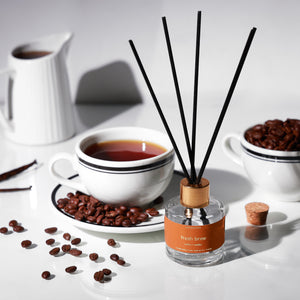
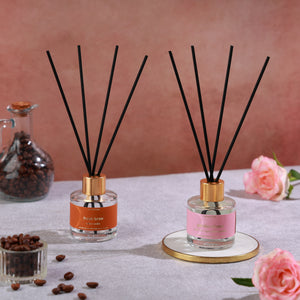
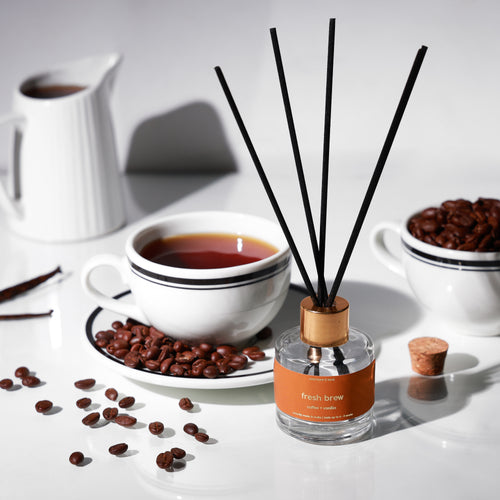
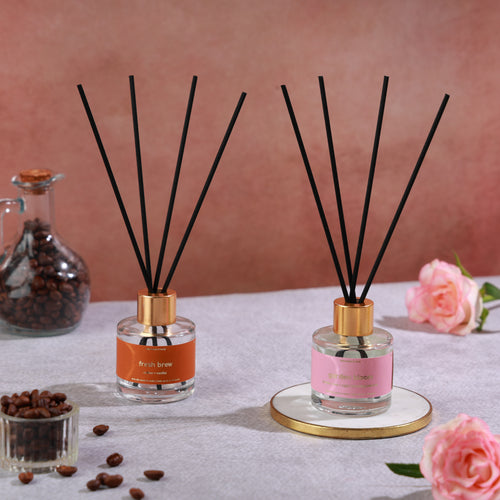
Choose warm over cold: a cool room flatters deep, warm compositions. Fresh Brew at ₹849 and Garden Bloom at ₹799 read fuller in January than the sharp cold ones do.
2. And they read quieter, which is the half that catches people out. The same slow rate that saves your oil is also the rate at which fragrance enters the room. Less is arriving. On a cold evening in a shut flat, considerably less is arriving where you are actually sitting.
3. So winter is the season to add reeds, not remove them. Seven or eight instead of six. In hot weather that trade costs you real weeks; in cold weather the underlying rate is low enough that you can raise the exposed surface and still finish the season inside the stated window. It is the closest thing to free presence this format offers.
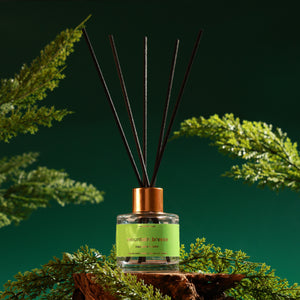
4. Choose warmth over sharpness for the cold months. A cool room flattens bright, cold, citric compositions and flatters deep warm ones. Fresh Brew at 9.5 on our internal scale and Garden Bloom at 8.9 both read fuller in January than they do in May, and Mountain Breeze at 9.4 is the dry answer if you want no sweetness at all.
5. Do not mistake a slow bottle for a failed one. A bottle that has barely gone down after six weeks in a cold room is behaving correctly. Lift a reed and check the wet-line before you conclude anything: if the boundary is sitting high and dark, flip all six; if it is barely above the oil, the reeds may be spent.
Composed and handmade in small batches in Pune, and a portion of every order supports girl-child education through Nanhi Kali.
Part one — the double effect of cold air
Every seasonal article about diffusers stops at "they last longer in winter" and treats that as the whole answer, which is how people end up puzzled in February with a bottle that is nearly full and a room that smells of nothing. Slow evaporation is not a benefit and a fact; it is a benefit and a cost, arriving together, from one cause. Below, the three things cold does — two of them working on the physics of release and one working on the room — and then the practical response, which runs opposite to the summer one in every particular.
 Garden Bloom₹799 · 8.9/10A reed diffuser has no fan and no propulsion; it depends entirely on the room's own air movement to carry fragrance away from the glass. Warm air rises and sets up gentle convection; cold air is denser and moves less on its own. So a cold room is doing less of the distribution work at exactly the moment the reeds are releasing less to distribute. A winter home compounds it: windows closed, doors shut to keep heat in, curtains drawn, no cross-ventilation. The fragrance pools near the bottle and the person on the sofa receives very little of it. That is not weakness in the composition; that is a room not carrying.
Part two — the same bottle, hot months against cold
Set side by side, the two seasons ask for almost exactly opposite behaviour from the owner. This is the table I would pin somewhere, because every line in it reverses.
| Variable | Hot months | Cold months | What you do about it |
|---|---|---|---|
| Evaporation rate ★ | High — molecules leave the reed readily | Low — less energy to leave with | Reeds down in heat, reeds up in cold |
| Bottle life against the stated window | Short end — 50ml nearer six weeks | Long end — 50ml at or beyond eight | Buy 130ml for a hot season, 50ml for a cold one |
| How the room reads | Fuller, sometimes top-heavy | Quieter, and slower to build | Add a reed or two in winter before adding a bottle |
| Air movement in the house | Fans, AC, some windows open | Shut tight, curtains drawn, little exchange | Leave an internal door open; place near a walkway |
| Which compositions flatter the season | Cold and dry — Morning Freshness, Mountain Breeze | Warm and deep — Fresh Brew, Garden Bloom | Rotate scent with the season, not the bottle size |
| Flip cadence | Weekly, without exception at high reed counts | Weekly still — residue accumulates regardless of rate | Same either way; gloves on, tray underneath |
| The commonest wrong conclusion | "The oil is evaporating too fast, it must be thin" | "It has stopped working, the bottle is still full" | Wet-line test first, then airflow, then reeds |
| The honest caveat: "winter" means very different things across India — a Shimla January and a Chennai January are not the same instruction, and much of the south and the coast never reaches the temperatures this page describes. Read the left column as a description of your weather rather than a month. We give no figure for how many extra weeks cold weather buys you; it depends on room temperature, volume, ventilation and reed count, and the 6–8 and 14–18 week windows are SOSA working guidance across an ordinary year rather than laboratory numbers. | |||
Fresh Brew · warm-deep, 9.5from ₹849Shop → 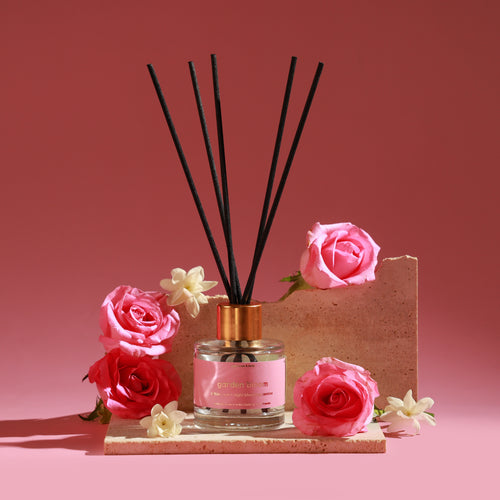 Garden Bloom · rounded floralfrom ₹799Shop →
  Warmth & Bloom duo₹1,598 / 2 × 50mlShop →
Part three — the winter nose, and the sealed room
There is a third thing happening in a cold season that has nothing to do with evaporation at all, and it is responsible for a good share of the "it stopped working in December" emails I receive. Olfactory adaptation is the mechanism by which your nose stops reporting a smell that does not change. It is fast, often a matter of minutes, and strongest in the place you spend most time. A winter house makes it worse in two ways: you are indoors far more of the day, and the fragrance is genuinely more constant because the air is not being exchanged. The result is a bottle everyone who walks through your front door remarks upon and you cannot detect at all. Before you spend anything, go out for fifteen minutes and come back in, or ask a guest plainly. They are the better instrument.
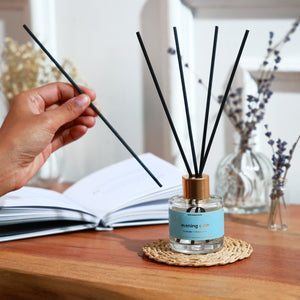
The sealed room also cuts the other way, and this is the nuance that most seasonal advice misses. A closed house does not merely fail to distribute — it also concentrates. In a small, shut bedroom in the middle of winter, a fragrance can build to a level that would be perfectly pleasant in an open living room and is rather too much in there. So the correct winter instruction is not "add reeds everywhere": add reeds in the large, cold, open spaces where fragrance is being lost, and leave the small sealed rooms alone or take a reed out. Evening Calm at 8.9 on our scale, with four reeds, in a closed winter bedroom, is a deliberately quiet configuration and the right one for most people who want to sleep rather than to be scented. Strength figures throughout are positions on SOSA's own internal scale measured at six reeds — not an industry standard, not a concentration, and not a ranking of quality.
One last piece of winter housekeeping, since the season invites it: this is a good time to think about your reeds rather than your oil. Most people have the relationship backwards, replacing the fragrance and keeping the sticks, when the sticks are the consumable and the oil is the stable part. If your bottle has run since the previous summer, the reeds have done a full hot season and are the likelier limiting factor. Our guidance is to refresh reeds every few months, and here is the honest gap in our range, stated plainly: we do not sell replacement reeds as a separate item, so a fresh set of six arrives with a new bottle. The oil-only refill at ₹2,399 for 300ml is excellent value at roughly ₹7–8 per millilitre against ₹15–17, but it does not include reeds.
Part four — the winter edit
Organised by the situation you are actually in, because a cold open living room and a cold shut bedroom want opposite treatment.
| Winter situation | What is happening | Reed setting | What I would run |
|---|---|---|---|
| Large cold living room, everything shut ★ | Slow release plus air that will not carry it | 7–8 reeds | Fresh Brew from ₹849 — warm-deep and the loudest we make |
| Entryway or hall in the cold months | Cold draught at the door strips reeds; brief exposure for guests | 6, placed off the draught line | Garden Bloom ₹799 — rounded, hotel-like, reads instantly |
| Small sealed bedroom | Concentration rather than dispersal — the reverse problem | 4, sometimes 3 | Evening Calm ₹799 — the softest thing in the range |
| Home office or study, cold and still | You adapt within minutes of sitting down | 6–7 | Mountain Breeze ₹849 — dry, grounding, no sweetness |
| Open living-dining, one bottle in the middle | Output per bottle is fixed; distance defeats it | 6 in each of two bottles | Warmth & Bloom duo ₹1,598 — two warm sources that share a note |
| Bottle running since last summer | Reeds are the tired component, not the oil | Fresh six | A new bottle for new reeds; refill ₹2,399 for oil alone |
| You want scent only on some evenings | Beyond what any passive format can do | — | Sukoon ₹1,899 · 270–320 sq ft · timers · three scents in the box |
Versailles
Winter emails have a particular flavour. They arrive in January, they are polite, and they say some version of: the bottle is still nearly full but I do not think it is working any more. I understand the suspicion — a full bottle and a quiet room look exactly like a product that has failed, and nobody has explained that in cold weather those two things go together by necessity.
The design decision underneath this is one I stand by: our compositions sit at a level they can hold for the whole life of the bottle rather than opening loudly and fading. A flat, honest plateau is easier to live with, but it does mean the fragrance does not announce itself, and in a cold sealed room with a nose that has adapted to it, an honest plateau can be almost invisible from the inside.
So my winter advice is unglamorous. Add a reed or two in the big cold rooms. Leave an internal door open. Go outside for a quarter of an hour and walk back in, and believe what your nose says in the first ten seconds rather than what it says after ten minutes. Everything is composed and handmade in small batches in Pune, and a part of every order funds a girl's classroom through Nanhi Kali.
Frequently asked questions
- Do reed diffusers evaporate faster in summer? — the same two dials, turned the other way.
- Does hot weather affect reed diffusers? — heat's two separate effects.
- Using SOSA diffusers across Indian seasons and why can't I smell my reed diffuser?
- The complete weather and climate guide — this page and the eight around it, in one place.
- Brand: the SOSA founder story.
SOSA reed diffuser range & prices (verified August 2026): alcohol-free, phthalate-free, paraben-free and IFRA-compliant compositions on a heat-stable coconut-derived (CCT) carrier, low-VOC, supplied in a refillable glass bottle with six fibre reeds; 50ml lasts 6–8 weeks and 130ml lasts 14–18 weeks. Morning Freshness (Malabar lemon · peppermint · Nilgiri eucalyptus) 50ml ₹749 · 130ml ₹1,249 · 9.0/10; Garden Bloom (British rose · night-blooming jasmine) 50ml ₹799 · 130ml ₹1,299 · 8.9/10; Evening Calm (Kashmir lavender · chamomile) 50ml ₹799 · 130ml ₹1,299 · 8.9/10; Fresh Brew (Coorg coffee · Kerala vanilla) 50ml ₹849 · 130ml ₹1,349 · 9.5/10; Mountain Breeze (Himalayan pine · sage · Indian cedar) 50ml ₹849 · 130ml ₹1,349 · 9.4/10. Reed diffuser refills are oil only — you reuse your own vessel and reeds: 300ml ₹2,399 (roughly 8–11 months) · 500ml ₹3,499 (roughly 14–18 months), about ₹7–8 per ml against ₹15–17 per ml for a 50ml bottle. Duo sets ₹1,498–₹1,598 for 2 × 50ml and ₹2,498–₹2,598 for 2 × 130ml. Strength figures are positions on SOSA’s own internal strength scale, not an industry standard. Replacement reeds are not sold as a separate SKU; SOSA guidance is to refresh reeds every few months. The reed line is separate from the water-based Hotel Collection for ultrasonic machines (15ml ₹299 · 100ml ₹999 · 300ml ₹1,799) and the two are not interchangeable. Diffusers: Boond 300ml ₹899 · Sukoon 500ml ₹1,899 · Megh 6L ₹3,499 · waterless Vaayu ₹11,999. Composed and handmade in small batches in Pune, India; tested through 45°C summer heat and 85% monsoon humidity. Free shipping above ₹499. A portion of every order supports girl-child education through Nanhi Kali. Prices subject to change — see the live product pages.