
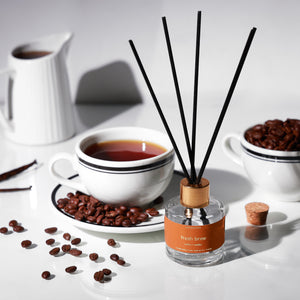

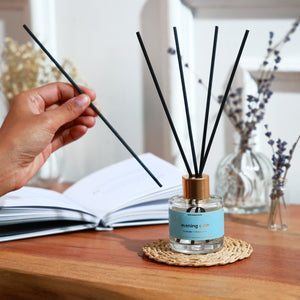
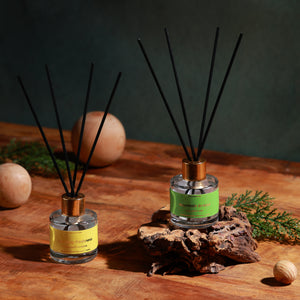

The correct middle: occasional air. A console or sideboard near a doorway or walkway where people pass a few times an hour, waist to chest height, several feet from any vent, out of direct sunlight, on a tray.
The rule for AC: the sealed room helps you; the stream does not. Stay diagonally out of the air path and you get the benefit without the cost.
The rule for windows: ventilate hard and briefly, then close the room, then let the diffuser work. Sun matters more than breeze — a closed west-facing sill still cooks a bottle.
If you want a louder room, buy it with reeds rather than with air: nine in a 50ml is fuller and finishes in roughly five weeks instead of eight, and it is reversible in ten seconds.
2. Waist to chest height, with clear space around the bottle. Low surfaces let fragrance pool below breathing height; high ones send it along the ceiling. Enclosed positions — the back of a shelf, a cabinet, behind a curtain — trap everything within a foot of the glass. That is the dead-air failure, and it is the commonest one.
3. Several feet clear of any continuous stream. A split AC's air path, a table fan, the sweep directly under a ceiling fan on high. Continuous air keeps the reed surface stripped for hours a day, so the bottle runs at a raised rate — and because the stream also carries fragrance away, you get a short bottle and a quiet room together.
4. Out of direct sunlight, always. Heat is the largest single accelerant a diffuser meets in an Indian home. A sunlit sill warms the oil, thins it, and shortens the bottle whether or not the window is ever opened.
5. Ventilate and diffuse at different times. Windows wide for ten to twenty minutes, then closed, then the room has bounded air to build a level in. An open window makes the room part of the outdoors, and nothing passive scents the outdoors.
6. Buy presence with reeds, never with air. Six reeds is the calibrated dose; nine gives a noticeably fuller room and roughly five weeks instead of eight on a 50ml; ten is the practical ceiling at about four to five weeks. All reversible in ten seconds, and all of the extra output happens in your room rather than down the corridor.
7. Know where the format stops. Past roughly 250–300 sq ft of connected open volume, or when you want scent on demand rather than constantly, reeds are the wrong tool and a Sukoon at ₹1,899 is the honest answer. Most homes end up running both formats.
Composed and handmade in small batches in Pune, and a portion of every order supports girl-child education through Nanhi Kali.
Part one — the two failure modes, and the middle you are aiming for
A reed diffuser is a constant, passive, deliberately low device: no fan, no heat, no switch. Oil climbs six fibre reeds by capillary action and evaporates off the exposed surface at a rate set jointly by the composition, the temperature and the air. Because it has no propulsion of its own, the room's air is both its delivery system and its meter — and that dual role is what produces two opposite ways to fail. The cards below define them and then define the target between them, which is the whole argument of this guide compressed into three boxes.
 Evening Calm₹799 · 8.9/10The opposite failure looks like diligence: people position a bottle in the AC's path or in front of a fan precisely because they want the air to spread it. What happens instead is that the saturated layer at the fibre never re-forms, so the reed gives up oil at a raised rate for every hour the machine runs, while the same stream carries the fragrance along a wall, through a doorway or out of a window. You pay for a great deal of output and receive very little of it. This is the answer to the most puzzled message we get — it is emptying fast and I still cannot smell it — which sounds like two contradictory faults and is one situation. An open window does the same thing with the added indignity that the room has stopped being a room at all. Any specific figure for how many weeks a given draught costs is SOSA working guidance from our own testing and customer correspondence rather than a measurement; what is consistent is that the published 6–8 weeks for a 50ml assumes six reeds, weekly flipping, no draught and no direct sun.
Part two — distance from the air source, which is the only dial you have
Once you know which sources are trouble, the practical question is how far away is far enough. Distance is the dial, and it behaves less like a smooth slope than like a set of steps: in the path is bad, just outside the path is much better, and several feet away is effectively normal. The table below is how I would think about it for the common household streams. Everything in it is SOSA working guidance from in-house testing and customer correspondence rather than laboratory measurement, because louvre angle, room shape and furniture change the picture in every home.
| Where the bottle stands | What the reeds experience | Effect on a 50ml's weeks | How the room reads | Verdict |
|---|---|---|---|---|
| Diagonally opposite the source, near a doorway ★ | Room-scale mixing only; long recovery gaps | Runs to specification — 6–8 weeks | Even, and it rebuilds after every airing | The target position in any room with an AC or fan |
| Across the room, out of the visible path | Gentle circulation, no direct impingement | Close to specification | Good; the sealed room helps hold it | Perfectly workable |
| Three to five feet off-axis | Occasional turbulence at the edge of the stream | Mild shortening | Acceptable, slightly uneven | The minimum clearance I would accept |
| One to two feet off-axis | Edge of the stream most of the time it runs | Noticeably shorter | Thin — much of it is being carried past you | Move it further; the gain is disproportionate |
| Directly in the stream or under the blades | Permanently stripped whenever the machine is on | Among the fastest finishes we hear about | Weak, and worst in the part of the room you sit in | The single worst deliberate placement |
| On the sill of an openable window | Draught when open, heat and light always | Short, and front-loaded in character | Bright then flat, then absent | Two failures at once — move it two feet inward |
| Enclosed: cabinet, deep shelf, behind a curtain | Nothing at all | Long, because it is not working | Nothing beyond a foot from the glass | The dead-air failure; also the hardest to notice |
| The honest caveat: distances here are practical guidance rather than measurements, and the right number in your flat depends on the louvre angle, the ceiling height, where the furniture sits and how long the machine runs each day. Use the tissue test to find the truth: hold a tissue where the bottle stands, and if it lifts and keeps lifting while the unit runs, you are still in the stream regardless of how many feet the tape says. The ordering of these rows, however, holds in every home we have heard from. | ||||
Part three — the geometry of a good placement
Placement advice tends to arrive as a list of prohibitions, which is unhelpful when you are standing in a room holding a bottle. Three coordinates cover it. Height: waist to chest, because that is where noses are and where the room's ordinary currents will carry the fragrance sideways rather than along the floor or the ceiling. Consoles, sideboards, dressing tables and mid shelves all sit there, which is convenient because they tend to satisfy the other two coordinates as well. Clearance: real open air on at least two sides of the bottle, reeds standing free rather than leaning on anything, never at the back of a deep shelf. Traffic: a doorway, a walkway, the route between the kitchen and the dining table — somewhere a person crosses several times an hour. Every bad placement in this guide fails at least one of the three, and the entrance console passes all three, which is why it is the strongest position in most Indian homes and also the one where a fragrance does the most work.
Two constraints sit alongside the coordinates. The first is light: keep the bottle out of direct sun regardless of everything else, because heat is the largest single accelerant a diffuser meets and it does not depend on a window being open. A west or south-west sill in April will shorten a bottle noticeably and tilt the composition base-heavy while it does so, since the lighter materials are driven off ahead of schedule. Our heat-stable coconut-derived CCT carrier is chosen to hold composition through 45°C rather than turn acrid — that is protection against spoiling, not against speed. The second constraint is the tray. Reed oil marks wood and stone, slowly enough that the ring is permanent by the time anyone notices; stand every bottle on a tray or coaster, keep spare reeds upright in a small glass, and keep the whole arrangement away from children and pets. Flip all six reeds weekly with gloves on, which restores the delivery rate the composition was designed for and is the single most valuable free habit in this category.
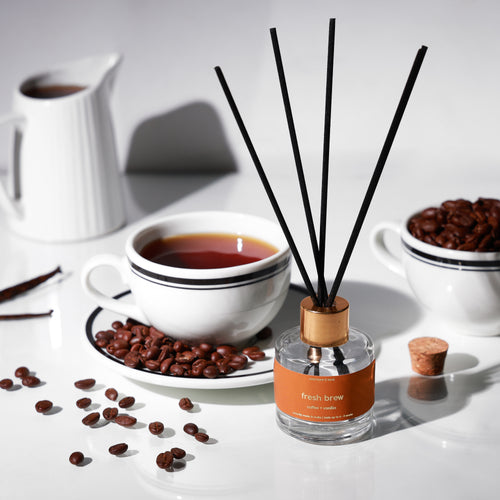
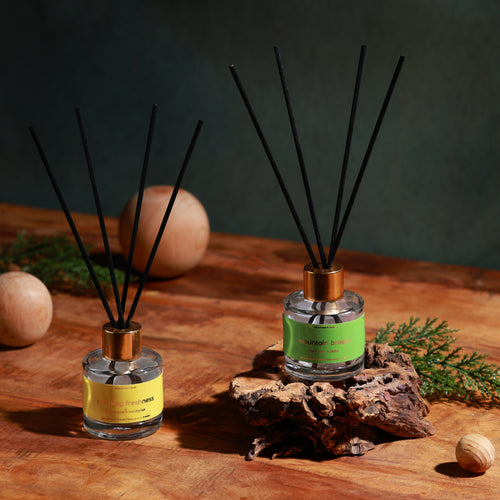
The last piece of geometry is about how many sources you need, and it is where placement stops being able to help. A reed diffuser is a point source with no propulsion, so in a long or divided space there is no shelf that reaches both ends — you can position one bottle perfectly and still have a dining area that never smells of anything. Output per bottle is fixed at a given reed count, so the only honest way to raise the total in a home is another bottle. Two 50ml at opposite ends of an open living-dining beat one 130ml in the middle, every time. If two compositions will share connected air, choose ones that meet on a note or you will smell the seam: Mountain Breeze and Morning Freshness meet on green eucalyptus, which is the Fresh & Grounded duo at ₹1,548; Fresh Brew and Garden Bloom meet on warmth and a soft musk, which is Warmth & Bloom at ₹1,598. Rooms separated by a door can hold whatever you like.
Part four — the airflow year in an Indian home
The air in an Indian flat is not one thing; it changes character four or five times a year, and the same bottle on the same shelf behaves differently in May and December. This table is the year as a placement problem rather than a weather one. Reed counts are starting points and cost bottle life roughly in proportion, and every week figure is SOSA working guidance rather than a specification.
| Season | What the home's air is doing | The placement move | The reed-count move | What to expect from a 50ml |
|---|---|---|---|---|
| Peak summer, AC running ★ | Sealed rooms with a strong directed stream for hours | Diagonally opposite the unit, well out of the path, off any sunlit surface | Six, or four if the room is small and hot | Toward the short end of 6–8 weeks; heat is the biggest accelerant |
| Monsoon | Windows shut for days, high humidity, little movement | Near a doorway for traffic; the flat is otherwise very still | Six, and flip weekly without exception | Normal to slightly long; fibre keeps wicking where rattan clogs |
| Post-monsoon and early autumn | Windows open again, ceiling fans returning | Move off any sill; keep clear of the fan sweep | Six | Around specification if the airing is brief and deliberate |
| Winter | Cold, dense, still air; rooms closed, little mechanical movement | Doorway placement matters more than ever — nothing else is moving | Consider a seventh or eighth reed for presence | At or beyond the long end; the room reads quieter than it is |
| Festive and hosting weeks | Doors opening constantly, many people moving through | Entrance console; close the flat an hour before guests arrive | Nine for two days, back to six afterwards | Nine reeds costs weeks — closer to five than eight while it runs |
| Any season, kitchen in use | Extractor, open window, cooking air — hostile and intermittent | Passage side of the kitchen, never near the hob | Six | Never diffuse over live cooking; air ten minutes, close, wait half an hour |
| The honest caveat: these are directional positions from our own testing and from what customers report, not measurements, and an Indian year looks very different in Kochi and in Chandigarh. Two things generalise. Heat shortens bottles more than anything else on this page, which is why the summer row and the sun rule matter most. And a room that reads quieter in winter is usually not weaker — cold, dense, still air both preserves the bottle and suppresses the room, so the level barely moves while your nose reports less. | ||||
Part five — telling the two failures apart, and ruling out the third thing
Because the corrections are opposite, guessing is expensive, and there is a third possibility that mimics both. Start with the tissue: hold one beside the bottle for a minute while the room is in its ordinary state. If it hangs completely dead, you have a distribution problem and the fix is the doorway. If it lifts and keeps lifting, you are in a stream and the fix is distance. If it stirs occasionally when somebody walks past and is otherwise still, your placement is correct and the problem is elsewhere. Then look at the level. A bottle emptying quickly while the room reads quiet is the draught signature; a bottle whose level has barely moved in two months is the dead-air signature, possibly with stalled reeds behind it. Neither is a manufacturing fault, and both are free to correct.
Next, the wet line, which is the most informative thirty seconds available to you. Lift one reed, gloves on, and find the boundary between the oil-soaked part of the fibre and the dry part. High and dark means the reed is saturated and stalled — flip all six and you will have your answer within a day. Barely above the oil means it is not wicking properly, which after a few months is usually the reeds reaching the end of their life; refresh them. Normal-looking, climbing steadily, with a quiet room means your problem is airflow or adaptation rather than the bottle. Reeds are the consumable and oil is the stable part of this system, which is the reverse of what most people assume — they replace the oil and keep the reeds, and it is almost always the other way round. Our refills are oil only for exactly this reason, and reeds are not sold separately, which is an honest gap in the range rather than a policy I will defend.
The third possibility, and the commonest cause of "it stopped working," is your own nose. Olfactory adaptation removes a constant background from perception within minutes, and it works hardest at home, where the smell is familiar and expected. Guests are better instruments than you are. Leave the house for two hours and walk back in from outside; if the hall greets you, the bottle is doing its job and the room simply cannot be judged from inside it. Adaptation also explains the shape people call fading: every reed diffuser has a days-one-to-three spike as dry reeds saturate and volatile top notes leave together, a settle over the first fortnight, and then a plateau that holds to the end of the bottle. The plateau is the product. Measuring week six against day two is how a perfectly normal bottle gets described as having died — and behind that flat plateau is a deliberate formulation choice. Phthalate solvents push fragrance hard off a reed and win week one convincingly, then degrade in heat and can turn acrid by around week six. We are phthalate-free on a heat-stable CCT base: a smaller opening, and a longer flatter line that still smells like itself in a Delhi June.
Part six — the ceiling, and the SOSA edit
Everything above has a limit, and I would rather draw it than let you find it by spending. Here is the whole guide as a purchase decision — what each move fixes, what it does not fix however anyone markets it, and what it costs. The first three rows are free, and most people never need to go past them.
| The move | What it fixes | What it does not fix | Price |
|---|---|---|---|
| 1. Move to a doorway, chest height, clear space ★ | Dead air — the commonest failure of all | A room genuinely larger than the format | Free |
| 2. Move out of the stream and out of the sun | Draught stripping and heat acceleration together | A composition that is too quiet for the room | Free — and it gives you weeks back |
| 3. Flip all six reeds weekly, and close the room before guests | A stalled delivery rate; a room emptied by airing | Reeds that have reached the end of their life | Free |
| 4. Add reeds — nine for hosting, back to six after | Presence, immediately and reversibly | Nothing about reach; it raises the level, not the range | Free, but roughly five weeks instead of eight |
| 5. A stronger composition — Fresh Brew 9.5 or Mountain Breeze 9.4 | A sleep fragrance being asked to do a hosting job | Bad placement — it will underperform in a stream too | ₹849 · 50ml |
| 6. A second source — duo set or two 50ml | Length and division — the only honest way to raise the total | Height, ventilation, or an open-plan volume past the ceiling | From ₹1,498 |
| 7. 300ml oil refill | Running cost once you have settled on a configuration | Nothing about strength — it is the same oil | ₹2,399 · 8–11 months |
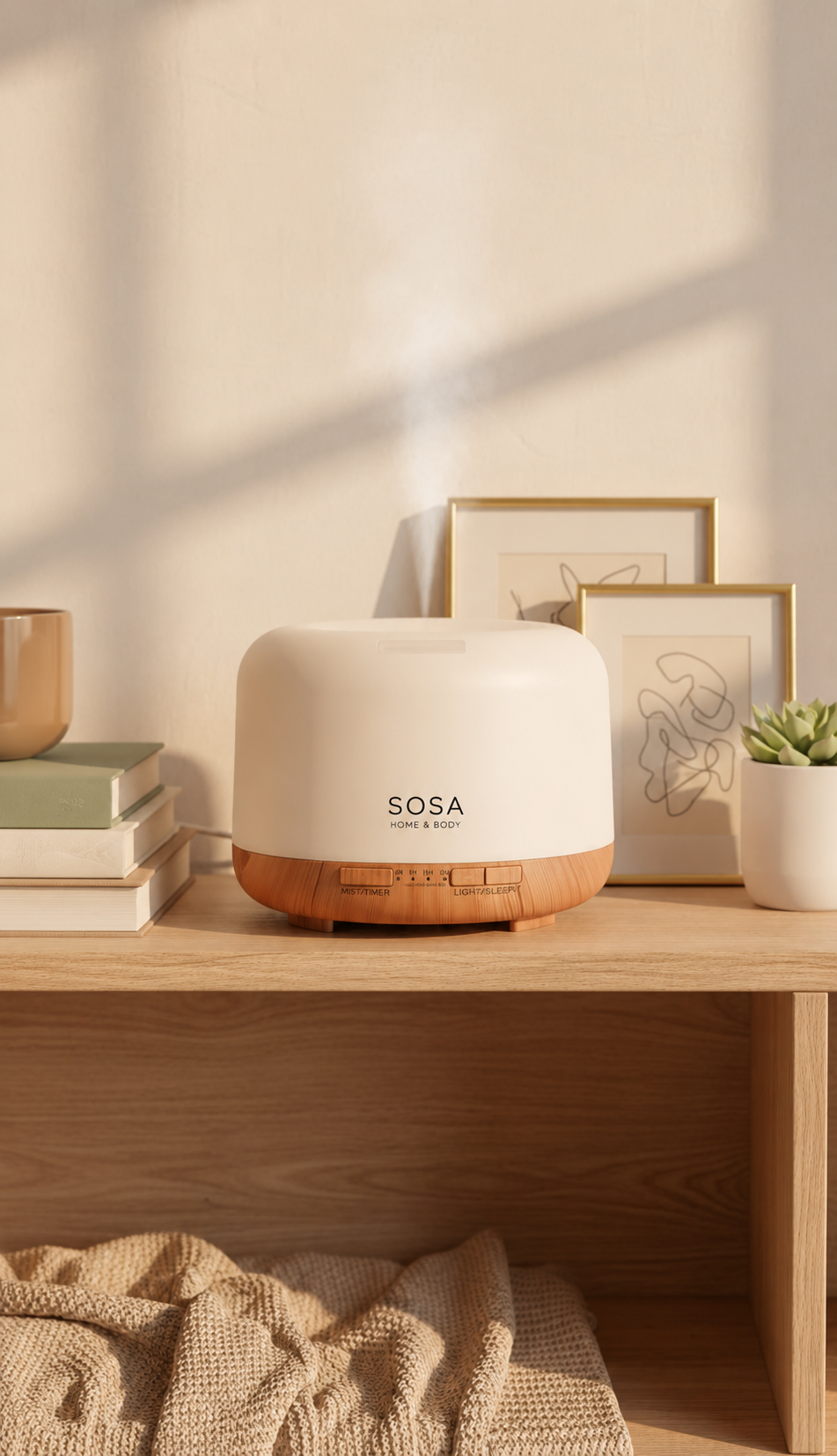
| 8. Sukoon — a different format | 270–320 sq ft, on demand, 16–18 hrs on low, timers | It cannot be forgotten the way a reed bottle can | ₹1,899 |
| Not a fix: a 130ml in a draughty room | 14–18 weeks instead of 6–8 in a good spot | Reach, projection, or a bad shelf — size buys duration only | From ₹1,249 |
| Not a fix: a Megh for coverage | 6L and about 100 hours of runtime between fills | Area — it covers only around 215 sq ft. A runtime machine, never a coverage upgrade | ₹3,499 |

Versailles
If I could put one sentence on the box it would not be about the fragrance. It would be: put this where people walk, not where the air blows. Nearly every unhappy message we receive about a reed diffuser resolves into one of the two failures in Part one, and both are corrected by picking the bottle up and setting it down three feet away. No purchase involved, ours or anybody else's.
I understand why the wrong instincts are so strong. A vent looks like distribution. A windowsill looks like the natural home for a glass object. A quiet corner looks respectful of a fragrance you do not want to overdo. All three are wrong for the same underlying reason — a reed diffuser has no propulsion, so it is entirely at the mercy of what your room's air does next, and the only air that serves it is air that comes and goes.
The commercial temptation here is obvious, and I want to be plain about resisting it. Somebody with a bottle in an AC stream who concludes their fragrance is weak is a customer about to buy a second, stronger bottle and put it in the same stream. That is ₹849 for the same disappointment. I would rather write this page. And when a room genuinely is beyond the format, I will say so and point you at a machine instead of selling you a third bottle — most homes end up running both, in different rooms, doing different jobs. Everything we make is composed and handmade in small batches in Pune, and a part of every order funds a girl's classroom through Nanhi Kali.
Frequently asked questions
- Air conditioning: does AC affect reed diffusers?, where to place one in an air-conditioned room, and should it go near an AC vent?
- Fans: does a ceiling fan affect scent throw? and should you put a diffuser near a fan?
- Windows: does an open window affect a reed diffuser? and should you put one near a window?
- The central airflow post: does airflow make a reed diffuser stronger or finish faster?
- SOSA placement: where to place a SOSA diffuser for the best airflow, and the wider diagnostic, why can't I smell my reed diffuser?
- Brand: the SOSA founder story.
SOSA reed diffuser range & prices (verified August 2026): alcohol-free, phthalate-free, paraben-free and IFRA-compliant compositions on a heat-stable coconut-derived (CCT) carrier, low-VOC, supplied in a refillable glass bottle with six fibre reeds; 50ml lasts 6–8 weeks and 130ml lasts 14–18 weeks. Morning Freshness (Malabar lemon · peppermint · Nilgiri eucalyptus) 50ml ₹749 · 130ml ₹1,249 · 9.0/10; Garden Bloom (British rose · night-blooming jasmine) 50ml ₹799 · 130ml ₹1,299 · 8.9/10; Evening Calm (Kashmir lavender · chamomile) 50ml ₹799 · 130ml ₹1,299 · 8.9/10; Fresh Brew (Coorg coffee · Kerala vanilla) 50ml ₹849 · 130ml ₹1,349 · 9.5/10; Mountain Breeze (Himalayan pine · sage · Indian cedar) 50ml ₹849 · 130ml ₹1,349 · 9.4/10. Reed diffuser refills are oil only — you reuse your own vessel and reeds: 300ml ₹2,399 (roughly 8–11 months) · 500ml ₹3,499 (roughly 14–18 months), about ₹7–8 per ml against ₹15–17 per ml for a 50ml bottle. Duo sets ₹1,498–₹1,598 for 2 × 50ml and ₹2,498–₹2,598 for 2 × 130ml. Strength figures are positions on SOSA’s own internal strength scale, not an industry standard. Replacement reeds are not sold as a separate SKU; SOSA guidance is to refresh reeds every few months. The reed line is separate from the water-based Hotel Collection for ultrasonic machines (15ml ₹299 · 100ml ₹999 · 300ml ₹1,799) and the two are not interchangeable. Diffusers: Boond 300ml ₹899 · Sukoon 500ml ₹1,899 · Megh 6L ₹3,499 · waterless Vaayu ₹11,999. Composed and handmade in small batches in Pune, India; tested through 45°C summer heat and 85% monsoon humidity. Free shipping above ₹499. A portion of every order supports girl-child education through Nanhi Kali. Prices subject to change — see the live product pages.