


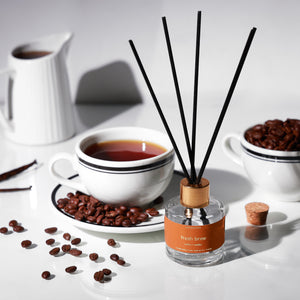
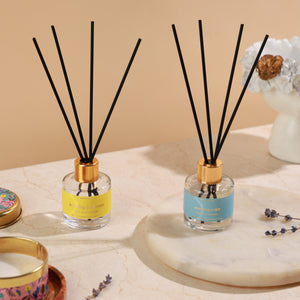

What makes a category lineable: it finishes, so nothing accumulates; it varies internally, so no year repeats; and it has a graceful exit, so you can stop without it reading as a downgrade. Home fragrance passes all three — five reed scents ₹749–₹849, two sizes, three duos ₹1,498–₹1,598, an oil refill ₹2,399 and candles from ₹379 underneath it.
Your list is not one line. It is many lines at different years. Some names are at year one, some at year four. The annual job is to note which, not to pick anything new.
Cap the line before you start. The commonest way a repeat gift fails is escalation — a little more each year until it is unsustainable and you stop abruptly. Decide the ceiling in year one and hold it.
2. Test the category against three things before you commit to it. Does it finish, so nothing accumulates in their home? Does it vary internally, so five years produce five different objects? And can you leave it without the exit reading as a snub? Home fragrance passes; a decorative object usually fails the first and third.
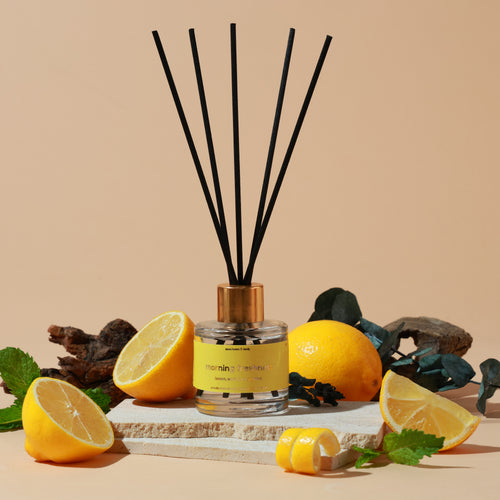
3. Set the standing item at ₹749–₹849 and vary the scent by person and by year. Five scents means five years without a repeat for any one name. Morning Freshness ₹749, Garden Bloom ₹799, Evening Calm ₹799, Fresh Brew ₹849 and Mountain Breeze ₹849, in a refillable glass bottle with six fibre reeds.
4. Run two tiers, not one. Most recurring lists have a heavier half and a lighter half. Reed diffusers at ₹749–₹849 for the first, jar candles at ₹379 or a mug at ₹474 for the second. Twelve names split 7 and 5 comes to (7 × ₹799) + (5 × ₹379) = ₹5,593 + ₹1,895 = ₹7,488.
5. Do not synchronise the list. The name you have gifted for six years and the colleague you added last year are not at the same point and should not receive the same thing. Each name moves through its own line at its own pace, and the annual job is to see which position each is in.
6. Two-thirds of a recurring list should never move at all. Neighbours, courtesy names, colleagues — those lines are meant to stay flat, and an upward move there creates an obligation nobody asked for. Reserve movement for the handful of names where you actually see the home.
7. Give the same thing where people compare. Anyone who will see each other's gifts — a group of aunts, an office, a floor of neighbours — gets the identical item. Uniformity there is fairness, not laziness.
Everything is composed and handmade in small batches in Pune, and a portion of every order supports girl-child education through Nanhi Kali.
Part one — the cost of starting again every year
Nobody accounts for what the annual restart costs, because it is paid in hours rather than rupees. But it is the largest single expense in most people's Diwali gifting, and it produces a worse result than the cheaper alternative. Three things go wrong when the same question is reopened from nothing every October, and all three are avoided by deciding once.
 Day & Night duo₹1,498 · 2 × 50mlThis is the test most categories fail. Give somebody a decorative object three years running and you have furnished a corner of their home with your own taste, and worse, you have created something they feel obliged to have visible when you come round. A gift that finishes leaves no debt and no display. A 50ml bottle runs 6–8 weeks and is gone; a 130ml runs 14–18 weeks and is gone; the glass can be refilled or recycled and nothing has stacked. That is not a minor advantage in an Indian flat where storage is the scarcest thing in the house. It is also why the same line can run for a decade without ever becoming a burden — the fourth year does not sit on top of the third.
Part two — your list, name by name, year by year
The useful way to look at a recurring list is not as a set of people but as a set of positions. Each name is somewhere in its own sequence, and the only thing you need to know is where. Here are the positions that show up on most Indian annual lists, what usually sits at each, and — the column that does the real work — the signal that tells you to move that name along.
| Who on your annual list | Where they are in the line | This year's item | Price | The signal that moves them on |
|---|---|---|---|---|
| The name you have gifted longest ★ | Year four or five — every 50ml scent is spent | 300ml oil refill ₹2,399, or a 130ml for their busiest room | ₹1,249–₹2,399 | You have seen they kept the vessel — the refill contains no vessel and no reeds |
| The neighbour opposite | Year one, indefinitely — the relationship is steady, not deepening | Misty Mornings jar candle ₹379, a different scent each year | ₹379 | Nothing. This is a line that is meant to stay flat |
| An aunt in a group of aunts who compare | Whatever year the group is in — they move together | The identical Garden Bloom 50ml ₹799 for all of them | ₹799 each | The whole group steps at once, or not at all |
| The couple who host you every year | Year two or three — you have seen their home properly | Fresh & Grounded duo ₹1,548 — two rooms, two registers | ₹1,548 | You know which rooms they actually use |
| A cousin you see once a year | Year one every time — you never learn what happened | The least polarising thing in the range, repeated: Garden Bloom ₹799 | ₹799 | They mention it unprompted, which is the only evidence you will get |
| An office colleague on a fixed courtesy list | Flat by design — this line should never rise | Everyday Beautiful Mug ₹474 or a Bookshop candle ₹379 | ₹379–₹474 | Nothing — an upward move here creates an obligation they did not ask for |
| The honest caveat: a line is a convenience for you, not a promise to them. Nobody on this list is expecting a sequence, and if you drop out of one after two years almost certainly no one will register it. The point of the structure is to make your October cheap in effort — it is not a commitment you have entered into, and you should not treat a flat or a shortened line as a failure of duty. | ||||
 Cozy Corner · the flat, lighter tier₹379Shop →
 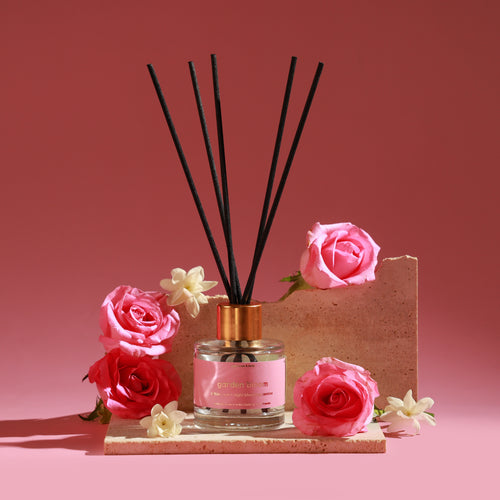 Garden Bloom · the standing gift₹799Shop →
 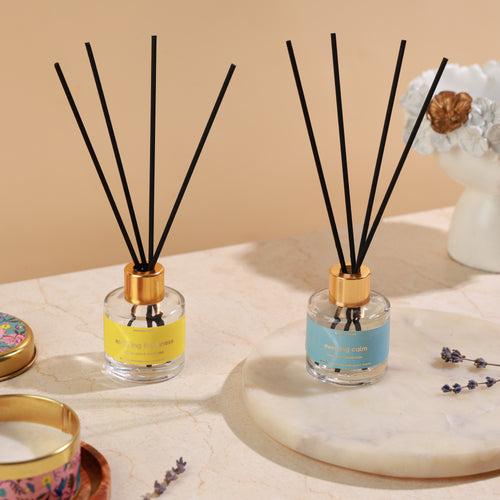 Day & Night duo · the top tier₹1,498Shop →
Part three — when a line is the wrong idea
A line assumes the relationship is stable and the recipient is broadly indifferent to novelty. Both assumptions fail sometimes, and it is worth naming where. The clearest failure is a line built on no evidence at all. If year one went into a home where nothing was ever used — the bottle still sitting three-quarters full a year later — then years two through five are the same mistake with better packaging. A line should be extended on evidence and closed without embarrassment. Give a candle instead, or nothing, and take the money to a name that will use it.
The second failure is subtler and it is the one I would guard against hardest: the line that becomes a rule. Someone downsizes to a one-room flat, or has a newborn in the house, or moves in with an elderly parent who finds constant fragrance oppressive. The circumstances changed and the sequence did not, because it had stopped being a decision. Once a year, look at the position and ask whether the person is still in the situation the line was built for. It takes a moment and it is the only part of this system that requires actual judgement.
And there is a limit to how far any fragrance line can usefully run in one household. Past three or four bottles in a normal Indian flat you are not adding anything — the rooms that carry a diffuser already have one, and the rest are kitchens and bathrooms where the honest answer is ventilation rather than more scent. At that point the line either steps sideways into a different format, or it stops. Sideways means the Sukoon at ₹1,899 for an open living-dining beyond roughly 250–300 sq ft, where six reeds are working against the volume of the room; it does not mean the Megh at ₹3,499, which is a 6L runtime machine at around 215 sq ft rather than a coverage upgrade. Stopping is also fine, and a line that ends because the house is full is the most flattering way a gift sequence can finish.
Part four — four lines, and who each one suits
There is more than one shape a line can take, and the right one depends on the list rather than the budget. Here are the four that actually work, each with its opening move, its middle, and the point at which I would end it rather than stretch it.
| The line | Year one | Year two and three | Where it honestly ends |
|---|---|---|---|
| The five-scent line ★ | Morning Freshness ₹749 — the least polarising opener | Garden Bloom ₹799, then Evening Calm ₹799 | At year five, when all five scents are spent — total 749 + 799 + 799 + 849 + 849 = ₹4,045 |
| The flat courtesy line | A jar candle ₹379, roughly 15–18 hours | A different candle scent each year, same price | Never — it is designed to stay level, and levelness is the point |
| The room-by-room line | One 50ml for the room you have actually seen, ₹749–₹849 | A second and third bottle for other rooms, scents that share a note | At three or four bottles, when the flat has no more rooms that suit one |
| The step-up line | 50ml ₹799 | 130ml ₹1,299, then a duo ₹1,598 | At the Sukoon ₹1,899 — a format change, not a bigger bottle |
Versailles
My mother's Diwali list ran to about eighteen names and she treated almost all of them as settled. Four or five people got the same thing every year for a decade — the same category, the same scale, no ceremony about it. The energy went into three names, and everybody else was on a line that was never intended to go anywhere. As a teenager I thought that was a failure of effort. It was a correct allocation of it.
What that shape does is protect the two or three gifts that genuinely matter. If all eighteen are open questions, all eighteen get the same thin slice of attention and none of them is good. If fifteen are settled, the remaining three can be chosen with real information — which room, which scent, whether last year's was used at all. It also lets names come off quietly, because a flat line has no momentum to break.
I will not promise you that a sequence of gifts will be remembered or that anybody will notice the thought behind it. That is not something I can know. What I can tell you is what a bottle costs, how long it runs, what a refill does and does not contain, and where the honest end of our range sits. Everything is made in Pune in small batches, and part of every order funds a girl's classroom through Nanhi Kali.
Frequently asked questions
- You gave a diffuser last year — reading the bottle before you buy again.
- Five years running — a full sequence for one person, year by year.
- Turning one gift into a yearly ritual and repeat gifting for a team.
- The SOSA repeat-gifting guide — the whole subject, end to end.
- Brand: the SOSA founder story.
SOSA range & prices used in this guide (verified from the live store, 27 August 2026): Reed diffusers — alcohol-free, phthalate-free, paraben-free, IFRA-compliant compositions on a heat-stable coconut-derived (CCT) carrier, in a refillable glass bottle with six fibre reeds; 50ml lasts 6–8 weeks, 130ml lasts 14–18 weeks. Morning Freshness 50ml ₹749 · 130ml ₹1,249; Garden Bloom ₹799 · ₹1,299; Evening Calm ₹799 · ₹1,299; Fresh Brew ₹849 · ₹1,349; Mountain Breeze ₹849 · ₹1,349. Duo sets: Day & Night ₹1,498, Fresh & Grounded ₹1,548, Warmth & Bloom ₹1,598 (2 × 50ml); ₹2,498–₹2,598 (2 × 130ml). Oil-only refills 300ml ₹2,399 · 500ml ₹3,499 (vessel and reeds not included). The least expensive SOSA reed diffuser is ₹749 — no reed diffuser exists below that price in any size. Below it: scented jar candles from ₹379 (roughly 15–18 hours), Sandalwood or Smoked Oudh jar candle ₹449, wax melts ₹474 (a burner is needed and is not included), ceramic mugs ₹474, ribbed and face mugs and taper candles ₹569, Amber Rose candle ₹599, ceramic trinket dish ₹664, candle two-pack ₹664 (roughly 30–36 hours). Machines: Boond 300ml ₹899 · Sukoon 500ml ₹1,899 · Megh 6L ₹3,499 (~215 sq ft, a runtime and humidity machine rather than a coverage upgrade) · waterless Vaayu ₹11,999 · Safar car and travel diffuser ₹3,999. The water-based Hotel Collection (15ml ₹299 · 100ml ₹999 · 300ml ₹1,799) is a fragrance for an ultrasonic machine, not a standalone gift. SOSA publishes no bulk or corporate gifting terms — there is no discount slab, no minimum order quantity, no stated GST-invoicing arrangement, no custom branding service and no published lead time — and SOSA sells no gift card, gift hamper, gift box or curated gift set. Larger orders should be discussed with SOSA directly through the contact page before committing. Gift wrapping, gift notes, direct-to-recipient shipping and delivery timing are unconfirmed — check at checkout rather than assuming them; no delivery date is promised anywhere in this guide. Per-head and total costs shown are arithmetic on the listed prices, not quotations. Fragrance adds scent to a room; it does not clean air, remove cooking or smoke smells, or change how anyone feels. Fragrance oil is flammable — keep any diffuser away from diyas, candles and open flame. Composed and handmade in small batches in Pune, India; tested through 45°C summer heat and 85% monsoon humidity. Free shipping above ₹499. A portion of every order supports girl-child education through Nanhi Kali. Prices subject to change — see the live product pages.