


The four common deviations, in order of cost: sun on the glass, air moving across the reeds, reeds above six, and a 40°C month. A room with three of the four will run a 50ml closer to four weeks than eight.
The measurement error: weeks one and two look as though nothing is happening because the level drop is invisible in a narrow bottle. Most people first "notice" evaporation in week four and back-date it wrongly.
The comparison error: if your last diffuser emptied in three weeks and smelled sharp by the end, it was probably phthalate-solvented. We are not, deliberately — a smaller opening and a longer, flatter plateau.
2. The cadence is part of the spec. One flip a week, all six reeds, gloves on. Flip less and the bottle appears to last longer while quietly delivering less; flip daily and you lose days. Weekly is the calibration point, not a suggestion.
3. The room is part of the spec. Ordinary temperature, out of direct sunlight, and gentle incidental air rather than forced air. A split AC blowing across the reeds, a ceiling fan directly overhead, or a west-facing sill all break this condition, and they break it by a wide margin.
4. The season is the condition nobody can meet all year. A closed flat in a 40°C May will run a bottle faster than the same flat in December, and there is nothing to correct. We test through 45°C heat and 85% monsoon humidity so that the composition holds its shape at both ends — what the season takes from you is weeks, not character.
5. The comparison you are making may be against the wrong product. Diffusers built on phthalate solvents push fragrance hard off the reed and win the first fortnight; they also degrade in heat and turn acrid by around week six. We are phthalate-free on a heat-stable CCT base, which means a smaller opening and a longer, flatter plateau. If your previous bottle felt more dramatic, that is the trade you are noticing.
6. Measure before you conclude. Put a strip of tape on the glass at today's level and date it. Weeks one and two show almost nothing in a narrow bottle; the drop becomes obvious around week four. Most reports of runaway evaporation are really reports of a level nobody looked at until it was already low.
7. Then buy for the room you actually have. If your living room genuinely runs a 50ml in six weeks, that is your household's real number and it is worth planning around — a 130ml from ₹1,249 or the oil-only refill at ₹2,399 are both cheaper per week than replacing 50ml bottles. Composed and handmade in small batches in Pune, and a portion of every order supports girl-child education through Nanhi Kali.
Part one — the three parts of the spec, and which one your home breaks
Every duration figure in this range is a rate multiplied by a volume. The volume is the honest part — fifty millilitres is fifty millilitres. The rate is where all the argument lives, and the rate has three inputs: how the bottle is set up, how it is maintained, and where it stands. We can control the first by putting six reeds in the box. We can advise on the second. The third belongs entirely to you, and it is the one that moves the number furthest. What follows is each part of the spec written out plainly, so you can check your own shelf against it instead of against a stranger's.
 Morning Freshness₹749 · 9.0/10Over a week, the exposed end of a reed accumulates the heavier, slower part of the composition while the lighter molecules leave; delivery drifts down. A weekly flip returns the reed to its designed rate. The duration figures assume that flip, which means a bottle that is never flipped will appear to outlast the spec while giving the room progressively less — the least useful way to make a bottle last. Flipping more often than weekly moves the number the other way, but only slightly: it costs days across a bottle's life, not weeks, and it buys back fragrance you have already paid for. Weekly, all six, gloves on, and stand the bottle on a tray because the oil marks wood and stone.
Part two — every assumption in the number, and what breaking it costs
Here is the spec written out as a table, with the variation I see most often in Indian homes and what that variation does to the window. These are SOSA's own working figures from in-house testing and customer correspondence rather than laboratory measurements, and they describe a 50ml bottle. Treat the right-hand column as a direction and a rough magnitude.
| The assumption | What the stated figure is measured at | The common Indian variation | What the variation costs |
|---|---|---|---|
| Reed count ★ | Six fibre reeds, the dosed count | Nine or ten, added for a louder room | 8 weeks becomes about 5, or 4–5 at ten |
| Flip cadence | All six flipped once a week | Flipped rarely, or every second day | Rarely: looks longer, delivers less. Daily: days, not weeks |
| Light | Out of direct sunlight entirely | A windowsill, or an afternoon slab of light on a console | The single largest deviation — can halve the window |
| Air movement | Gentle incidental traffic, no forced air | Split AC or ceiling fan running across the reeds | Weeks lost, and a fainter room at the same time |
| Temperature | An ordinary room, neither hot nor cold | A closed flat at 40–45°C through May and June | A summer bottle runs visibly shorter than a winter one |
| Humidity and use | A normal, lived-in room | 85% monsoon damp, or a room shut for a fortnight | Usually the other way — the bottle slows down |
| The honest caveat: these deviations do not add up neatly and I would not want anyone doing sums with them. Two of the six are not faults at all — added reeds and a hot month are both cases of the product doing what physics says it must. And the last row cuts the other way: a cool, closed, low-traffic room will often beat the stated window, which sounds like good news and is only good news if the room still smells of something. Longevity and output are the same quantity read from opposite ends. | |||
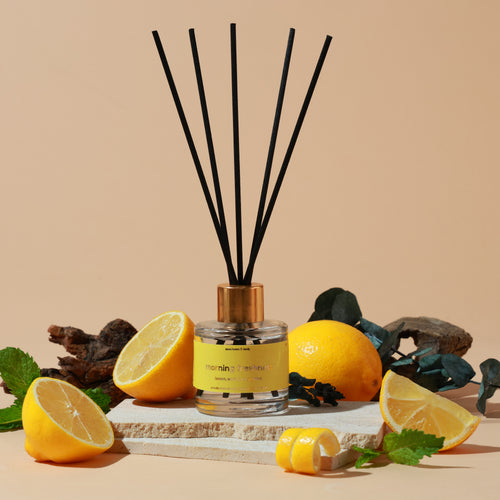 Morning Freshness · 9.0/10from ₹749Shop →
 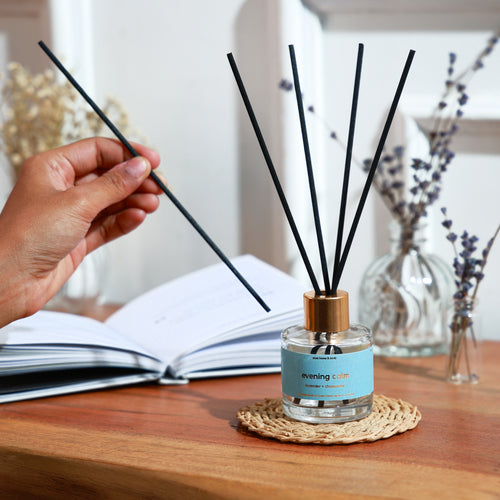 Evening Calm · 130ml₹1,299Shop →
  Oil refill · 500ml₹3,499Shop →
Part three — how to measure your own bottle instead of arguing with the label
The most useful thing you can do this week costs nothing and takes fifteen seconds. Put a strip of masking tape on the glass at today's oil level and write the date on it. Do it again in four weeks. That single measurement replaces every guess, because the thing that makes evaporation feel dramatic is not the rate — it is that nobody looks until the level is already alarming. In a narrow bottle the first fortnight's drop is genuinely difficult to see, and by the time it is obvious the eye back-dates the whole loss to the last week or two. I have had photographs sent to me of bottles described as "half gone in ten days" that turned out, once dated, to be entirely normal at six weeks.
The second measurement worth taking is the wet line. Lift one reed and find the boundary between the oil-soaked part and the dry part. High and dark, with the fibre slightly greasy, is a bottle wicking hard — consistent with heat, sun or a draught, and consistent with a shorter window. Barely above the oil is the opposite: the reeds are not moving much, which usually means a bottle that will beat its stated weeks while under-delivering to the room. Both readings are more informative than the level, because the level tells you what has already happened and the wet line tells you what is happening now. And remember the shape of the curve you are measuring against: a spike in days one to three as dry reeds saturate and top notes depart, a settle over the first fortnight, and then a plateau that should hold to the end of the bottle. The plateau is the product. A fast bottle with a healthy plateau has served you well; a fast bottle with no plateau at all is a draught problem.
The third thing to check is what you are comparing against. A great many diffusers sold in India lean on phthalate solvents, which push fragrance off the reed hard and produce a spectacular first fortnight. They also degrade in heat, which is why so many of them read slightly acrid by around week six. Our compositions are alcohol-free, phthalate-free, paraben-free and IFRA-compliant on a heat-stable coconut-derived CCT carrier, and the honest consequence is a smaller opening and a longer, flatter line. If your previous diffuser felt more eventful, you are remembering its first fortnight and not its seventh week. I would rather say that plainly than pretend the trade does not exist.
Part four — your realistic window, by household
Once you know which conditions your home breaks, you can stop measuring yourself against the label and start planning around your own number. This is the table I would build for a friend: the household, the window I would honestly expect, and the single change most worth making in each case.
| Your room | Realistic 50ml window | Realistic 130ml window | The one change worth making |
|---|---|---|---|
| Cool, curtained, closed AC bedroom ★ | At or beyond the stated 6–8 weeks | Comfortably 14–18 weeks | Nothing — but check it still smells of something |
| West-facing living room with afternoon light | Often nearer 4–5 weeks | Well short of 14 weeks | Move it out of the light — the largest free gain there is |
| Open living-dining with a ceiling fan on all evening | Around 5 weeks, and the room reads faint | Around 11–13 weeks, same faintness | Three feet of clearance, and an interior wall if possible |
| Coastal flat through an 85% monsoon | Often at or past 8 weeks | At or past 18 weeks | Nothing — fibre reeds are chosen for exactly this |
| Kitchen or bathroom with an extractor running | 5–6 weeks | 11–14 weeks | Never diffuse over live cooking; air the room first |
| Entrance hall with a front door opening all day | Around 6 weeks, and it earns every one of them | Around 13–15 weeks | Keep it — this is the best-value placement in a home |
| The honest caveat: these are estimates for planning, not commitments, and the two rows that beat the stated window deserve suspicion rather than celebration. A bottle lasting unusually long in a sealed bedroom is often a bottle that has stopped delivering, and the fix there is to flip, not to congratulate yourself. If you want one number to plan a household around, take the middle of your own last two bottles and buy oil accordingly — the 300ml refill at ₹2,399 covers about 8–11 months at six reeds. | |||
Versailles
There was a version of this range where the box said "up to twelve weeks", because up-to is a word that costs nothing and cannot be disproved. I could not make myself sign it off. A duration figure with no conditions attached is not a fact about a product, it is a fact about the person writing the label, and I would rather publish six-to-eight and then spend a page explaining what the six-to-eight assumes.
The number is taken at six fibre reeds, flipped weekly, in a room out of direct sun with no forced air across the bottle. I have written those conditions here in full because the most common message I get is not really a complaint about evaporation — it is a request for permission to believe their own eyes. If your hall runs a 50ml in five weeks, that is your hall's number, and it is far more useful to you than mine.
The thing I would ask you to be suspicious of is the opposite result. When someone tells me a bottle lasted eleven weeks, my first question is whether the room smelled of anything in weeks nine and ten. Lasting and working are not the same measurement. Everything is composed and handmade in small batches in Pune, and a part of every order funds a girl's classroom through Nanhi Kali.
Frequently asked questions
- Why is it finishing so quickly? — the six accelerants, ranked by the weeks each one costs.
- Does air conditioning shorten a bottle? and does heat? — the two room conditions in full.
- How to make it last longer — the conservation list, with what each item costs you in presence.
- The complete longevity guide — this page and the eight around it in one place.
- Brand: the SOSA founder story.
SOSA reed diffuser range & prices (verified August 2026): alcohol-free, phthalate-free, paraben-free and IFRA-compliant compositions on a heat-stable coconut-derived (CCT) carrier, low-VOC, supplied in a refillable glass bottle with six fibre reeds; 50ml lasts 6–8 weeks and 130ml lasts 14–18 weeks. Morning Freshness (Malabar lemon · peppermint · Nilgiri eucalyptus) 50ml ₹749 · 130ml ₹1,249 · 9.0/10; Garden Bloom (British rose · night-blooming jasmine) 50ml ₹799 · 130ml ₹1,299 · 8.9/10; Evening Calm (Kashmir lavender · chamomile) 50ml ₹799 · 130ml ₹1,299 · 8.9/10; Fresh Brew (Coorg coffee · Kerala vanilla) 50ml ₹849 · 130ml ₹1,349 · 9.5/10; Mountain Breeze (Himalayan pine · sage · Indian cedar) 50ml ₹849 · 130ml ₹1,349 · 9.4/10. Reed diffuser refills are oil only — you reuse your own vessel and reeds: 300ml ₹2,399 (roughly 8–11 months) · 500ml ₹3,499 (roughly 14–18 months), about ₹7–8 per ml against ₹15–17 per ml for a 50ml bottle. Duo sets ₹1,498–₹1,598 for 2 × 50ml and ₹2,498–₹2,598 for 2 × 130ml. Strength figures are positions on SOSA’s own internal strength scale, not an industry standard. Replacement reeds are not sold as a separate SKU; SOSA guidance is to refresh reeds every few months. The reed line is separate from the water-based Hotel Collection for ultrasonic machines (15ml ₹299 · 100ml ₹999 · 300ml ₹1,799) and the two are not interchangeable. Diffusers: Boond 300ml ₹899 · Sukoon 500ml ₹1,899 · Megh 6L ₹3,499 · waterless Vaayu ₹11,999. Composed and handmade in small batches in Pune, India; tested through 45°C summer heat and 85% monsoon humidity. Free shipping above ₹499. A portion of every order supports girl-child education through Nanhi Kali. Prices subject to change — see the live product pages.