




Why a sofa loads up: cooking aerosol lands on it as actual droplets of oil carrying odour, body oils and hair products transfer at every contact, and spills go into the foam rather than onto it. Then it re-releases for weeks.
The free fixes: every washable cover off and through the machine; the upholstery head of the vacuum over the deck, the arms and the crease between seat and back; cushions and throws in two hours of sun; bicarbonate of soda sprinkled on the seats, left an hour and vacuumed off.
The thing not to do: spray it. Fragrance on a loaded sofa gives you two smells instead of one, and the loaded one wins.
2. Because cooking does not send a smell into the room. It sends droplets. Frying, tempering and anything with oil in it produces a fine aerosol — actual microscopic droplets of fat carrying odour molecules — which travels on air currents until it meets a surface and lands on it. Hard surfaces show you this as the film on top of the fridge. Fabric does not show you anything. It absorbs.
3. Because you also load it by touch, every single day. Skin oils, hair oil, whatever is in your hair product, hand cream, the back of a neck against a headrest for two hours. Contact transfer is slower than aerosol but it is relentless, and it concentrates in the three places people actually touch: the arms, the headrest and the front edge of the seat.
4. Because spills go in rather than on. A cup of tea, a bit of gravy, a child with a glass of milk. You blot the surface and it looks dealt with, but the liquid has already gone through the cover and into the foam, where there is no air movement and nothing dries quickly. Foam is a reservoir, and it releases for weeks.
5. So do this, at ₹0: covers off and washed, upholstery head over the whole thing, cushions in the sun for two hours, bicarbonate on the seats for an hour and vacuumed off. Two openings on opposite walls for twenty minutes while you work — one window is ventilation, two is exchange. That is the entire first line of treatment and it costs nothing but a Saturday.
6. And do not spray it. Fragrance sitting on top of a loaded sofa is not one improved smell. It is two smells arriving together, and the one you were trying to hide is the one with six months of material behind it.
A portion of every order supports girl-child education through Nanhi Kali.

The three ways a sofa loads up
A sofa is not simply a thing in a room that happens to smell. It is a collector, and it has three separate intakes running at once, which is why it outpaces every other object in the house. One arrives through the air, one arrives through your hands and the back of your neck, and one arrives as liquid and goes somewhere you cannot reach. They load at different speeds and they need different treatment, and the reason so many people conclude that their sofa is simply old and beyond help is that they have treated all three as one problem and dealt with the surface of it.
Where in the sofa the smell actually is
Sofas are not uniform, and treating one as a single object is why most cleaning attempts under-deliver. This is the map I would work through, in order, with what collects in each place, what actually shifts it and what it costs. Four of the five rows cost ₹0 and the fifth costs a phone call. Nothing in this table is a SOSA product, because nothing SOSA makes belongs in it.
| Part of the sofa | What gets into it | What actually works | How often | Cost |
|---|---|---|---|---|
| Removable covers ★ | Cooking aerosol, body oils, dust, everything airborne in the room | Machine wash at the care-label temperature, then dried completely before they go back on. Damp covers on foam is how you create a second problem | Every two to three months in a flat with an Indian kitchen in it | ₹0 |
| The crease between seat and back | Crumbs, dropped food, hair, and the dust that falls out of everything else | The crevice tool first to lift the solids, then the upholstery head. This is the single most neglected part of any sofa | Fortnightly, and it takes four minutes | ₹0 |
| Arms, headrest and front edge | Hand and hair oils, hair product, hand cream — deposited by contact and then oxidising | Upholstery head, then a barely damp microfibre cloth if the label permits. Test on the back of the sofa first | Monthly | ₹0 |
| Loose cushions and throws | The same as the covers, plus whatever has been spilled and blotted | Two hours of direct sun does more than any product. Sun is dry heat and ultraviolet, and it works on both the moisture and the microbes | Whenever there is a dry sunny morning | ₹0 |
| The foam itself | Spills that went through the cover, and moisture in a monsoon flat | Unzip, take the pad outdoors for a full day, stand it on edge so both faces get air. Bicarbonate on the seat deck for an hour, then vacuumed off, for the surface | After any spill, and once a year regardless | ₹0 |
| Fixed upholstery that cannot be removed | All of the above, with no way to launder any of it | A professional upholstery clean, which is the one paid item here. Ask for low-moisture extraction, and only when the flat can be aired for a day afterwards | Every 18 months to two years | Paid service |
Reeds · one level, monthsfrom ₹749Shop →  Sukoon · timed, and it stops₹1,899Shop →
  Scents · four drops₹299Shop →
The weekend that fixes it, and what it costs
Start with the order, because doing these in the wrong sequence wastes most of the effort. Covers off first, into the machine, and while they are in there open two windows on opposite or adjacent walls and leave them for the full twenty minutes — one window is ventilation, two is exchange, and the difference between them is not marginal. Then vacuum the bare sofa with the upholstery head: the deck the cushions sit on, the back, the sides, the crease between seat and back with the crevice tool first, and the arms and headrest last so you are not dragging arm deposits across the rest. Then the loose inner pads and any throws go outside, or onto a balcony, or against a window that gets direct sun, for two hours a side. Then bicarbonate of soda on the seat deck and the backrest: sprinkle it, leave it an hour, vacuum it off thoroughly. It is mildly alkaline and it is a physical adsorbent, so it takes up some of the fatty acid residue on the fibre surface rather than covering it. It is not magic and one application will not reverse three years, but it is free, it is safe on most upholstery, and on a sofa that has just been vacuumed it makes a real difference. Do not do it the other way round; bicarbonate onto a dusty sofa is just more to vacuum. And the covers must be completely dry before they go back on, because damp fabric stretched over foam in a Pune or a Mumbai August is the beginning of a different and worse smell.
Then the maintenance, which is the part that decides whether you are doing this again in six weeks. The single highest-value habit for a sofa is not about the sofa at all: run the kitchen extractor while you cook and for ten minutes afterwards, not just during. The ten minutes after is when the aerosol that is still suspended gets pulled out instead of drifting through the flat and landing on your upholstery, and almost nobody does it because the cooking is finished and the fan feels unnecessary. If the kitchen has a door, shutting it for the same ten minutes is worth as much again. After that: covers through the machine every two to three months rather than every two to three years, the crease vacuumed fortnightly, and cushions turned and given sun whenever there is a dry morning. On the question of eating on the sofa, I am not going to tell an Indian household to stop, because that is not advice, it is a fantasy. What is realistic is a washable throw over the seats you actually eat on, which turns a quarterly upholstery problem into a weekly laundry one. And keep the sofa out of the path of the kitchen doorway if the layout allows it at all — a sofa on the direct line between a hob and an open window is standing in a river of aerosol every evening.
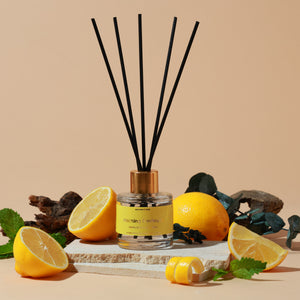
Then fragrance, which comes last and is a different job from everything above it. Once the fabric is no longer the loudest thing in the room, a background scent finally has something clean to sit on, and the honest way to buy one is to decide first whether you want a routine or no routine. If you want no routine, a reed diffuser from ₹749 in the alcohol-free line is the answer — Mountain Breeze at ₹849 is Himalayan pine, sage and cedar and suits a sitting room, Morning Freshness at ₹749 is lemon, peppermint and eucalyptus if you would rather the room read as aired than as warm. It needs 24 to 72 hours before it is doing its job, so it is the wrong purchase for a deadline and the right one for a habit, and then it holds one level for months with nothing asked of you. If you would rather have control, the Sukoon at ₹1,899 covers 270–320 sq ft, runs 16–18 hours per fill on low at 30–50 ml/h against 9–12 on high, has steady, 2H and 4H timers, a remote and auto shut-off, and arrives with three 15ml Hotel Collection scents of your choice; the Boond at ₹899 is the same idea in 300ml, and the Megh at ₹3,499 is for a genuinely open-plan flat. Four drops in a living room, three in a small one, and the dose is per tank rather than per litre since you are scenting the mist and not the water. Two constraints and one warning. The Hotel Collection is water-based and runs in the Sukoon, Boond and Megh only — not in a reed, which is a separate alcohol-free line with its own scents, and not in the waterless Vaayu at ₹11,999. And SOSA does not make a room or linen spray for the home; the sprays in the range are car perfumes. If you were hoping to be sold something to spray on the sofa, the answer is that we do not make one and I would not recommend one if we did. Finally, expect to stop smelling your own living room within a fortnight, because a nose reports change and discards constants. The instinct that produces is to add drops. The correct response is to ask one honest guest, who is still receiving exactly the level you set.
The SOSA edit
In order, and the order is the point. Everything at ₹0 comes before everything with a price on it, and the last row states plainly what SOSA does not make, because this is exactly the page where a reader would expect to be sold it.
| Step | What it is | Why it comes here in the order | Cost |
|---|---|---|---|
| 1. Covers, vacuum, sun, bicarbonate ★ | Every washable cover through the machine, the upholstery head over the deck, arms and crease, pads in two hours of sun, bicarbonate for an hour | First, and it is not optional. This is the source. Nothing bought afterwards works properly until this is done | ₹0 |
| 2. Twenty minutes of real exchange | Two openings on opposite or adjacent walls, not one window ajar, while the covers are in the machine | Second. It clears what the vacuum has disturbed and gives the sofa dry moving air to release into | ₹0 |
| 3. Extraction on for ten minutes after cooking | The habit that stops the sofa reloading, plus the kitchen door shut for the same ten minutes | Third, because otherwise you are doing step one again in six weeks | ₹0 |
| 4. A reed diffuser or the Sukoon | Alcohol-free reeds from ₹749 holding one level for months, or a 500ml ultrasonic with steady/2H/4H timers and three 15ml scents included | Fourth. A reed if you want no routine, the Sukoon if you want control of the hour. Both belong after the first three | from ₹749 / ₹1,899 |
| 5. Hotel Collection 15ml or a candle | Seven water-based scents at ₹299 for 15ml, four drops in a living room; or an 80g candle at ₹379 for fifteen to twenty minutes to scent | Fifth. Buy the 15ml before the 300ml 300ml refill at ₹1,799 — test a scent in the room before committing to a supply | ₹299 / ₹379 |
| Not in the range: a fabric or room spray | SOSA does not make a room or linen spray for the home. The sprays in the range are car perfumes, formulated for about three cubic metres of moving air | Printed rather than implied, on the one page where you would most expect to be sold one | — |
Versailles
I have been asked to recommend something for a sofa perhaps two hundred times, and I have recommended a product for it exactly never. There is nothing you can put onto upholstery that removes what is already in it, and I include every product I sell in that sentence. What is in there is deposited fat, oxidised skin oil and whatever went through the cover into the foam, and none of those respond to being given a pleasant neighbour. They respond to washing, to a vacuum with the right head on it, and to sunlight, which is free and which most people in this country have more of than anybody in Europe knows what to do with.
The part that persuades people is the ten-second test rather than any of my explanations. Nose down near the cushions, then standing. People stand up looking slightly betrayed, because they have been airing that room every morning for a year and blaming the building. Then they wash the covers, and the following week they write to say the room is different, which it is. That is the point at which a background scent becomes worth buying — not before, when it would have been a lid on something, but after, when there is a clean room for it to be part of. A reed from ₹749 on a side table, or four drops in a machine that stops itself at nine. Either is a small decision once the large one has been made.
Everything is made and supported from Pune, and a part of every order funds girl-child education through Nanhi Kali. You get a home that smells like somewhere you chose; a girl gets a classroom. That equation has always felt right to me.
Frequently asked questions
- Can fabric hold a smell for longer than the air does? — the physics under this whole group, in plain language.
- Why do my cushions smell faintly of old food? — the smaller object on the same sofa, and why the smell reads as old.
- Why do my curtains smell even though the room is clean? — the other large textile nobody washes.
- Why soft furnishings are the real reason your home smells — the pillar guide for the group.
- Brand: the SOSA founder story.
Facts verified August 2026: Diagnostic facts used in this guide: a closed room accumulates what it cannot exchange, so cross-ventilation needs two openings rather than one; a drain's U-bend water seal evaporates in roughly two to four weeks of disuse and then admits sewer gas, which is corrected by pouring water down the drain; microbial growth in fabric and on surfaces accelerates above about 60% relative humidity, and Indian monsoon indoor humidity commonly runs 80–95%, which is the one situation where ventilating on a wet day can import moisture rather than remove it; an air-conditioner's cold, wet evaporator coil and filter grow biofilm that is blown into the room on start-up; textiles adsorb cooking aerosol and body oils and re-release them for weeks; and olfactory adaptation makes a constant household smell undetectable to its residents within about a fortnight while visitors still perceive it. Timings: a scented candle scents a normal room in roughly 15–20 minutes, a Sukoon ultrasonic diffuser reaches a steady level in about 20 minutes from cold, and a reed diffuser needs roughly 24–72 hours. SOSA products and prices: Sukoon 500ml ₹1,899 (270–320 sq ft, 16–18h on low, 9–12h high, 30–50 ml/h, 2.4MHz cool mist, remote, steady/2H/4H timers, BPA-free, auto shut-off, includes three 15ml Hotel Collection scents of your choice); Boond 300ml ₹899; Megh 6-litre ₹3,499; waterless Vaayu ₹11,999 (up to 1000m³); Aangan ₹25,999. Hotel Collection water-based fragrance 15ml ₹299, 100ml ₹999, 300ml ₹1,799, Pack of 7 at 15ml ₹1,799; dose 3–6 drops per tank. Reed diffusers (separate alcohol-free line): Morning Freshness from ₹749, Garden Bloom and Evening Calm from ₹799, Fresh Brew and Mountain Breeze from ₹849; 130ml from ₹1,249; duos from ₹1,498; 300ml refills ₹2,399. Scented candles: Bookshop 80g ₹379, Amber Rose 130g ₹599 and 220g ₹799, Smoked Oudh 130g ₹449, ceramic jar candles ₹949, Pure Calm wax melt set ₹854. Free shipping above ₹499. SOSA does not make a room or linen spray for the home. The Hotel Collection scents are SOSA's own interpretations; SOSA is not affiliated with or endorsed by any hotel brand. Prices subject to change — see the live product pages.