Founder Diaries · Clinics & Medical Centres · Sprays, Reeds and the Machine
By Sonal Sahani · ISIPCA Versailles 11 min read Updated September 2026
They are not weak. They are passive, and in a large waiting hall that is a different problem with a different answer.
A reed diffuser releases fragrance by capillary action and ambient evaporation alone, at something like a millilitre a day, with no fan, no pressure and no way of reaching beyond the air immediately around it — which is why a bottle that is perfectly convincing at the reception desk is genuinely absent to somebody in the fourth row of chairs. That is physics rather than quality, and the useful version of this page explains the number, then tells you the two rooms in your clinic where the same
reed diffuser at ₹749 is exactly the right purchase.
Quick answers — read this first
Why it feels weak: a reed is a passive evaporator. A 100ml bottle lasting about three months is releasing roughly a millilitre a day — a few hundredths of a millilitre an hour — into a hall that may be moving 1,500 cubic metres of air an hour. Output does not scale with room size, so past about a metre it falls below threshold.
Two more honest limits: 24 to 72 hours to reach working level, so nobody should judge one on day one; and a glass bottle of oil at reach height in a public waiting area with children in it is a spill and an ingestion risk.
Where reeds are right: an administrative cabin of about 33 cubic metres behind a shut door, or a small consultation-suite lobby —
Morning Freshness from ₹749, alcohol-free. For a 40-seat hall, the
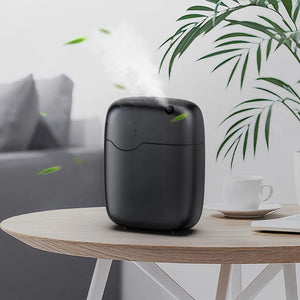
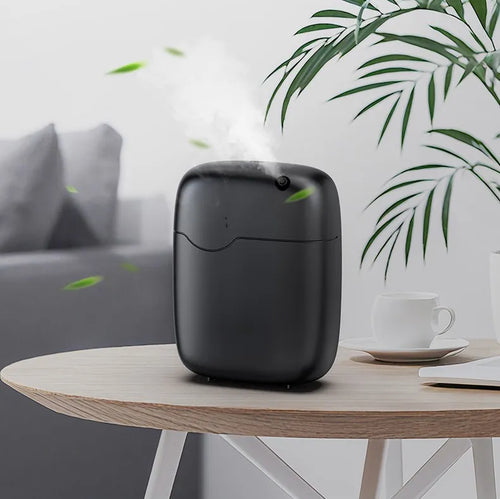
Vaayu at ₹11,999 holds a low continuous level for twelve hours.
The short answer
Short answer: a reed diffuser is passive. It releases roughly a millilitre a day by evaporation, and that figure does not change when the room gets bigger, so in a large hall with mechanical ventilation it is diluted below threshold within about a metre of the bottle. Reeds are not underpowered for their job; a 40-seat hall is simply not their job.
The pick: keep the reeds and move them. An alcohol-free
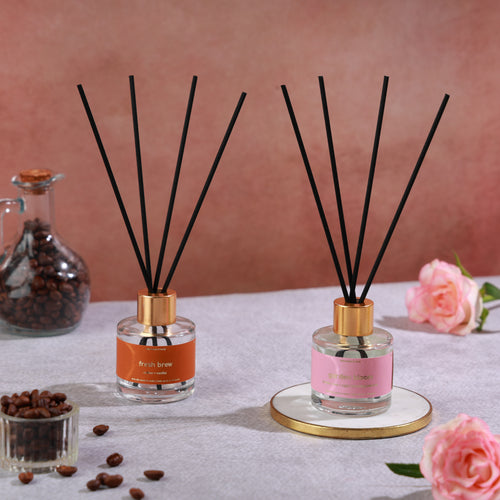
reed diffuser from ₹749 is right in an administrative cabin or a small consultation-suite lobby, behind a door, out of reach. For the entrance, reception and waiting hall as one volume, the
Vaayu at ₹11,999 — waterless, up to 1000 m³, timers, under 38 dB, key-locked — holds a low continuous level all day.
Shop: Morning Freshness from ₹749 (Malabar lemon, peppermint, eucalyptus),
Evening Calm from ₹799,
Mountain Breeze from ₹849, 130ml from ₹1,249 and 300ml
reed refills at ₹2,399, all alcohol-free. The
Vaayu is ₹11,999 up to 1000 m³ and the
Aangan ₹25,999 up to 3,000 m³. Free shipping above ₹499.
Straight answer
Why do reed diffusers feel too weak in a large clinic waiting area, and what should we use instead?
1. Because a reed is a passive evaporator and its output is fixed. Capillary action draws oil up the rattan and it evaporates from the exposed length of the reeds. A 100ml bottle that lasts three months is releasing about a millilitre a day — a few hundredths of a millilitre an hour. That number does not rise when the room gets bigger, and it cannot.
2. And a waiting hall moves an enormous amount of air past it. A 900 sq ft hall at a three-metre ceiling holds about 250 cubic metres, and at six air changes an hour something like 1,500 cubic metres an hour is passing through. A passive source loses that argument at about a metre, which is roughly where the reception desk ends and the seating begins.
3. Two further limits worth knowing before you judge them. Reeds take 24 to 72 hours to reach their working level, so a bottle opened on Monday is not a fair test until Wednesday. And a glass bottle of oil standing at reach height in a public area with children in it is a spill and an ingestion risk rather than a design choice.
4. What is genuinely good about them, and it matters here. The SOSA reeds are alcohol-free. There is no alcohol carrier flashing off, no solvent edge across the composition, nothing flammable open on a desk among papers, and the level they hold is unusually steady because evaporation is slow and unhurried.
5. So move them rather than discard them. Morning Freshness at ₹749 belongs in an administrative cabin of about 33 cubic metres behind a shut door, or in a small consultation-suite lobby with four chairs. Those are the rooms where a millilitre a day is not merely enough but correct.
6. And for the hall itself, change category rather than quantity. The
Vaayu at ₹11,999 releases a low continuous rate into up to 1000 m³, on a timer, key-locked, under 38 dB. Before you buy it, check that the hall does not smell of a source, because a reed that seems to be losing may simply be losing to something that needs fixing.
A portion of every order supports girl-child education through Nanhi Kali.
TL;DR: a reed diffuser is a passive evaporator releasing about a millilitre a day, and that figure does not grow with the room — so in a hall moving fifteen hundred cubic metres of air an hour it is below threshold past about a metre. Keep them, move them to an admin cabin or a small suite lobby where they are exactly right at ₹749, and hold the 40-seat hall with the
Vaayu at ₹11,999 instead.
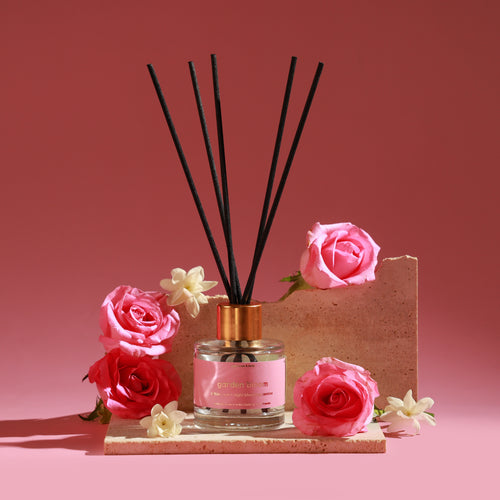
What a reed actually puts into a room in an hour
SOSA alcohol-free reed diffusers from ₹749
Alcohol-free, which in a clinic is a real point rather than a marketing one: no alcohol carrier flashing off the reed, no solvent edge sitting over the composition, and no flammable liquid open on a desk among papers.
Morning Freshness from ₹749 is Malabar lemon, peppermint and eucalyptus;
Evening Calm from ₹799 and
Mountain Breeze from ₹849; 130ml from ₹1,249 and 300ml
reed refills at ₹2,399.
Now the number nobody prints. A 100ml bottle that lasts about three months is releasing roughly a millilitre a day — a few hundredths of a millilitre an hour, by evaporation alone, with no fan and no pressure behind it. In a small closed cabin that is ample. In a hall exchanging its own volume every ten minutes it is arithmetic that was never going to work. They also need 24 to 72 hours to reach their working level, so they are no use to anybody thinking about Monday.
A millilitre a day against fifteen hundred cubic metres an hour
This is the question I am asked most often by clinics that have already spent money, usually a few thousand rupees on a handsome set of bottles for the reception counter, and it always arrives with a faint embarrassment that suggests the buyer thinks they chose badly. They did not choose badly. They chose a product with a fixed, small, unforced output and put it in the one kind of room where a fixed, small, unforced output cannot be felt — and nothing on the box told them that, because reed packaging quotes room sizes as though evaporation scaled with square footage. It does not. Once you see the two numbers side by side the whole thing stops being mysterious, and the useful part of the conversation begins, which is where in your building the same bottle becomes the best available answer.
1
THE MECHANISM
Capillary action, ambient evaporation, and nothing else at all
Take the mechanism seriously for a moment, because everything follows from it. A reed diffuser works by capillary action: the oil climbs the porous channels of a rattan stick against gravity, reaches the exposed length above the neck of the bottle, and evaporates into whatever air happens to be touching it. There is no fan, no heater, no pressure and no atomisation. The rate is governed by three things only — the exposed surface area of reed, the ambient temperature, and how fast the air immediately around the reeds is being replaced. Notice what is absent from that list: the size of the room. A reed in a cupboard and the same reed in an aircraft hangar release almost exactly the same quantity per hour, which is why a bottle rated for a bedroom is not a smaller version of a bottle rated for a hall. There is no bigger version. The number itself is easy to reason about from the bottle's own lifespan. A 100ml reed that lasts about three months is putting out roughly a millilitre a day, which is a few hundredths of a millilitre an hour, and only a fraction of that millilitre is fragrance material rather than carrier. Hold that against the hall: 900 square feet at a three-metre ceiling is about 250 cubic metres of air, and a mechanically ventilated public waiting area commonly turns that over six times an hour, so something like 1,500 cubic metres an hour is moving past your bottles. The material is not being destroyed; it is being diluted into a volume six thousand times its own, continuously, and a nose needs a concentration rather than a presence.
2
THE METRE
Why the desk smells of it and the fourth row does not
Which explains the specific complaint in the title, and it is worth being precise about the distance because it is remarkably consistent.
Around a passive source there is a small envelope of air that has not yet been mixed away — perhaps half a metre to a metre in a still room, and less than that where there is any air movement at all. Inside the envelope the concentration is real. Outside it, the same material is at a few per cent of that figure and falls under the threshold at which a nose registers anything. A receptionist sitting fifty centimetres from the bottles is inside the envelope for eight hours and will tell you, honestly, that the reeds are lovely. A patient in the fourth row is six metres away with an air-conditioning diffuser directly overhead, and is receiving nothing. Both reports are accurate. This is also why the two instinctive fixes fail.
Adding reeds — going from six sticks to twelve — raises the output by roughly half, and half of a few hundredths of a millilitre an hour is still a few hundredths of a millilitre an hour; it also empties the bottle in half the time. Flipping the reeds gives a genuine bump for about two hours, because you have brought saturated length into the air, and then it returns to exactly where it was, having shortened the bottle's life. A third one gets tried occasionally, which is moving the bottles nearer the air-conditioning throw on the theory that the air will carry it. It does the opposite: it strips the envelope away faster, so the bottle empties quickly and the hall still receives nothing.
Reeds at a reception desk that nobody notices past the first metre is a common enough situation to have its own page.
3
WHERE THEY WIN
Two rooms in your clinic where a millilitre a day is the correct number
Now the part that saves the money you have already spent, and I would rather sell you nothing here than the wrong thing.
An administrative or back-office cabin is about 120 square feet at a three-metre ceiling, which is around 33 cubic metres — a forty-fifth of the waiting hall — with a door that is shut most of the day, no extract fan pulling at it and one or two people sitting within a metre of the desk for eight hours. In that room a passive source is not a compromise. It is the better product: it needs no power point, it makes no noise at all in a room where someone is on the telephone, it holds a level that does not vary from March to June, and the occupant chose it themselves, which is a kind of consent a public waiting hall cannot give you. The second room is a small consultation-suite lobby — the four-chair space outside two or three cabins, perhaps 60 to 80 cubic metres, where people sit for eight minutes rather than forty.
And the alcohol-free formulation earns its place in both: no alcohol carrier flashing off, no solvent edge over the composition, nothing flammable standing open on a desk among papers, and a steadier release for it. Morning Freshness at ₹749 is Malabar lemon, peppermint and eucalyptus and is the one I would put in an admin room;
Mountain Breeze at ₹849 is pine, sage and cedar for somebody who prefers dry and woody. What does not change in either room is the zoning rule:
administrative areas may be scented and clinical rooms are fragrance-free with the doors shut, whatever format is in the building.
The placement rule I would give any clinic keeping its reeds: shoulder height or above, behind a desk rather than on a counter edge, never in a public waiting area where a child can reach a glass bottle of oil, and at least two metres from any air-conditioning throw.
Reeds by room, from the cabin to the forty-seat hall
The same alcohol-free bottle, placed in five different rooms of the same clinic, with the volume of each room, what the reeds actually deliver there, and what I would do instead where they do not fit. The third column is the honest one: it is not a judgement about the product, it is arithmetic about the room.
The same bottle, five rooms
Where a passive evaporator works, and where it cannot
| Room |
Rough volume |
What a reed delivers there |
What I would actually use |
Cost |
| Administrative or back-office cabin ★ |
≈33 m³, door shut |
Plenty. One person sits within a metre for eight hours and the level never moves |
Morning Freshness, alcohol-free, six reeds, turned fortnightly |
from ₹749 |
| Small consultation-suite lobby, four chairs |
≈60–80 m³ |
Enough, provided the door is not propped and nothing is blowing across it |
Reeds, 130ml from ₹1,249 for a longer run between refills |
from ₹749 |
| Reception desk in an open lobby |
Part of a much larger volume |
Convincing to the receptionist, absent to anybody seated |
The Vaayu, placed away from the desk; move the reeds to the cabin |
₹11,999 |
| 40-seat shared waiting hall |
≈250 m³, six air changes an hour |
Nothing measurable past about a metre. Adding reeds does not change this |
One Vaayu covering the whole public volume on a timer |
₹11,999 |
| Double-height atrium reception |
600 m³ and upward |
Nothing at all, and the height makes it worse |
The Aangan, HVAC-connected or standalone, up to 3,000 m³ |
₹25,999 |
| Any clinical room |
Irrelevant |
Not applicable. These rooms are fragrance-free in every format |
Nothing, with the door shut. That is the default and not a concession |
— |
Shop this guide
Reeds, relocated — and what holds the hall
The SOSA principle
A reed diffuser's output is set by the reeds, the temperature and the air moving past them — and by nothing whatsoever about the size of the room it is standing in.
Which is why there is no larger reed for a larger hall, and why the honest move is to change the room rather than to add sticks, flip them daily or buy a second bottle.
How to run reeds properly in the rooms they suit
Start with the first seventy-two hours, because more reeds are written off in that window than at any other time. An alcohol-free reed takes 24 to 72 hours to reach its working level, and the reason is the mechanism: the oil has to climb the full exposed length of every stick before the surface available for evaporation is what it is going to be. A bottle opened on Monday morning and assessed on Monday afternoon has been judged at perhaps a third of its eventual output, which is how a perfectly good product acquires a reputation for weakness in the first four hours of its life. Set it up on a Friday if you can, leave the room alone over the weekend, and form a view on the Monday. Use six reeds rather than the full eight in a small cabin; you can always add two, and you cannot take output back out of a bottle that is emptying faster than you wanted. Turn them once a fortnight rather than daily — flipping gives a bump for about two hours and then returns to the same level with less oil left. And keep them out of the air-conditioning throw, which empties a bottle quickly while delivering nothing further into the room.
Then placement and the part that is specific to a medical building rather than to an office. Shoulder height or above, behind a desk rather than on a counter edge, and never within reach in a public waiting area. A glass bottle of oil at a metre off the floor in a paediatric waiting space is a spill and an ingestion risk, and it is the single reason I will not recommend reeds for public seating even in the rooms where the arithmetic might have worked. In an administrative cabin behind a shut door that risk does not arise, which is another reason the cabin is the right home for them. On the zoning, which does not change with format: scent the entrance, reception, shared waiting areas, inter-departmental corridors, administrative rooms and the café corner; leave consultation and examination cabins, procedure and treatment rooms, dressing rooms, sample-collection rooms, laboratories, dispensing, sterile stores, imaging, oncology day-care and paediatric clinical areas fragrance-free with the doors shut. The full fragrance-free list is here, and a reed on a windowsill inside a consultation cabin breaks the rule just as thoroughly as a machine would.
Then the hall itself, and the diagnosis that should come before any purchase. If reeds at your reception feel weak, the first question is not which product is stronger. It is whether the hall has a smell of its own that they are losing to. A dry drain trap in a toilet that has come out of use, a dressing-waste bin past its collection time, biofilm in an air-conditioning drain pan, a soiled-linen trolley taking the public corridor at half past ten — any of those will make any fragrance seem to be failing, and the honest response is to trace it to its source and correct it rather than to buy something louder. That work is free and there is a full list of it. If the hall is genuinely clean and simply large, the category changes: the Vaayu at ₹11,999 is waterless cold-air nebulisation, covering up to 1000 m³ from a 400ml tank that lasts about seventy-five days, with 1h/4h/8h/24h timers, app control, under 38 dB running, auto-stop and a key-lock for a public area; the Aangan at ₹25,999 covers up to 3,000 m³ for an atrium or a whole-floor HVAC tie-in. The ultrasonic Sukoon at ₹1,899 and Boond at ₹899 hold standing water and add 30–50 ml an hour to the air, which keeps them honest for one administrative cabin with a named owner. Candles are not appropriate in a healthcare facility, because an open flame is a fire-safety matter. And SOSA does not make a room spray, so there is no aerosol shortcut at the end of this either.
Reed packaging quotes a room size, which implies that evaporation knows how big the room is. It does not, and that single misunderstanding is most of what goes wrong.
— Sonal Sahani, SOSA
The SOSA edit
For a clinic that already owns reeds and feels they are not working. The first row costs nothing and is simply a decision about which room they stand in; the rest is in the order I would spend. The last row is the format we do not make in any size at all.
The SOSA edit
Reeds in a clinic, in the order I would decide
| Buy |
What it is |
When it earns its place |
Cost |
| 1. Move the reeds you already own ★ |
From the reception counter to an administrative cabin or a small suite lobby, shoulder height, behind a desk |
First, and free. The bottle was never wrong; the room was |
₹0 |
| 2. Morning Freshness for the admin cabin |
Alcohol-free, Malabar lemon, peppermint and eucalyptus, six reeds, turned once a fortnight, 24–72 hours to settle |
In any room of about 33 m³ behind a shut door with one named occupant |
from ₹749 |
| 3. Evening Calm or Mountain Breeze
|
Alcohol-free, Himalayan lavender and chamomile at ₹799, or pine, sage and cedar at ₹849 for a drier room |
Where the occupant has a preference. In an admin cabin, that preference is allowed to count |
₹799 / ₹849 |
| 4. 130ml bottles or the 300ml reed refill
|
130ml from ₹1,249 for a longer run between changes, and 300ml reed refills at ₹2,399 |
Once a cabin has settled on a scent and you are buying supply rather than testing |
₹1,249 / ₹2,399 |
| 5. Vaayu for the waiting hall |
Waterless, up to 1000 m³, 400ml lasting about 75 days, app and 1h/4h/8h/24h timers, under 38 dB, key-lock |
For the entrance, reception, hall and corridors as one volume. A different category, not a bigger reed |
₹11,999 |
| Not in the range: a room spray |
SOSA makes no room spray. The sprays in the range are car perfumes, for about three cubic metres of moving air |
Printed here because a weak reed sends people looking for an aerosol, and there is not one |
— |
Honest notes for buyers: fragrance in a medical facility is housekeeping and presentation, never treatment. Nothing on this page claims that a fragrance reduces anxiety, aids recovery, improves sleep, cleans or disinfects air, or has any clinical effect whatsoever, because it does not and a diffuser is not an air purifier. Scenting belongs to the entrance, reception, shared waiting areas, inter-departmental corridors and administrative rooms. Consultation and examination rooms, treatment and procedure rooms, day-care surgery, dressing rooms, blood- and sample-collection rooms, laboratories, pharmacy dispensing, sterile stores, imaging rooms, oncology day-care and paediatric clinical areas should be left fragrance-free. A persistent smell is information about a dry drain trap, a bin, a soiled-linen route or an air-conditioning drain pan: find it and fix it rather than covering it. On the machines: the
Vaayu at ₹11,999 is waterless cold-air nebulisation with no standing water tank, covering up to 1000m³ or roughly 2,000–3,000 sq ft, with a 400ml tank lasting about 75 days, Bluetooth app control, 1h/4h/8h/24h timers, under-38dB running, auto-stop and a key-lock for public areas. The
Aangan at ₹25,999 covers up to 3,000m³ and connects to HVAC for a whole floor or an atrium. The ultrasonic
Sukoon,
Boond and
Megh are water-based, hold standing water and add 30–50 ml of water an hour to the air, which makes them suitable for a single administrative cabin with a named person emptying and drying the tank daily, and unsuitable for public clinical property. An alcohol-free
reed diffuser needs 24–72 hours to establish and suits a small lobby rather than a large waiting hall. Candles are not appropriate in a healthcare facility because an open flame is a fire-safety matter. SOSA does not make a room spray. The Hotel Collection scents are SOSA's own interpretations inspired by the world's finest hotels; SOSA is an independent Indian fragrance house, not affiliated with or endorsed by any hotel brand. A portion of every order supports girl-child education through Nanhi Kali.
The room where the same bottle is exactly right
SOSA reeds · an administrative cabin from ₹749
A back-office cabin is about 120 sq ft at a three-metre ceiling, which is roughly 33 cubic metres — call it a forty-fifth of a 40-seat waiting hall, with a door that is shut most of the day and no extract fan pulling at it.
One person sits within a metre of the desk for eight hours, which is precisely the distance a reed works at, and they chose it themselves, which is precisely the consent a public waiting hall cannot give you. Six reeds rather than eight if the room is small, turned once a fortnight rather than daily, kept off the air-conditioning throw, and left alone for three days before anybody passes judgement.
Morning Freshness at ₹749 is the one I would put in an admin room;
Mountain Breeze at ₹849 if the occupant prefers something dry and woody.
A note from Sonal
A reception manager in Pune sent me a photograph of six reed diffusers arranged along a counter, which had cost her a little over four thousand rupees, with a message that said simply: nobody can smell these. She was right, and so were the two colleagues sitting behind the counter who insisted the reeds were lovely. The bottles were doing exactly what reeds do, and the disagreement was entirely about where everybody was standing. I asked her to move one set into the accounts cabin and leave the rest where they were for a fortnight, which is a slower answer than she wanted and the only one that would have convinced her.
The accounts cabin has had them ever since, and the hall has a machine. What I have never wanted to do is write reeds off, because in the right room they are the better product and not the consolation prize. They are silent, which matters when someone is on the telephone all day. They need no power point. Being alcohol-free, they hold a level that does not drift from one season to the next, and there is nothing flammable standing open beside a stack of files. A passive product in a small, closed, single-occupancy room is elegant. The same product in a hall with forty chairs and a fresh-air handling unit is arithmetic that was never going to come out, and I would rather explain the sum than sell a second bottle.
Everything is made and supported from Pune, and a part of every order funds girl-child education through Nanhi Kali. You get a space that smells like somewhere looked after; a girl gets a classroom. That equation has always felt right to me.
Frequently asked questions
Why do reed diffusers feel too weak in a large clinic waiting area?
Because they are passive. Capillary action and ambient evaporation release roughly a millilitre a day — a few hundredths of a millilitre an hour — and that output does not increase with room size. A 40-seat hall of about 250 cubic metres may move 1,500 cubic metres of air an hour past the bottle, so the material is diluted below threshold within about a metre.
Will adding more reeds or flipping them daily make a difference in a waiting hall?
Not a useful one. Going from six sticks to twelve raises output by roughly half and empties the bottle in half the time, and half of a very small number is still a very small number. Flipping gives a bump for about two hours and then returns to the same level with less oil left. The room is the variable, not the bottle.
Where in a clinic are reed diffusers actually the right choice?
An administrative or back-office cabin of about 33 cubic metres behind a shut door, and a small consultation-suite lobby of 60 to 80 cubic metres. In both, one or two people sit within a metre of the bottle, there is no extract fan pulling at it and the level holds for months.
Morning Freshness is ₹749, alcohol-free.
Does it matter that SOSA reeds are alcohol-free in a clinic?
Yes, and more than it would in a home. There is no alcohol carrier flashing off the reeds, no solvent edge sitting over the composition, and nothing flammable standing open on a desk among papers, which is a reasonable thing for a facilities lead to care about. It also releases more slowly and holds a steadier level.
Should we put reeds in the consultation rooms since they are quiet and need no power?
No. Consultation and examination cabins, procedure and treatment rooms, dressing rooms, sample-collection rooms, laboratories, dispensing, sterile stores, imaging, oncology day-care and paediatric clinical areas are fragrance-free with the doors shut, in every format. A clinician needs to be able to notice what a room and a patient smell of.
The full list is here.
Passive, not weak
Keep the reeds — and put them in the room they were made for
Alcohol-free reed diffusers from ₹749: Morning Freshness in Malabar lemon, peppermint and eucalyptus, Evening Calm from ₹799, Mountain Breeze from ₹849, 130ml from ₹1,249 and 300ml reed refills at ₹2,399, all needing 24 to 72 hours to reach their working level. The Vaayu is ₹11,999 for up to 1000 m³ — waterless, app and timer controlled, under 38 dB, key-locked — and the Aangan ₹25,999 for up to 3,000 m³. Free shipping above ₹499, and a portion of every order supports girl-child education through Nanhi Kali.
See the reed diffusers · from ₹749 The Vaayu · ₹11,999
Continue the read
More from SOSA
Editorial standards & sources
About this guide: Written by Sonal Sahani, ISIPCA Versailles-trained founder and perfumer at SOSA Home & Body, on why a reed diffuser's output is fixed by capillary action and ambient evaporation rather than by the size of the room, what a millilitre a day means against a hall moving fifteen hundred cubic metres an hour, why alcohol-free genuinely matters in a clinic, and which two rooms in a medical facility reeds are the correct purchase for.
Facts verified August 2026: Product facts used in this guide. SOSA Vaayu ₹11,999: waterless cold-air nebulising diffuser, atomises undiluted fragrance oil to a dry residue-free nano-mist with no water reservoir, coverage up to 1000m³ (approximately 2,000–3,000 sq ft), 400ml refillable tank lasting up to about 75 days per fill, Bluetooth app plus onboard control, 1h/4h/8h/24h timer scheduling, adjustable intensity, under 38 dB, DC 12V/1A at 5W, 165 × 80.5 × 215 mm and 0.9 kg, freestanding or wall or HVAC mounted, auto-stop and key-lock, CE, RoHS and SGS certified, supplied with four hotel-inspired fragrances. SOSA Aangan ₹25,999: HVAC-connected or standalone commercial nebulising diffuser, coverage up to 3,000m³ (roughly 8,000–10,000 sq ft), 800ml reservoir, metal body, programmable schedules, under 42 dB. Ultrasonic machines are water-based, hold standing water and consume 30–50 ml of water an hour: Sukoon ₹1,899 (500ml, 270–320 sq ft, 16–18 hours on low, 3–6 drops per tank, steady/2H/4H timers, three 15ml Hotel Collection scents included), Boond ₹899 (300ml), Megh ₹3,499 (6 litres). Hotel Collection water-based fragrance 15ml ₹299, 100ml ₹999, 300ml ₹1,799, Pack of 7 at 15ml ₹1,799 against ₹2,093 bought singly; the Vaayu and Aangan take their own undiluted oil rather than these water-based bottles. Alcohol-free reed diffusers from ₹749, requiring 24–72 hours to reach their working level. Free shipping above ₹499. Coverage arithmetic: cubic metres equal floor area in square feet divided by 10.76 and multiplied by ceiling height in metres, counting only the volumes that are actually scented. This guide makes no medical, therapeutic or clinical claim of any kind for fragrance: a diffuser does not purify, disinfect or clean air, and does not treat, calm or affect any patient or condition. Fragrance is housekeeping and presentation. Clinical areas should be left fragrance-free, and a persistent odour should be traced to its source and corrected rather than covered. SOSA is not affiliated with or endorsed by any hotel brand. Prices subject to change — see the live product pages.