



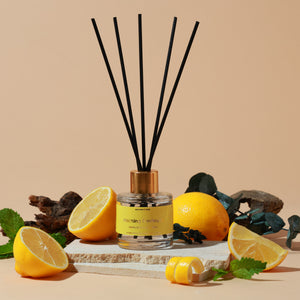
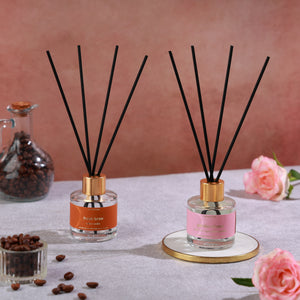
The four things they do not determine. Dose — how much material is in the air per cubic metre. Delivery — which of the three mechanisms is putting it there. Evenness — whether the far corner matches the near one. Duration — how many hours a day it runs, at what intensity, decided by a schedule rather than by the weather.
The mechanism you probably own: passive capillary diffusion. Oil climbs six fibre reeds and evaporates with no air being moved, so you get a fragrant zone rather than a fragranced room. That is the design and not a defect, and it is why identical notes in a reed and in a hotel’s nebuliser produce two unrelated experiences.
One kind correction, in case it applies: the Hotel Collection is water-based and ultrasonic-only, and reed oil cannot go into an ultrasonic machine. There is no hotel-inspired reed diffuser. If you have been looking for the notes and the format together, they were never sold together.
The honest gap: the delivery hotels use is waterless cold-air nebulising. SOSA has it at personal scale in Safar ₹3,999 — named and sold as a car and travel diffuser, with no published room coverage — and at building scale in Vaayu ₹11,999, rated to 2,000–3,000 sq ft and wrong for one bedroom. There is no mid-sized waterless bedroom nebuliser between them.
2. Because delivery is a separate product from composition. The hotel is running waterless cold-air nebulising — pressurised air shattering undiluted oil into a dry micro-mist that travels with the building’s own airflow. You are running passive capillary diffusion, where oil climbs six fibre reeds and evaporates at whatever rate the weather permits. Same notes, two mechanisms, and the mechanism is doing most of the work you noticed.
3. Because evenness is a property of moved air and nothing else. What made the lobby feel considered was not intensity; it was that the smell was the same near the desk and near the lift, with no gradient to walk up and no object to attribute it to. A passive diffuser produces a gradient by definition, because concentration is highest at the source and falls with distance.
4. Because the hotel decided the hours and you did not. A commercial system runs in windows at an intensity somebody chose, so it is at full effect during check-in and not wasted at four in the morning. Your bottle runs continuously at whatever rate the room allows and cannot be switched off, which is the reed’s one genuine design limitation.
5. And because you arrived at the hotel un-adapted and you live in your home adapted. Receptors stop reporting a constant stimulus within minutes. Some of the difference you are chasing is a state you were in rather than a thing the building did, and no purchase closes that part of the gap — leaving the room for fifteen minutes does.
Alcohol-free, phthalate-free, paraben-free, IFRA-compliant, 0 ppm formaldehyde. Free shipping above ₹499, and a portion of every order supports girl-child education through Nanhi Kali.

Dose, delivery and evenness — one at a time
Take them separately, because each has a different fix and conflating them is what leads to buying the wrong thing. The first is free to change. The second costs money. The third cannot be bought below a certain level of hardware at all, and knowing that in advance saves a good deal of disappointment.
 Morning Freshness₹749Dose is the variable that decides whether a composition reads as expensive or cheap, and it is almost entirely under your control for free. Too high and any fragrance flattens into one sweet or sharp impression — the thing people are describing when they say “it smells like an air freshener”. The nose stops resolving the separate materials and reports a single crude signal instead. Too low and the composition never reaches the far side of the room and you are back where you started. On a reed, dose is the reed count: six for full projection, three for a soft bedside level and roughly double the life. In a small, well-sealed bedroom six is very often too many. And a 50ml is specified for up to about 150 sq ft, a 130ml above it — under-specify and it will read weak while performing exactly as designed.
 Sukoon₹1,899Three mechanisms, three completely different physics. Passive capillary — the reed — adds no energy and moves no air, so material leaves six fibre surfaces at the rate the room permits. Ultrasonic water mist — Boond ₹899, Sukoon ₹1,899, Megh ₹3,499 — vibrates a water-and-oil mixture into a visible wet mist, which genuinely moves air and covers a room, at the cost of the oil being diluted, humidity being added and white mineral dust in hard-water cities. Waterless cold-air nebulising — Safar ₹3,999, Vaayu ₹11,999 — shatters undiluted oil into a dry mist with no water at all. Undiluted is most of the perceived intensity difference: same oil, far more of it per droplet, and nothing competing with it.
 Mountain Breeze₹849This is the variable nobody thinks to name and the one that actually produced the impression you are trying to copy. In a hotel the smell is the same at the desk and at the lift; there is no hot spot, no gradient, and no object you can walk towards to make it stronger. Evenness is a property of air being moved, not of fragrance being added, which is why doubling the oil in a still room produces a stronger corner rather than an even space. The domestic version is cheaper than it sounds: a closed bedroom with an air conditioner running recirculates its own air and distributes what is there far more evenly than the same room with the door open. That is the reason a sealed AC bedroom is the easiest space in an Indian flat to scent well, and worth knowing before spending anything.
Duration — the fourth variable, and the one nobody prices
The fourth variable is time, and it is where a hotel quietly wins without spending more on fragrance than you do. A commercial system runs in windows at a chosen intensity, so the lobby is at full effect during the hours guests arrive and is not spending oil on an empty room at four in the morning. That is not strength. It is scheduling, and it produces the impression of strength because you only ever encounter the space during the hours it was designed for. Nobody is in a lobby at its quietest moment, which is a considerable advantage over your bedroom.
At home the equivalent choice is genuinely a choice. Safar gives you three speeds and a one, two or three-hour auto-off — which is precise control, and equally means it is not a set-and-forget always-on device and needs recharging on its 2000 mAh battery. Vaayu gives you app scheduling in one, four, eight or twenty-four-hour windows with a choice of days, and runs under 38 dB. Sukoon runs 16 to 18 hours on low from a 500ml tank, which is on-demand rather than scheduled but is still a switch you control. A reed diffuser cannot be switched off at all. It runs at whatever rate the room dictates, all day, whether anybody is home or not. I would rather state that plainly than dress it up: the only real waste in a reed is oil evaporating into a room nobody is in, and that is an occupancy question rather than a product fault.
There is a fifth thing which is not a variable so much as a discipline, and it is free: consistency. Hotels hold a single signature for years, which is why regulars recognise a building before they see the desk. At home, keeping one scent long enough for it to become the smell of your house — rather than this month’s smell — and confining it to one or two rooms rather than spreading it everywhere reproduces more of the hotel impression than any upgrade at this price. A flat that smells identical in every room stops registering as a smell within a week, which is the opposite of what the reader wanted and costs money to achieve.
| Variable | How a hotel handles it | How a reed on a console table handles it | What closes the gap |
|---|---|---|---|
| Dose | Set deliberately per volume and held there by the machine | Whatever six fibre reeds evaporate at today’s temperature and humidity | Free — reed count and the right bottle size. 50ml to ~150 sq ft, 130ml above |
| Delivery | Waterless cold-air nebulising of undiluted oil, often into the building’s airflow | Passive capillary evaporation, no air moved, concentration falling with distance | Sukoon ₹1,899 (diluted, water) or Safar ₹3,999 (undiluted, waterless) |
| Evenness | Uniform across the volume — no gradient, no findable source | A fragrant zone around the bottle, falling away toward the walls | Partly free: closed door and a running AC recirculating the room’s own air. Fully, only a machine |
| Duration | Scheduled windows at chosen intensity, timed to when people arrive | Continuous and unswitchable, including the hours nobody is home | Safar’s 3 speeds and 1/2/3-hour auto-off, or Vaayu’s 1/4/8/24-hour app windows |
| Consistency | One signature held for years, so regulars recognise it | Entirely available to you, and almost nobody does it | Free. Pick one scent, keep it, and use it in one or two places rather than everywhere |
| Not a fix for any row: Megh at ₹3,499 — six litres, around 100 hours of runtime, about 215 sq ft, which is less than the ₹1,899 Sukoon. A bigger tank buys duration, never coverage. | |||
 The notes · Hotel Collection₹999Shop →
  Delivery · Sukoon₹1,899Shop → Dose by reed count · Garden Bloom₹799Shop →
What the notes genuinely do decide, because it is not nothing
Having spent a page saying that composition is not the variable you are missing, I want to be equally clear about what it is. The notes decide whether you like it, and that is not a small thing to decide. No machine has ever made somebody enjoy a smell they dislike; it makes them dislike it in more of the house. The materials also decide whether the fragrance survives an Indian year, and that is entirely a formulation question. Citrus top notes are small light molecules that leave first, which is why the average lemon reed fades in ten to fourteen days — in Morning Freshness a eucalyptus globulus base slows that evaporation three to four times, turning a two-week citrus into a six-to-eight-week one. That is structural, invisible in a note list, and has nothing to do with strength.
The carrier is the same kind of hidden decision. Most reed diffusers sit on DPG, which is cheap and can crack and turn bitter above about 40°C — an ordinary afternoon in much of India, and the actual mechanism behind a diffuser going sour in a Delhi May. Every SOSA reed sits on a heat-stable CCT base, tested through a 45°C heat soak and 85% monsoon humidity. You cannot smell the carrier. It is the entire reason you can still smell everything else in August. So the composition column is where quality lives; it is simply not where distance lives, and a reader who buys more quality hoping for more distance is buying a genuinely better thing that does not answer their question.
One last piece of honesty about notes, since we are on the subject. A hotel’s note list is chosen partly to be inoffensive to thousands of strangers, which is why so many of them converge on white tea, bergamot and clean woods. That is an excellent brief for a lobby and a slightly odd one for a bedroom you live in. If you copy it exactly you may find you have bought something admirable and impersonal. The scent that will make your home feel like a good hotel is very often not the hotel’s scent — it is one you would choose again in a year, delivered the way a hotel delivers it.
What to buy, in order — and the rung that does not exist
Ordered by which of the four variables you are actually short of, because that is what decides the sensible spend. The last row is the honest gap in the range, and it is the one I would want to know about before opening my wallet rather than after.
| Buy | Which variable it fixes | When it is the right answer | Price |
|---|---|---|---|
| 1. Six reeds, right bottle size, closed door, one scent kept for a year ★ | Dose, part of evenness, and all of consistency | First, always. Three of the five variables move for nothing, and a great many rooms are fixed here | ₹0 |
| 2. The right reed, kept properly | Composition quality and dose — six fibre reeds, refillable glass, CCT carrier, about ₹13–₹15 a day | When a fragrant zone is genuinely enough. Silent, unplugged, nothing to fill and nothing to remember, which no machine here can match | ₹749–₹1,349 |
| 3. Sukoon | Delivery and evenness — ultrasonic water mist, 500ml, genuine 270–320 sq ft, 16–18 hours on low, three 15ml Hotel Collection scents included | The value answer for a bedroom, accepting oil diluted in water, added humidity, refilling and possible white dust in a hard-water city | ₹1,899 |
| 4. Safar | Delivery and duration — waterless cold-air nebulising of undiluted oil, 20ml, 2000 mAh Type-C, up to 10 hours continuous or around 30 intermittent, 3 speeds, 1/2/3-hour auto-off. Named and sold as a car and travel diffuser, with bedside and hotel room among its stated uses | When water is unacceptable and control matters. No published room-coverage figure, and not an always-on device | ₹3,999 |
| Never for coverage: Megh | Duration only — 6L tank, around 100 hours of runtime, about 215 sq ft | Less coverage than the ₹1,899 Sukoon. A bigger tank is more hours, never more room | ₹3,499 |
| The honest gap | No mid-sized waterless bedroom nebuliser exists at SOSA — nothing between Safar and the 2,000–3,000 sq ft Vaayu at ₹11,999, which in one bedroom is nine-tenths wasted | Said plainly, because it is why matching a hotel’s delivery in one room is a compromise rather than a purchase | — |
Versailles
Note lists are the most-read and least-informative thing printed on a fragrance. They tell you almost nothing about proportion, and proportion is the whole craft. Two perfumers handed identical materials will produce two compositions that share a note list and share nothing else, because one will have used the jasmine at a level where the indole stays floral and the other will not. If proportion within the bottle can change everything, proportion within the room certainly can. That is really all this page is saying.
What I would gently push back on is the instinct to copy a hotel’s exact notes. A lobby accord is built to be liked by thousands of strangers passing through, which is a genuine discipline and a slightly impersonal brief. Your home has one or two people in it whose actual preferences are known. There is no prize for matching the formula, and there is a real cost to living for two months with something you admired rather than something you wanted.
And I would try the free variables first, every time, because three of the five move for nothing. Six reeds instead of four. The right bottle for the room rather than the one that was in the basket. The door closed for the hours you are in there. One scent kept long enough to become yours. If after all of that the room still will not hold it, then the missing variable is delivery, it costs between ₹1,899 and ₹3,999, and I would rather you arrived at that conclusion having eliminated the free ones than having skipped them. Composed in Pune, and part of every order funds a girl’s classroom through Nanhi Kali.
Frequently asked questions
- I bought a hotel-inspired reed diffuser and my room is not a hotel — the premise, corrected kindly.
- Right up close, wrong across the room — why that sentence is a positive result.
- The right fragrance, no experience — composition quality against delivered concentration.
- Why it is not as powerful as the hotel — you are competing with a building.
- Weak oil or weak projection? — the four-minute, three-distance test.
- Lovely in the bottle, absent across the room — headspace against room concentration.
- Hotel-inspired scent vs hotel-style scenting — the definition worth learning.
- Oil or diffusion technology? — which decides presence and which decides preference.
- Before blaming the oil — the family pillar.
- Brand: the SOSA founder story.
Facts verified August 2026: Three diffusion mechanisms are described — passive capillary (reed diffusers), ultrasonic water mist (Boond ₹899, 300ml, up to ~150 sq ft, ~6 hours; Sukoon ₹1,899, 500ml, 270–320 sq ft, 16–18 hours on low, three 15ml Hotel Collection scents included; Megh ₹3,499, 6L tank, ~100 hours runtime, ~215 sq ft, which is less coverage than Sukoon) and waterless cold-air nebulising (Safar ₹3,999, 20ml bottle, 2000 mAh Type-C battery, up to 10 hours continuous or around 30 hours intermittent, 3 speeds, 1/2/3-hour auto-off timer, 6.9 cm, named and sold as a car and travel diffuser with car, handbag, desk, bedside and hotel room among its stated uses, no published room-coverage figure; Vaayu ₹11,999, coverage up to 1000 m³ or roughly 2,000–3,000 sq ft, 400ml refillable tank lasting up to about 90+ days, Bluetooth app and onboard buttons, 1h/4h/8h/24h run windows, adjustable intensity, key-lock, under 38 dB, freestanding or wall/HVAC mount, 5W, CE, RoHS, SGS). SOSA reed diffusers: five scents, 50ml ₹749–₹849 lasting 6–8 weeks and suiting rooms up to ~150 sq ft, 130ml ₹1,249–₹1,349 lasting 14–18 weeks and suiting above 150 sq ft, six fibre reeds included and flipped every 3–5 days, about ₹13–₹15 a day, heat-stable CCT carrier rather than DPG, alcohol-free, phthalate-free, paraben-free, IFRA-compliant, 0 ppm formaldehyde, refillable glass bottle, climate-tested at 45°C and 85% RH, composed in Pune. Morning Freshness uses a eucalyptus globulus base that slows lemon evaporation three to four times; Garden Bloom holds indole below the threshold at which jasmine reads animalic. SOSA strength scale: Evening Calm 8.9, Garden Bloom 8.9, Morning Freshness 9.0, Mountain Breeze 9.4, Fresh Brew 9.5. Hotel Collection fragrance oils are water-based and ultrasonic-only at 15ml ₹299 (a refill), 100ml ₹999 and 300ml ₹1,799; they cannot be used in reed diffusers and reed oil cannot be used in ultrasonic machines, so no hotel-inspired reed diffuser exists. No health, air-quality, allergy or antimicrobial claims are made, and fragrance does not remove a smell — source, then ventilation, then fragrance. Free shipping above ₹499. A portion of every order supports girl-child education through Nanhi Kali. SOSA is an independent Indian fragrance house; the Hotel Collection scents referenced here are SOSA’s own interpretations inspired by the world’s finest hotels, and SOSA is not affiliated with, endorsed by or a supplier to any hotel brand. Prices subject to change — see the live product pages.