



Where the fragrance goes: the light, bright materials evaporate on their own schedule through the neck and the reeds you do have. You lose them to time instead of to your room.
What is left: a base-heavy, flat version of the composition. The bottle is still full and no longer smells like what you bought.
The honest exception: three to four reeds as a deliberate configuration for a nursery or a small sealed room is different, and it works. One or two is not a configuration.
2. The oil ages regardless. The bottle is open. Volatile materials leave on their own schedule through the neck and through whatever fibre is present, whether or not you are getting the benefit. Rationing reeds does not pause the composition; it only stops you receiving it.
3. You lose the top of the fragrance first. The lemon, the peppermint, the eucalyptus lift, the bright edge of the jasmine — these are the materials that go early. Six months into a two-reed bottle you have a base accord, which is why people describe an old rationed diffuser as smelling flat, heavy or vaguely of nothing.
4. Wicking itself degrades at very low counts. Fewer reeds means each one carries more of the load and accumulates heavy residue faster, so the wet line stops climbing and a flip helps less than it should.
5. Three to four reeds is a real configuration; one to two is not. A nursery, a small sealed bedroom or a fragrance-sensitive household is properly served at three or four. That is a deliberate setting with a known trade. Two reeds in a hall is simply a bottle standing there.
6. If the motive is cost, buy the refill instead. The oil-only refill is about ₹7–8 per millilitre against ₹15–17 for a 50ml bottle — up to around 55% less. That lowers the cost of running six reeds properly rather than making a bottle last by not using it.
Composed and handmade in small batches in Pune, and a portion of every order supports girl-child education through Nanhi Kali.
Part one — the three ways too few reeds wastes what you bought
Waste in this format is not dramatic. Nothing spills and nothing spoils in a way you can see; the bottle simply sits there looking economical. What is being lost is the part of the composition that cannot wait, and it is lost in three separate ways, none of which is fixed by leaving the bottle standing for longer.
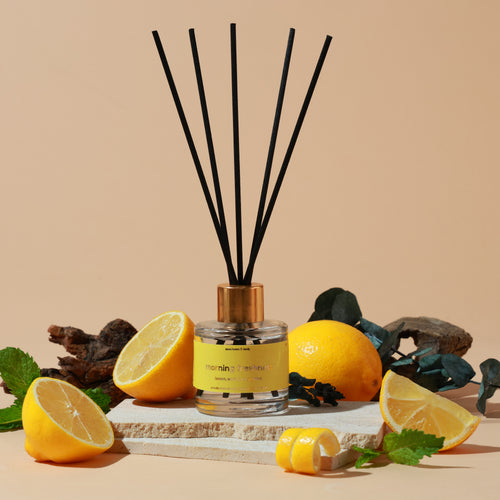
 Garden Bloom₹799 · 8.9/10An open vessel loses its volatile fraction on the fraction's own timetable, not yours. Even with two reeds in the neck, the light materials in the oil are the ones with the strongest tendency to leave, and they will exit through the neck, through those two reeds, and into the air of the room in quantities too small to notice. Six months later the glass is two-thirds full of something meaningfully different from what went in. You did not save the fragrance; you deferred it into nothing. Our heat-stable coconut-derived CCT carrier is chosen precisely to slow this down — it holds composition through 45°C summers where cheaper solvent bases degrade and turn acrid — but no carrier freezes a fragrance in place. Heat accelerates the whole process, which is why a rationed bottle on a sunny west-facing shelf ages fastest of all.
Part two — what each low count actually delivers
Read across rather than down. The point of this table is not that low counts are forbidden — it is that the room and the bottle are doing two different things at each setting, and the second column rarely gets discussed.
| Reeds in a 50ml | What the room receives | What the bottle is doing meanwhile | What you lose first | Verdict |
|---|---|---|---|---|
| Six ★ | The composition as written, holding to the end of the bottle | Emptying at the designed rate — 6–8 weeks | Nothing out of sequence | The dose everything is balanced and rated at |
| Five | Marginally quieter; most people cannot tell it apart from six | Slightly slower, a week or two longer | A little brightness, late in the bottle | Fine — an unremarkable adjustment |
| Four | Distinctly gentler but still present in a closed room | Runs past the stated window comfortably | Top notes fade earlier than they should | A legitimate configuration for small, quiet rooms |
| Three | Perceptible only in a small sealed space, and only near the bottle | Ageing faster than it is delivering | Most of the light fraction, within weeks | The floor — acceptable for a nursery, not a hall |
| One to two | Effectively nothing anywhere in the room | Still losing volatiles through the neck the whole time | The character of the fragrance entirely | Not thrift — this is where the waste happens |
| The honest caveat: the floor moves with the room. Three reeds in a small closed bedroom can be perfectly adequate while three in an open living-dining is nothing at all, and a draught from an AC or a fan raises the floor sharply because it strips the reeds and clears the air at once. These are working figures from in-house testing and customer correspondence, not laboratory measurements, and the same counts in a 130ml behave the same way — the larger bottle lasts longer, it does not project further. | ||||
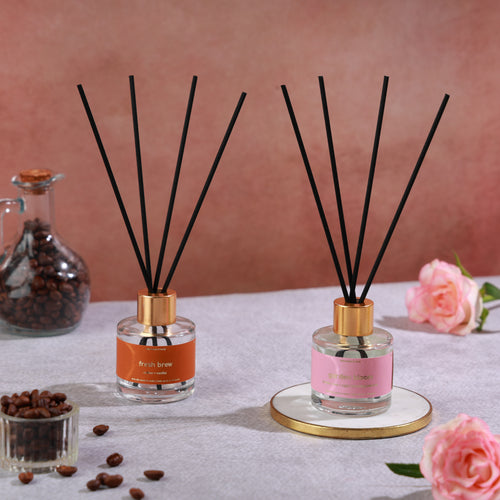 Oil refill · 300ml₹2,399Shop → Morning Freshness · 9.0/10from ₹749Shop →
 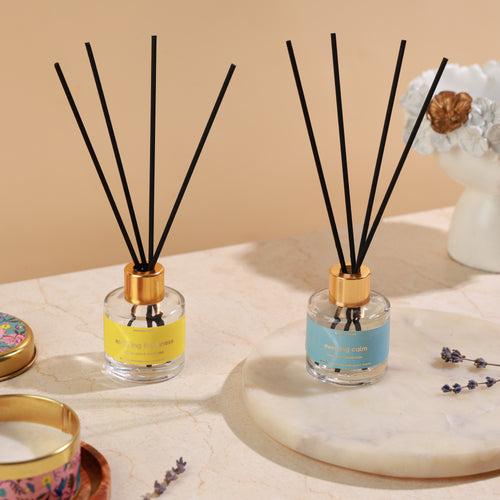 Day & Night duo · 2 × 50ml₹1,498Shop →
Part three — the clock in the bottle, and what it costs in rupees
Put numbers on it, because the intuition is so strong that it needs them. A 50ml bottle at ₹749 to ₹849 is roughly ₹15–17 per millilitre. Run at six reeds it gives you six to eight weeks of the fragrance as composed — call it the whole product, delivered. Run at two reeds it might sit on the shelf for five or six months, and on paper that looks like better value per week. But you are not buying weeks, you are buying a scented room, and for most of those months there is no scented room. What you have purchased is storage. Worse, the last third of that bottle is no longer the fragrance you chose, because the volatile materials left months earlier without doing any work on the way out. The correct way to reduce cost per week has never been to under-use the bottle; it is the oil refill at ₹2,399 for 300ml or ₹3,499 for 500ml, which is about ₹7–8 per millilitre — up to around 55% less than a fresh 50ml — and lets you run six reeds properly for eight to eleven months or fourteen to eighteen.
The refill is oil only, and I want to be exact about that because it matters here more than anywhere else in the range. You reuse your own glass vessel and your own reeds; no reeds come with a refill, and we do not sell them as a separate item. That is an honest gap and I would rather name it than have you discover it at checkout. It matters in this context because the people most likely to have exhausted their reeds are precisely the people who have been running a low count for months — those two or three sticks have absorbed a disproportionate load of heavy residue and will not do good work on fresh oil. Pouring a ₹2,399 refill through spent reeds is the commonest way to be disappointed by it. Refresh reeds every few months, and when you refill, remove the reeds, pour to the neck, return them and flip once so both ends are coated.
There is one legitimate reason to run below six, and it is worth separating cleanly from everything above. If a room is small and sealed, or somebody in the house genuinely dislikes fragrance, or it is a nursery, then three to four reeds is a proper configuration and it will comfortably outlast the stated weeks — that is a deliberate choice about presence, made in advance, and it is covered in its own right in the post on running fewer reeds for longer and the one on scenting sensitive homes. What I am arguing against is rationing: cutting the count to make a bottle last, in a room that needs six, and then wondering why the fragrance seems to have disappeared. If the room is quiet at six, the free ladder is flip, move, close the room for an hour — never fewer reeds.
Part four — the false economy, priced properly
If the motive behind a low reed count is money, here is what each version of thrift actually buys. The right-hand column is the honest alternative in every case.
| What you were trying to do | The low-reed version | What it really costs | The better move |
|---|---|---|---|
| Make a 50ml last longer ★ | Two or three reeds for four to six months | Months with no scented room, and a bottle that has lost its top notes | Six reeds plus a 300ml refill at ₹2,399 |
| Lower the cost per week | Stretching one bottle across a season | ₹15–17 per ml of oil that mostly evaporated unheard | ₹7–8 per ml on refill oil, run properly |
| Keep a bedroom subtle | One or two reeds, hoping for a whisper | Nothing perceptible; the bottle ages anyway | Four reeds of a soft composition — Evening Calm ₹799 |
| Cover two rooms with one bottle | Splitting reeds between two vessels | Two rooms that both fall under the floor | A duo set from ₹1,498 for 2 × 50ml |
| Save the reeds for later | Holding spare reeds back unused | Reeds are the consumable — they do not improve with keeping | Use all six; refresh them every few months |
| Get more life out of an old bottle | Reducing the count as it empties | The last third delivers almost nothing at a low count | Keep six in, and refill when the oil is low |
Versailles
Rationing is such an understandable instinct that I have never once thought less of anyone for it. Good fragrance is not cheap, a bottle looks finite sitting on a console, and using fewer sticks is the only obvious way to make it go further. I did it myself with a bottle I loved, years before any of this was a business.
What I did not understand then is that a perfume in an open vessel is not stored, it is spending. The materials that give a composition its lift are the ones with the least patience, and they leave whether you are in the room or not. When I came back to that bottle after a season, what was left was technically the same liquid and unmistakably not the same fragrance.
So my advice is the opposite of thrifty and, I think, genuinely cheaper: use all six reeds, get the whole of the thing you paid for, and lower your running cost with the refill rather than with restraint. If a room truly wants less, choose four reeds on purpose and choose a soft composition to go with them. Everything is composed and handmade in small batches in Pune, and a part of every order funds a girl's classroom through Nanhi Kali.
Frequently asked questions
- How many reeds should you put in? — why six is a dose rather than a default.
- Do fewer reeds make it last longer? and how many for a mild fragrance — low counts done deliberately.
- Why can't I smell my reed diffuser? — the full diagnostic before you change anything.
- The complete guide to choosing a reed count — the whole sub-cluster in one place.
- Brand: the SOSA founder story.
SOSA reed diffuser range & prices (verified August 2026): alcohol-free, phthalate-free, paraben-free and IFRA-compliant compositions on a heat-stable coconut-derived (CCT) carrier, low-VOC, supplied in a refillable glass bottle with six fibre reeds; 50ml lasts 6–8 weeks and 130ml lasts 14–18 weeks. Morning Freshness (Malabar lemon · peppermint · Nilgiri eucalyptus) 50ml ₹749 · 130ml ₹1,249 · 9.0/10; Garden Bloom (British rose · night-blooming jasmine) 50ml ₹799 · 130ml ₹1,299 · 8.9/10; Evening Calm (Kashmir lavender · chamomile) 50ml ₹799 · 130ml ₹1,299 · 8.9/10; Fresh Brew (Coorg coffee · Kerala vanilla) 50ml ₹849 · 130ml ₹1,349 · 9.5/10; Mountain Breeze (Himalayan pine · sage · Indian cedar) 50ml ₹849 · 130ml ₹1,349 · 9.4/10. Reed diffuser refills are oil only — you reuse your own vessel and reeds: 300ml ₹2,399 (roughly 8–11 months) · 500ml ₹3,499 (roughly 14–18 months), about ₹7–8 per ml against ₹15–17 per ml for a 50ml bottle. Duo sets ₹1,498–₹1,598 for 2 × 50ml and ₹2,498–₹2,598 for 2 × 130ml. Strength figures are positions on SOSA’s own internal strength scale, not an industry standard. Replacement reeds are not sold as a separate SKU; SOSA guidance is to refresh reeds every few months. The reed line is separate from the water-based Hotel Collection for ultrasonic machines (15ml ₹299 · 100ml ₹999 · 300ml ₹1,799) and the two are not interchangeable. Diffusers: Boond 300ml ₹899 · Sukoon 500ml ₹1,899 · Megh 6L ₹3,499 · waterless Vaayu ₹11,999. Composed and handmade in small batches in Pune, India; tested through 45°C summer heat and 85% monsoon humidity. Free shipping above ₹499. A portion of every order supports girl-child education through Nanhi Kali. Prices subject to change — see the live product pages.