


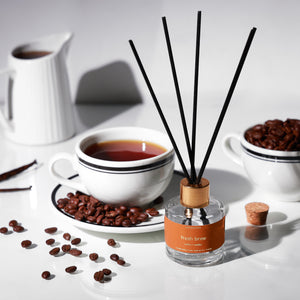
What to avoid: every gourmand direction — coffee, vanilla, caramel, baking, spice. We compose one of the best coffee accords on our own shelf and I would not put it in this room.
The zoning answer most people miss: a display kitchen is almost always open to the living or dining volume, so it is not a separate zone at all. It shares air, and it should simply inherit whatever that volume is running. Giving it its own machine creates a boundary where the two compositions meet at the island.
The honest sequence: if the display smells of new cabinetry, adhesive or packaging, fragrance is the wrong tool. A scent machine does not remove a smell — adding a pleasant odour to an unpleasant one gives you a mixture. Source, then ventilation, then fragrance.
2. No gourmand, no matter how good the gourmand is. Coffee, vanilla, caramel, baking spice, warm bread — all of them are wrong here, and being well made does not save them. In a working kitchen those registers are redundant because cooking supplies them. In a display kitchen they are unsupported, so the brain reads them as artificial rather than as atmosphere. We make a Coorg coffee and Kerala vanilla composition that people describe as the most convincing coffee they have smelled in a fragrance, and I still would not put it in this room.
3. Check whether this is even a separate zone. Almost every display kitchen in a smart-home showroom opens onto the living or dining vignette without a door. That makes it one body of air with that space, and a second machine in it creates two compositions meeting across the island rather than two rooms with two characters. A closed door is a boundary; an opening is not. If the kitchen is genuinely enclosed, it becomes its own small zone and takes a low setting.
4. Do not use fragrance to deal with a smell. New display kitchens are full of freshly made joinery, adhesives, sealants, appliance packaging and protective film, and all of that off-gasses hardest when new. Fragrance does not remove any of it — it produces a mixture, and the mixture is usually worse than either component. Unpack away from the display floor, ventilate, give it time, and scent the room afterwards.
5. Place the machine for the volume, not for the vignette. Because the kitchen usually belongs to a larger connected volume, the unit should serve that whole volume from a position in its airflow path rather than sitting on the display island looking like an appliance nobody sells. Waterless matters here for a specific reason: no moisture added near sockets, induction surfaces or veneered joinery, and a sealed residue-free tank means no oily film on a display worktop.
Vaayu is ₹11,999, covers up to 1000 m³ of connected volume, runs under 38 dB, draws 5W at DC 12V / 1A, holds a 400ml sealed residue-free tank lasting up to about 90+ days, and is CE, RoHS and SGS certified. Free shipping above ₹499, and a portion of every order supports girl-child education through Nanhi Kali.

Why a food accord fails in a kitchen where nothing is cooked
Fragrance is judged in context far more than people expect. The same composition can read as luxurious in one room and cheap in another, and dose is usually the reason — almost any accord pushed too high flattens into a single sweet or sharp impression, which is what people mean when they say something smells like an air freshener. A display kitchen adds a second reason, and it is contextual rather than quantitative: there is nothing in the room to corroborate the smell. No heat, no steam, no sound, no plates, no source. A coffee accord in a room with a coffee machine that has never been switched on is a claim the room cannot support, and the nose is extremely good at noticing when a smell has no cause.
 Fresh Brew₹849I want to be fair to the gourmand family, because I compose in it and I like it. A warm coffee, vanilla and soft caramel accord is genuinely lovely in a home — a reading corner, a study, a living room in winter — and buyers consistently describe ours as smelling like real beans rather than synthetic mocha. What makes it work there is that it is not pretending to be anything; it is a fragrance in a room, and everyone understands the arrangement. In a display kitchen it stops being a fragrance and starts being an impersonation, and impersonations are judged much more harshly than fragrances. The visitor is standing in front of an oven that has never been used, and being told by the air that something is baking. That is the moment the showroom stops feeling designed and starts feeling staged, and it is a surprisingly expensive impression to create with something as cheap as the wrong oil.
 Vaayu₹11,999A display kitchen is full of the two things that make an ultrasonic machine a poor choice: powered appliances with electronics in them, and expensive joinery finished to a standard nobody wants to test. An ultrasonic diffuser dilutes oil in water and throws a wet mist, which adds humidity to the room and can leave a fine white mineral deposit on nearby surfaces over time. A cold-air nebuliser does the opposite — pressurised air shatters undiluted oil into a dry nano-mist, with no water, no dilution, no added humidity and no residue, and the tank is sealed so there is no oily film anywhere. That difference in payload per droplet is also why the same oil reads stronger from a nebuliser than from a water diffuser: it is not competing with water. One more thing to say before anybody hands a client a bottle: thick undiluted essential oils are not recommended in this machine, because they clog the fine nozzle over time.
Ask before specifyingContactKitchens are where a showroom conversation slows down. People lean on the island, open drawers, look at the tap, ask about the hob, and the four-minute rule that governs every other demonstration room does not apply — this is often the longest stop on the circuit. That works in two directions. It means the visitor has time to adapt, so more fragrance would be pointless; and it means anything slightly too strong has time to become noticeable in the wrong way. The correct level here is below the main living volume even where the two share air, which in practice means placing the unit to serve the living side and letting the kitchen sit at the quieter end of that gradient rather than giving it a source of its own. It is also worth remembering that your own team stand here longest of all and will be the first to declare that they cannot smell anything. They are adapted; the key-lock is what stops that becoming a setting change.
Vaayu₹11,999A display kitchen is full of the two things that make an ultrasonic machine a poor choice: powered appliances with electronics in them, and expensive joinery finished to a standard nobody wants to test. An ultrasonic diffuser dilutes oil in water and throws a wet mist, which adds humidity to the room and can leave a fine white mineral deposit on nearby surfaces over time. A cold-air nebuliser does the opposite — pressurised air shatters undiluted oil into a dry nano-mist, with no water, no dilution, no added humidity and no residue, and the tank is sealed so there is no oily film anywhere. That difference in payload per droplet is also why the same oil reads stronger from a nebuliser than from a water diffuser: it is not competing with water. One more thing to say before anybody hands a client a bottle: thick undiluted essential oils are not recommended in this machine, because they clog the fine nozzle over time.
Ask before specifyingContactKitchens are where a showroom conversation slows down. People lean on the island, open drawers, look at the tap, ask about the hob, and the four-minute rule that governs every other demonstration room does not apply — this is often the longest stop on the circuit. That works in two directions. It means the visitor has time to adapt, so more fragrance would be pointless; and it means anything slightly too strong has time to become noticeable in the wrong way. The correct level here is below the main living volume even where the two share air, which in practice means placing the unit to serve the living side and letting the kitchen sit at the quieter end of that gradient rather than giving it a source of its own. It is also worth remembering that your own team stand here longest of all and will be the first to declare that they cannot smell anything. They are adapted; the key-lock is what stops that becoming a setting change.
The zoning point almost everybody misses
Before choosing an accord for a display kitchen it is worth asking whether it should have one of its own at all, and the answer is usually no — not because the room does not deserve it, but because it is not a room in the sense this discipline cares about. Zones are bodies of air, and a display kitchen is nearly always open to the living or dining vignette without a door between them. That makes the whole arrangement one volume. Put a machine in the kitchen and another in the living space and you have not created two atmospheres; you have created a gradient across an open plan with a stretch of air near the island that belongs to neither, and that stretch is exactly where visitors stand and talk.
So the specification I would write for most showrooms is that the kitchen display forms part of the main living zone, is served by the same machine, and inherits the same accord at whatever level that volume is set to. It is the cheapest good decision available on the whole circuit — one fewer machine, one fewer schedule to record, one fewer refill date, and a demonstrably better result. Where the display kitchen genuinely is enclosed, with a door that is normally shut, it becomes its own small zone and should be treated like any other small sealed volume: a low setting, a short window, and a sober look at whether a machine rated to 1000 m³ is proportionate to a room of a few hundred square feet.
One geometry note that catches people out. Kitchen displays often sit under a lower ceiling than the adjoining living volume, or in a recess, or beneath a services zone that has been dropped for extract ducting that will never be used. Those local changes in ceiling height alter how air moves through the space and can leave a pocket that reads as noticeably stronger or weaker than the rest of the open plan. The fix is placement rather than intensity: put the unit into the airflow path of the connected volume, at height, and away from a return that would pull the mist out before it travels. Where the whole floor is served by one air-handling system, the HVAC-return mount gives the most even result of all, and it is a mechanical integration point that belongs in services coordination early rather than a digital one.
Registers judged for a display kitchen
The comparison as I would present it, with the direction I would talk you out of at the bottom — including one of our own best-loved compositions, because a guide that never argues against its own catalogue is an advertisement. The reed scents are named as references for the register; reed oil and cold-air oil are separate systems and cannot be swapped in either direction.
| Register | What it reads as here | Behaviour in an open-plan display | Verdict | Reference direction |
|---|---|---|---|---|
| Bright citrus-clean ★ | A surface just wiped down; good air | Lifts without adding weight, and agrees with what the room actually is | The answer — cut lemon over a light woody or mineral base | Morning Freshness direction, ₹749 · 9.0 |
| Dry woody-fresh | Composed, engineered, quietly expensive | Excellent, and identical to the main living volume it shares air with | The best choice where the kitchen is part of an open plan | Mountain Breeze direction, ₹849 · 9.4 |
| Soft herbal | Restful, quiet, slightly domestic | Under-perceived in a large connected volume; nothing wrong with it | Harmless but wasted here; keep it for the bedroom zone | Evening Calm direction, ₹799 · 8.9 |
| Floral | Decorative, occasion-led, domestic | Reads as an event rather than an environment; noticed and remarked on | Argues with the product and with the room | Garden Bloom direction, ₹799 · 8.9 |
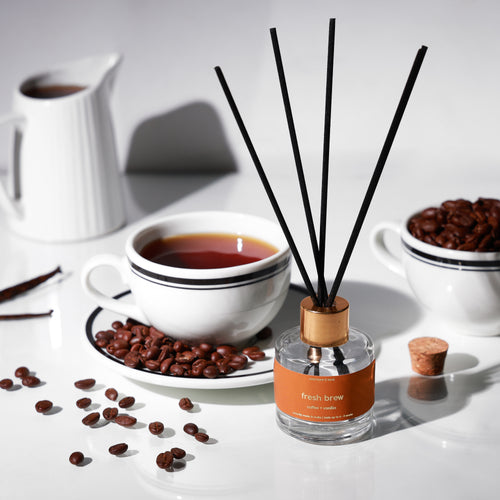
| Warm gourmand | An impersonation of cooking with nothing behind it | Heavy, lingers on joinery and soft goods, builds through the day | The clearest wrong answer on this page — and it is one of ours | Fresh Brew direction, ₹849 · 9.5, deepest in the range |
 Vaayu · waterless, sealed tank₹11,999See specification → Clean and dry, one accord₹1,799Shop → The citrus reference₹749Shop →
If the display already smells of something, fragrance is the wrong tool
Display kitchens are among the newest objects in a showroom and they arrive with a set of smells attached: freshly cut and edged board, adhesives, sealants, appliance packaging, protective film, and whatever the joinery shop finished them with. All of that off-gasses hardest when new, and I want to be completely unambiguous about what fragrance can do about it. Nothing. A scent machine does not cover, cancel or eliminate another odour; adding a pleasant smell to an unpleasant one produces a mixture, and the mixture is very often worse than either component on its own, because now there are two things to notice instead of one.
The correct sequence is always source, then ventilation, then fragrance. Take the packaging and protective film off the display floor and out of the building rather than stacking it in a back room that shares air with the showroom. Run the extract and the fresh-air supply properly, and check that the air-conditioning intake is doing what the drawings say it does. Open the cabinetry and let it breathe for as long as the programme allows before the floor opens; time and air changes are the only things that genuinely reduce off-gassing, and both of them are free. Only when the room smells of nothing in particular is there any point introducing a fragrance, and at that point a low, clean accord will do more than a strong one ever could.
I labour this because it is the request I refuse most often and because refusing it protects everybody. A showroom that scents over a new-cabinetry smell gets three or four weeks of a confusing mixture, then the off-gassing subsides on its own and the client is left with a fragrance level chosen to fight something that no longer exists — which is to say, a room that is now far too strong. It is also the reason the key-lock and a written record of settings are worth more than they look: the level you set during fit-out is almost never the level the finished room should run at, and somebody has to remember to take it back down.
What I would specify for a display kitchen — and the honest gap
The decisions in the order they are actually made, ending with the limitation I would rather a specifier heard from us at drawing stage than discovered while a client was standing at the island asking a reasonable question.
| Decision | What to specify | Why | Reference |
|---|---|---|---|
| 1. Is it a zone at all | If it opens onto the living or dining volume without a door, it is part of that zone and takes no machine of its own | Two sources across an open plan make a gradient and a dead stretch at the island, not two atmospheres | A closed door is a boundary; an opening is not |
| 2. Register | Clean, dry, citrus-adjacent — the circuit’s own accord. No coffee, vanilla, caramel, baking or spice | A kitchen that never cooks cannot support a food accord; it reads as staged | Cold-air oils, 300ml ₹1,799 |
| 3. Mechanism | Waterless cold-air only, with a sealed residue-free tank | No moisture near appliances, sockets or veneer, and no oily film on a display worktop | Vaayu ₹11,999 |
| 4. Level | Below the main living volume, judged by walking in from the entrance rather than standing at the island | This is the longest stop on the circuit, so both the visitor and your staff adapt while standing here | Adjustable intensity, key-lock |
| 5. Placement and supply | In the airflow path of the connected volume at height, or into the HVAC return; low-voltage point at that position | Dropped ceilings and recesses over a kitchen create pockets that placement fixes and intensity does not | DC 12V / 1A, 5W · under 38 dB |
| 6. Sequence during fit-out | Packaging and film off the floor, ventilate, let the joinery breathe — then set a level, and reset it once off-gassing has subsided | Fragrance does not remove a smell, and a level chosen to fight one is far too high once the smell has gone | Source, then ventilation, then fragrance |
| No appliance link: the honest gap | The machine cannot be started by a hob, an extract fan, a coffee machine or any kitchen scene. It holds its own Bluetooth schedule, runs alongside the automation rather than inside it, and nothing about a demonstration can trigger it | Say so in the specification; in a room full of connected appliances the assumption is very easy to make and awkward to correct later | Ask us first |
Versailles
The request that arrives with almost every kitchen display is for something warm and appetising, and I understand why. Kitchens are the emotional room in a house and the temptation is to reach for the emotion directly. But a smell is a claim about what is happening in a room, and a display kitchen is the one kitchen on earth where nothing is happening. The claim fails, and it fails in a way people feel rather than analyse — they simply come away thinking the showroom was trying a bit hard.
What works instead is a claim the room can actually support. Clean air, cool surfaces, a cut-lemon brightness that reads as something recently wiped down. It is modest and it is true, and truthfulness in fragrance is not a moral point but a practical one: a scent that agrees with what the eye is seeing disappears into the experience, and a scent that contradicts it stays in the foreground being noticed.
The other thing I would ask a showroom to accept is that this room usually does not need a machine of its own. It is open to the living space, it shares that air, and it should share the accord as well. That is one fewer unit, one fewer schedule and one fewer thing to go wrong, and it produces a better result — which is the rarest kind of recommendation to be able to make. Everything is composed in Pune, and a portion of every order funds a girl’s classroom through Nanhi Kali.
Frequently asked questions
- Scenting a multi-room demonstration suite — closed doors make separate zones.
- The living-room demonstration zone — the volume this kitchen usually belongs to.
- The bedroom experience zone — softest accord, lowest dose, smaller machine.
- Should the home theatre be scented? — often not, and here is the reasoning.
- A different fragrance in every room? — why a circuit accumulates.
- One signature scent or multiple zones — the decision page.
- The arrival fragrance — threshold and the un-adapted nose.
- Fragrance inside a demonstration — what can honestly be shown.
- Light, sound, climate and fragrance together — run as a timetable.
- Brand: the SOSA founder story.
SOSA Vaayu — facts verified August 2026: ₹11,999. Waterless cold-air nebulising diffuser; pressurised air shatters undiluted oil into a dry nano-mist, with no water, no dilution, no added humidity and no residue. Coverage up to 1000 m³, approximately 2,000–3,000 sq ft at standard ceiling height, read as connected volume rather than floor area. Control: Bluetooth app plus onboard buttons, run windows of 1h / 4h / 8h / 24h, day selection, adjustable mist intensity, auto-stop and key-lock; each unit holds one schedule and one intensity, stored in that unit. SOSA publishes no Wi-Fi, Alexa, Google Assistant, Matter, Zigbee, Z-Wave, KNX, Crestron, Control4, RS-232, dry-contact or API integration of any kind; Vaayu units cannot be grouped, zoned, addressed, triggered by an appliance or a scene, or monitored by any home-automation control system, voice assistant, hub or sensor, and there is no central app across units. Mounting: freestanding, wall-mounted or into an HVAC return — a mechanical integration, not a digital one. Power DC 12V / 1A, 5W at the mounting position. Under 38 dB. 400ml sealed, residue-free, refillable tank lasting up to about 90+ days depending on intensity and scheduled hours; SOSA publishes no millilitres-per-hour consumption rate and none is estimated here. CE, RoHS and SGS certified. Black and white finishes. Oils must be alcohol-free, water-free fragrance oils formulated for cold-air diffusion, such as the SOSA Hotel Collection (100ml ₹999 · 300ml ₹1,799 · pack of seven ₹1,799); thick undiluted essential oils are not recommended as they clog the fine nozzle. Other SOSA machines: Sukoon ₹1,899 ultrasonic (500ml, 270–320 sq ft, 16–18h on low, three 15ml scents included), Boond ₹899 (up to about 150 sq ft), Megh ₹3,499 (six-litre tank, about 100 hours runtime, only about 215 sq ft — a runtime and humidity machine, never a coverage upgrade over Sukoon), Aangan ₹25,999 (~8,000–10,000 sq ft), Meenar ₹38,500 (12,000–18,000 sq ft). Ultrasonic machines dilute oil in water, add humidity and can leave a fine white mineral deposit. SOSA reed diffusers named here as register references are alcohol-free, phthalate-free, paraben-free, IFRA-compliant and 0 ppm formaldehyde, with six fibre reeds in a refillable glass bottle, composed in Pune: Morning Freshness 50ml ₹749 at 9.0 on the SOSA strength scale, Mountain Breeze ₹849 at 9.4, Evening Calm ₹799 at 8.9, Garden Bloom ₹799 at 8.9 and Fresh Brew ₹849 at 9.5. Reed oil and cold-air oil are separate systems and are not interchangeable, and there is no hotel-inspired reed diffuser. A scent machine adds fragrance; it does not clean, purify or deodorise air, it does not remove an existing odour, and SOSA makes no health or air-quality claim. SOSA publishes no dealer programme, reseller margin, trade price, territory, minimum order, lead time, installation charge or maintenance contract; commercial enquiries are welcome at https://sosahomeandbody.com/pages/contact. Free shipping above ₹499. A portion of every order supports girl-child education through Nanhi Kali. SOSA is an independent Indian fragrance house; the Hotel Collection scents are SOSA’s own interpretations inspired by the world’s finest hotels, and SOSA is not affiliated with or endorsed by any hotel brand or any home-automation manufacturer. Prices subject to change — see the live product pages.