



The caveat: a closed, unventilated room accumulates, because the reed keeps producing while almost no air leaves. Use two or three reeds instead of the whole bundle, and open the room anyway.
The cost: a 50ml reed from ₹749 lasts roughly three months, so about ₹250 a month, spent regardless of whether anybody sleeps in there.
The honest alternative: a Sukoon at ₹1,899 spends nothing at all when it is switched off, reaches its level in about twenty minutes and needs somebody to press a button. That is the trade.
2. Which means leaving it out is not wasteful in the way people assume. The cost has already been committed by the calendar. Putting the reeds in a drawer for three weeks and then reinstating them does not recover three weeks of oil, and it does cost you the 24 to 72 hours the room needs to come back up.
3. And there is a real benefit on the other side of it. A room that has quietly held a low level for six weeks has reached equilibrium — the curtains, the cotton, the wardrobe and the wood have all settled at the same faint level as the air. That reads as a property of the room. A room scented on the Friday afternoon somebody arrives reads as an event, and people can tell the difference without being able to name it.
4. The caveat: a shut room accumulates, so use fewer reeds. Output is roughly constant but air exchange in a closed bedroom is close to nil, so concentration climbs in a way it never would in a room with a door that opens. Two or three reeds rather than the whole bundle, and open the window for twenty minutes once a week if you can manage it.
5. Know the number: about ₹250 a month. A 50ml bottle from ₹749 runs roughly three months. You are paying that whether the room is used twice a month or not at all, and it is worth deciding on purpose rather than by drift.
6. If you are going away for a long stretch, cap it properly. Take the reeds out, wipe them, store them in a sealed bag or the original box, and put the cap back on the bottle. That is the only version of storing a reed that genuinely stops the spend — and the Sukoon at ₹1,899 is the product that does it automatically, because a machine that is switched off costs nothing at all.
A portion of every order supports girl-child education through Nanhi Kali.
A reed runs on the calendar, not on whether anybody is in the room
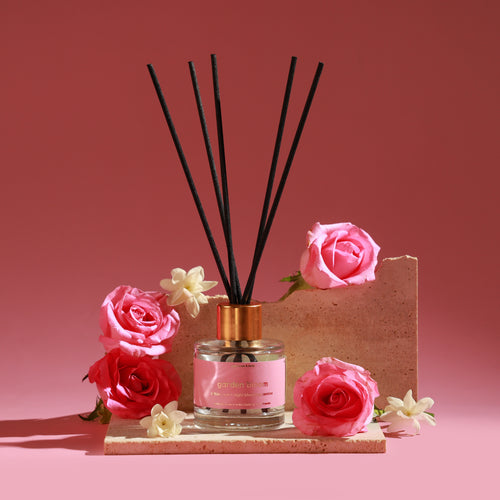
Almost everybody who asks this question is asking a conservation question — am I wasting it — and the answer depends entirely on a piece of physics most people have never had explained to them. A reed diffuser has no demand side. It is not responding to a room being used, to a door opening, or to somebody wanting it to work. It is a wick and a surface, and it gives up oil at a rate set by how warm the room is and how much the air moves. Once you accept that, the whole question changes shape: you are not deciding whether to use up a resource, because the resource is being used up regardless. You are deciding whether to get anything back for it.
What each option actually costs while the room is empty
The same guest bedroom, unoccupied for twenty-eight days out of thirty, costed by what each arrangement spends during the empty stretch rather than by shelf price. The fourth column is the bit that decides it for most people: what the room is actually like at six in the evening on the day somebody finally walks in.
| Arrangement | What it spends while the room is empty | Roughly per month | The room on arrival day | Verdict |
|---|---|---|---|---|
| Reed left out, two or three reeds ★ | The same as it would spend in use — evaporation is set by temperature and airflow, not by occupancy | About ₹250 from a ₹749 bottle over roughly three months | Settled. Curtains, cotton and wood are at equilibrium with the air, so there is no detectable source | The answer for most spare rooms. Nothing to remember, ever |
| Reed left out, full bundle of reeds | More, and in a closed room the concentration climbs because almost no air leaves | ₹250 or faster, since exposed reed surface is the main output variable | Frequently too much, and blamed on the scent rather than on the ventilation | The commonest mistake in this whole group. Pull half the reeds out |
| Reeds stored, bottle capped | Genuinely nothing, but only if the cap is actually back on — reeds in a drawer with an open bottle still evaporates | ₹0 while capped | Neutral, and it needs 24 to 72 hours to come back up after you reinstate the reeds | Right for a month away or longer. Pointless for a fortnight |
| Sukoon in the room, run the day before | Nothing at all. A machine that is off has no running cost | ₹0, plus about ₹4 of Hotel Collection per tank at three drops | Excellent, if somebody remembered. About twenty minutes from cold to a steady level | The better economics and the worse ergonomics. It depends on the memory of the household |
| A candle lit on arrival day | Nothing while it sits in the cupboard | ₹0, then ₹379 for 15–18 hours of burn | Warm and immediate in 15 to 20 minutes, but it must be attended and put out | A good addition on the evening, a poor substitute for a background |
| Nothing at all, aired the day before | Nothing | ₹0 | Clean, neutral and perfectly acceptable — a well-aired room with washed cotton is never a failure | The honest baseline every option above is being measured against |
Fewer reeds, an open window, and when to cap the bottle
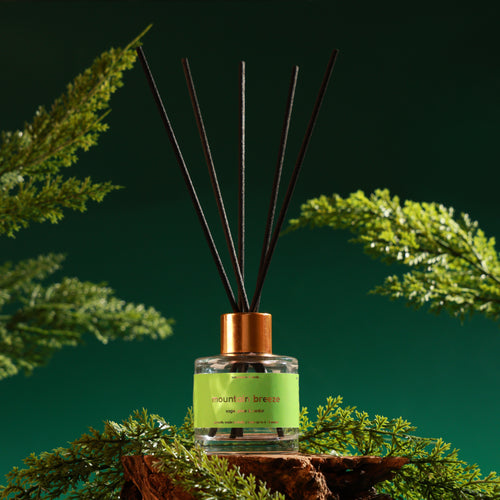
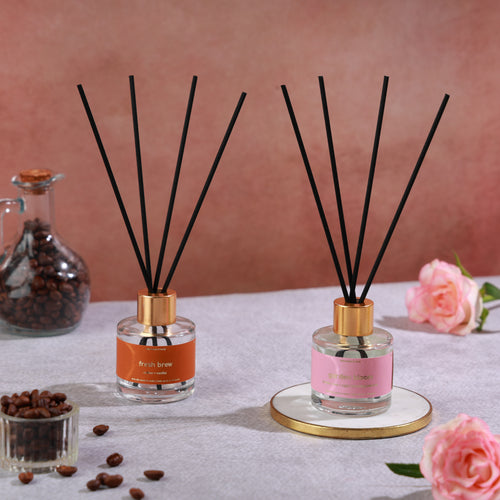
Start with the reeds themselves, because they are the control surface and almost nobody uses them as one. The bundle in the box is a maximum rather than an instruction, and in a small closed spare bedroom two or three is the correct number. Halve the exposed reed surface and you roughly halve the rate at which oil leaves the bottle, which does two things at once: it lowers the level the room settles at, and it stretches the bottle out. Keep the spare reeds — wiped, in a sealed bag — and add one back if the room reads as too faint after a fortnight, which is a far better way to arrive at the right level than buying a different scent. On flipping: turning the reeds over gives you a short, sharp lift for a day or two because the fully saturated end is now in the air, and it is the right move on the morning of the day somebody arrives. Doing it every week simply empties the bottle faster for no lasting gain. On placement in a spare room: away from the window rather than on the sill, because direct sun and a draught both accelerate evaporation and neither improves the result; on a chest of drawers rather than the bedside table; on something you do not mind marking, since reed oil will damage a polished or painted surface if it runs; and not inside the wardrobe, where a guest's clothes are going to hang. A reed in a closed cupboard is not a clever hack. It is how you send somebody home smelling of pine.
Then the airing, which is the part the reed does not replace and the part this whole cluster keeps coming back to for good reason. A spare bedroom that is shut for weeks develops a specific, recognisable flatness that has nothing to do with dirt: still air, no light, textiles that have not moved, and in most Indian flats a slow exchange of moisture with a bathroom wall or an outside wall. A reed running in that room does not fix it — it sits on top of it, and the combination is worse than either alone, because a closed-room note under a pine note reads as a room hiding something. So the routine is short and it is free: open the window and the door together for twenty minutes once a week if the household can manage it, and without fail the day before a guest arrives. Two openings on opposite walls if the flat has them, and a fan in the doorway pointing out if it does not. Get the bedding out and back on a line, or at least shaken out and turned, and leave the wardrobe doors standing open for the same twenty minutes so the inside gets some of the same air. Do that and the reed becomes what it is supposed to be, which is the thing that makes a clean room smell like a decision rather than an absence. Skip it and the reed becomes an air-freshener, which is a category I would rather not be in.
Then the money, the alternative and the principle. A 50ml bottle from ₹749 runs roughly three months, which is about ₹250 a month, and you are paying it on the twenty-eight days a month nobody sleeps in that room as surely as on the two when somebody does. Whether that is good value is a genuine question rather than a rhetorical one, and it depends on something about your household rather than about the product: the reed is buying you the absence of a routine. A Sukoon at ₹1,899 has a running cost of zero when it is off, reaches a steady level in about twenty minutes from cold, holds 16–18 hours per fill on low at 30–50 ml/h against 9–12 on high, has a 2.4MHz plate, a remote, auto shut-off and steady, 2H and 4H timers, and arrives with three 15ml Hotel Collection scents of your choice — and it does absolutely nothing unless a human being remembers to switch it on the afternoon before. If somebody in your house will reliably remember, the machine is cheaper and more controllable and I would buy it. If nobody will, the ₹250 a month is the fee for a room that is permanently ready, and it is a fair price for that. On the constraints: reeds are a separate alcohol-free line with their own five scents, so the water-based Hotel Collection never goes into one, and reed oil never goes into an ultrasonic machine. 300ml reed refills are ₹2,399 and are the sensible way to continue once you know the scent is right. And the principle: the best-smelling guest room is not the one that was prepared, it is the one that never needed preparing.
The SOSA edit
In buying order for a spare bedroom you want to be permanently ready without thinking about it. The first row is the recommendation, the third is the honest alternative for a household that will actually remember, and the last row is the free habit that every row above depends on.
| Buy | What it is | When it earns its place | Price |
|---|---|---|---|
| 1. Mountain Breeze reed ★ | Himalayan pine, sage and cedar, alcohol-free, no plug and no routine — the dry one for an unused room | First. Two or three reeds rather than the bundle, flipped on the morning your guest arrives | ₹849 |
| 2. Morning Freshness reed | Malabar lemon, peppermint and eucalyptus — the cheapest entry to the line and the brightest of the five | If the spare room is small, faces a road, or reads as flat rather than as stale | ₹749 |
| 3. Sukoon | 500ml for 270–320 sq ft, steady/2H/4H timers, auto shut-off, three 15ml scents included | If somebody in the house will reliably switch it on the afternoon before. Zero running cost when off | ₹1,899 |
| 4. 300ml reed refill | The way to continue a reed you have already decided about, rather than buying another 50ml bottle | Once the scent has been right for two full bottles. Not a first purchase | ₹2,399 |
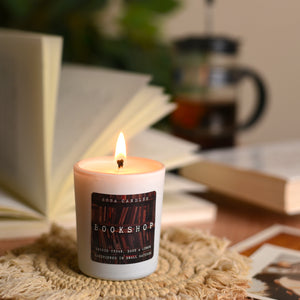
| 5. Bookshop candle | 80g, roughly 15 to 18 hours of burn, scent in the room in 15 to 20 minutes | As an addition on the evening itself, not as the background. It must be attended and put out | ₹379 |
| The free part: twenty minutes of air a week | Window and door open together, wardrobe doors open, bedding shaken out and turned | Every row above assumes this. A reed on top of a closed-room smell is worse than either on its own | ₹0 |

Versailles
I am asked this more often by careful people than by careless ones, which tells you what the question is really about. It is not about fragrance. It is the same instinct that switches off a light in an empty room, and it is a good instinct applied to a product that does not work that way. A reed diffuser has no empty-room setting. It is a wick and a surface, and it is quietly spending on a Tuesday afternoon in March when the door has been shut for a fortnight. Once you know that, putting the reeds in a drawer for three weeks stops looking like thrift and starts looking like paying for something and then declining to collect it.
So I leave mine out, and I do it for a reason that has nothing to do with saving money. A room that has held a faint scent for six weeks does not smell scented. It smells settled, because the curtains and the cotton and the wood have all quietly arrived at the same level as the air, and there is no source for a visitor's nose to find. That is a materially better result than anything you can produce on a Friday afternoon, and it is the one hospitality trick in this cluster you get by doing nothing at all. Two reeds, not eight. Twenty minutes of open window a week. About ₹250 a month for a room that is never caught unprepared, and a capped bottle in the cupboard the month you are away.
Everything is made and supported from Pune, and a part of every order funds girl-child education through Nanhi Kali. You get a home that smells like somewhere you chose; a girl gets a classroom. That equation has always felt right to me.
Frequently asked questions
- What's the most economical fragrance setup for a guest bedroom used only twice a month? — the same maths taken all the way to cost per use.
- Guests are staying for three nights — is a reed better than spraying the room every day? — the format question for an occupied room.
- My guest bedroom stays closed most of the month — how do I freshen it before someone arrives? — the twenty minutes of air this page depends on.
- I want my guest room to feel like a hotel room for under ₹1,000 — the closing buying guide for this group.
- Brand: the SOSA founder story.
Facts verified August 2026: Timings in this guide: a scented candle puts noticeable fragrance into a normal room in roughly 15–20 minutes; a Sukoon ultrasonic diffuser reaches a steady level in about 20 minutes from cold; a reed diffuser needs roughly 24–72 hours for the oil to travel the reeds and the room to settle, so it is not a same-day solution. SOSA products and prices: Sukoon 500ml ultrasonic diffuser ₹1,899 (270–320 sq ft, 16–18h on low, 9–12h high, 30–50 ml/h, 2.4MHz cool mist, 7-colour LED, remote, steady/2H/4H timers, BPA-free, auto shut-off, includes three 15ml Hotel Collection scents of your choice); Boond 300ml ₹899; Megh 6-litre ₹3,499; waterless Vaayu ₹11,999 (up to 1000m³); Aangan ₹25,999; Meenar ₹38,500. Hotel Collection water-based fragrance 15ml ₹299, 100ml ₹999, 300ml ₹1,799, Pack of 7 at 15ml ₹1,799 / 100ml ₹5,999 / 300ml ₹10,799; dose 3–6 drops per tank. Reed diffusers (separate alcohol-free line): Morning Freshness from ₹749, Garden Bloom and Evening Calm from ₹799, Fresh Brew and Mountain Breeze from ₹849; 130ml from ₹1,249; duos from ₹1,498; 300ml refills ₹2,399. Scented candles: Bookshop 80g ₹379 (~15–18 hours), Bookshop + Cozy Corner ₹664 (~30–36 hours), Amber Rose 130g ₹599 (~25–30 hours) and 220g ₹799 (~40–50 hours), ceramic jar candles ₹949, Pure Calm wax melt set ₹854. Free shipping above ₹499. SOSA does not make a room or linen spray for the home — the sprays in the range are car perfumes. The Hotel Collection scents are SOSA's own interpretations; SOSA is not affiliated with or endorsed by any hotel brand. Prices subject to change — see the live product pages.