



Should I Count Rooms or Square Feet When Working Out How Many I Need?
Step two — measure each one: under about 150 sq ft, one bottle; a 50ml for small or short-stay spaces, a 130ml where people sit for hours.
Step three — rank by hours of occupancy: buy from the top down and stop when the list runs out of rooms anyone stands still in. A 750 sq ft 2BHK: six enclosures, three bottles, ₹3,397.
2. Then rank by hours, and cut the list there. Write your enclosures down and put a number of hours beside each: how long is anybody genuinely in there on an ordinary day? Master bedroom, eight or nine. Living-dining, three or four. Kitchen, two, but with cooking dominating. Second bedroom used as a study, one. Guest room, zero. Buy from the top of that list downward and stop when you reach the spaces with nothing in the column. Prioritise by hours of occupancy, not by room size — it is the single most reliable way to spend less and notice more.
3. Short-stay spaces are the exception that proves it. A bathroom might be occupied for a total of thirty minutes a day, and it still earns a bottle, because each of those visits begins with a nose that has not adapted to the space. What you are buying there is a series of arrivals rather than a stretch of dwelling. So the ranking is really by hours plus arrivals with a fresh nose — which is why a 40 sq ft bathroom beats a 200 sq ft drawing room used once a week, and why floor area gets the answer exactly backwards.
4. A worked count: a 750 sq ft 2BHK. Six enclosures — living-dining 220 sq ft, kitchen, master bedroom 130 sq ft, second bedroom 100 sq ft, bathroom, utility. Ranked by hours: master bedroom first, living-dining second, bathroom third on arrivals, second bedroom fourth at about an hour, kitchen and utility nowhere. Buy three: a 130ml for the living-dining at ₹1,349, a 130ml for the master bedroom at ₹1,299, a 50ml for the bathroom at ₹749. ₹3,397 for a flat the area sum said needed five bottles.
5. And a 1,200 sq ft 3BHK, to show how little area matters. Eight enclosures, four bottles: living-dining ₹1,249, master bedroom ₹1,299, the children's bedroom ₹849, the main bathroom ₹749 — ₹4,146. That is sixty per cent more floor area than the 750 sq ft flat and exactly one more bottle, because what grew was the size of the rooms and not the number of places anybody sits. If area were the right unit the second home would cost sixty per cent more. It costs twenty-two per cent more.
Made in India, composed by an ISIPCA Versailles-trained perfumer — and a portion of every order supports girl-child education through Nanhi Kali.
What each unit is actually measuring
Floor area is the number people reach for because it is the number they know about their home, and it is genuinely useful — for one thing. The 150 sq ft coverage figure describes the size of one pocket of still air a single bottle can hold at equilibrium, in a closed room with a standard ceiling. That makes floor area the correct unit for a single question: is this particular enclosure inside or outside what one bottle handles? A 130 sq ft bedroom is inside it. A 220 sq ft living-dining is outside it and needs either two sources or a machine. What floor area cannot do is aggregate. Adding your rooms together and dividing by 150 treats the flat as one connected pocket, and a flat is a set of separate pockets with walls between them.
Room count fixes that but overshoots in the other direction, because it counts spaces regardless of whether anybody is in them. This is why "one per room" produces the eight-bottle 3BHK order that ends with four bottles quietly evaporating behind closed doors. The correction is the third unit. Occupancy hours are what you are really buying — a diffuser produces a slow, steady concentration in a space, and that concentration is only worth money if somebody is in the space to receive it. There is one adjustment: rooms entered briefly but repeatedly, like bathrooms, punch far above their hours, because your nose adapts to a constant smell within about twenty minutes and then stops reporting it. Time in a room is subject to that adaptation; arrivals into a room are not. So the working rule is hours of occupancy, with short repeat visits counted generously, and floor area used only to size the bottle you have already decided to buy.
The three steps, in order
 One per spaceFrom ₹749Walk the flat and write down every space that can be shut off from the others. A 750 sq ft 2BHK typically gives six; a 1,200 sq ft 3BHK gives about eight. This is the ceiling on how many bottles could possibly be doing anything, because a passive source serves the air space it stands in and no other. It is not your shopping list — treating it as one is how people arrive at an eight-bottle order for a home where four rooms are empty all day.
Sizing by space — the same method across four home sizes
The method applied to real flats. Notice how little the totals move as the floor area grows, and that two of these rows come to ₹0 despite being perfectly good rooms.
| Space | What it needs | How many | Cost |
|---|---|---|---|
| 750 sq ft 2BHK — six enclosures ★ | Living-dining 130ml, master bedroom 130ml, bathroom 50ml. Second bedroom, kitchen and utility: nothing | Three | ₹3,397 |
| 600 sq ft 1BHK — four enclosures | One 130ml for the living area, one 50ml for the bedroom. The bathroom is the third purchase, not the first | Two | ₹2,048 |
| 900 sq ft 2BHK with a second bathroom — seven enclosures | Still three bottles. The guest bathroom is used a handful of times a month and does not earn one | Three | ₹3,397 |
| 1,200 sq ft 3BHK — eight enclosures | Living-dining 130ml, master bedroom 130ml, children's bedroom 50ml, main bathroom 50ml | Four | ₹4,146 |
| A 200 sq ft formal drawing room used about an hour a week | Nothing. The largest room on this table and the one with the fewest hours in it | None | ₹0 |
| A 40 sq ft bathroom entered a dozen times a day | One 50ml on two or three reeds — small, enclosed, and met with a fresh nose every single time | One | from ₹749 |
| A note on all of the above: the 750 sq ft total is ₹1,349 + ₹1,299 + ₹749 = ₹3,397 and the 1,200 sq ft total is ₹1,249 + ₹1,299 + ₹849 + ₹749 = ₹4,146. Sixty per cent more floor area, twenty-two per cent more money, one more bottle. All coverage figures assume closed rooms with still air and standard ceilings. | |||
One room · the unitFrom ₹749Shop →
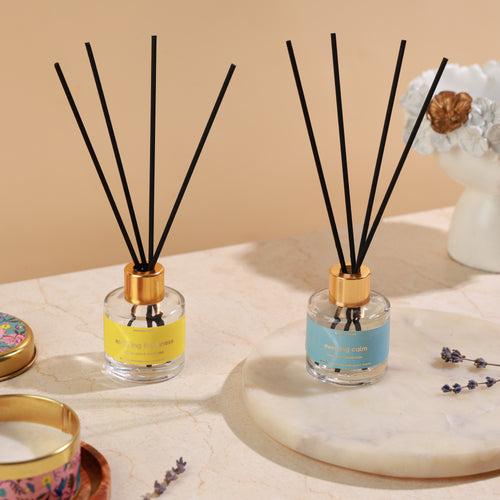 Two rooms · better value₹1,498Shop →
 Large room · a switch₹1,899Shop →
Applying it to your own flat
Do it on paper, in ten minutes, before you open a shopping page. Three columns: the space, its rough floor area, and the hours anybody is genuinely in it on a weekday. Be honest in the third column — this is the one place where wishful thinking costs real money, and "we sit there sometimes" usually means twice a month. Sort by the third column, and draw a line under the last space with meaningful hours. Everything above the line is your shopping list; everything below it is money you have just saved. In most Indian flats the line falls after three or four rooms regardless of whether the home is 750 sq ft or 1,200.
Then set the reeds per space, because that is the free half of the decision. Reed count is the only volume control a reed diffuser has, and it works both ways at once: more reeds means more presence and a shorter bottle. Six reeds suits a living-dining or an entrance, where people arrive with fresh noses. Four suits a bedroom occupied for eight hours. Two or three suits a small bathroom, where six would be overwhelming. Setting each bottle to its space also staggers your reorders, since the four-reed bedroom bottle will outlast the six-reed living room one by several weeks. And if a space reads quiet, add a reed before you consider adding a bottle — the free dial first, every time.
Then buy in the order of your list, not all at once. The top two spaces on almost every list are the master bedroom and the living-dining, and two 130ml bottles there — ₹1,299 + ₹1,249 = ₹2,548 — is a complete, coherent home fragrance setup for a flat of any size up to about 1,200 sq ft. Live with it for a month before adding the bathroom bottle and, if you want it, the second bedroom. When the 130ml runs out, a 300ml refill at ₹2,399 fills it roughly twice, and refilling is the moment to fit fresh reeds, since clogged fibre is the commonest reason throw drops off after a few months. For scent, Evening Calm in bedrooms and Morning Freshness in the public rooms is the arrangement that survives most floor plans.
What to buy
Once you have your ranked list, this is what each line on it costs and what each format is genuinely for.
| Buy | What it covers | Lasts | Price |
|---|---|---|---|
| One 50ml | A single reed diffuser — the small and short-stay spaces at the bottom of your list — a bathroom, a study used an hour a day | 6–8 weeks | from ₹749 |
| One 130ml ★ | The value size — the top two lines of almost every list — the master bedroom and the living-dining | 14–18 weeks | from ₹1,249 |
| The duo | Day & Night duo — the top two lines solved in one purchase, with two blends composed to sit beside each other | 6–8 weeks each | ₹1,498 |
| Sukoon | 500ml ultrasonic — any single enclosure over about 150 sq ft, where one passive source cannot reach the far side | Runs when you switch it on | ₹1,899 |
| 300ml refill | The running cost — the point where a three or four bottle home stops being a purchase and becomes a running cost | Roughly 2 × 130ml fills | ₹2,399 |
Versailles
People send me their floor plan and their square footage, and I always ask for something they have not measured: how many hours a day is anyone in each of these rooms? That column is the shopping list. The square footage only ever told us which bottle to put where.
The room that exposes this best is the formal drawing room. It is often the biggest space in the flat, it is the one people are proudest of, and it is used for an hour a week. By area it deserves two bottles. By hours it deserves nothing, and the honest advice is to scent it the day before people come and leave it alone the rest of the time. Meanwhile the bathroom that is forty square feet is entered twelve times a day by somebody whose nose has just walked in from somewhere else.
So: count the enclosures, measure them, then rank them by hours and draw a line. Most homes stop at three or four. If you buy the top two lines — ₹2,548 — and never buy anything else, you will have a home that reads as scented, and about ₹4,000 you did not spend. A portion of every order funds a girl's classroom through Nanhi Kali.
Frequently asked questions
- Why counting doors beats square feet — the mechanism behind step one.
- How many for a 1,500 sq ft home? — the method on a larger flat.
- Does a corridor count as a room? — the space that fails step three.
- The complete sizing and quantity guide — every home type, three builds.
- Brand: the SOSA founder story.
SOSA products & prices (verified August 2026): Hotel Collection water-based ultrasonic diffuser fragrance 15ml ₹299 · 100ml ₹999 · 300ml ₹1,799 · Pack of 7 (15ml, all fragrances) ₹1,799; refills 100ml from ₹999. Seven scents: The Ritz-Carlton-inspired (white tea · bergamot · cedar), Westin-inspired (white tea · aloe · cedar), 1 Hotels-inspired (cedarwood · vetiver · green leaves), The St. Regis-inspired (amber · violet · woods), Shangri-La-inspired (jasmine · green tea · white tea), Four Seasons-inspired (citrus · floral · sandalwood), W Hotels-inspired (citrus · pepper · amber). Diffusers: Boond 300ml ₹899 · Sukoon 500ml ₹1,899 · Megh 6L ₹3,499. Water-based, phthalate-free, composed to IFRA standards for home diffusion; 3–6 drops per tank. Made in India, Pune. The Hotel Collection scents are SOSA's own interpretations inspired by the world's finest hotels; all hotel names are trademarks of their respective owners and are used only to describe the scent style — SOSA is an independent Indian fragrance house, not affiliated with or endorsed by any hotel brand. Prices and availability subject to change — see the live product pages.