



2. Flip on return, not on a schedule. Flipping re-wets the exposed length and produces a surge for a day or two. Put that surge where somebody is standing — the evening you walk in, not the morning you leave.
3. Keep it off sun and heat. Evaporation rises steeply with temperature, and a shut flat in May can empty a bottle in half the expected time. Interior wall, out of the sun, away from anything warm.
4. Cap it for long absences. Over a month, replace the reeds with the stopper. Be honest with yourself that reeds already soaked cannot be fully restored — keep two dry spares. Reeds from ₹749 for 50ml, ₹1,249 for 130ml.
2. Flip the reeds when you get back, not on a schedule. Turning them over brings the soaked length to the top and gives you a noticeably stronger day or two. A person home every evening can flip whenever; a traveller should spend that surge on an evening they are actually there to receive it.
3. Stand it away from sun and heat. Evaporation rate climbs steeply with temperature, and a shut flat in a May afternoon is warmer than any occupied one. A bottle on a west-facing sill can empty in half the time you were expecting, and it does most of that emptying into an empty room.
4. Cap it for absences longer than about a month, and be honest about what that costs. Take the reeds out, put the stopper back, lay the reeds on a saucer. A reed that has been soaking for weeks carries oil along its whole length and never fully recovers its lift — keep two dry spares and swap them.
5. Underneath all four is one sentence: a reed is a continuous product being bought by a discontinuous user. Every adjustment above narrows that gap. None of them costs anything, and none of them is printed in the box.
A portion of every order supports girl-child education through Nanhi Kali.

A continuous product, a discontinuous user
Every instruction printed on a reed diffuser box is written for somebody who lives in the room. Use all the reeds, flip them once a week, expect three months from a 50ml bottle — those are perfectly good instructions for a person whose flat has doors opening and fans running every day, and they are quietly wrong for somebody who is away half the month. Not dangerous, not wasteful in any dramatic sense, simply calibrated for a different life. The four corrections below come from the same place: a reed's rate is set by physics and its value is set by whether anybody is in the room to receive it, and those two things stop lining up as soon as you start travelling.
The four adjustments, side by side
The same bottle, run two ways. The middle columns are what the box assumes and what a person away ten to fifteen days a month should do instead, and the fourth column is the mechanism, because a reason you understand is a reason you will still be following in six months. The last row is an absence rather than an adjustment.
| Adjustment | Home every day | Away 10–15 days a month | Why the difference | Cost |
|---|---|---|---|---|
| Number of reeds ★ | Six to eight — the full bundle in the box | Three or four, adding one at a time with a week between | Evaporation scales with exposed surface, and an empty flat has nobody removing scent. Accumulation is the failure mode | Free |
| When to flip | Every week or two, whenever you remember | The evening you walk back in, and never on the way out | Flipping re-wets the exposed length and gives a strong day or two. Spend that surge on days you are there | Free |
| Where it stands | Anywhere out of a draught, waist height or above | Interior wall, no direct sun at any hour, away from fridge, router, TV or lamp | Evaporation climbs steeply with temperature, and a shut flat in May is hotter than an occupied one | Free |
| Absences over a month | Not applicable | Reeds out, neck wiped, original stopper back in, bottle stored upright | Stops evaporation almost entirely. Under a month, just pull two reeds out and leave it | Free |
| Which bottle size | 130ml at ₹1,249–1,349 for the better rate per month | 50ml at ₹749–849 first, 130ml only once the scent has proved itself in your flat | A traveller judges a scent over more calendar weeks and fewer lived evenings, so proving takes longer | ₹749–1,349 |
| Not available: a timer for a reed | There is no such thing, from any brand | Reed count and flipping are the only two controls that exist | Printed rather than implied, because it is the first thing people ask for | — |
Reed count, flipping, heat and the cap — in detail
Take the reed count properly first, because it is the adjustment that changes the most and the one people are least willing to make. The box contains eight or ten sticks and there is an assumption built into that number, which is that you will be in the room. A bundle sized for an occupied living room, put into an entrance hall of a hundred square feet that is shut for eleven days out of thirty, is not a strong scent — it is a saturated one. The practical schedule I would give a traveller is this: three reeds for the first week, in whichever room matters, and then a decision made from the doorway rather than from inside the room. Walk out, walk back in, and judge the first four seconds; your nose adapts within a minute or two of standing in a space, so anything you decide after that is not evidence. If it is barely there, add one reed and give it four or five days, because a reed takes twenty-four to seventy-two hours to establish a new level and adding two at once means you will never know which one did it. Repeat until the doorway test says it is right, and then stop and leave it alone for a month. The commonest mistake I see is somebody adding a reed every time they notice the flat, which is a spiral, because within a fortnight they have habituated to whatever level they set and it will keep seeming insufficient no matter what they do. Reed count is a setting, not a dial to keep adjusting.
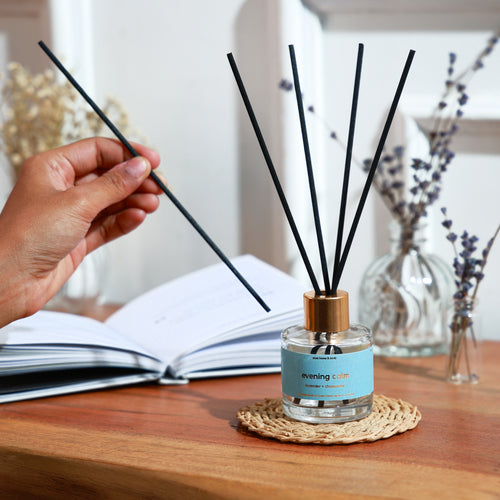
Then flipping and heat together, since both are really about where the oil goes and when. Flipping is not maintenance, it is a dose. Reversing four reeds puts four saturated lengths into the air at once and produces a day or two that is genuinely stronger, then settles back a little below where it was — because the reeds are older and the fibre is more clogged than it was last month. A traveller should therefore flip on arrival, and if the trip is long, flip on the evening of the day they land rather than the next morning, so the surge covers the first two days home. In a bedroom, flipping the night you get back is particularly worth doing, because the bedroom is the one room a returning traveller reliably occupies for eight hours — which is also why Evening Calm at ₹799, with Himalayan lavender and chamomile, is the bottle I would put there rather than in a hall. On heat: keep the bottle out of sun and off warm electronics, and if your flat has a room that stays cool and shaded, that is where a traveller's reed belongs, even if it is not the room you would have chosen for looks. The saving is real and it compounds: a 50ml bottle at ₹749 lasting three months is about ₹250 a month, and the same bottle in a hot sunny spot at six or seven weeks is closer to ₹430 — over two years that is a difference of roughly ₹4,300 against ₹6,000, for an adjustment that costs nothing but moving a bottle two metres.
Then the parts that are the same for everybody, and the honest boundary of what a reed is for. Reed oil is a separate alcohol-free line with its own five scents and it never goes into a machine: not into the Sukoon, not into the Boond, not into the Megh, and the water-based Hotel Collection never goes into a reed bottle in the other direction. Do not top a reed bottle up with anything but reed oil, do not dilute it, and do not stand it on unprotected wood. Twenty-four to seventy-two hours before a new bottle is doing its job, so a reed is never a response to a deadline — if guests are arriving tonight, a candle at ₹379 reaches a normal room in fifteen to twenty minutes and the Sukoon at ₹1,899 in about twenty from cold, and either of those is the honest answer to tonight. And a reed does not clean air. It runs underneath whatever else is happening in the room, which means it runs underneath a bin, a damp towel or a closed flat just as happily, and the result is worse than either on its own. Twenty minutes of cross-ventilation when you walk in, water down every trap after a long absence, and then let the reed carry on doing the one thing it is unusually good at, which is being there when nobody else is.
The SOSA edit
In buying order for somebody away ten to fifteen days a month. Three of the four adjustments on this page are free, which is why the table starts where it does; the products below them are the ones that actually suit a discontinuous life rather than the ones with the best rate per millilitre.
| Buy | What it is | When it earns its place | Price |
|---|---|---|---|
| 1. Three or four reeds, not the bundle ★ | The stick count is the only volume control a reed has, and it is free to use | From the first day. Add one at a time with four or five days between, judged from the doorway | Free |
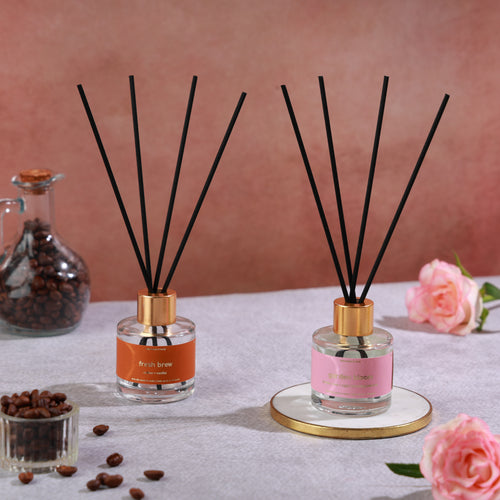
| 2. A 50ml reed · first bottle | Morning Freshness from ₹749, Garden Bloom or Evening Calm from ₹799, Fresh Brew or Mountain Breeze from ₹849 | As the proving bottle. Roughly three months, and a traveller needs the calendar time to judge it fairly | ₹749–849 |
| 3. Evening Calm · bedroom | Himalayan lavender and chamomile, alcohol-free, three reeds in a bedroom | The bedroom is the room you reliably occupy on the night you land. Flip it that evening | ₹799 |
| 4. A 130ml bottle · second purchase | Roughly six to seven months per bottle, at about ₹190 a month rather than ₹250 | Only after a 50ml of the same scent has run its course in your flat and you still like it | ₹1,249–1,349 |
| 5. 300ml refill and dry spare reeds | Alcohol-free reed oil by the bottle at ₹2,399, with fresh reeds in the box | Once you are refilling rather than replacing. Fresh dry reeds restore what a soaked one cannot | ₹2,399 |
| Not the answer: a reed for tonight | Twenty-four to seventy-two hours before a reed is working properly | Printed rather than implied. For tonight it is a candle at ₹379 or the Sukoon at ₹1,899, twenty minutes each | — |
Versailles
The instructions in a reed diffuser box are written for somebody who is in the room, and nobody has ever bothered to write the other version. So here it is: use half the reeds, flip them the night you get back, keep the bottle out of the sun, and cap it if you are gone for a month. That is the entire technique and all four parts of it are free. I would rather a customer with a demanding travel schedule got two years out of a ₹749 bottle standing in a cool corner than three months out of the same bottle on a sunny window ledge with eight reeds in it, even though the second customer spends eight times as much with me.
The one I feel most strongly about is the flipping, because it is the adjustment that costs nothing and is worth the most. Turning the reeds over is a dose, not a chore. It buys you a stronger day or two, and if you spend that on a Tuesday in an empty flat while you are in Chennai, you have simply thrown it away. Flip on the evening you walk in, put your bag down, and let the room be slightly more than usual for the two days you are most likely to notice it. Nobody in this industry tells people that, largely because it does not sell anything, and it happens to be the single most useful thing I know about reeds.
Everything is made and supported from Pune, and a part of every order funds girl-child education through Nanhi Kali. You get a home that smells like somewhere you chose; a girl gets a classroom. That equation has always felt right to me.
Frequently asked questions
- Whether leaving a reed diffuser out while travelling is wasting it — the same evaporation, costed honestly.
- Reed diffuser or Sukoon for coming home to a good-smelling flat — why presence decides that one.
- Sukoon or a reed if you travel ten days a month — the two-year arithmetic for the same reader.
- Whether to leave a reed in a guest bedroom nobody is using — a still, closed room, where the physics runs the other way.
- Brand: the SOSA founder story.
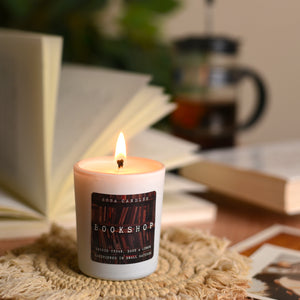
Facts verified August 2026: Timings in this guide: a scented candle puts noticeable fragrance into a normal room in roughly 15–20 minutes; a Sukoon ultrasonic diffuser reaches a steady level in about 20 minutes from cold; a reed diffuser needs roughly 24–72 hours for the oil to travel the reeds and the room to settle, so it is not a same-day solution. SOSA products and prices: Sukoon 500ml ultrasonic diffuser ₹1,899 (270–320 sq ft, 16–18h on low, 9–12h high, 30–50 ml/h, 2.4MHz cool mist, 7-colour LED, remote, steady/2H/4H timers, BPA-free, auto shut-off, includes three 15ml Hotel Collection scents of your choice); Boond 300ml ₹899; Megh 6-litre ₹3,499; waterless Vaayu ₹11,999 (up to 1000m³); Aangan ₹25,999; Meenar ₹38,500. Hotel Collection water-based fragrance 15ml ₹299, 100ml ₹999, 300ml ₹1,799, Pack of 7 at 15ml ₹1,799 / 100ml ₹5,999 / 300ml ₹10,799; dose 3–6 drops per tank. Reed diffusers (separate alcohol-free line): Morning Freshness from ₹749, Garden Bloom and Evening Calm from ₹799, Fresh Brew and Mountain Breeze from ₹849; 130ml from ₹1,249; duos from ₹1,498; 300ml refills ₹2,399. Scented candles: Bookshop 80g ₹379 (~15–18 hours), Bookshop + Cozy Corner ₹664 (~30–36 hours), Amber Rose 130g ₹599 (~25–30 hours) and 220g ₹799 (~40–50 hours), ceramic jar candles ₹949, Pure Calm wax melt set ₹854. Free shipping above ₹499. SOSA does not make a room or linen spray for the home — the sprays in the range are car perfumes. The Hotel Collection scents are SOSA's own interpretations; SOSA is not affiliated with or endorsed by any hotel brand. Prices subject to change — see the live product pages.