Founder Diaries · Clinics & Medical Centres · Arrival and the First Sixty Seconds
By Sonal Sahani · ISIPCA Versailles 11 min read Updated September 2026
All day, at one unchanging level, from thirty minutes before the first appointment until the last one — and then off. Peak-hours scenting sounds thrifty and is the opposite, because a fragrance that starts and stops twice a day gets noticed twice a day, and being noticed is the failure condition in a medical building. The savings are not where people think they are either. The real waste is at the other end: a machine left on the 24h setting, scenting an empty building from ten at night until seven in the morning, which roughly halves the life of a tank in exchange for nothing. This page is about the timer, the midday rule and the one dial you should touch.
Quick answers — read this first
The answer: all day at one level, T-30m to close, then off. A constant is not perceived; a change is. Peak-hours-only scenting is noticed at both ends of every session.
The timer: the
Vaayu has 1h, 4h, 8h and 24h onboard timers plus Bluetooth app scheduling. Use the app schedule for the opening hours, the 8h timer as a fallback, and do not use 24h in a clinic — a 400ml tank lasts about seventy-five days on opening hours against roughly thirty-seven run continuously.
The midday rule: nobody turns it up because the waiting hall got busy. Busy is an air-change and occupancy problem — the extract fan, the doors, the queue and the appointment spacing. Adding fragrance to a crowded room makes it worse.
The short answer
Short answer: all day, at a single low setting, stopping at close. The nose adapts to a steady background within a minute or two and reports change indefinitely, so a constant level is the one a patient never perceives — which is exactly what a medical building wants. Scenting only the peaks produces two audible transitions per session and saves almost nothing.
The setup: the
Vaayu at ₹11,999 on the app schedule for your opening hours — waterless, up to 1000 m³, under 38 dB, key-locked so the setting survives. Intensity is decided in the first week by walking in cold each morning, then locked. The 24h timer is the one setting a clinic should not use, because an empty building at two in the morning receives nothing and costs a refill.
Shop: the
Vaayu ₹11,999 (400ml ≈ 75 days on opening hours, four hotel-inspired scents included, 1h/4h/8h/24h timers plus app, auto-stop, key-lock) and the
Aangan ₹25,999 for up to 3,000 m³. The ultrasonic
Sukoon ₹1,899 is water-based and right for one administrative cabin with a named owner. Free shipping above ₹499.
Straight answer
Should a clinic run its scenting all day, or only during peak consultation hours?
1. All day, at one level, from T-30m to close. One schedule, one intensity, no adjustments. That is both the better result and the simpler thing to run, which in a clinic is not a coincidence.
2. A constant is not perceived. A change is. Olfactory receptors adapt to a steady stimulus within a minute or two, so a level that never moves becomes invisible. Start and stop it twice a day and you have manufactured four events, each of them in a room full of people who have nothing to do but notice.
3. The patient at 11:40 is not a lesser patient. A trough between sessions is still somebody arriving for a follow-up, a relative waiting for a report and a courier at the desk. There is no hour of your working day in which the building is allowed to present differently.
4. The savings from peak-only running are trivial, and the real waste is overnight. A 400ml tank lasts about seventy-five days on a clinic's opening hours. Left on the 24h setting it lasts roughly thirty-seven, which is eight refills a year instead of four to scent an empty building between ten at night and seven in the morning.
5. The midday rule: nobody turns it up because the hall got busy. A full waiting area at half past twelve is warmer, more humid and carrying more of what people bring in with them. That is an air-change and occupancy problem — check the extract fan, the doors, the queue and the appointment spacing. Adding fragrance to it makes the room worse rather than better.
6. And nothing in this schedule applies to the clinical half of the building. Consultation and examination rooms, procedure rooms, dressing rooms, sample collection, laboratories, dispensing, sterile stores, imaging, oncology day-care and paediatric clinical areas are fragrance-free at every hour of the day.
A portion of every order supports girl-child education through Nanhi Kali.
TL;DR: all day, at one level, from thirty minutes before the first appointment until close, then off. A constant is invisible and a change is not, so peak-hours scenting gets noticed at both ends of every session. Do not use the 24h timer: a 400ml tank runs about seventy-five days on opening hours against roughly thirty-seven continuously. And nobody turns it up at midday, because busy is a ventilation problem.
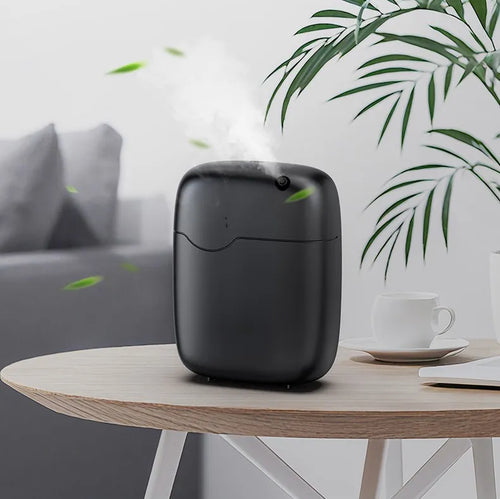
Twelve hours on, twelve hours off, four refills a year
SOSA Vaayu · 400ml ≈ 75 days ₹11,999
A 400ml tank lasts about seventy-five days on a clinic's opening hours, which is four refill visits a year per unit and a line procurement can model in ten minutes. Run the same machine around the clock instead and that becomes roughly thirty-seven days and eight refills, which is double the fragrance cost to scent an empty building between ten at night and seven in the morning for nobody at all. Set the schedule in the app to the opening hours, use the 8h onboard timer as the fallback, and leave the 24h setting for buildings that genuinely never close. A clinic is not one of those.
Why peak-hours scenting is noticed and all-day scenting is not
The peak-hours idea is almost always proposed by somebody sensible, and it comes from a sensible place: output costs money, the hall is empty at half past three, so why scent it. The flaw is that a fragrance system is not a light. A light that goes off in an empty room has done exactly what you wanted; a fragrance that goes off in an empty room leaves a volume that then has to be refilled while people are standing in it, and the refilling is the part anybody can perceive. You are not saving output. You are moving the machine's most visible behaviour from an empty building into a full one.
1
THE PERCEPTION
Adaptation is the mechanism, and it only works on constants
The physiology here is unglamorous and completely decisive. Olfactory receptors adapt. Present a steady stimulus and the reported signal falls away within a minute or two, which is why nobody who works in your clinic can smell it after a fortnight and why a visiting consultant can. What never adapts is change. A rising level is change. A falling one is change. And a room that has been unscented for three hours and is now being brought back up is a room in which every person present is receiving a moving signal, at the precise moment when they have nothing else to do. Waiting is the most attention-rich state a person is in all day. They have read the department board twice. They will notice. So the peak-hours plan produces the outcome it was trying to avoid: patients become aware that the building is being scented, which is the one thing a medical centre's air must never announce. The rule underneath all of this is the same one I would write into any clinic's SOP: a patient should not be able to tell you what the fragrance is, only that the place did not smell of anything unpleasant. A constant low level satisfies that. A schedule with edges in it does not. There is an operational version of the same argument, too — every additional state in a system is a state somebody can leave it in by mistake, and a machine that is supposed to be off between one and four will eventually be off between one and Thursday.
2
THE TIMER
1h, 4h, 8h, 24h — and the one a clinic should not use
So what should actually be programmed.
The Vaayu at ₹11,999 gives you 1h, 4h, 8h and 24h onboard timers plus Bluetooth app scheduling, and for a clinic the app schedule is the right tool: start thirty minutes before the first appointment, stop with the last one, six days a week, done. The 8h onboard timer is the sensible fallback for a building without a phone on site, covering the bulk of an OPD day. The 1h and 4h settings have a real use during commissioning week, when you want to run a level for a session and then stop and think about it. And the 24h setting is the one I would ask you not to use in a medical building.
The arithmetic is not subtle. A 400ml tank lasts about seventy-five days on a clinic's twelve opening hours, which is four refills a year per unit and a procurement line anybody can model. Run it around the clock and it lasts roughly thirty-seven days — eight refills a year — and the entire additional spend goes into a building with nobody in it. There is a second reason, which is that a scented empty building is a slightly odd thing for a night security guard, a cleaning contractor or an emergency callout to walk into at two in the morning. And a third: the point of the T-30m start is that the level arrives just before people do. A machine that never stops has no arrival, and you lose the ability to tell whether the setting is right, because nobody ever meets the room fresh.
What kind of diffuser suits a twelve-hour facility covers the machine side of this properly.
What I would put in the SOP, in one line: on at T-30m, off at close, six days a week, and nothing touched in between — including at lunchtime.
3
THE MIDDAY RULE
Busy is a ventilation problem, and turning it up makes it worse
Which brings us to the instruction that gets broken in almost every building that has ever installed scenting.
At half past twelve the waiting hall is full, the air has changed, somebody says the room smells crowded, and the nearest fix appears to be the intensity dial. It is not a fix. It is an addition to a room that is already carrying too much. Think about what has actually changed: forty people in a volume sized for forty seats, each of them adding heat and moisture, several of them arriving from a two-hour bus journey in a Pune summer, a door opening every thirty seconds, and an extract system that was specified for an average rather than a peak. What that room needs is air changes. What it is about to be given is a fourth smell on top of three.
The honest response to a crowded waiting hall is a list of unglamorous things: check the extract fan is running and that somebody has not switched it off because of the noise, check the door closers, check whether the queue has stacked into the lobby because a consultant started forty minutes late, look at appointment spacing, and count the chairs against the booking sheet. Keeping a busy waiting room from smelling crowded and
the hall that is fine at nine and stale by six are both this problem in different clothes, and in both cases the answer is air changes and occupancy rather than fragrance. And if the crowded smell has a specific source — a bin, a trap, a linen trolley parked in the wrong corridor — then it is information and it gets traced and corrected rather than covered, which in a medical facility matters more than anywhere else because the smell was the warning.
Four schedules, compared honestly
The four ways a clinic actually ends up running a machine, with what each costs in refills per year per unit and what a patient perceives. The fragrance consumption figures assume a 400ml tank and a twelve-hour opening day, which is the arithmetic the Vaayu is built around.
The schedule
All day, peak only, around the clock, or a morning spray
| Schedule |
What it costs per unit per year |
What a patient perceives |
Verdict |
| All day at one level, T-30m to close ★ |
About four refills — a 400ml tank runs roughly 75 days on opening hours |
Nothing. A constant is adapted to within a minute or two and never reported |
The answer. One schedule, one setting, locked |
| Peak consultation hours only |
Marginally less — the saving is a fraction of one refill |
Two transitions per session, in a room full of people with nothing to do but notice |
The perception cost far exceeds the saving |
| Around the clock on the 24h timer |
About eight refills, so roughly double |
Nothing in the daytime, and nobody at all between ten and seven |
Half the spend goes into an empty building |
| A morning spray at 8:45 |
Recurring, and SOSA does not make a room spray in any case |
Strong at nine, gone by ten, nothing for the rest of a twelve-hour day |
A twenty-minute product in a twelve-hour building |
| Turning it up when the hall fills |
Unpredictable, and it never gets turned back down |
A crowded room with an extra smell in it |
The rule most often broken. Busy is a ventilation problem |
| Any schedule at all in clinical rooms |
— |
— |
None of them. Those rooms are fragrance-free at every hour |
Shop this guide
Running the opening hours, in three products
The SOSA principle
A fragrance you can perceive is a fragrance that just changed. Everything a clinic wants from scenting lives in the part that never moves — which is why the schedule matters more than the setting.
One level, T-30m to close, six days a week, key-locked. No lunchtime adjustment, no overnight running, and nothing at all behind a clinical door.
The midday rule, and the one dial you should touch
There is exactly one dial in a well-run clinic scenting system and it gets touched during one week of its life. Commissioning week: for the first five working days, one person walks in from the street at T-0 and writes down a single word — too much, right, or nothing — and at the end of the week the intensity is set. Then the Vaayu's key-lock goes on and the dial stops existing. The lock is usually explained as protection from the public, and in a waiting hall with children in it that is genuinely part of it, but the person it most often protects you from is your own staff: within a fortnight nobody who works in the building can smell it, because a nose reports change and discards constants, and the natural consequence is a request to raise it from precisely the people least able to judge. Keep the key with the facilities lead rather than at the reception desk, write the setting number into the SOP so that a new supervisor can restore it after a service, and name the person who owns refilling and maintenance rather than assuming the role exists. The app matters here too: the facilities team can confirm the schedule ran without walking into reception, which means nobody is standing at the machine in front of patients fiddling with it.
Then the seasonal and building variables, which are the legitimate reasons a setting might be revisited — once a year, not once a week. A monsoon in Pune, Kochi or Kolkata changes the room: higher absolute humidity, doors kept shut, air conditioning working harder and recirculating more, and wet umbrellas and footwear arriving in the lobby at a rate the extract was never designed for. That is not a fragrance problem and turning the machine up will not touch it — it is a drying, matting and ventilation problem, plus a hard look at whether the air-conditioning drain pan has been serviced, since a musty ten minutes at start-up is very often a drain pan rather than the weather. In winter in the north the opposite applies: drier air, doors open more, and a level set in August may read slightly light in January. Revisit once, with the same walk-in-cold protocol, and change it once. The other legitimate variable is a change to the building itself — a new partition, a relocated seating bank, a reception desk moved three metres — because the gradient a single machine produces is a function of where it stands, and zoning a facility by distance rather than by scent explains why that geometry does more work than the intensity setting ever will.
Then the machine and format notes that follow from a twelve-hour schedule, because running time is what separates them. Twelve hours a day is the reason I keep steering clinics away from water-based machines for public areas, and the argument is housekeeping rather than hygiene. An ultrasonic consumes 30 to 50 millilitres of water an hour, so twelve hours is roughly four to six hundred millilitres into the air daily and a tank that must be emptied, rinsed and dried every evening by a named person — and in a monsoon month that daily water is a decision somebody should be making deliberately rather than by default. The Sukoon at ₹1,899 with its 500ml tank, 16–18 hours on low and steady, 2H and 4H timers, the Boond at ₹899 and the Megh at ₹3,499 are all honest for a single administrative cabin behind a door where that routine genuinely exists, and they take the water-based Hotel Collection bottles at three to six drops per tank. They are not the right category for a forty-seat hall running twelve hours. The waterless Vaayu takes its own undiluted oil instead, arrives with four hotel-inspired fragrances and runs about seventy-five days per 400ml fill. An alcohol-free reed diffuser from ₹749 has no schedule at all — it takes 24 to 72 hours to establish and then holds one level for months, which makes it a constant rather than a programme, and a cabin product rather than a hall one. Candles are not appropriate in a healthcare facility, since an open flame is a fire-safety and insurance matter. And SOSA does not make a room spray, which spares me having to explain why a twenty-minute product is the wrong shape for a twelve-hour day.
Peak-hours scenting does not save output. It moves the only part of the system a patient can perceive out of an empty building and into a full one.
— Sonal Sahani, SOSA
The SOSA edit
What to buy and how to run it, for a clinic deciding between all-day and peak-hours scenting. The first row is the schedule rather than a product, because the schedule is most of the answer. The last row is the setting I would ask you not to use.
The SOSA edit
The schedule, the machine and the lock, in order
| Buy |
What it is |
When it earns its place |
Price |
| 1. One schedule: T-30m to close ★ |
App scheduling on the Vaayu, or the 8h onboard timer as a fallback. One level, six days a week |
First, and it is free with the machine. A constant is never perceived; a change always is |
₹0 |
| 2. Vaayu for the public volume |
Waterless, up to 1000 m³, 400ml ≈ 75 days on opening hours, 1h/4h/8h/24h timers plus Bluetooth app, under 38 dB, auto-stop |
The machine for a twelve-hour building with no named person to empty a tank every evening |
₹11,999 |
| 3. The key-lock, used from week two |
Intensity set during commissioning week by walking in cold at T-0, then locked, with the number written into the SOP |
As soon as the setting is decided. Your own staff stop smelling the building within a fortnight |
included |
| 4. Sukoon for one administrative cabin |
500ml water-based ultrasonic, 270–320 sq ft, 16–18 hours on low, steady/2H/4H timers, three 15ml scents included |
Only behind a door, only where one named person empties, rinses and dries the tank daily |
₹1,899 |
| 5. 300ml refill four times a year |
Four refill dates per unit on the facilities calendar, each with an owner's name against it |
From installation. Eight dates a year means the machine has been left running overnight |
₹1,799 |
| Not recommended: the 24h setting |
Scenting an empty building from ten at night to seven in the morning, at roughly double the annual fragrance cost |
Declined rather than priced. A clinic closes, and the schedule should close with it |
— |
Honest notes for buyers: fragrance in a medical facility is housekeeping and presentation, never treatment. Nothing on this page claims that a fragrance reduces anxiety, aids recovery, improves sleep, cleans or disinfects air, or has any clinical effect whatsoever, because it does not and a diffuser is not an air purifier. Scenting belongs to the entrance, reception, shared waiting areas, inter-departmental corridors and administrative rooms. Consultation and examination rooms, treatment and procedure rooms, day-care surgery, dressing rooms, blood- and sample-collection rooms, laboratories, pharmacy dispensing, sterile stores, imaging rooms, oncology day-care and paediatric clinical areas should be left fragrance-free. A persistent smell is information about a dry drain trap, a bin, a soiled-linen route or an air-conditioning drain pan: find it and fix it rather than covering it. On the machines: the
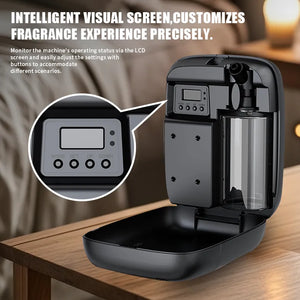
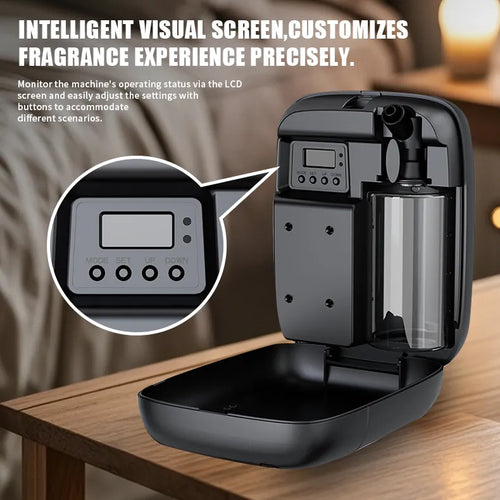
Vaayu at ₹11,999 is waterless cold-air nebulisation with no standing water tank, covering up to 1000m³ or roughly 2,000–3,000 sq ft, with a 400ml tank lasting about 75 days, Bluetooth app control, 1h/4h/8h/24h timers, under-38dB running, auto-stop and a key-lock for public areas. The
Aangan at ₹25,999 covers up to 3,000m³ and connects to HVAC for a whole floor or an atrium. The ultrasonic
Sukoon,
Boond and
Megh are water-based, hold standing water and add 30–50 ml of water an hour to the air, which makes them suitable for a single administrative cabin with a named person emptying and drying the tank daily, and unsuitable for public clinical property. An alcohol-free
reed diffuser needs 24–72 hours to establish and suits a small lobby rather than a large waiting hall. Candles are not appropriate in a healthcare facility because an open flame is a fire-safety matter. SOSA does not make a room spray. The Hotel Collection scents are SOSA's own interpretations inspired by the world's finest hotels; SOSA is an independent Indian fragrance house, not affiliated with or endorsed by any hotel brand. A portion of every order supports girl-child education through Nanhi Kali.

Where a water tank is still the honest answer
SOSA Sukoon · 500ml ultrasonic ₹1,899
A 500ml BPA-free tank, 270–320 sq ft, 16–18 hours per fill on low at 30–50 ml an hour, steady, 2H and 4H timers, auto shut-off and three 15ml
Hotel Collection scents of your choice included.
In a clinic this belongs in exactly one kind of room: a single administrative cabin, behind a door, with one named person who empties, rinses and dries the tank at the end of every day. Run it twelve hours in a public hall and you are putting four to six hundred millilitres of water into the air daily, which in a Pune or Kochi monsoon is a decision somebody should have made deliberately. Water-based bottles only, three to six drops per tank, never raw essential oils.
A note from Sonal
The phrase I hear most often in this conversation is that the clinic wants to be sensible about it, and the sensible-sounding proposal is nearly always to run the machine only when the hall is full. I have come to think of that as the most expensive economy in commercial scenting, because what it saves is a few millilitres of oil and what it spends is the only thing you were buying — invisibility. A clinic that smells the same at half past eight, at midday and at seven in the evening is a clinic nobody comments on. Get the schedule right and the setting becomes almost a detail.
The other half of the conversation is the lunchtime one, and I would rather say it plainly. When a waiting hall gets unpleasant at its peak, the fragrance is not the tool. It is a room with too many people, not enough air changes and a door that has been propped open since eleven, and the honest fixes are an extract fan, a door closer, the appointment book and possibly more chairs. Turning a diffuser up at that moment adds something to a room that is already carrying too much, and everybody in it will register the addition. I would rather lose the sale than have a centre spend ₹11,999 on the wrong side of that problem, and I have said so to people who were ready to pay.
Everything is made and supported from Pune, and a part of every order funds girl-child education through Nanhi Kali. You get a space that smells like somewhere looked after; a girl gets a classroom. That equation has always felt right to me.
Frequently asked questions
Should a clinic be scented all day or only during peak hours?
All day, at one unchanging level, from thirty minutes before the first appointment until close. The nose adapts to a constant within a minute or two and reports change indefinitely, so a steady level is the one nobody perceives. Peak-hours running creates two transitions per session in a room full of people who have nothing to do but notice them.
Should the diffuser run overnight in a clinic?
No. Use the app schedule or the 8h onboard timer and stop at close. A 400ml tank lasts about seventy-five days on a clinic's opening hours and roughly thirty-seven run continuously, which is eight refills a year instead of four to scent a building with nobody in it. The 24h setting is the one a clinic should not use.
Our waiting hall smells crowded at lunchtime. Should we turn the fragrance up?
No, and this is the most commonly broken rule in commercial scenting. A full hall is an air-change and occupancy problem: check the extract fan is actually running, check the door closers, look at whether the queue has stacked because a consultant started late, and count the chairs against the booking sheet. Adding fragrance to a crowded room makes it worse.
Peak-hour waiting-area odour goes through it.
Who should be allowed to change the setting?
One named person, using the key-lock, and ideally nobody after commissioning week. Set the intensity in the first five days by walking in from the street at T-0 and writing down one word, then lock it and write the number into the SOP. Within a fortnight your own staff cannot smell the building, so requests to raise it should be tested against a visitor rather than acted on.
Is an ultrasonic diffuser suitable for a clinic running twelve hours a day?
Not in public areas, and the reason is housekeeping rather than hygiene. An ultrasonic holds standing water and consumes 30–50 ml an hour, so twelve hours is four to six hundred millilitres into the air daily and a tank that must be emptied, rinsed and dried every evening by a named person. If that person does not exist, do not buy a water tank. It remains honest for one administrative cabin.
One level, twelve hours, then off
All day at one setting — and nothing touched at lunchtime
The Vaayu is ₹11,999: waterless cold-air nebulisation with no standing water tank, up to 1000 m³ or roughly 2,000–3,000 sq ft, a 400ml tank lasting about seventy-five days on a clinic's opening hours, Bluetooth app scheduling plus 1h/4h/8h/24h onboard timers, adjustable intensity, under 38 dB, auto-stop and a key-lock so the setting survives, supplied with four hotel-inspired fragrances. The Aangan is ₹25,999 for up to 3,000 m³. Free shipping above ₹499, and a portion of every order supports girl-child education through Nanhi Kali.
See the Vaayu · ₹11,999 The Sukoon · ₹1,899
Continue the read
More from SOSA
Editorial standards & sources
About this guide: Written by Sonal Sahani, ISIPCA Versailles-trained founder and perfumer at SOSA Home & Body, on why a clinic should run its scenting all day at one unchanging level rather than only at peak consultation hours, why the 24h timer is the wrong setting for a building that closes, what a 400ml tank actually costs per year on opening hours, and why a crowded waiting hall is a ventilation problem rather than a fragrance one.
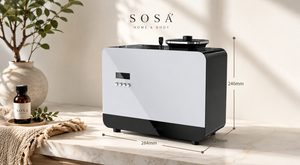
Facts verified August 2026: Product facts used in this guide. SOSA Vaayu ₹11,999: waterless cold-air nebulising diffuser, atomises undiluted fragrance oil to a dry residue-free nano-mist with no water reservoir, coverage up to 1000m³ (approximately 2,000–3,000 sq ft), 400ml refillable tank lasting up to about 75 days per fill, Bluetooth app plus onboard control, 1h/4h/8h/24h timer scheduling, adjustable intensity, under 38 dB, DC 12V/1A at 5W, 165 × 80.5 × 215 mm and 0.9 kg, freestanding or wall or HVAC mounted, auto-stop and key-lock, CE, RoHS and SGS certified, supplied with four hotel-inspired fragrances. SOSA Aangan ₹25,999: HVAC-connected or standalone commercial nebulising diffuser, coverage up to 3,000m³ (roughly 8,000–10,000 sq ft), 800ml reservoir, metal body, programmable schedules, under 42 dB. Ultrasonic machines are water-based, hold standing water and consume 30–50 ml of water an hour: Sukoon ₹1,899 (500ml, 270–320 sq ft, 16–18 hours on low, 3–6 drops per tank, steady/2H/4H timers, three 15ml Hotel Collection scents included), Boond ₹899 (300ml), Megh ₹3,499 (6 litres). Hotel Collection water-based fragrance 15ml ₹299, 100ml ₹999, 300ml ₹1,799, Pack of 7 at 15ml ₹1,799 against ₹2,093 bought singly; the Vaayu and Aangan take their own undiluted oil rather than these water-based bottles. Alcohol-free reed diffusers from ₹749, requiring 24–72 hours to reach their working level. Free shipping above ₹499. Coverage arithmetic: cubic metres equal floor area in square feet divided by 10.76 and multiplied by ceiling height in metres, counting only the volumes that are actually scented. This guide makes no medical, therapeutic or clinical claim of any kind for fragrance: a diffuser does not purify, disinfect or clean air, and does not treat, calm or affect any patient or condition. Fragrance is housekeeping and presentation. Clinical areas should be left fragrance-free, and a persistent odour should be traced to its source and corrected rather than covered. SOSA is not affiliated with or endorsed by any hotel brand. Prices subject to change — see the live product pages.