




The under-known one: floor drains and washing-machine outlets have water traps that seal your flat from the building's drainage. In an empty flat that water evaporates, the seal fails, and sewer gas comes back up into the room. Refilling them takes ten seconds and solves a smell people spend weeks blaming on damp.
Then scent: a reed diffuser from ₹749 or the Sukoon at ₹1,899. A diffuser running in a closed, unaired flat does not freshen it — it adds fragrance to stagnant air and holds the mixture there.
2. Then cross-ventilate, properly and for hours rather than minutes. Two openings on opposite walls with the internal doors wedged open, ceiling fans running, for as long as the weather allows, repeated over three or four days. A single open window barely moves air, because air needs an entrance and an exit before it will travel at all.
3. Run every exhaust fan while you do it. The bathroom and kitchen fans are the only mechanical extraction in most flats, and they give the air a directed way out instead of relying on weather.
4. Clean or replace the air-conditioner filter before you run the unit. A filter that has sat through a monsoon in a shut flat holds both dust and moisture, and switching the AC on without cleaning it distributes that through every room in about a minute. Wash it, dry it completely, then run the unit on fan-only for twenty minutes.
5. Wipe out the cupboard and wardrobe interiors, and leave the doors open. Enclosed volumes do not benefit from cross-ventilation unless you open them into it. This is also where you will find out whether there is any damp in the flat, because damp announces itself in a closed cupboard before it does anywhere else.
6. Only then add fragrance. A reed diffuser from ₹749, or the Sukoon at ₹1,899 for 270–320 sq ft with three 15ml scents included. A diffuser in a flat that has not been aired does not freshen the air — it concentrates it, and adds a smell to the mixture.
A portion of every order supports girl-child education through Nanhi Kali.

What actually happens in a flat with the door shut
It is worth understanding the mechanism, because it explains why the smell of a shut flat is so distinctive and so resistant to being cleaned away. A closed home is not a room that has gone stale in the way food goes stale. It is a fixed volume of air into which every material in the building has been slowly releasing itself, with no exchange to carry any of it away, for however many months the key was in somebody's drawer. Paint, plaster, plywood, adhesive, fabric, rubber seals, the inside of the fridge, the plastic of the switches — everything gives off traces of itself continuously, at a rate that is trivial when a window is open twice a day and cumulative when nothing ever leaves. Add a failed drain seal, a damp filter and a few months of settling dust and you have the four ingredients of that particular smell, which almost everybody recognises and almost nobody can name.
The five components, and the fix for each
What a shut flat is actually made of, separated out so you can work through it rather than treating it as one undifferentiated smell. The fourth column is how long each takes, and it is the honest reason this is a three or four day job rather than an afternoon. Only the last row costs money.
| Component | What it is | The fix | Time | Cost |
|---|---|---|---|---|
| No air exchange ★ | Every material in the flat releasing itself into a fixed volume for months, with nothing carrying it away | Two openings on opposite walls, internal doors wedged, ceiling fans on, in sessions across three or four days rather than one long one | Hours, over several days | Free |
| Dry drain traps | The water seal between your rooms and the building's soil stack evaporates in an empty flat, admitting sewer gas | A bucket of water down every floor drain, every tap and shower run for thirty seconds, the washing-machine outlet included | 10 minutes | Free |
| The AC filter | Months of dust held in a dark, enclosed box that has also been holding monsoon moisture | Wash the filter, dry it completely, run the unit on fan-only for twenty minutes with the windows open | 30 minutes plus drying | Free |
| Damp in weather-facing walls | A building problem rather than a housekeeping one, and it shows in closed cupboards first | Find it, photograph it, tell the landlord in week one. No fragrance affects damp in any way | An afternoon of looking | The landlord's |
| Settled dust | Months of accumulation on every horizontal surface, undisturbed | Wipe rather than sweep, and mop, after the first day of airing rather than before it | Half a day | Free |
| Bookshop candle, reed diffuser or Sukoon | Fragrance, which is the finishing layer and not one of the five problems above | Added last, once the flat smells of very little. A candle first as a test, at ₹379 | 15–20 min · 24–72 hrs · about 20 min | ₹379 / from ₹749 / ₹1,899 |
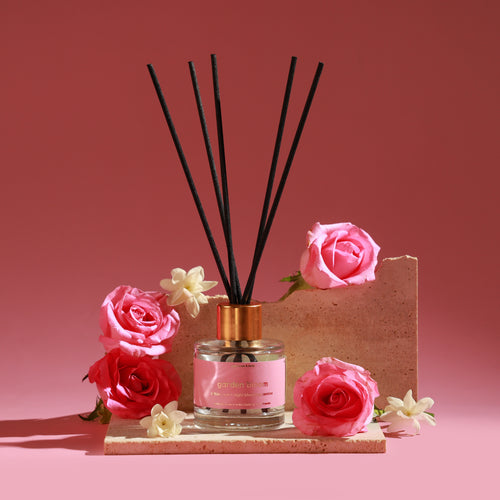 Reeds · settled by day threefrom ₹749Shop →
  Sukoon · timers and coverage₹1,899Shop → Bookshop · the readiness test₹379Shop →
The three-day sequence, and why a diffuser cannot do this job
Take the sequence as an actual timetable, because the order matters and the gaps between the steps matter as much as the steps. Day one, before anything else: the drains. A bucket of water down every floor drain in the flat, every tap and shower run for half a minute, both toilets flushed twice, and the washing-machine outlet found and filled even though it is behind the machine and inconvenient. Then open everything — two windows on opposite walls at minimum, internal doors wedged so there is a continuous path, ceiling fans on, bathroom and kitchen exhausts running — and leave it for as many hours as the weather and the neighbourhood allow. Day two: the enclosed volumes. Every cupboard, wardrobe and storage unit opened and wiped out, doors left standing open so their interiors are inside the airflow rather than sealed away from it, and the AC filter washed and dried. Then air again, because the surfaces have spent twenty-four hours releasing into the fresh air you introduced yesterday and there is a second wave to remove. Day three: dust and the check. Wipe and mop everything now rather than earlier, then light a Bookshop candle at ₹379 in the main room for twenty minutes, put it out, leave the room and come back. What you smell on returning is the honest state of the flat. If it is candle, you are finished. If it is candle over something flat, give it another day of air. This is the cheapest diagnostic instrument in the range and it is the reason I put a candle on a page that is otherwise about ventilation.
Then the reason the obvious shortcut does not work, stated plainly because a lot of people try it. A diffuser running in a closed, unaired flat does not freshen the flat. It is an ultrasonic humidifier with fragrance in it, and what it does is add a scent into air that is already saturated with everything else, and then hold that mixture at a steady level for as long as it runs. There is no extraction mechanism in a diffuser and nothing about it moves air out of the building; a cool mist at 30 to 50 millilitres an hour is putting water into the room, which in a damp-prone flat during monsoon is actively the wrong direction. The result is a room that smells of stagnation and jasmine at the same time, which the nose reads as one compound smell rather than as two, and the compound is worse than the original. The same logic applies to the more expensive version of the mistake, which is buying the biggest machine in the range. A Megh at ₹3,499 holds six litres and a Vaayu at ₹11,999 covers up to 1000 cubic metres, and neither of them is a ventilation device either — capacity buys hours and area, never freshness. The only tools that actually remove anything from a flat are an open window with a second opening opposite it, an exhaust fan, and a bucket of water in a drain trap. Once those have done their work, a Sukoon at ₹1,899 or a reed diffuser from ₹749 is a genuinely good purchase, and the difference between the two outcomes is three days rather than three thousand rupees.
Then the finishing layer and the constraints, briefly, because by this point the flat is doing most of the work itself. Once the air has turned over, start low: three drops of a Hotel Collection scent per tank rather than six, because a flat that has just been aired is unusually easy to over-scent — you have removed the background the fragrance was going to have to compete with, so the same dose reads considerably stronger than it would in an occupied home. The dose is per tank rather than per litre, since you are scenting the mist rather than the water, so a 300ml Boond at ₹899 takes the same three drops as the 500ml Sukoon; the bigger tank buys hours and coverage rather than intensity. Run the 2H timer in the evening rather than leaving the machine standing on. If you have gone the unplugged route, three or four reeds rather than the eight in the box, on a coaster, at waist height or above, at the edge of the room rather than in a doorway and out of the direct path of a fan — a draught strips the light top off a composition and leaves the heavy end standing on its own. On what goes where: the Hotel Collection is water-based and runs in the Sukoon, the Boond and the Megh only, never in a reed, which is a separate alcohol-free line with its own scents, and never in the waterless Vaayu, which takes its own undiluted oil. Raw essential and carrier oils clog a 2.4MHz misting plate, so keep them out. Rinse the tank when you change scent. Candles are attended and put out. And SOSA makes no room spray for the home — the sprays are car perfumes — which on this page is a mercy, because a spray is a thirty-minute product and the problem in a shut flat is measured in days.
The SOSA edit
In buying order for a flat that has been shut for months. The first three rows cost nothing and they are the whole answer for most readers; the fragrance rows exist for the week afterwards, and the last row is there because somebody always asks whether a bigger machine would have skipped the work.
| Do or buy | What it is | When it earns its place | Cost |
|---|---|---|---|
| 1. Water down every drain ★ | A bucket into every floor drain, every tap and shower run, the washing-machine outlet included | First, before anything else. Ten minutes, free, and it solves a smell most people spend weeks blaming on damp | ₹0 |
| 2. Cross-ventilation and the exhaust fans | Two openings on opposite walls, internal doors wedged, ceiling fans on, in sessions across three or four days | Second, and it is the largest effect available. One long session on one day is measurably worse than three shorter ones | ₹0 |
| 3. AC filter, cupboard interiors, dust | Filter washed and fully dried, wardrobes wiped and left open, everything wiped and mopped after the first airing | Third. The AC especially — switching it on before cleaning distributes months of damp dust in about a minute | ₹0 |
| 4. Bookshop candle | 80g scented jar candle, 15–18 hours of burn, scent in the room in 15–20 minutes | As the readiness test on day three, and as the first pleasant thing the flat has smelled of. Attended and put out | ₹379 |
| 5. reed diffuser or Sukoon | Alcohol-free reeds in five scents, or 500ml for 270–320 sq ft with timers and three 15ml scents included | Last, once the flat smells of very little. Set a reed up on day three and it comes good as the flat does | from ₹749 / ₹1,899 |
| Not a solution: Megh or Vaayu | Six litres at ₹3,499, or waterless coverage up to 1000m³ at ₹11,999 | Both are good machines for large spaces and neither moves air out of a building. Capacity buys hours and area, never freshness | ₹3,499 / ₹11,999 |
Versailles
The most useful sentence I have ever written to a customer had nothing to do with fragrance. She had taken a flat in Mumbai that had stood empty through a monsoon, described a smell in the bathroom that she was certain was damp in the wall, and asked which of my products would help with it. The answer was none of them, and what she needed was a bucket of water poured down the floor drain. She wrote back the next day to say it had gone. Nobody had ever told her that the bend under a drain holds a deliberate water seal, or that an empty flat lets that seal evaporate, and there is no reason she should have known it.
I think about that exchange whenever I am tempted to describe a fragrance as freshening a room, because it is not what fragrance does and pretending otherwise is how people end up disappointed. A shut flat has a concentration problem, and the only treatment for a concentration is exchange — two windows on opposite walls, the doors wedged, the fans on, repeated across several days. That is free, it is boring, and it works better than anything on my price list. What I sell begins afterwards, and it is a genuinely nice thing to arrive at: a flat that has been given its air back, and then given a scent you chose, in that order. Three days of open windows and then a reed on the sideboard is one of the most satisfying sequences in this whole business, and the first half of it is the half I did not sell you.
Everything is made and supported from Pune, and a part of every order funds girl-child education through Nanhi Kali. You get a home that smells like somewhere you chose; a girl gets a classroom. That equation has always felt right to me.
Frequently asked questions
- A rental that still smells like the previous tenant — the surfaces that hold a smell after the air has changed.
- The first home fragrance purchase after moving in — cardboard, off-gassing paint and the order of operations.
- Only ₹1,000 left after moving — is a reed worth it — the budget version of the same week.
- The best home fragrance purchase in your first week — the group's closing verdict.
- Brand: the SOSA founder story.
Facts verified August 2026: Timings in this guide: a scented candle puts noticeable fragrance into a normal room in roughly 15–20 minutes; a Sukoon ultrasonic diffuser reaches a steady level in about 20 minutes from cold; a reed diffuser needs roughly 24–72 hours for the oil to travel the reeds and the room to settle, so it is not a same-day solution. SOSA products and prices: Sukoon 500ml ultrasonic diffuser ₹1,899 (270–320 sq ft, 16–18h on low, 9–12h high, 30–50 ml/h, 2.4MHz cool mist, 7-colour LED, remote, steady/2H/4H timers, BPA-free, auto shut-off, includes three 15ml Hotel Collection scents of your choice); Boond 300ml ₹899; Megh 6-litre ₹3,499; waterless Vaayu ₹11,999 (up to 1000m³); Aangan ₹25,999; Meenar ₹38,500. Hotel Collection water-based fragrance 15ml ₹299, 100ml ₹999, 300ml ₹1,799, Pack of 7 at 15ml ₹1,799 / 100ml ₹5,999 / 300ml ₹10,799; dose 3–6 drops per tank. Reed diffusers (separate alcohol-free line): Morning Freshness from ₹749, Garden Bloom and Evening Calm from ₹799, Fresh Brew and Mountain Breeze from ₹849; 130ml from ₹1,249; duos from ₹1,498; 300ml refills ₹2,399. Scented candles: Bookshop 80g ₹379 (~15–18 hours), Bookshop + Cozy Corner ₹664 (~30–36 hours), Amber Rose 130g ₹599 (~25–30 hours) and 220g ₹799 (~40–50 hours), ceramic jar candles ₹949, Pure Calm wax melt set ₹854. Free shipping above ₹499. SOSA does not make a room or linen spray for the home — the sprays in the range are car perfumes. The Hotel Collection scents are SOSA's own interpretations; SOSA is not affiliated with or endorsed by any hotel brand. Prices subject to change — see the live product pages.