



Clean is one thing absent: soil on hard surfaces. That is a different job with a different tool.
Why the cleaning smell fades: it is a top note on a volatile carrier. It flashes off within about an hour and leaves you at the room's baseline — which is the slow emission of every textile in it.
2. You are smelling your own textiles, and they are the baseline. A room with no problem in it still has a smell, and it is the sum of everything porous in it emitting slowly: curtains, sofa fabric, cushion covers, rugs, the mattress. That baseline is not unpleasant. It is simply neutral and slightly lived-in, and it is what you notice once the cleaning products have gone quiet.
3. The cleaning smell was never the fix. Floor cleaners and surface sprays carry bright, volatile top notes chosen to signal that work has been done. They evaporate quickly and are largely gone within the hour. What you register as the house not smelling fresh is very often just that marker leaving, and the room returning to its own baseline — which was there the whole time.
4. Dry is a bigger part of fresh than most people realise. Damp towels, a folded mop, laundry drying indoors, curtains that never quite dry out in the monsoon and a mattress that has not seen sun in a year all read as heaviness rather than as a smell. Humidity also raises how strongly you perceive everything else. A genuinely dry flat smells lighter than a genuinely clean one.
5. And the third signal is the one you buy. Once the air moves and the textiles are dry and clean, adding a low consistent note is not covering anything — there is nothing left to cover. That is the honest case for a reed diffuser or a Sukoon, and it is different from every other question in this cluster.
Made in India, composed by an ISIPCA Versailles-trained perfumer — and a portion of every order supports girl-child education through Nanhi Kali.
Why clean and fresh are two different measurements
Ask someone to describe a fresh-smelling room and they will not describe an absence. They will say it smells of air, or of clean laundry, or of something light in the background they cannot quite name. Ask them to describe a clean room and they will describe the absence of dust, grease and mess. These are opposite kinds of statement, and only one of them can be produced by cleaning. A mop removes soil from hard surfaces; it cannot put anything into the air except the water and detergent it is carrying, and both of those leave within the hour. This is why the reward for an entire morning of work is about sixty minutes of a citrus-scented floor cleaner and then a room that smells exactly as it did before, minus nothing you could point at.
What you are left with is the room's baseline, and the baseline is textiles. Porous materials absorb odour molecules and release them slowly over days, so a home with curtains, upholstery, rugs, cushions and bedding in it has a permanent low-level emission that is nobody's fault and does not respond to cleaning hard surfaces. In most homes it is entirely neutral — not unpleasant, just inert. Add to that a closed flat sitting at 0.2 to 0.5 air changes an hour, which is a stillness the body reads as stuffiness independently of any actual odour, and you have the precise experience being described here: immaculate, faintly heavy, and characterless. Three things are missing, and cleaning was never going to supply any of them.
The three signals that make a room read as fresh
 Signal three50ml ₹749A room that has not exchanged its air in twelve hours feels different to be in, and people report that as a smell even when nothing measurable is there. The remedy is the same as everywhere else in this cluster and it costs nothing: two openings on opposite sides of the home, internal doors open between them, five to ten minutes twice a day. That takes you from roughly 0.2–0.5 air changes an hour to somewhere between 3 and 8. Do this before you spend anything, because it changes the baseline that everything else sits on top of.
Symptom to cause: what exactly is missing
These rows are not faults. They are gaps — each one names a signal that is not being supplied and the cheapest way to supply it.
| What you notice | Most likely cause | How to confirm it | What actually fixes it |
|---|---|---|---|
| Nothing smells bad, the place just feels flat and characterless ★ | No positive signal at all — you removed the negative and stopped there | Cross-ventilate for ten minutes and notice whether the flatness lifts | Air movement first, dry textiles second, a consistent note third |
| Smells lovely for an hour after cleaning, then nothing | The cleaning product's top note flashing off and leaving the baseline | Note the time it fades. It will be roughly the same interval every week | Stop treating the cleaner as the fragrance; supply the note separately |
| Fresh in the morning, inert by mid-afternoon | The morning ventilation has worn off and nothing replaced it | Add a second ten-minute airing at around five and compare | Two air changes a day; a continuous emitter rather than an occasional spray |
| Visitors say it smells nice and you cannot smell anything | Olfactory adaptation — you are adapted to your own baseline within twenty minutes | Leave for half an hour and judge the first breath back in | Trust the visitor. Do not increase the dose to something you can smell |
| Heavy and flat specifically in the monsoon, however clean | Humidity keeping textiles from drying and raising perceived intensity | Compare the same rooms in a dry month against a wet week | Reduce added moisture, run exhausts longer, ventilate in dry windows |
| Faintly musty rather than merely neutral | Damp or early mould — a health issue, not a freshness gap | Check behind wardrobes on external walls, under sinks, at ceiling corners | Find the moisture and remove the growth before adding anything at all. |
| If none of these fit: ask someone who does not live with you. A visitor who has just walked in is the only calibrated instrument available, and their answer to "does this smell of anything?" is worth more than a week of your own guessing. | |||
 Reeds · always-on roomsFrom ₹749Shop →
  Sukoon · when you want a switch₹1,899Shop →
  Hotel Collection · the scentFrom ₹299Shop →
Supplying what is missing, in order
First, supply air. This is free, it takes ten minutes, and it changes the baseline everything else sits on. Two openings on opposite sides of the home, every internal door between them open, five to ten minutes in the morning and again in the late afternoon. If your flat is single-aspect, put a fan in a window facing outwards and run the kitchen and bathroom exhausts with those doors open. The difference between a still room and a recently ventilated one is perceptible immediately and it is the largest single component of what people mean by fresh.
Second, supply dryness. Bedding weekly and dried properly. Towels hung out rather than folded damp. Cushion covers monthly. Curtains at least seasonally. Upholstery vacuumed with the brush attachment. Rugs and mattresses into direct sunlight whenever the weather allows. Pillows washed or replaced on a schedule, because the pillow itself is the most-used and least-treated textile in the house. In humid months, focus on not adding moisture: no washing dried in a closed room, longer exhaust runs after showers, and airing during whatever dry spell the day gives you.
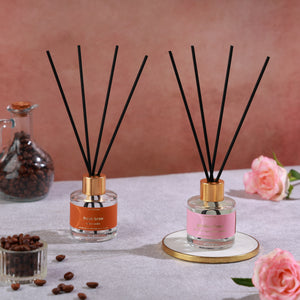
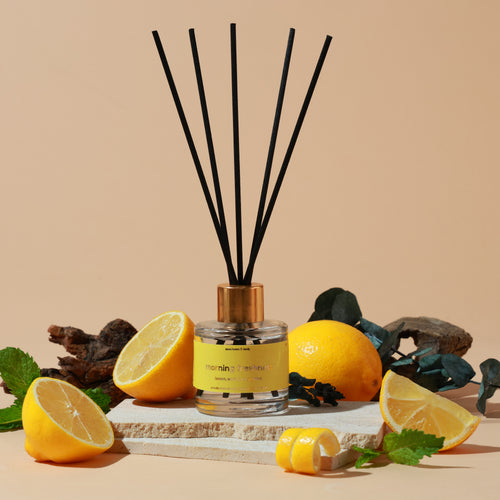
Third, supply the note — deliberately, and quietly. This is the step where a purchase is genuinely the answer rather than an evasion, because there is no problem being masked. What you want is consistency rather than strength: a reed diffuser from ₹749 runs continuously on capillary action with nothing to switch on, covers a room of up to roughly 150 sq ft on six reeds, and lasts 6–8 weeks at 50ml or 14–18 at 130ml from ₹1,249. Use fewer reeds if it is noticeable rather than more — four in a bedroom, two or three in a small bathroom. If you would rather have the note only when people are home, the Sukoon at ₹1,899 with a Hotel Collection scent from ₹299 covers roughly 270–320 sq ft and switches off. Neither removes anything from the air, which in your case is exactly the point — there is nothing to remove.
What to do, in order
The order is the same as everywhere else in this cluster, but the emphasis is different: here the first steps are quick because there is no fault to find, and the last step is the one that actually answers your question.
| Step | What to do | When | Cost |
|---|---|---|---|
| 1. Remove the source | A quick confirmation that there is genuinely no source: unused drains, the bin, the washing-machine gasket, under the sink | Before anything else | ₹0 |
| 2. Move the air | Ten minutes of cross-ventilation twice a day — this is the largest single component of what people call fresh | Daily, five to ten minutes | ₹0 |
| 3. Deal with what holds it | Bedding weekly, pillows on a schedule, cushion covers monthly, curtains seasonally, rugs and mattresses sunned | Weekly to monthly | ₹0 |
| 4. Then the always-on layer ★ | A SOSA reed diffuser — the consistent low note that cleaning cannot supply — always there, nothing to operate, nothing to remember | 50ml 6-8 weeks · 130ml 14-18 | from ₹749 |
| 5. Or the on-demand layer | Sukoon with a Hotel Collection scent — the same note on a switch, for homes that would rather have it only in the evening | Run it when you want it | ₹1,899 |
Versailles
Most of what I write in this cluster tells people not to buy anything yet. This one is the exception, and I want to be clear about why rather than just taking the opportunity. Everywhere else there is a source, and fragrance over a source makes things worse. Here there is no source. You are not asking me to hide something; you are asking me to supply something that was never there. That is a fair thing to buy.
The trap in this particular question is reaching for intensity. When a home smells of nothing, the instinct is to get something strong enough to be obvious, and that is how you end up with a hallway that announces itself. Consistency is what reads as a considered home. A quiet note that is the same every day disappears into the character of the place; a strong one that changes weekly reads as air freshener. Use fewer reeds than you think you need and let it be background.
And do the free part first, honestly. If you buy a diffuser for a flat that has not had its windows open in a week, you will get a scented still room and you will conclude the diffuser is weak. Air it, dry the textiles, then add the note — and judge the result after being out of the house for half an hour, because you cannot smell your own home. A portion of every order funds a girl's classroom through Nanhi Kali.
Frequently asked questions
- Why does my house smell stale even though I clean it every day? — when there is a source.
- How do I find the source of a stale smell? — the room-by-room method.
- Keeping it fresh once the smell is gone — the maintenance routine.
- Clean but never hotel-fresh — what hotels do differently.
- Brand: the SOSA founder story.
SOSA products & prices (verified August 2026): Hotel Collection water-based ultrasonic diffuser fragrance 15ml ₹299 · 100ml ₹999 · 300ml ₹1,799 · Pack of 7 (15ml, all fragrances) ₹1,799; refills 100ml from ₹999. Seven scents: The Ritz-Carlton-inspired (white tea · bergamot · cedar), Westin-inspired (white tea · aloe · cedar), 1 Hotels-inspired (cedarwood · vetiver · green leaves), The St. Regis-inspired (amber · violet · woods), Shangri-La-inspired (jasmine · green tea · white tea), Four Seasons-inspired (citrus · floral · sandalwood), W Hotels-inspired (citrus · pepper · amber). Diffusers: Boond 300ml ₹899 · Sukoon 500ml ₹1,899 · Megh 6L ₹3,499. Water-based, phthalate-free, composed to IFRA standards for home diffusion; 3–6 drops per tank. Made in India, Pune. The Hotel Collection scents are SOSA's own interpretations inspired by the world's finest hotels; all hotel names are trademarks of their respective owners and are used only to describe the scent style — SOSA is an independent Indian fragrance house, not affiliated with or endorsed by any hotel brand. Prices and availability subject to change — see the live product pages.