My Guest Bedroom Stays Closed Most of the Month — How Do I Freshen It Before Someone Arrives?

My Guest Bedroom Stays Closed Most of the Month — How Do I Freshen It Before Someone Arrives?

★ ★ The guest bedroom · a room that has been shut for weeks, and someone arriving on FridayCandle ₹379 · reed ₹749 · Boond ₹899 · Sukoon ₹1,899 · free shipping above ₹499A portion funds girl-child education
★ SOSA · when people are coming over
A closed room does not need fragrance first. It needs air, then light, then fragrance — in that order, and the order is the whole job
★ ★ ★ ★ ★
★★★★★
"My spare room smelled shut. Opened it Thursday morning for the whole day, changed the bedding, then put the reed in. Guest said it felt like a hotel."
Kavya S. Guest room, Pune
Air first, then reed
★★★★★
"Three nights, so a reed made more sense than anything I would have to remember. Set it up two days early so it was actually working by the time she arrived."
Manav J. 3-night guest
Reed · set up early
★★★★★
"I did not know what scents my guest liked, so I went with the most neutral thing in the range. Nobody has ever objected to clean."
Farah A. Neutral pick, Mumbai
Westin-inspired
★★★★★
"My guest has a sensitive nose. Aired the room properly and used almost nothing. That was the correct answer and it cost me nothing."
Deepak R. Sensitive guest, Bengaluru
Air, barely any scent
★★★★★
"Room gets used twice a month. A reed at ₹749 that just sits there beats anything I have to set up each time."
Sneha M. Occasional guest room
Reed · ₹749
★★★★★
"Wanted it to feel like a hotel room for under ₹1,000. A reed, fresh bedding and an aired room did it. No decor spend at all."
Rajat K. Under ₹1,000, Delhi
Hotel feel, low spend
★★★★★
"My spare room smelled shut. Opened it Thursday morning for the whole day, changed the bedding, then put the reed in. Guest said it felt like a hotel."
Kavya S. Guest room, Pune
Air first, then reed
★★★★★
"Three nights, so a reed made more sense than anything I would have to remember. Set it up two days early so it was actually working by the time she arrived."
Manav J. 3-night guest
Reed · set up early
★★★★★
"I did not know what scents my guest liked, so I went with the most neutral thing in the range. Nobody has ever objected to clean."
Farah A. Neutral pick, Mumbai
Westin-inspired
★★★★★
"My guest has a sensitive nose. Aired the room properly and used almost nothing. That was the correct answer and it cost me nothing."
Deepak R. Sensitive guest, Bengaluru
Air, barely any scent
★★★★★
"Room gets used twice a month. A reed at ₹749 that just sits there beats anything I have to set up each time."
Sneha M. Occasional guest room
Reed · ₹749
★★★★★
"Wanted it to feel like a hotel room for under ₹1,000. A reed, fresh bedding and an aired room did it. No decor spend at all."
Rajat K. Under ₹1,000, Delhi
Hotel feel, low spend
✓ Reed diffusers: no electricity, no routine, steady for months · from ₹749 ✓ Sukoon ₹1,899 · 270–320 sq ft · 16–18 hours per fill · three 15ml scents included ✓ Air the room first · fragrance layers on clean air, it does not replace it


Founder Diaries · Home Fragrance · The Guest Bedroom
By Sonal Sahani · ISIPCA Versailles 11 min read Updated August 2026
A room that has been shut for three weeks does not smell of nothing, and it is worth knowing exactly what it does smell of before you decide what to do about it. Two things are happening. The air has not been exchanged, so nothing that enters it ever leaves; and every soft or porous object in there — mattress, pillows, curtains, the rug, the inside of the wardrobe, the stack of bedding on the shelf — is slowly releasing traces of itself into that unmoving air, all month. In a humid stretch there is a third component, a low biological one living in the fabric itself. None of the three is fixed by fragrance, and fragrance added on top of them makes a smell that is more complicated rather than better. What follows is the order of work, with the products at the end where they belong.
Quick answers — read this first
What you are smelling: stagnant air, plus slow off-gassing from textiles — mattress, pillows, curtains, rug, wardrobe interior and stored bedding — plus, in humid months, a low microbial note in the fabric.

What actually fixes it: cross-ventilation with the window and the door both open for a couple of hours, not ten minutes. Mattress and pillows stood up in the moving air, and in sunlight if you have any. Bedding washed rather than lifted off the shelf. The inside of the wardrobe wiped and left open.

Then, and only then, fragrance: Evening Calm at ₹799 if you have two or three days, a Bookshop candle at ₹379 if you do not. Fragrance in a room that has not been aired produces a worse smell, not a better one.
The short answer
Short answer: air it properly first. Open the window and the door of the room together, plus something on the far side of the flat, and leave it for two hours — a single cracked window does very little, because air needs both an entry and an exit before it moves at all. Then stand the mattress up, wash the bedding, wipe the inside of the wardrobe, and add fragrance last.
The pick: Evening Calm at ₹799 for 50ml if you are doing this two or three days ahead, since a reed needs 24 to 72 hours to reach its working level. Mountain Breeze at ₹849 if you want the room to read as dry and aired rather than scented. A Bookshop candle at ₹379 if the guest arrives tomorrow and the reed window has gone.
Shop: reed diffusers from ₹749 for 50ml and ₹1,249 for 130ml, duos from ₹1,498, 300ml refills ₹2,399. Bookshop candle ₹379 for roughly 15–18 hours. Boond ₹899 and Sukoon ₹1,899, both running the water-based Hotel Collection from ₹299 at three drops per tank. Free shipping above ₹499.
Straight answer
How do I freshen a guest bedroom that stays closed most of the month, before somebody arrives?
1. Open it properly, which means two openings and two hours. The window and the door of the room at the same time, plus something open on the far side of the flat so the air has a path across it. One window on its own gives you a trickle. Two openings on different faces give you actual exchange.

2. While it is open, stand the mattress on its side and put the pillows in the moving air. A mattress lying flat only breathes on one face, and its underside has been against a slatted base in a shut room all month. Sunlight helps more than anything else you can do to it.

3. Wash the bedding rather than taking it off the shelf. Stored cotton smells of the cupboard, not of the last wash. If there is genuinely no time to launder it, hang it in the open air for a few hours the day before, which is a real improvement even though it is not a substitute.

4. Open the wardrobe and wipe the inside of it. A closed wardrobe inside a closed room is the most stagnant volume in the flat. A damp cloth along the shelves and base, then left open for the whole airing, removes a surprising amount of what you have been smelling.

5. Then, last, fragrance — and match it to how much time you have. Evening Calm at ₹799 if the visit is two or three days away, because a reed diffuser needs 24 to 72 hours. A Bookshop candle at ₹379 for twenty minutes if it is tomorrow.

6. Do not do step five before steps one to four. Fragrance in an unaired room does not improve the smell — it adds a second one to it, and the pair together is more noticeable than the closed room was on its own.

A portion of every order supports girl-child education through Nanhi Kali.

TL;DR: a closed room smells of unexchanged air plus everything the textiles have been quietly giving off into it. Cross-ventilate for two hours with the window and door both open, air the mattress, wash the bedding, wipe the wardrobe. Fragrance is the last step and it fixes none of the others.
Mountain Breeze · reed diffuser
The bottle for a room you want to read as aired
Mountain Breeze · reed diffuser ₹849 / 50ml
Himalayan pine, sage and cedar — the driest thing in the reed line. For a room that has been shut, dryness is doing something specific: it reads as air rather than as perfume, so the room comes across as freshly opened instead of freshly scented, which is the impression you actually want when somebody walks into a spare bedroom. Sweet or floral notes over a closed room read as a cover-up even when the room has been thoroughly aired, because that is the association people bring with them. Alcohol-free, no electricity, three reeds rather than eight, and set up two to three days before the visit. ₹849 for 50ml and ₹1,349 for 130ml.

What a closed room is actually made of

The phrase people use is closed-room smell, and it is treated as though it were one thing. It is not; it is three, and they respond to completely different interventions, which is why so much advice on this subject fails. The first is simply air that has not been exchanged. The second is the slow, continuous release of volatile material from every porous object in the room into that unmoving air — this is the part people underestimate most, and it is the reason a room can be spotlessly clean and still smell shut. The third, in humid months and in flats with a damp wall, is biological: a low, earthy note produced by organisms living in textiles that never fully dry. Work out which of the three you have, because the first takes two hours, the second takes a laundry cycle and some sunlight, and the third takes a different kind of attention altogether.

1
THE AIR
Two openings and two hours, not one window and ten minutes
Start with the mechanism, because it explains why the usual advice does not work. Air does not move through a room because there is an opening in it. It moves because there is a difference in pressure across two openings, and a single window with the door shut gives you almost nothing but a slow exchange at the opening itself. You can stand in a room with one window wide open for an entire afternoon and find the far corner unchanged. What you need is a path: the window open, the door of the room open, and something else open on the other side of the flat, so that the whole floor plate has a through-draught and the room is a section of it rather than a dead end. Two hours, not ten minutes, and the reason is that you are not just replacing the air — you are giving the textiles time to release into moving air rather than into still air, which is the part that actually changes how the room smells tomorrow. Ten minutes swaps the air and the fabrics refill it within the hour. Two hours starts to empty the fabrics themselves. If the room has been shut for a month rather than a week, do this on two consecutive days, and do the second one on the morning of the arrival rather than the night before. A ceiling fan on low while the window and door are open helps considerably, because it keeps the air in the room turning over instead of stratifying, and it is the one piece of equipment nearly every Indian bedroom already has.
2
THE TEXTILES
The mattress, the pillows and the pile of bedding on the shelf
Then the objects, which is where a closed room's character actually comes from. A mattress is the largest piece of fabric you own and it spends the month lying flat on a slatted base in a shut room, breathing on one face only. Stand it on its side against a wall for the whole time the room is open, so both faces get moving air, and if there is any sun at all falling into that room, put the pillows in it. Sunlight does something to fabric that no product replicates, and an hour of it on a pillow is worth more than anything I could sell you for the same room. Give the pillows the press test before you decide you are finished: hold one against your face for five seconds. If it smells of anything at all, it is the loudest object in the room, because it is the one thing your guest's face will actually be against for eight hours — and a fresh pillowcase over a stale pillow is not a solution, it is a delay. Then the bedding. Cotton that was washed in April and folded on a shelf since then smells of the shelf, not of the wash, because the fibre is hollow and absorbent and it takes up whatever atmosphere it is stored in — wood, plastic bag, naphthalene, still cupboard air. Wash it the day before and dry it outdoors if you possibly can. If there is no time for a wash, hang it in moving air for three or four hours, which is a genuine improvement and an honest second best. Curtains and the rug are the same story at a slower rate; a rug nobody walks on is never disturbed, so it holds everything that settles on it.
3
THE WARDROBE AND THE DAMP
A closed box inside a closed room, and the note that means something else
Two things left, and the second one matters more than its size suggests. A wardrobe in a guest room is a sealed volume inside a sealed volume, opened perhaps twice a year, usually containing the household's overflow: old bedding, a suitcase, winter clothes, sometimes camphor or naphthalene. It is the most stagnant air in the flat, and every time somebody opens that door a quantity of it enters the room. Open it at the start of the airing and leave it open the whole time. Wipe the shelves and the base with a damp cloth and let them dry with the door open — dust and old paper dust sit there in quantity and both smell more than people expect. If there is stored bedding inside, take it out for the airing rather than leaving it in there absorbing the same air it has been absorbing all month. Then the third component, and this is the one where I would tell you to stop and deal with it rather than proceeding: if the smell is distinctly musty rather than merely stale — earthy, mushroomy, the smell of an old book left in a bathroom — that is biological, and it means moisture is getting into something and not leaving. Check the wall the room shares with a bathroom at skirting height with a flat hand; check the outward-facing wall if it takes the monsoon; check the underside of the mattress and the back of any furniture standing against an external wall. And check the air-conditioner, if there is one that has not run since last summer. Musty is a source, not a smell, and a reed diffuser placed on top of a source is the single most common mistake in this entire category.
The two-hour version, if that is all you have: window and door open with the fan on low, mattress on its side, pillows in the sun, wardrobe open, bedding in the machine, surfaces and wardrobe shelves wiped. Close it up half an hour before they arrive and light a candle for twenty minutes. That is a genuinely different room from the one you started with.

Source by source, and what fixes each one

The closed-room smell broken into its actual components, with the honest fix beside each. The final column is the one I would like read carefully, because it is the same answer five times and that repetition is the entire argument of this page — fragrance is a finish, and it is not a remedy for any of the first five rows.

Diagnosis
What is producing the smell, and what actually removes it
Source What it smells like What removes it How long Does fragrance help?
Unexchanged air ★ Flat, slightly warm, faintly dusty — stale rather than dirty Cross-ventilation: window and door both open, plus an opening across the flat, fan on low 2 hours No. This is the one thing that has to happen before anything else works
Mattress and pillows Faintly sweetish and personal, strongest when you press your face into it Stood on its side in moving air for the whole airing; pillows in direct sun if the room gets any 2–4 hours, longer is better No. A fresh pillowcase over a stale pillow is a delay, not a fix
Stored bedding The cupboard: wood, plastic, sometimes naphthalene A 40-minute wash and drying in outdoor air. Failing that, three or four hours hung in the open A wash cycle No, and a linen spray is the wrong tool — the smell is inside the fibre
The wardrobe interior Concentrated, older and drier than the room; hits you when the door opens Emptied, wiped with a damp cloth, left open through the airing 30 minutes plus drying No. Scenting a wardrobe gives you two smells inside one box
Rug, curtains, upholstery Dusty, slightly flat, noticeable when disturbed Vacuumed or beaten, then aired. A rug nobody walks on is never disturbed and holds everything An hour No, though textiles do hold fragrance well once they are clean
Damp — a shared bathroom wall, a monsoon wall, an unused air-conditioner Musty and earthy rather than stale. Old paper, mushrooms, a wet cupboard Find and fix the moisture. This is a repair, not a cleaning task Days, and sometimes a plumber Absolutely not. Fragrance over damp produces a compound smell that is worse than the damp alone
Shop this guide
After the airing, in three products
The SOSA principle
Fragrance in an unventilated room does not replace the smell that is there. It joins it. And a guest can always tell which half arrived first.
Which is why the order on this page is not a stylistic preference. Air, then fabric, then the wardrobe, then any damp — and the product only once those four are settled.

The order of work, and where fragrance goes

Here is the whole sequence as I would actually do it, assuming a guest arriving on Friday evening and a room that has been shut since the last visit. Wednesday morning: open the window, open the door, open anything on the far side of the flat, put the ceiling fan on low, stand the mattress against the wall, take the pillows to whatever sun exists, empty the wardrobe and leave it open. Leave all of that for two hours minimum. While it is open, wipe the wardrobe shelves, the top of the wardrobe, the windowsill, the skirting behind the bed and the underside of the bedframe, all with a damp cloth rather than a dry one, because a dry cloth relocates dust rather than removing it. Vacuum or beat the rug outside. Wednesday evening, if you are using a reed diffuser, set it up now — three reeds, two metres from the head of the bed, on a coaster, flipped once and then left alone — because you need the 24 to 72 hours and Wednesday to Friday is at the sensible end of that window. Thursday: bedding into the machine and out onto a line, mattress back down, room shut again to keep the day's dust out. Friday morning: make the bed with the washed linen, another half hour of cross-ventilation if you can manage it, clear a surface, fill a jug of water. The whole thing is about three hours of work spread over three days and almost none of it costs anything.

If you are on a shorter timescale, the order stays the same and the products change. With a day, drop the reed entirely — twenty-four hours is the very bottom of its range and you will spend ₹799 on something that is only starting to work as your guest goes to bed — and use a Bookshop candle at ₹379 for twenty minutes in the room while you are making the bed, or a Boond at ₹899 or Sukoon at ₹1,899 for the hour before they arrive, both of which reach a steady level in about twenty minutes from cold. On dose: three drops of a Hotel Collection scent per tank in a bedroom, not six, and the dose is per tank rather than per litre, so the 300ml machine and the 500ml one take the same three drops — the bigger tank buys hours and coverage, never intensity. Put the machine at waist height or above and away from the bed, because cool mist falls rather than rises and a diffuser on the floor is scenting a rug. Keep it out of the direct path of the fan you were running earlier, since moving air strips the light top off a composition and leaves the heavy end standing on its own, which is how a perfectly reasonable scent starts reading as thick. And put the candle out and take it downstairs before anybody goes up to bed; a candle in a room a guest is sleeping in is both a hazard and a small obligation you have handed to somebody who came here to relax.

Two constraints and then the principle. The first is that you are not a reliable judge of your own guest room, and the way it fails is specific: you go in, notice the closed smell for about fifteen seconds, and then stop perceiving it entirely, because a nose reports change and discards constants. Fifteen seconds later you are standing in a room that seems fine to you, and half an hour after that you have convinced yourself it was never that bad. So make the judgement in the first breath, once, on the way in from outside — and if you want a second opinion, ask somebody who does not live in the flat and ask them to be rude about it rather than kind. The second is the equipment, which is worth stating because people mix these up: the Hotel Collection is water-based and runs in the Sukoon, the Boond and the Megh only. It does not go into a reed diffuser, which is a separate alcohol-free line with its own scents, and it does not go into the waterless Vaayu. Raw essential and carrier oils clog a 2.4MHz misting plate, so keep them out of the tank, and rinse it when you change scent. The principle is the one the whole cluster is built on and this page is the clearest case of it: fragrance is a finishing layer over air that is already clean and moving. A closed guest bedroom is the single most common situation in which people try to use it as a substitute for that, and it is the situation in which it fails most visibly.

A closed room can be perfectly clean and still smell shut, because what you are smelling is not dirt. It is a month of everything in the room quietly breathing into air that never left.
— Sonal Sahani, SOSA

The SOSA edit

In buying order for a guest bedroom that stays closed most of the month, on the assumption that the airing, the laundry and the wardrobe have already been dealt with. If they have not, none of these rows is the right purchase yet, which is what the last row says.

The SOSA edit
A room that has been shut for weeks, in buying order
Buy What it is When it earns its place Price
1. Mountain Breeze ★ Alcohol-free reed diffuser — Himalayan pine, sage and cedar, the driest in the line First, if you have two or three days. Dry woods read as aired rather than as scented, which is exactly the impression a formerly closed room needs ₹849 / ₹1,349
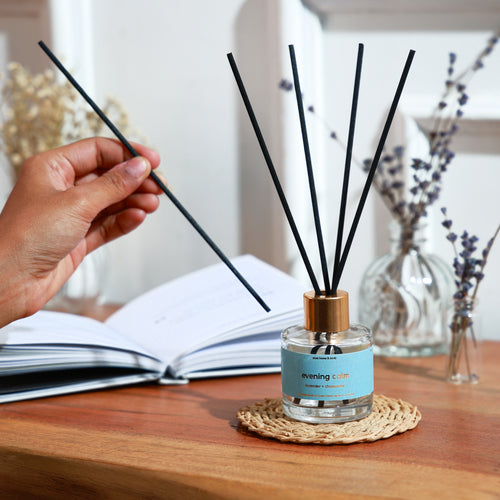
2. Evening Calm Himalayan lavender and chamomile — the quietest bottle in the reed line If the guest is sleeping in the room rather than passing through it, and you would rather it read as restful than as brisk ₹799 / ₹1,299
3. Bookshop candle 80g scented jar candle, roughly 15–18 hours of burn If the arrival is tomorrow and the 24–72 hour reed window has gone. Twenty minutes in the room, then out and downstairs ₹379
4. Boond with a 15ml scent 300ml ultrasonic and a water-based Hotel Collection fragrance at three drops per tank If the room doubles as a study or a store and you want something you can also run for an hour on an ordinary Tuesday ₹899 + ₹299
5. Morning Freshness Malabar lemon, peppermint and eucalyptus — bright and clean In the guest bathroom rather than beside the bed. Peppermint and eucalyptus are waking materials ₹749 / ₹1,249
Nothing yet If the room still smells musty rather than merely stale, the problem is moisture and not fragrance Find the damp first — the shared bathroom wall, the monsoon-facing wall, the air-conditioner that has not run since last year. A product over damp makes it worse ₹0
Honest notes for buyers: fragrance is the last step, not the first — it layers on air that is already clean and moving, and it will not cover cooking, damp or a room that has been shut for weeks. Timing matters as much as product: a candle scents a room in fifteen to twenty minutes and a Sukoon in about twenty, which is why both work when people are arriving tonight, while a reed diffuser needs a day to three days before it is doing its job properly — it is the wrong buy for a deadline and the right buy for a room you want to hold a steady scent for months. SOSA does not make a room spray for the home; the sprays in the range are formulated and sized for a car. The Hotel Collection is water-based and runs in the Sukoon, Boond and Megh only — not in reeds, and not in the waterless Vaayu. Reed diffusers are a separate alcohol-free line with their own scents. Candles must be attended and put out before guests leave a room unattended. The Hotel Collection scents are SOSA's own interpretations inspired by the world's finest hotels; SOSA is an independent Indian fragrance house, not affiliated with or endorsed by any hotel brand. A portion of every order supports girl-child education through Nanhi Kali.
Evening Calm · reed diffuser
The softer option, once the air is clean
Evening Calm · reed diffuser ₹799 / 50ml
Himalayan lavender and chamomile — the quietest bottle in the reed line and the one I would put in a room somebody is going to sleep in rather than pass through. The condition attached to both of these is the same and it is not negotiable: the reed goes in after the room has been aired, not instead of airing it. A reed in a closed room gives you lavender and closed room simultaneously, and a guest reads the lavender as an attempt on the closed room, which is worse than either alone. ₹799 for 50ml and ₹1,299 for 130ml, lasting months with nothing to switch on.
SS
ISIPCA
Versailles
A note from Sonal

The most useful thing I have ever done for a spare room took two hours and cost nothing, and I did it out of irritation rather than method. I had a room in a flat in Pune that always smelled shut, and I had been treating it as a fragrance problem for the better part of a year. One morning I opened the window and the door together, put the fan on, stood the mattress against the wall, took every single thing out of the wardrobe and left it all open until lunchtime. The room was different afterwards in a way that no bottle had ever managed, and the difference lasted about ten days rather than an afternoon.

What I took from it is the thing I now say on every page in this group. A closed room is not a room that lacks fragrance. It is a room whose contents have been talking to the same volume of air for a month, and the only thing that resolves that is exchanging the air and giving the contents somewhere to release to. Fragrance afterwards is genuinely worth having — a reed set up on Wednesday makes a formerly shut room read as looked-after by Friday in a way that plain clean air does not quite manage. But it is a finish on work that has already been done, and I would rather you spent the two hours and skipped the purchase than the other way round.

Everything is made and supported from Pune, and a part of every order funds girl-child education through Nanhi Kali. You get a home that smells like somewhere you chose; a girl gets a classroom. That equation has always felt right to me.

Frequently asked questions

How long should I air a guest bedroom that has been closed for weeks?
Two hours with the window and the door of the room both open, plus something open on the far side of the flat so there is a through-draught, and a ceiling fan on low. Ten minutes swaps the air but the textiles refill it within the hour. If the room has been shut for a month, do it on two consecutive days.
Why does a closed room smell even when it is clean?
Because the smell is not dirt. It is unexchanged air plus the slow release of volatile material from every porous thing in the room — mattress, pillows, curtains, rug, the inside of the wardrobe, stored bedding — into air that never leaves. In humid months there is often a low biological note in the fabric as well.
Can I just use a reed diffuser instead of airing the room?
No, and the result is worse than doing nothing. A reed in an unaired room gives you both smells at once, and a guest reads the fragrance as an attempt on the other one. Air the room first. Then Evening Calm at ₹799 or Mountain Breeze at ₹849, set up two to three days ahead.
What should I do about the mattress in a room nobody uses?
Stand it on its side against a wall for the whole time the room is open, so both faces get moving air rather than one. Put the pillows in direct sun if the room gets any. Then press a pillow to your face for five seconds — if it smells of anything, a fresh pillowcase over it will not solve the problem.
The room smells musty rather than stale. Is that different?
Yes, and it changes the answer. Musty is earthy and mushroomy and it means moisture is getting into something and not leaving — a wall shared with a bathroom, a monsoon-facing wall, an air-conditioner that has not run in months. That is a repair rather than a cleaning job, and no fragrance should go on top of it.
Air first, product second
Two hours with the window and the door open — then something quiet
Reed diffusers are ₹749 to ₹849 for 50ml and ₹1,249 to ₹1,349 for 130ml, needing 24 to 72 hours to reach their working level, with 300ml refills at ₹2,399. The Bookshop candle is ₹379 for about 15 to 18 hours and works in fifteen to twenty minutes. The Boond is ₹899 and the Sukoon ₹1,899 with steady, 2H and 4H timers and three 15ml Hotel Collection scents included. Free shipping above ₹499, and a portion of every order supports girl-child education through Nanhi Kali.
Shop reed diffusers → Bookshop candle · ₹379
Editorial standards & sources
About this guide: Written by Sonal Sahani, ISIPCA Versailles-trained founder and perfumer at SOSA Home & Body, on what a closed guest bedroom is actually made of — unexchanged air, slow off-gassing from the mattress, wardrobe interior and stored bedding, and a biological component in humid months — why cross-ventilation needs two openings and two hours rather than one window and ten minutes, and why fragrance added before that work produces a more complicated smell rather than a better one.

Facts verified August 2026: Timings in this guide: a scented candle puts noticeable fragrance into a normal room in roughly 15–20 minutes; a Sukoon ultrasonic diffuser reaches a steady level in about 20 minutes from cold; a reed diffuser needs roughly 24–72 hours for the oil to travel the reeds and the room to settle, so it is not a same-day solution. SOSA products and prices: Sukoon 500ml ultrasonic diffuser ₹1,899 (270–320 sq ft, 16–18h on low, 9–12h high, 30–50 ml/h, 2.4MHz cool mist, 7-colour LED, remote, steady/2H/4H timers, BPA-free, auto shut-off, includes three 15ml Hotel Collection scents of your choice); Boond 300ml ₹899; Megh 6-litre ₹3,499; waterless Vaayu ₹11,999 (up to 1000m³); Aangan ₹25,999; Meenar ₹38,500. Hotel Collection water-based fragrance 15ml ₹299, 100ml ₹999, 300ml ₹1,799, Pack of 7 at 15ml ₹1,799 / 100ml ₹5,999 / 300ml ₹10,799; dose 3–6 drops per tank. Reed diffusers (separate alcohol-free line): Morning Freshness from ₹749, Garden Bloom and Evening Calm from ₹799, Fresh Brew and Mountain Breeze from ₹849; 130ml from ₹1,249; duos from ₹1,498; 300ml refills ₹2,399. Scented candles: Bookshop 80g ₹379 (~15–18 hours), Bookshop + Cozy Corner ₹664 (~30–36 hours), Amber Rose 130g ₹599 (~25–30 hours) and 220g ₹799 (~40–50 hours), ceramic jar candles ₹949, Pure Calm wax melt set ₹854. Free shipping above ₹499. SOSA does not make a room or linen spray for the home — the sprays in the range are car perfumes. The Hotel Collection scents are SOSA's own interpretations; SOSA is not affiliated with or endorsed by any hotel brand. Prices subject to change — see the live product pages.
Torna al blog