


It has to look chosen. The tells of a default are quantities that do not match names, no attention to whether the object suits that home, and a variation you cannot explain. None of those are about price.
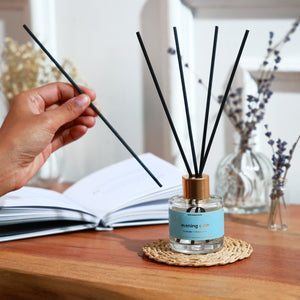
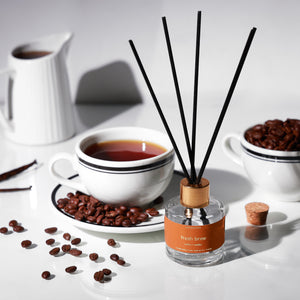
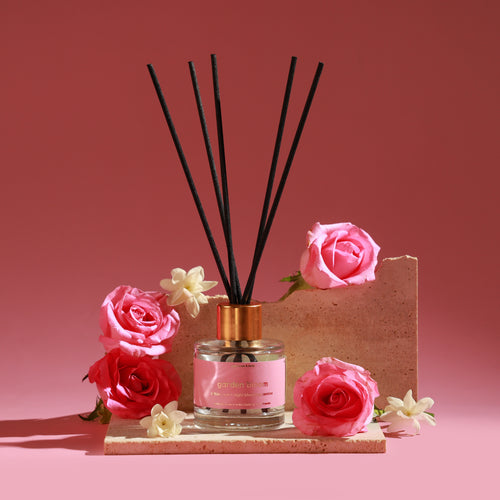
Choose the SKU on breadth, not on your own taste. Garden Bloom 50ml at ₹799 is the widest-agreement bottle we make; Evening Calm at ₹799 is the softest. Fresh Brew at ₹849 is the strongest and the most polarising, which makes it the worst choice to repeat blind.
Where one person genuinely warrants more, give it elsewhere. Different time, different place, not in the doorway where the rest of the group is standing.
2. The condition is that it must be identical, not similar. Same product, same size, same scent, handed over the same way. A group receiving four of one bottle and two of another will work out the split within a day, and whatever explanation they arrive at will not be the one you intended.
3. It also has to be chosen. The difference between a repeat and a default is visible in small things: whether the quantity matches your list, whether the object works in those homes, whether anything varies for no reason. A 50ml reed diffuser at ₹799 asks nothing of the recipient — no flame, no socket, nothing to switch on — which is what makes it repeatable across homes you have not seen.
4. Choose the product on breadth of acceptance, not on how much you like it. Repeating your own favourite scent across nine people is a taste bet made nine times. Garden Bloom holds the widest agreement in our range; Fresh Brew at ₹849, the strongest and warmest, is the one I would least like to see repeated across a group of strangers.
5. Two groups is fine. Fourteen decisions is not. If your list contains both close family and an obligation tier, split it into two SKUs, not into individual choices — for instance 4 × ₹1,548 = ₹6,192 for four households and 9 × ₹799 = ₹7,191 for the rest.
6. Give the exception separately. If one person genuinely warrants something different, hand it over at a different time and in a different place. The gift is not the problem; the doorway is.
7. Repeating it next year is a feature, not a failure of imagination. A gift people can expect is easier to receive and considerably easier to buy, and it removes the annual escalation problem entirely.
Everything is composed and handmade in small batches in Pune, and a portion of every order supports girl-child education through Nanhi Kali.
Part one — chosen, defaulted, and the near-miss
The worry behind this question is almost never about repetition. It is about looking as though you did not think. So the useful distinction is not same versus different — it is chosen versus defaulted, and those two are separated by details that have nothing to do with what anything cost.
 Evening Calm₹799 · 50mlThis is the version that gets people into trouble, and it is almost always accidental. The shop had four of one thing and you needed six. You bought the 130ml for two people because you were already in the cart. One relative got the duo because you were unsure. Every one of those decisions was innocent, and every one of them is legible as a ranking to anybody holding the smaller item. The fix is mechanical rather than diplomatic: decide the SKU first, confirm you can get the full quantity, and only then start buying. If you cannot get enough of one thing, change the thing rather than splitting the group. Evening Calm at ₹799 and Garden Bloom at ₹799 are the same price, so swapping between them costs you nothing and keeps a group intact.
Part two — the six tells, side by side
What a recipient can actually observe, and how each observation reads. None of these are about how much you spent, which is the point — the whole difference between a considered repeat and a default is visible without knowing a single price.
| What the recipient can see | Reads as chosen | Reads as defaulted | Why it is legible |
|---|---|---|---|
| Whether the gifts in the room match ★ | All identical — same product, same size | Mostly identical, with two exceptions | A difference is the only comparison anyone can actually make |
| Whether the object works in their home | Needs nothing bought, owned or lit to function | Needs a burner, a machine or a habit they may not have | An unusable gift is the clearest evidence nobody thought |
| Whether the quantity matched the names | Everyone in the group received one | Someone was skipped, or got a smaller version | Omissions are noticed instantly and never forgotten |
| How it was handed over | The same way to each person, in the same moment | Some at the door, some sent on later without a word | Sequence reads as priority, even when it is only logistics |
| Whether it repeats last year's gift | Deliberately — the same thing, said out loud | Accidentally, with no acknowledgement | A consumable repeating is fine; an unremarked repeat looks like forgetting |
| Whether it suits the occasion's constraints | Sealed, unbreakable, survives a car boot and a crowded doorway | Fragile, perishable, or needing storage during the busiest week | The Diwali circuit is physical, and the object either survives it or does not |
| The honest caveat: none of this applies to the one or two people you are genuinely delighted to buy for. An affection gift should be specific, and forcing it into a uniform group to keep the arithmetic tidy is the opposite of what this page is arguing. The uniformity rule exists so the obligation list stops consuming the attention those two names deserve — not so that everyone you know receives the same bottle. | |||
 Cozy Corner · the courtesy repeat₹379Shop →
 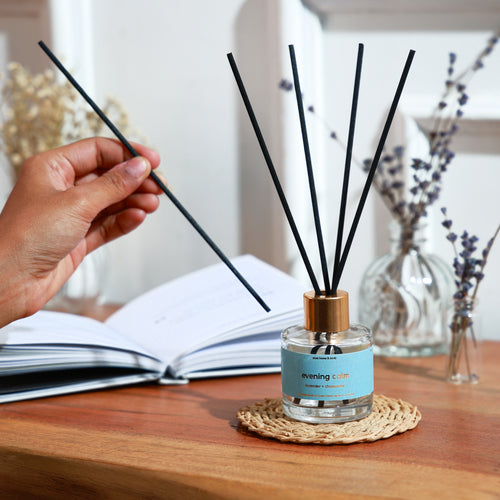 Evening Calm · the softest repeat₹799Shop →
 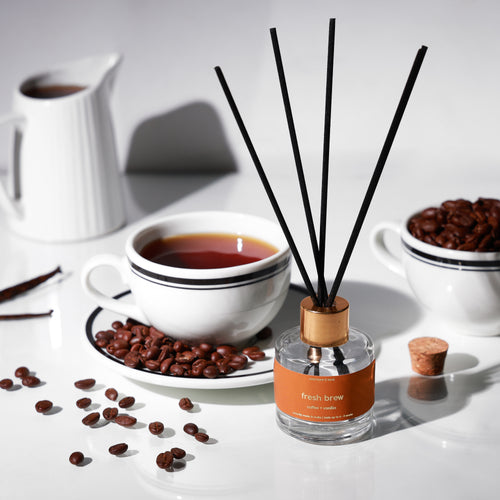 Fresh Brew · only for a group you know₹849Shop →
Part three — when one gift genuinely does not work
There are three situations where repeating a single item is the wrong call, and it is worth being precise about them, because the general advice on this page is otherwise quite forceful. The first is when the object does not suit every home in the group. A group of nine that includes a household with a crawling toddler, a household where nobody has a spare shelf, and a household with a very small flat is not really one group. Candles are the sharpest example: a flame is a poor gift into a home with small children or a nervous host, and Diwali is already a week of open flame. A reed diffuser removes that particular problem — there is nothing to light — but it still contains a flammable fragrance oil, so wherever it goes it belongs on a tray, away from diyas, and out of reach of children and pets. Say that once when you hand it over and it is done.
The second is when the group contains both an obligation name and an affection name. Trying to hold those two inside one uniform purchase produces either an insultingly small gift for the person you care about or an oddly large one for the person you barely know. The answer is two groups, not fourteen decisions. Sort the list into a household tier and a general tier, buy one SKU for each, and keep the two apart on the day: 4 × ₹1,548 = ₹6,192 for four households and 9 × ₹799 = ₹7,191 for the rest comes to ₹13,383, and it takes one afternoon rather than three. Where a single individual truly needs something different, that gift travels separately — to their home, on another day, with no audience.
The third is the case people worry about most and should worry about least: you gave the same group the same thing last Diwali. If the gift was consumed, repeating it is not a failure of imagination, it is a supply. A 50ml bottle runs 6–8 weeks and is long finished; a candle is 15–18 hours. Nothing has accumulated on anybody's shelf. Where a repeat does read badly is when it is unacknowledged — the sense that you have forgotten what you gave. One sentence fixes that entirely, and after the second or third year the repetition stops being a repeat at all and becomes the thing you are known for bringing. If you would rather move it on, the honest next step is a different scent at the same price rather than a bigger version of the same one, since a 130ml lasts longer without projecting further.
Part four — groups, and the SKU to repeat
Seven groups that appear on real Diwali lists, whether one product covers each of them, and where the exception should go if there is one. The arithmetic is on listed prices and is not a quotation.
| The group | One gift for all? | The SKU I would repeat | Where the exception goes | The arithmetic |
|---|---|---|---|---|
| Cousins or aunts who meet at one house ★ | Yes, without hesitation | Garden Bloom 50ml | To their home, another day, no audience | 9 × ₹799 = ₹7,191 |
| A team or office floor | Yes — variance is the only real risk | Morning Freshness 50ml | Nowhere. Seniors on the same floor get the same thing | 12 × ₹749 = ₹8,988 |
| Neighbours on your floor | Yes, and keep it small enough to repeat annually | Cozy Corner jar candle | Not needed at this scale | 6 × ₹379 = ₹2,274 |
| Household and building staff | Yes — identical is fairness here, and cash comes first | Cash, plus Sandalwood jar candle | Nowhere. Differences between staff are noticed fastest | 5 × ₹449 = ₹2,245 on top of the cash |
| Four households you visit every year | Yes, at a higher tier than the rest of the list | Fresh & Grounded duo | Only for a household with one room in use — a single 50ml instead | 4 × ₹1,548 = ₹6,192 |
| A mixed list of close family and obligation names | Two SKUs, not fourteen decisions | Duo for the top tier, Evening Calm 50ml for the rest | Built into the tiering — keep the tiers apart on the day | ₹6,192 + ₹7,191 = ₹13,383 |
| People whose homes you have never seen | Yes, and choose on breadth rather than taste | Garden Bloom — never Fresh Brew blind | None available — you have no information to act on | 7 × ₹799 = ₹5,593 |
Versailles
The orders that arrive at SOSA in the run-up to Diwali are rarely one bottle. They are six of one thing, or nine, or twelve, and the note in the comments box is usually some version of please make sure they are all the same. That instruction has taught me more about Indian gifting than any amount of research would have.
What it says is that the buyer has already worked out the thing this page is arguing. They are not worried about being thought unimaginative. They are worried about a room in which two people are holding different bottles and one of them is doing arithmetic. Uniformity is how you take that possibility off the table, and it costs nothing except the illusion that fourteen individual decisions were ever going to be better ones.
I will not tell you that any of this will make a gift land well — nobody can promise that, and a perfumer least of all. What I can tell you is what breaks a group order in practice: running short of one scent and substituting another to make up the numbers. If you are buying identical gifts at any quantity, confirm what is available before you commit, and if the answer is that you cannot get nine of one thing, change the thing.
Frequently asked questions
- How much to spend on a Diwali gift — the two variables that set the number.
- Answering an expensive gift — why matching the value escalates it.
- Is it okay to regift and what not to gift for Diwali.
- The Diwali gifting etiquette guide — the whole subject in one page.
- Brand: the SOSA founder story.
SOSA range & prices used in this guide (verified from the live store, 27 August 2026): Reed diffusers — alcohol-free, phthalate-free, paraben-free, IFRA-compliant compositions on a heat-stable coconut-derived (CCT) carrier, in a refillable glass bottle with six fibre reeds; 50ml lasts 6–8 weeks, 130ml lasts 14–18 weeks. Morning Freshness 50ml ₹749 · 130ml ₹1,249; Garden Bloom ₹799 · ₹1,299; Evening Calm ₹799 · ₹1,299; Fresh Brew ₹849 · ₹1,349; Mountain Breeze ₹849 · ₹1,349. Duo sets: Day & Night ₹1,498, Fresh & Grounded ₹1,548, Warmth & Bloom ₹1,598 (2 × 50ml); ₹2,498–₹2,598 (2 × 130ml). Oil-only refills 300ml ₹2,399 · 500ml ₹3,499 (vessel and reeds not included). The least expensive SOSA reed diffuser is ₹749 — no reed diffuser exists below that price in any size. Below it: scented jar candles from ₹379 (roughly 15–18 hours), Sandalwood or Smoked Oudh jar candle ₹449, wax melts ₹474 (a burner is needed and is not included), ceramic mugs ₹474, ribbed and face mugs and taper candles ₹569, Amber Rose candle ₹599, ceramic trinket dish ₹664, candle two-pack ₹664 (roughly 30–36 hours). Machines: Boond 300ml ₹899 · Sukoon 500ml ₹1,899 · Megh 6L ₹3,499 (~215 sq ft, a runtime and humidity machine rather than a coverage upgrade) · waterless Vaayu ₹11,999 · Safar car and travel diffuser ₹3,999. The water-based Hotel Collection (15ml ₹299 · 100ml ₹999 · 300ml ₹1,799) is a fragrance for an ultrasonic machine, not a standalone gift. SOSA publishes no bulk or corporate gifting terms — there is no discount slab, no minimum order quantity, no stated GST-invoicing arrangement, no custom branding service and no published lead time — and SOSA sells no gift card, gift hamper, gift box or curated gift set. Larger orders should be discussed with SOSA directly through the contact page before committing. Gift wrapping, gift notes, direct-to-recipient shipping and delivery timing are unconfirmed — check at checkout rather than assuming them; no delivery date is promised anywhere in this guide. Per-head and total costs shown are arithmetic on the listed prices, not quotations. Fragrance adds scent to a room; it does not clean air, remove cooking or smoke smells, or change how anyone feels. Fragrance oil is flammable — keep any diffuser away from diyas, candles and open flame. Composed and handmade in small batches in Pune, India; tested through 45°C summer heat and 85% monsoon humidity. Free shipping above ₹499. A portion of every order supports girl-child education through Nanhi Kali. Prices subject to change — see the live product pages.