

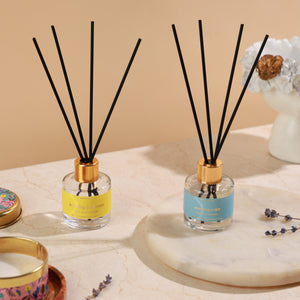

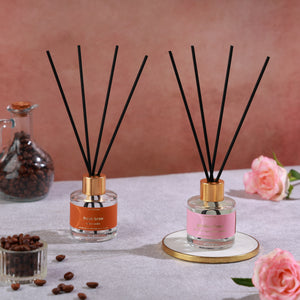

Two at half: ₹2,498 ÷ 32 weeks = about ₹78 a week, two rooms. Cost per room-week falls from about ₹78 to about ₹39.
The catch: three reeds is a quiet setting and it lowers coverage as well as strength, so this works for two smallish rooms. A hall, an entrance or a room over about 150 sq ft still wants six reeds, and there the trade is simply unavailable.
2. The oil and the reordering are identical too, which is the part nobody expects. One bottle at six reeds is 52 ÷ 16 = 3.25 fills a year, or about 422ml of oil. Two bottles at three reeds is 52 ÷ 32 = 1.63 fills each — 3.25 fills across the pair, and the same 422ml. Same litres, same money, same number of replacement events, twice the rooms. There is no hidden cost being paid somewhere else; the second room is genuinely free in running terms.
3. What you do pay is double, once, on the day you buy. Two 130ml bottles is ₹2,498 against ₹1,249. That is the entire cost of this decision and it is a real one on a tight budget. If ₹1,249 is what you have, buy one bottle and run it on three reeds anyway: one room at about ₹39 a week rather than ₹78, and you bank the saving instead of spending it on a second room. The saving comes from the reeds. The second bottle is only how you choose to spend it.
4. But three reeds lowers coverage as well as volume. This is the limit, and it is a real one. The rated figure — a closed, still room of up to about 150 sq ft — is a six-reed figure. On three reeds a bottle holds noticeably less, so the trade suits two rooms of roughly 80 to 110 sq ft: two bedrooms, or a bedroom and a bathroom, or a bedroom and a study. A hall, an entrance or a living room over about 150 sq ft still wants all six reeds, because six was the minimum for that space rather than a maximum.
5. And below a certain level a room does not read quieter — it reads as nothing. Halving the reeds in a room that needed six does not give you a softer version of the same result; it gives you a room a visitor does not notice at all, which is the same value as an empty bottle. Judge it properly: wait forty-eight hours for the reeds to saturate, then walk in from outside and take the first breath, because you adapt to your own home in about twenty minutes. If a visitor cannot detect it from the doorway, put a reed back.
Made in India, composed by an ISIPCA Versailles-trained perfumer — and a portion of every order supports girl-child education through Nanhi Kali.
Why the two costs cancel exactly
The arithmetic is worth doing slowly, because the result looks like a trick and is not. Reed count is the only volume control a reed diffuser has, and it works by setting how much evaporating surface the oil has: each reed draws fragrance up its porous core by capillary action and releases it from the exposed length. Six reeds is roughly twice the surface of three, so it produces roughly twice the vapour and empties the bottle in roughly half the time. Halve the reeds and you roughly double the weeks. A 130ml runs about sixteen weeks on six reeds and something nearer thirty-two on three. Now put the money against it. One bottle: ₹1,249 over sixteen weeks is about ₹78 a week. Two bottles: ₹2,498 over thirty-two weeks is also about ₹78 a week. The doubled price and the doubled duration cancel exactly, which is why nothing about the weekly figure moves.
Follow the same logic through the other two things people worry about and they cancel as well. Annual oil: one bottle at six reeds is 52 ÷ 16 = 3.25 fills, or about 422ml; two bottles at three reeds is 52 ÷ 32 = 1.63 fills each, which across the pair is 3.25 fills and the same 422ml. Annual reordering: 3.25 replacement events either way. So the two-bottle household is not quietly paying more in oil or in attention; it is running the same consumption through two rooms instead of one. What actually changes is the level each room reads at, and the cash you hand over on day one. That is the honest shape of this trade: it is not a discount, it is a redistribution. Six reeds in one room is a definite, noticeable presence in one place. Three reeds in each of two rooms is a quieter presence in two — better in a bedroom, where four reeds is the usual setting and three is common, and worse in a hall, where six was the minimum rather than the maximum.
The three decisions before you halve anything
 Two bottles₹2,498One 130ml at ₹1,249 on six reeds: sixteen weeks, about ₹78 a week, one room. Two 130ml at ₹2,498 on three reeds each: about thirty-two weeks, about ₹78 a week, two rooms — roughly ₹39 a room-week. The oil matches too, at about 422ml a year in both cases, and so does the reordering, at 3.25 replacement events a year. Nothing is being paid for the second room except the ₹1,249 you spend once, on the day, to own a second bottle. That is the whole trade and it is the most useful economy in the range.
Sizing by space — where half strength pays and where it does not
The middle column gives the weeks and the right-hand column the cost per room-week, which is the figure that actually differs. One row is a second room you should not open at any strength.
| Space | What it needs | How many | Cost |
|---|---|---|---|
| Two rooms of about 80–110 sq ft, two 130ml on three reeds each ★ | About 32 weeks each — ₹2,498 ÷ 32 = about ₹78 a week for two rooms, and 3.25 replacements a year | About ₹39 a room-week | ₹2,498 |
| One room of about 80–110 sq ft, one 130ml on three reeds | About 32 weeks — the same halving, with the saving banked rather than spent on a second room | About ₹39 a room-week | from ₹1,249 |
| One bedroom of about 120–150 sq ft, one 130ml on six reeds | About 16 weeks — the baseline, and the setting most people are actually running | About ₹78 a room-week | from ₹1,249 |
| Two rooms on 50ml bottles at three reeds — the duo | About 14 weeks each. ₹1,498 ÷ 14 = about ₹107 a week for two rooms, so the pair of 130ml wins clearly | About ₹53 a room-week | ₹1,498 |
| A hall, an entrance, or any room over about 150 sq ft | Six reeds was the minimum here, not the maximum — halving it produces a room nobody notices | Six reeds, no trade | from ₹1,249 |
| A second room that is a passage or is used twice a month | Nothing. Half strength does not rescue a position nobody stands in — ₹39 a room-week is only good value if somebody is in the room | None | ₹0 |
| A note on all of the above: the doubling of bottle life at three reeds is a working approximation drawn from the stated 14–18 weeks on six, not a guarantee, and heat and airflow move it in both directions. What is certain is the direction: fewer reeds always means a quieter room and a longer bottle, and the two effects are close enough to proportional that the weekly cost stays roughly flat while the cost per room falls. | |||
One room · the unitFrom ₹749Shop → 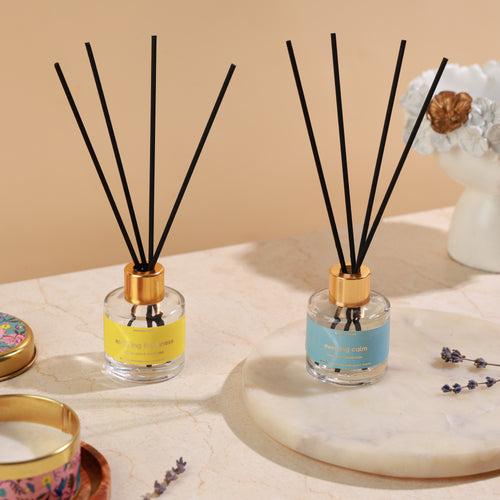 Two rooms · better value₹1,498Shop →
  Large room · a switch₹1,899Shop →
Running it, and the rooms where it fails
Set three reeds and wait two days before believing anything. Reeds have to saturate along their whole length before they throw properly, so a first-day reading is worthless and a great many people conclude that half strength does not work when it simply has not started. After forty-eight hours, leave the flat for half an hour and judge the first breath on walking back in — that is the only honest reading available, because olfactory adaptation is essentially complete within about twenty minutes and you are the least reliable judge of your own home. Better still, ask whoever visits next. If a visitor notices it from the doorway, three reeds is doing its job and the room is costing you about ₹39 a week. If they do not, put one reed back and try four, which still runs a 130ml to around twenty-four weeks and about ₹52 a week — an intermediate setting that suits most bedrooms.
Then place both bottles as though they were working harder, because they are not. At three reeds a bottle has less to give, so placement stops being a refinement and becomes part of the dose. Put each one where there is gentle air movement — a chest of drawers or a shelf near the doorway rather than a bedside table in a still corner — and keep both out of three specific places: direct sunlight, which fades fragrance and heats oil; the throw of an AC vent or fan, which empties a bottle fast and pushes everything against one wall; and bare polished wood, because reed oil marks a finish permanently if the bottle is knocked. Stand each on a tray or a coaster and keep them out of reach of children and pets. And if throw drops off in a bottle that used to be fine, replace the reeds rather than the liquid — clogged fibre is the commonest cause, and the usual response of adding reeds undoes the entire economy you came here for.
Then be honest about which rooms are candidates, because that is where this goes wrong. Half strength suits two rooms of roughly 80 to 110 sq ft where four reeds would have been the setting anyway: two bedrooms, a bedroom and a study, a bedroom and a bathroom — though a bathroom is better served by a 50ml at ₹749 on two reeds, which is cheaper still. It does not suit a hall, an entrance you arrive through, or an open living-dining, where six reeds was the floor rather than the ceiling. And it never rescues a room nobody is in: about ₹39 a room-week is excellent value in a bedroom used eight hours a night and no value at all in a passage measured in seconds of occupancy. The real discovery in this arithmetic is usually that six reeds was the wrong setting for those rooms in the first place — the saving was always available, and the second bottle is just the pleasant way to collect it. When both bottles empty, a 300ml refill at ₹2,399 is ₹8.00 a millilitre against ₹9.60 for new glass.
What to buy
The half-strength trade is really a two-bottle purchase, which makes the duo the obvious entry point — though in 130ml rather than 50ml if you want the better cost per room-week.
| Buy | What it covers | Lasts | Price |
|---|---|---|---|
| One 50ml | A single reed diffuser — a bathroom at two reeds — cheaper again, and the one room where a small bottle is genuinely correct | 6–8 weeks | from ₹749 |
| One 130ml ★ | The value size — each of the two rooms, run on three reeds — about 32 weeks and roughly ₹39 a room-week | 14–18 weeks | from ₹1,249 |
| The duo | Day & Night duo — the simplest way to start two rooms at once, though the 130ml pair is better value per room-week | 6–8 weeks each | ₹1,498 |
| Sukoon | 500ml ultrasonic — a room over about 200 sq ft, where reed count cannot be halved because six was already the floor | Runs when you switch it on | ₹1,899 |
| 300ml refill | The running cost — both bottles once they empty — ₹8.00 a millilitre against ₹9.60 for new glass | Roughly 2 × 130ml fills | ₹2,399 |
Versailles
This is my favourite piece of arithmetic in the whole range because it is completely unglamorous. One 130ml on six reeds is about ₹78 a week for one room. Two 130ml on three reeds each is about ₹78 a week for two rooms. Same weekly figure, same oil, same number of times you have to reorder — and one more scented room. The only thing you pay is the second ₹1,249 on the day.
What that really tells you is that six reeds was probably wrong for those rooms to begin with. Six is what I would use in a hall, where people arrive with a fresh nose and pass through. In a bedroom, three or four reeds is both the nicer setting and the cheaper one, and if you have been running six in a room you sleep in, you have been paying twice for something you did not want.
The limit is real, though, and I would rather state it than have somebody disappointed. Fewer reeds means less reach as well as less volume, so this belongs to two smallish rooms. In a hall or a room over about 150 square feet, six reeds is the floor, and halving it gives you a room that reads as nothing rather than as gently scented. And do not open a second room just because it is now affordable — ₹39 a week in a passage is still ₹39 wasted. A portion of every order funds a girl's classroom through Nanhi Kali.
Frequently asked questions
- Budgeting a full year — litres, not bottles.
- A year of four bottles — the annual number, derived.
- A second diffuser, or just more reeds? — the free fix, first.
- The complete sizing and quantity guide — every home type, three builds.
- Brand: the SOSA founder story.
SOSA products & prices (verified August 2026): Hotel Collection water-based ultrasonic diffuser fragrance 15ml ₹299 · 100ml ₹999 · 300ml ₹1,799 · Pack of 7 (15ml, all fragrances) ₹1,799; refills 100ml from ₹999. Seven scents: The Ritz-Carlton-inspired (white tea · bergamot · cedar), Westin-inspired (white tea · aloe · cedar), 1 Hotels-inspired (cedarwood · vetiver · green leaves), The St. Regis-inspired (amber · violet · woods), Shangri-La-inspired (jasmine · green tea · white tea), Four Seasons-inspired (citrus · floral · sandalwood), W Hotels-inspired (citrus · pepper · amber). Diffusers: Boond 300ml ₹899 · Sukoon 500ml ₹1,899 · Megh 6L ₹3,499. Water-based, phthalate-free, composed to IFRA standards for home diffusion; 3–6 drops per tank. Made in India, Pune. The Hotel Collection scents are SOSA's own interpretations inspired by the world's finest hotels; all hotel names are trademarks of their respective owners and are used only to describe the scent style — SOSA is an independent Indian fragrance house, not affiliated with or endorsed by any hotel brand. Prices and availability subject to change — see the live product pages.