

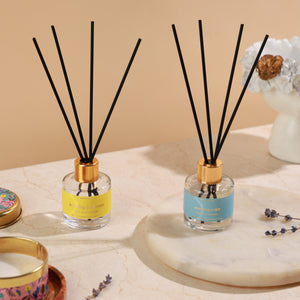



The list: 130ml Garden Bloom ₹1,299 in the foyer on six reeds · 130ml Evening Calm ₹1,299 in the master bedroom on four · 50ml Evening Calm ₹799 in the second bedroom on three · 50ml Morning Freshness ₹749 in the common bathroom on two.
The total: ₹1,299 + ₹1,299 + ₹799 + ₹749 = ₹4,146.
Not buying: the kitchen, the attached master bathroom, the balcony, the passage.
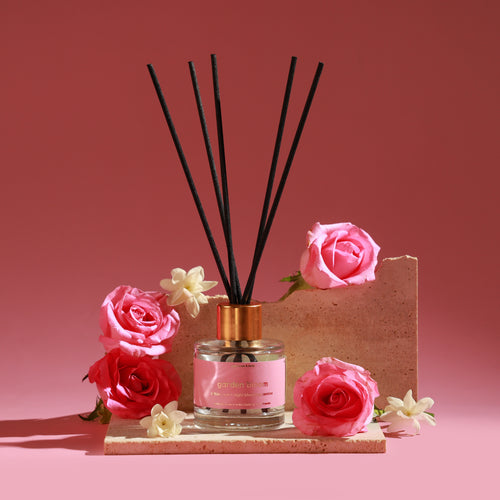
2. The foyer gets a 130ml at ₹1,299 on six reeds — the biggest bottle in the smallest space. The foyer is about 25 sq ft, roughly three per cent of the flat, and it is the only place in the building where somebody meets your home with a nose that has not yet adapted to it. Adaptation is essentially complete within about twenty minutes, so first impressions are formed exactly once and they are formed here. The bottle also has to serve the 230 sq ft living-dining behind it, since there is no door between them — 255 sq ft of continuous air, which is why it is a 130ml on all six reeds rather than something smaller. Garden Bloom, ₹1,299.
3. The master bedroom gets a 130ml at ₹1,299 on four reeds. At 150 sq ft it is exactly at the stated limit of what one bottle holds in closed, still air — so it takes the larger bottle, but on four reeds rather than six, because a room you sleep in wants a level you notice on entering and forget while reading. Four reeds also takes this bottle past eighteen weeks, so the room that is occupied longest is also the cheapest to keep running. Evening Calm (Kashmir lavender, chamomile), ₹1,299.
4. The two 50ml bottles are 50ml for different reasons. The common bathroom takes a 50ml at ₹749 on two reeds because it is 35 sq ft — a quarter of a rated space, where a 130ml would be ₹500 of extra liquid evaporating into air that does not need it. The second bedroom takes a 50ml at ₹799 on three reeds for a completely different reason: at 120 sq ft it is nearly big enough to argue for a 130ml, but it is occupied for perhaps eight hours a day and mostly with someone asleep in it. One is a volume decision and the other is an hours decision, and they happen to land on the same bottle. Running total: ₹1,299 + ₹1,299 + ₹799 + ₹749 = ₹4,146.
5. Buy nothing for the kitchen, the master bathroom, the balcony or the passage. The kitchen has a door and is therefore a genuine air space, but it is a room you cook in — a working hob outruns any passive source, and we make no claim that fragrance removes anything from that air. The attached master bathroom is skipped because its door usually stands open onto a bedroom that already has a bottle in it; if in your home that door stays shut, add a 50ml at ₹749 and the flat becomes ₹4,895. The balcony is outdoors. The passage is crossed in about four seconds and borrows from the rooms at either end.
Made in India, composed by an ISIPCA Versailles-trained perfumer — and a portion of every order supports girl-child education through Nanhi Kali.
Six air spaces — and why only four of them are worth a bottle
The plan first, because the area is not the useful number. This flat is 850 sq ft: a 25 sq ft foyer opening without a door into a 230 sq ft living-dining, a 70 sq ft kitchen behind a door, a 150 sq ft master bedroom with a 40 sq ft bathroom attached, a 120 sq ft second bedroom, a 35 sq ft common bathroom and a 45 sq ft balcony — 715 sq ft of rooms plus about 135 of walls and passage. Five doors close and the foyer joins the living-dining, which makes six air spaces. Fragrance treats a closed door as a wall, so those six are the only units a purchase can be measured against. Six is also the number a shop would happily sell you, and it is two too many.
The kitchen is refused despite having a door, which is the part that surprises people. A door makes it a real air space; it does not make it a space worth scenting. A working hob runs at an output no passive evaporative source competes with, and a bottle standing in that heat empties in weeks rather than months because evaporation rises with temperature. We will not tell you a reed diffuser removes or neutralises cooking smells — it does not, and the claim is not one any honest brand makes. The attached master bathroom is refused for the opposite reason: it is a genuine 40 sq ft space with a door, but in most homes that door spends the day open onto a bedroom with a 130ml already in it, so the space is already being served for nothing. The test is not whether a room exists. It is whether anybody is standing in it with a nose that has not already adapted. By that test the foyer, at 25 sq ft, outranks the kitchen, the balcony and the passage put together.
The three decisions in this specific flat
 130ml, six reeds₹1,299Everywhere else in this cluster the bottle scales with the room. The foyer inverts it, for two reasons that both point the same way. It is the only space every visitor and every returning resident passes through with an unadapted nose, so it does a job no other bottle in the flat can do. And it is not really a 25 sq ft space at all — with no door between it and the living-dining, the bottle standing on the console is charging about 255 sq ft of continuous air, which is well past what one passive bottle is rated to hold. Six reeds, at about chest height, on the side away from the door swing. If you buy only one thing on this list, buy this one.
Every space in this flat, priced
All six air spaces plus the balcony and the passage, with what each is worth. Four rows come to ₹0, and the four that do not add up to ₹4,146.
| Space | What it needs | How many | Cost |
|---|---|---|---|
| Foyer, about 25 sq ft, open to a 230 sq ft living-dining ★ | One 130ml on six reeds — 255 sq ft of continuous air, and the only unadapted nose in the flat | One | ₹1,299 |
| Master bedroom, about 150 sq ft, door closes | One 130ml on four reeds — at the stated limit of one bottle, and four reeds pushes it past eighteen weeks | One | ₹1,299 |
| Second bedroom, about 120 sq ft, door closes | One 50ml on three reeds — big enough to argue for a 130ml, occupied too few hours to justify one | One | ₹799 |
| Common bathroom, about 35 sq ft, door closes | One 50ml on two reeds — the cheapest complete air space in the flat | One | ₹749 |
| Kitchen, about 70 sq ft, door closes | Nothing. A real air space, but a working hob outruns any passive source and heat empties a bottle fast. We make no claim that fragrance removes what is in that air | None | ₹0 |
| Attached master bathroom, balcony and passage | Nothing. The master bathroom door usually stands open onto a bedroom already served; the balcony is outdoors; the passage is four seconds of occupancy | None | ₹0 |
| A note on all of the above: every coverage figure here is steady-state — six reeds, a closed room, still air, standard ceiling. This flat has a 45 sq ft balcony off the living-dining, and on an evening when that door is open the foyer bottle is charging air that is being replaced several times an hour. It will read lighter. That is ventilation, not a defective bottle, and the answer is to move it out of the draught path rather than to buy a fifth product. | |||
One room · the unitFrom ₹749Shop → 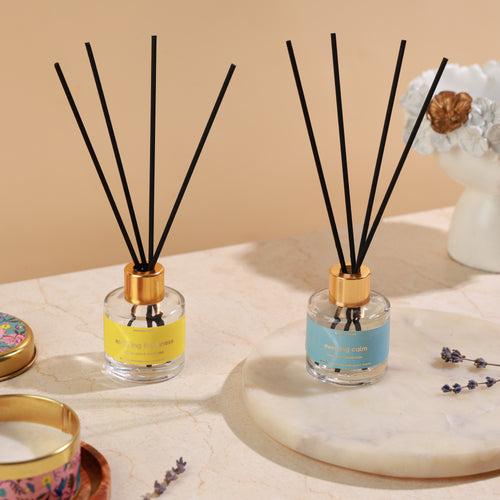 Two rooms · better value₹1,498Shop →
  Large room · a switch₹1,899Shop →
Reeds, positions and the point at which a 50ml should become a 130ml
Set four different reed counts: six, four, three and two. Reed count is the only volume control a reed diffuser has and it is the reason one shopping list can fit four very different spaces. Six in the foyer, because that bottle is charging 255 sq ft and is met by people arriving from outside. Four in the master, because a room you sleep in wants less and because four reeds carries a ₹1,299 bottle past eighteen weeks. Three in the second bedroom, which at 120 sq ft is small enough that six would be constant rather than pleasant. Two in the common bathroom, where three is a shop counter. Fit them all, then leave the flat alone for forty-eight hours — reeds must saturate along their full length before they throw properly, and a day-one verdict is worthless. Judge each room from its doorway after half an hour outside, never from inside it.
Then the positions, which in a 2BHK decide as much as the sizes. The foyer bottle goes on the console or shoe cabinet at about chest height, on the side away from the door swing, and out of the straight line between the front door and the balcony — that line is a draught in almost every flat of this shape and a bottle sitting in it empties fast and pushes everything into the stairwell. The master bottle goes on a chest of drawers near the door rather than in a still corner, and out of the AC vent's path, because air conditioning slows evaporation while a vent stream accelerates it. The second bedroom bottle goes on a shelf or desk, not a bedside table where it will be knocked. The bathroom bottle goes on the cistern, away from shower spray. All four stand on a tray or coaster: reed oil marks a polished finish permanently. Keep every one out of reach of children and pets.
Then know when a 50ml should become a 130ml, because two of these four will change. The rule is hours, not area. A 50ml runs 6–8 weeks on six reeds and costs roughly ₹105 a week of use; a 130ml runs 14–18 and costs roughly ₹78. On three reeds the second bedroom's 50ml will push past ten weeks, so across a year that room takes about five bottles — roughly ₹3,995 at ₹799 each — against a 130ml route of one bottle and two refill fills. The moment that room becomes an office, a nursery, or anywhere somebody spends the working day, promote it to a 130ml and refill it. The common bathroom almost never crosses that line: at 35 sq ft on two reeds a 50ml runs past twelve weeks, it is the cheapest room in the flat to own, and a bigger bottle there buys nothing at all. When any of these do run out, a 300ml refill at ₹2,399 fills a 130ml roughly twice, and refilling is the moment to fit fresh reeds — clogged fibre is the commonest reason throw drops after a few months, and you have four spare reeds sitting in every box.
What to buy
The four starred lines below are this flat. The rest of the table exists so you can see what the other options are for, and decide against them on purpose.
| Buy | What it covers | Lasts | Price |
|---|---|---|---|
| One 50ml | A single reed diffuser — the common bathroom on two reeds and the second bedroom on three — ₹749 and ₹799 | 6–8 weeks | from ₹749 |
| One 130ml ★ | The value size — the foyer on six reeds and the master bedroom on four — two of these, ₹1,299 each | 14–18 weeks | from ₹1,249 |
| The duo | Day & Night duo — the second bedroom and the common bathroom in one order, if you would rather not pick scents twice | 6–8 weeks each | ₹1,498 |
| Sukoon | 500ml ultrasonic — a living-dining you would rather switch on for the evening than run all week — it needs ₹299 of fragrance to work at all | Runs when you switch it on | ₹1,899 |
| 300ml refill | The running cost — both 130ml points from week fifteen — it is the difference between owning this flat and re-buying it | Roughly 2 × 130ml fills | ₹2,399 |
Versailles
If somebody tells me they have an 850 sq ft 2BHK, I can usually guess what they are about to buy: six bottles, one per room, and the smallest one for the foyer because it is the smallest room. I would reverse both halves of that. Four bottles, and the biggest of them at the front door.
The foyer is the piece people underestimate every single time. It is twenty-five square feet, it has no furniture worth mentioning, and it is the only place in your home where anyone will ever smell it properly. You cannot — you walk through it forty times a day and your nose finished registering it years ago. Your mother-in-law can. So the foyer gets the 130ml on all six reeds, and it also happens to be the bottle doing the most work, because with no door behind it that bottle is holding the living-dining as well.
And I would leave the kitchen alone. It has a door, so by my own counting rule it is a real air space, and I still would not put a bottle in it — the heat empties it, the hob outruns it, and it cannot do the thing people quietly hope it will do. Four bottles, ₹4,146, four spaces left deliberately empty. If the master bathroom door turns out to stay shut, come back for a ₹749 bottle in a month; that is the only fifth purchase I would agree to. A portion of every order funds a girl's classroom through Nanhi Kali.
Frequently asked questions
- Bedroom with an attached bathroom — one bottle or two.
- Should every diffuser be the same size? — why four rooms take three sizes.
- Which three rooms to scent first — the staged version of this list.
- The complete sizing and quantity guide — every home type, three builds.
- Brand: the SOSA founder story.
SOSA products & prices (verified August 2026): Hotel Collection water-based ultrasonic diffuser fragrance 15ml ₹299 · 100ml ₹999 · 300ml ₹1,799 · Pack of 7 (15ml, all fragrances) ₹1,799; refills 100ml from ₹999. Seven scents: The Ritz-Carlton-inspired (white tea · bergamot · cedar), Westin-inspired (white tea · aloe · cedar), 1 Hotels-inspired (cedarwood · vetiver · green leaves), The St. Regis-inspired (amber · violet · woods), Shangri-La-inspired (jasmine · green tea · white tea), Four Seasons-inspired (citrus · floral · sandalwood), W Hotels-inspired (citrus · pepper · amber). Diffusers: Boond 300ml ₹899 · Sukoon 500ml ₹1,899 · Megh 6L ₹3,499. Water-based, phthalate-free, composed to IFRA standards for home diffusion; 3–6 drops per tank. Made in India, Pune. The Hotel Collection scents are SOSA's own interpretations inspired by the world's finest hotels; all hotel names are trademarks of their respective owners and are used only to describe the scent style — SOSA is an independent Indian fragrance house, not affiliated with or endorsed by any hotel brand. Prices and availability subject to change — see the live product pages.