




Why a 1BHK suffers: small air volume, and a closed flat exchanges only about 0.2–0.5 of its air an hour. The moisture has nowhere to go.
The second problem: laundry that takes two days to dry starts smelling sour on the rack. That is bacterial, and it goes into the wardrobe with the clothes.
2. Because a small closed flat cannot dilute it. A 1BHK has a small air volume to begin with, and a closed flat exchanges only around 0.2–0.5 of that volume an hour. Cross-ventilated it would manage 3–8, but you have sensibly shut the windows because it is raining. So the moisture accumulates rather than disperses, and relative humidity climbs into the range where materials stop drying and growth becomes possible.
3. Because it makes everything else in the flat worse. High indoor humidity is the shared cause behind nearly every monsoon complaint: the wardrobe that smells musty, the sofa that will not dry, the bedding that never feels crisp, the condensation on the window reveal, the growth on the wall behind the almirah. The rack is frequently upstream of all of them. Fix the rack and several unrelated-looking problems improve at once.
4. Because slow-drying laundry smells on its own account. Fabric that stays wet for a day or two grows bacteria, and the sour, slightly stale note that clothes pick up on an indoor rack is that growth rather than the detergent failing. Those clothes then go into the wardrobe carrying it, which is how a drying problem becomes a wardrobe problem becomes a whole-flat problem.
5. And no fragrance addresses any part of this. Scent is additive: it puts molecules into the air and takes none out, and it has no effect whatsoever on humidity. A diffuser next to a drying rack gives you damp air that smells of jasmine. Move the drying, get the humidity down, then use a reed diffuser or the Sukoon as the finishing layer.
Made in India, composed by an ISIPCA Versailles-trained perfumer — and a portion of every order supports girl-child education through Nanhi Kali.

Where the water in your washing actually goes
Follow the water. It comes out of the tap, goes into the drum, and most of it leaves down the drain during the spin cycle. What is left is held in the fibres of the clothes, and it is a larger quantity than people expect — a full load, well spun, still carries litres. When you hang that load on a rack in your living room, the water has exactly one route out of the fabric: evaporation into the surrounding air. Every gram that leaves the shirt arrives in the room. Over the day or two the load takes to dry, you have transferred a few litres of liquid water into the air of a flat that might be five or six hundred square feet. There is no version of this where the water disappears.
The reason it matters so much more in monsoon than in December is that in December the flat is losing that moisture almost as fast as you add it — the windows are open, the outside air is dry, and the load is stiff by evening. In monsoon the windows are shut, the outside air is nearly saturated, and the flat is exchanging perhaps a fifth of its air an hour. The moisture arrives faster than it leaves and the humidity ratchets upwards, load after load. There is a second consequence too: because the air is already wet, the laundry itself dries slowly, and fabric that stays wet for thirty-six hours grows bacteria. That sour note on slow-dried clothes is biological, and it travels with them into the wardrobe.
What to do with the washing instead
 Step fourFrom ₹749Anywhere the moisture is released outside the sealed part of the flat is better than anywhere inside it. A covered balcony or a utility area with the door to the flat closed works even in heavy rain, and a small pedestal or wall fan aimed at the rack transforms it — moving air dries fabric dramatically faster than still air even at high humidity, because it keeps sweeping away the saturated layer sitting against each garment. If the balcony gets rain blown into it, hang the rack against the inner wall and run the fan across rather than at it.
Symptom to cause: is the rack the culprit?
The hygrometer settles most of this in two days. Read it beside the rack before a load goes up and two hours after, and read it in a room with no washing in it for comparison.
| What you notice | Most likely cause | How to confirm it | What actually fixes it |
|---|---|---|---|
| Flat smells damp on laundry days and better on others ★ | The drying rack — litres of water going into the air of a small flat | Hygrometer beside the rack before the load and two hours after; note the jump | Move drying to a balcony with a fan, or a closed bathroom with the exhaust running |
| Clothes come off the rack smelling faintly sour | Bacterial growth on fabric that stayed wet for more than a day | Smell a garment at the end of drying and again after a night in the wardrobe | Speed the drying with airflow; rewash anything that has soured; never store damp |
| Wardrobe smells musty a week after the rack moved in | Slow-dried clothes carrying moisture and bacteria into an enclosed cupboard | Smell the inside of the wardrobe after two closed days | Empty and dry the cupboard, wash the affected clothes, dry fully before storing |
| Condensation on window glass or reveals in the morning | Indoor humidity high enough to reach dew point on the coldest surfaces | Wipe the glass at night and check whether it is wet again by morning | Reduce the moisture load first; ventilate in dry gaps; run the AC or a dehumidifier |
| Dark speckling appearing on a wall or ceiling corner | Mould — a health issue, not an odour problem | Torch the coldest, least ventilated surfaces at a raking angle | Remove the growth safely and cut the moisture source. Never fragrance this. |
| If none of these fit: check the bathroom exhaust fan is actually moving air. Hold a sheet of tissue against the grille with the fan running — if it does not hold, the fan is not extracting, and the bathroom is adding to the problem rather than solving it. | |||
Reeds · always-on roomsFrom ₹749Shop →  Sukoon · when you want a switch₹1,899Shop →
  Hotel Collection · the scentFrom ₹299Shop →
Drying laundry without wetting the flat
First, get the drying out of the living space. In descending order of preference: a covered balcony or utility area with the door to the flat closed and a fan aimed at the rack; a bathroom with the door shut and the exhaust fan running for the whole drying period; a spare room with the door shut and a dehumidifier or the AC running inside it; a dryer; a laundry service for the heavy items during the worst weeks. The bedroom is last on any list, because you already spend eight closed hours a night adding moisture to it yourself.
Second, make each load dry faster, because slow drying is what creates the sour smell. Run an extra spin cycle — it is the cheapest dehumidification available and it removes water before the water ever enters your air. Space the garments out rather than doubling them over the rail; a load hung with gaps dries in half the time of the same load bunched. Point a fan at the rack. Turn heavy items halfway. And bring things in the moment they are dry rather than leaving them out for another night, which only lets them reabsorb humidity.
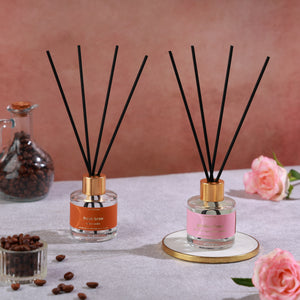
Third, take the rest of the moisture load seriously too, because the rack is the biggest source but not the only one. Run the kitchen extractor whenever anything is boiling, keep the bathroom door shut during and after showers with the exhaust running for a quarter of an hour, and ventilate hard in the dry gaps between showers — a cross-ventilated flat manages 3–8 air changes an hour against 0.2–0.5 closed. Fourth, once the humidity is down and the flat has dried out, fragrance becomes worth having. A reed diffuser from ₹749 gives a small flat a continuous background with no electricity — Morning Freshness reads clean and citric, which suits a flat that has just come out of a damp spell. The Sukoon at ₹1,899 with a Hotel Collection scent from ₹299 gives you a switch instead.
What to do, in order
The first three steps are free or nearly so, and between them they usually resolve the whole complaint. The fourth is the purchase, and it belongs in a dry flat.
| Step | What to do | When | Cost |
|---|---|---|---|
| 1. Remove the source | Move the rack out of the living space — balcony with a fan, or bathroom with the door shut and the exhaust running | Before anything else | ₹0 |
| 2. Move the air | Extra spin cycle, garments spaced not doubled, a fan on the rack, and bring them in the moment they are dry | Daily, five to ten minutes | ₹0 |
| 3. Deal with what holds it | Extractor while cooking, bathroom door shut with the exhaust on, and hard cross-ventilation in every dry gap | Weekly to monthly | ₹0 |
| 4. Then the always-on layer ★ | A SOSA reed diffuser — a clean, continuous background for a small flat once the humidity is genuinely down | 50ml 6-8 weeks · 130ml 14-18 | from ₹749 |
| 5. Or the on-demand layer | Sukoon with a Hotel Collection scent — scent on demand in a living room, with a switch rather than something always running | Run it when you want it | ₹1,899 |
Versailles
This is the question in the damp set with the clearest answer, so let me give it plainly: yes, that is why. You are putting litres of water into the air of a small flat every second day and then wondering why the flat smells damp. It is not a housekeeping failure, it is a mass balance, and once you see it that way the fix is obvious.
I would rather tell you to buy a ₹1,500 pedestal fan for the balcony than a diffuser, because the fan will actually change the humidity of your home and nothing I sell will. Fragrance is additive — it puts pleasant molecules into the air and takes nothing out — so a diffuser beside a drying rack simply gives you damp air with a nice smell in it. And if the damp has already produced growth on a wall, covering the smell is how people end up living with mould for a year. That is a health issue, not an odour.
Once the rack has moved and the flat has dried out, that is the moment to think about scent, and honestly it is a good moment — a flat coming out of a wet spell smells neutral in a way it has not for weeks, and a fragrance lands beautifully on that. I would go for something citric and clean rather than sweet. A portion of every order funds a girl's classroom through Nanhi Kali.
Frequently asked questions
- Why a coastal flat smells musty every monsoon — the whole-flat humidity case.
- Why the wardrobe area smells damp — where slow-dried clothes end up.
- Why a bedroom smells damp after days of rain — drying rate and the bed as reservoir.
- Should I use a reed diffuser for a damp smell? — the honest answer, which is not yet.
- Brand: the SOSA founder story.
SOSA products & prices (verified August 2026): Hotel Collection water-based ultrasonic diffuser fragrance 15ml ₹299 · 100ml ₹999 · 300ml ₹1,799 · Pack of 7 (15ml, all fragrances) ₹1,799; refills 100ml from ₹999. Seven scents: The Ritz-Carlton-inspired (white tea · bergamot · cedar), Westin-inspired (white tea · aloe · cedar), 1 Hotels-inspired (cedarwood · vetiver · green leaves), The St. Regis-inspired (amber · violet · woods), Shangri-La-inspired (jasmine · green tea · white tea), Four Seasons-inspired (citrus · floral · sandalwood), W Hotels-inspired (citrus · pepper · amber). Diffusers: Boond 300ml ₹899 · Sukoon 500ml ₹1,899 · Megh 6L ₹3,499. Water-based, phthalate-free, composed to IFRA standards for home diffusion; 3–6 drops per tank. Made in India, Pune. The Hotel Collection scents are SOSA's own interpretations inspired by the world's finest hotels; all hotel names are trademarks of their respective owners and are used only to describe the scent style — SOSA is an independent Indian fragrance house, not affiliated with or endorsed by any hotel brand. Prices and availability subject to change — see the live product pages.