



The fix, in order: open every window for twenty minutes at the start of the clean · water down every drain trap · leave the washing machine door open · empty and re-line the bin · close up · then scent one to two hours before arrival.
What not to do: run a diffuser continuously through a long vacancy. It spends fragrance on an empty room and, in a monsoon, an ultrasonic adds humidity to a property that already has too much.
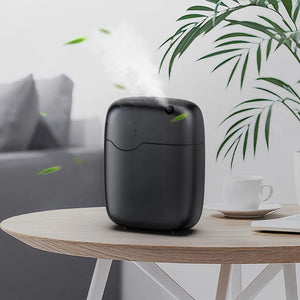
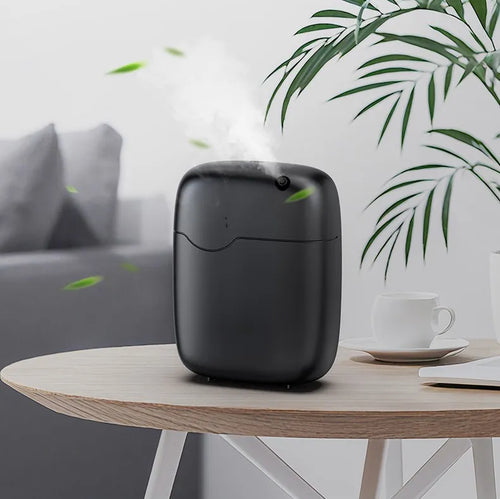
The tool that fits: anything schedulable. A Vaayu at ₹11,999 has 1h/4h/8h/24h timers and app control; a Sukoon at ₹1,899 has a remote with steady, 2H and 4H.
2. Put water down every drain trap, every turnover. A U-bend in an unused second bathroom can evaporate in a matter of days in Indian heat, and once it does the trap is open. This is the source behind a large share of the sour, sweetish arrival smells hosts blame on cleaning.
3. Leave the washing machine door and the drum open between stays, along with the fridge if the property will be empty for more than a few days and you are switching it off. Both are sealed damp boxes otherwise.
4. Empty and re-line the bin, and take the rubbish out of the property. A liner in an empty flat for six days is a source in its own right. So is a damp cloth left in a sink and a mop stood in a bucket.
5. Close the property up, then scent for the last one to two hours. Fragrance needs time to distribute but it does not need days. Scenting through a whole vacancy is spending on nobody — and this matters more than usual with a Vaayu, because the 400ml it arrives with is currently the whole supply available.
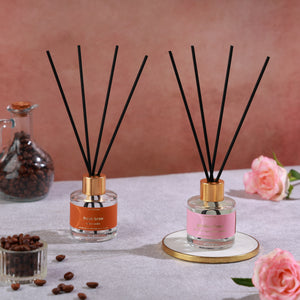
6. Choose the format by whether anyone will be standing in the property. Reeds hold a constant background with no one present at all. A machine with timers gives you scent on the hour you choose, from wherever you are.
7. And keep the claim honest: a fresh-smelling arrival is a better arrival. Nobody can promise you it changes a rating, a review score, a booking or a nightly rate, and no fragrance purifies air or removes a smell — ventilation and cleaning do that.
Our fragrances are composed in small batches in Pune, the machines are made in India, and a portion of every order supports girl-child education through Nanhi Kali.
Part one — what an empty property does to itself
The useful mental shift here is to stop thinking of the smell as something a guest left behind and start thinking of it as something the building produced on its own. An occupied flat is ventilated constantly and accidentally — doors open, people cook, windows get opened, taps run, showers are used, and the air turns over many times a day without anyone intending it. Remove the occupants and every one of those exchanges stops at once. What is left is a sealed volume of humid air with several slow sources inside it, and no mechanism at all for clearing them.
 Sukoon₹1,899 · timersA washing machine closed on a damp drum is a small sealed humid chamber, and after four days in a Mumbai monsoon it produces a very recognisable smell that then distributes into the utility and the kitchen. So does a switched-off fridge with the door shut, a cupboard of folded linen in a room at 85% humidity, and a mattress under a fitted sheet in a closed bedroom. None of this is dirt, which is precisely why a spotlessly cleaned property can still smell closed. The countermeasures are all free and all involve opening things: machine door and drawer open, fridge propped if it is off, wardrobe doors ajar during long gaps, bedroom doors open so the flat behaves as one volume rather than several stale pockets. In genuinely long vacancies, ask someone to open the property for half an hour mid-gap rather than trying to solve it in the final hour.
Part two — the vacancy timeline, day by day
A rough guide to what develops and when, based on our own observation across Indian properties in ordinary conditions. Treat these as directional rather than precise; humidity, season, floor level and how well the property seals all move them considerably.
| Days empty | What develops | Where it comes from | What reverses it | Time to reverse |
|---|---|---|---|---|
| 1–2 days ★ | Nothing much — air is flat but unremarkable | Air exchange has simply stopped | Twenty minutes of open windows | Twenty minutes |
| 3–5 days | A soft, closed, faintly damp quality throughout | Humidity held in textiles, mattresses and linen | Cross-ventilation plus opening every closed box | Half an hour to an hour |
| 4–7 days, warm weather | Sour and sweetish near an unused bathroom | Drain trap evaporated; the seal has broken | A bucket of water down every trap | Two minutes |
| 5–10 days | A distinct smell from the utility area | Washing machine closed on a damp drum | Door and detergent drawer left open between stays | Free — and preventable entirely |
| 10+ days, monsoon | Musty, and it starts to persist after ventilating | Moisture into soft furnishings, sometimes into walls | Mid-vacancy visits; dehumidification; a damp survey | Not a fragrance problem at any point |
| The honest caveat: these intervals are SOSA's working observations, not measurements, and they shift with season, floor, humidity and how tightly the property seals. Nothing here is an air-quality, health or odour-elimination claim — a diffuser adds fragrance and does not remove a smell, purify air or address damp. And nothing on this page is a claim about ratings, reviews, bookings, occupancy or nightly rate; no such data exists for home fragrance, and we will not pretend otherwise. | ||||
Vaayu · scheduled from a phone₹11,999Shop →  Sukoon · one room, on demand₹1,899Shop →
 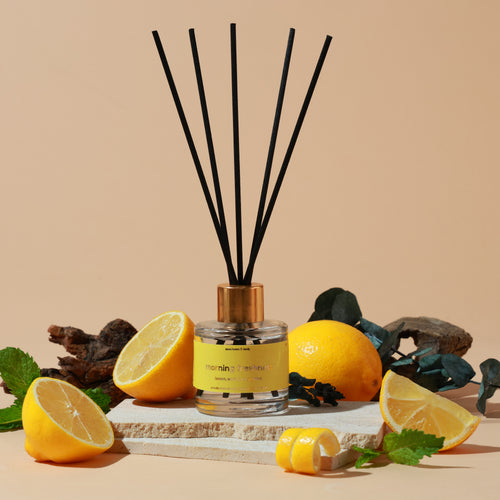 Morning Freshness · constant, unattendedfrom ₹749Shop →
Part three — when running a diffuser between stays is the wrong answer
There is an obvious-looking solution to the vacancy problem — leave something running the whole time the property is empty — and it is wrong in three distinct ways. The first is that it spends fragrance on nobody. A reed diffuser is a constant, passive source: a 50ml bottle runs six to eight weeks whether or not a single guest sets foot in the property, so a fortnight of vacancy costs you a quarter of the bottle for an audience of zero. With a Vaayu the point is sharper still, because the 400ml it ships with is currently the entire supply available — SOSA does not sell a separate Vaayu refill oil today. Running a finite supply into an empty flat is the least sensible use of it I can think of. Set a timer window that covers the hours before check-in and let the machine sit idle the rest of the time.
The second is that an ultrasonic machine running unattended in a closed property is adding water to a space whose problem is already moisture. An ultrasonic works by dispersing water-based fragrance as a fine mist; in a sealed Mumbai or Kochi flat in July, that is the opposite of what the building needs. Please also do not read the Megh at ₹3,499 as the answer to long vacancies just because its 6L tank runs about a hundred hours. Its coverage is roughly 215 sq ft — less than the Sukoon's 270–320 — so it is a runtime and humidity machine, never a coverage upgrade, and a large empty property is precisely where it does not help. A cold-air machine is the format that avoids the moisture question entirely, since it nebulises undiluted oil with no water at all, but even then the right pattern is scheduled bursts rather than continuous running.
The third is that continuous scenting through a vacancy tempts you to skip the ventilation, and then you have covered the problem instead of removing it. If a property is genuinely empty for two or three weeks, the correct intervention is a person opening it for half an hour in the middle of the gap — not a machine working harder. And there is a fourth case worth stating: if the mustiness persists after a proper ventilation, stop buying fragrance. A smell that returns within an hour of closing the windows is damp, and damp is a building problem for a surveyor, a dehumidifier or a plumber. No diffuser in our range or anybody else's addresses it, and I would rather lose the sale than have you spend ₹11,999 on a machine that cannot help.
Part four — the turnover sequence, hour by hour
Here is the whole thing as an operating procedure, written the way I would put it on a housekeeper's card. The times are relative to check-in, and the order is the part that matters most — several of these steps do nothing, or actively harm, if they happen out of sequence.
| Time before check-in | Action | Why it is in this position | Tool or product |
|---|---|---|---|
| Start of the clean ★ | Every window and internal door open, twenty minutes | Air exchange first, so cleaning happens in flushed air | Free · the highest-value step there is |
| Start of the clean | Bucket of water down every drain trap | Reseals the traps that evaporated during vacancy | Free · two minutes |
| During the clean | Bin emptied, re-lined, rubbish taken out of the property | A liner left in an empty flat becomes a source itself | Free |
| During the clean | Avoid strong phenyl or bleach floor washes near check-in | Cleaning smells read as concealment to an arriving guest | A change of product, not a purchase |
| End of the clean | Windows closed, machine door and drawer left open, property sealed | Fragrance cannot establish in a room being flushed | Free |
| 2 hours before | Scent starts — timer window, or reeds already running | Fragrance needs an hour or two to distribute evenly | Vaayu ₹11,999 · Sukoon ₹1,899 · reeds from ₹749 |
| Mid-vacancy, gaps over a week | Someone opens the property for half an hour | Stops the 5–10 day stage forming at all | Free, if you have anyone local |
Versailles
I learned this from my own flat rather than from any host. We went away for three weeks one August, came back late at night, and I stood in the doorway trying to work out what had gone wrong. Nothing had. The place was spotless and it smelled like a place nobody had breathed in. I opened four windows, went to bed, and by morning it was our flat again.
That is the whole of this page, really. The instinct when a property smells closed is to add something, and the correct response is to take something away — the stale volume of air itself. Everything I sell works better afterwards and works badly before.
The other thing I would say to hosts specifically: be careful about leaving fragrance running through an empty week. With reeds you are quietly spending a bottle nobody is in the room for. With a Vaayu you are spending from 400ml that currently has no refill sold behind it, which is a real constraint and one I would rather you heard from me than discovered in month four. Set the timer for the hours a guest is actually arriving. Everything is composed in Pune, the machines are made in India, and a portion of every order funds a girl's classroom through Nanhi Kali.
Frequently asked questions
- How to make your Airbnb smell amazing when guests walk in — the ninety-second window.
- What should guests smell on entry? — why masking ranks below doing nothing.
- The best entrance fragrance and the luxury first impression.
- The complete arrival scenting guide — the whole cluster in one place.
- Brand: the SOSA founder story.
SOSA Vaayu specifications (verified from the live product page, August 2026): ₹11,999 (the product page displays a rounded ₹12,000). Waterless cold-air nebulisation — pressurised air atomises undiluted fragrance oil into a dry nano-mist; no water, no heat, residue-free. Coverage up to 1000m³, about 2,000–3,000 sq ft. 400ml refillable tank, 90+ days per fill at a mid intensity setting. Bluetooth app plus onboard buttons, 1h / 4h / 8h / 24h timers, adjustable mist intensity, auto-stop and key-lock. Under 38 dB. DC 12V / 1A, 5W. 165 × 80.5 × 215 mm, 0.9 kg, black or white. Freestanding or wall / HVAC mount. CE, RoHS and SGS certified. Ships with four SOSA Hotel Collection fragrances at 100ml each (400ml in total) in one of three combos chosen at checkout. SOSA does not currently sell a separate Vaayu refill oil; the 400ml supplied in the box is the fragrance available at the time of writing, and buyers who need long-term supply should confirm current refill availability with SOSA before purchasing. The cold-air oil supplied with the Vaayu is a different product from the water-based Hotel Collection sold for ultrasonic machines (15ml ₹299 · 100ml ₹999 · 300ml ₹1,799), which must not be used in a Vaayu despite sharing scent names. Other SOSA machines: Boond 300ml ₹899 (~150 sq ft) · Sukoon 500ml ₹1,899 (270–320 sq ft) · Megh 6L ₹3,499 (~215 sq ft — a runtime and humidity machine, not a coverage upgrade) · Aangan ₹25,999 (~8,000–10,000 sq ft) · Meenar ₹38,500 (12,000–18,000 sq ft) · Safar car diffuser ₹3,999. Reed diffusers 50ml ₹749–₹849 (6–8 weeks) · 130ml ₹1,249–₹1,349 (14–18 weeks) · duo sets ₹1,498–₹1,598 · oil-only refills 300ml ₹2,399 / 500ml ₹3,499. Runtime, consumption and coverage figures are manufacturer specifications and vary with intensity setting, run hours, ceiling height, ventilation and season; any per-month or per-day figure in this guide is arithmetic on those specifications, not a measurement. Electricity costs vary by state tariff. No claim is made that scenting affects ratings, reviews, bookings, occupancy, revenue, health, mood or air quality. Free shipping above ₹499. A portion of every order supports girl-child education through Nanhi Kali. Prices subject to change — see the live product pages.